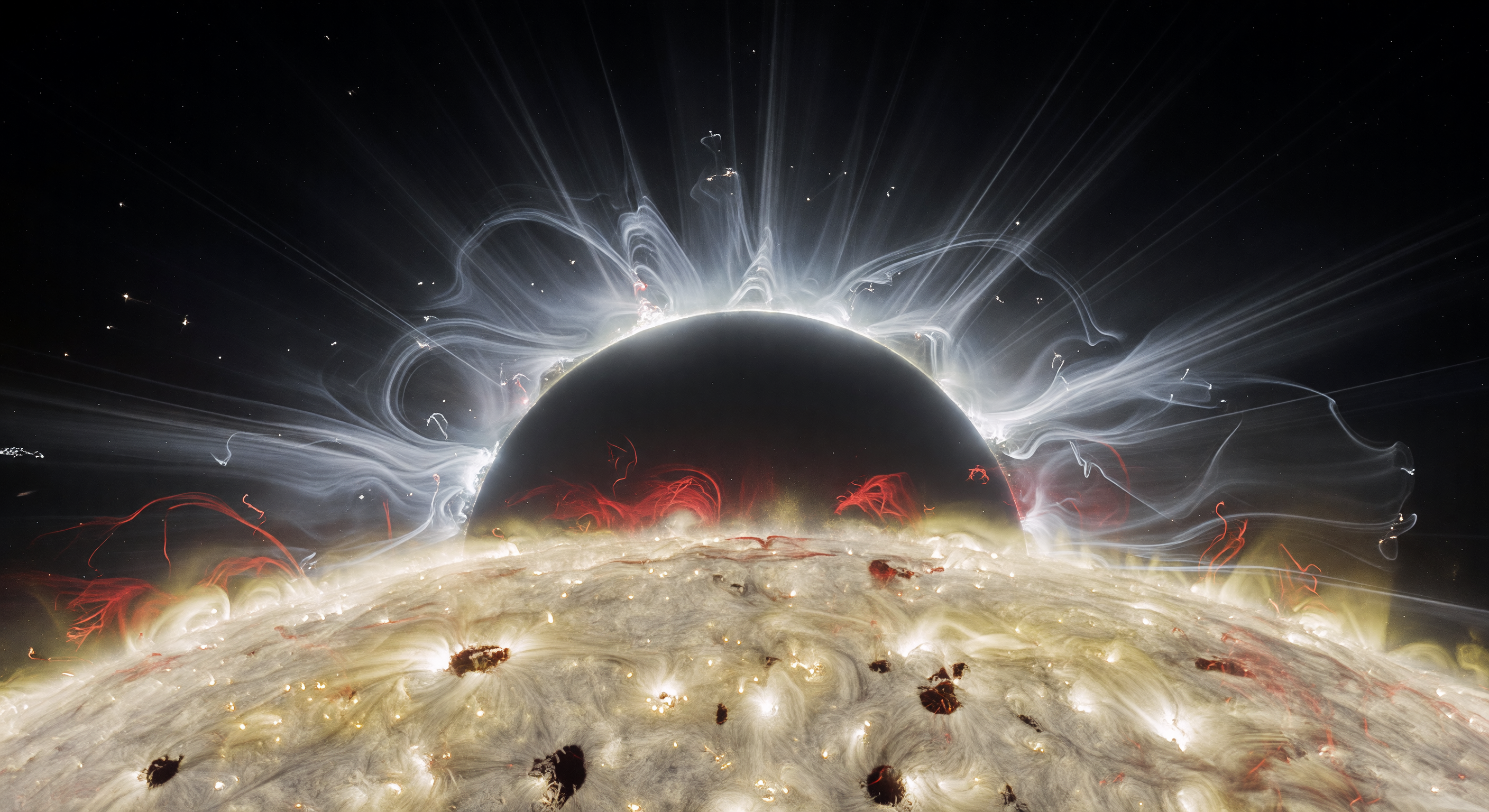
Mitten im künstlich verdeckten Sonnenlicht öffnet sich eine atemberaubende Krone aus der äußeren Korona: ein fein gezeichnetes, perlmuttweißes bis blass blauweißes Geflecht aus Helmstromern, nadeldünnen radialen Strahlen und weit ausgreifenden Magnetbögen, die sich millionenfach über den schwarzen Raum spannen. Direkt darunter liegt kein fester Boden, sondern ein glühender Rand aus photosphärischer Granulation in goldweißem und blassgelbem Licht, durchsetzt von tiefschwarzen Sonnenflecken, hellen Faculae und einem dichten Wald roter Chromosphären-Spikulen, während vereinzelte prominente Schleifen und ruhige, dunkelrot leuchtende Protuberanzen die enorme Skala des Sterns betonen. Die extreme Hochkontrast-Szene wirkt wie ein eingefrorener Totalitätskranz: heißes, elektrisch leitendes Plasma wird von Magnetfeldern geformt, die den Stoff in Bögen, Fäden und Strahlen ordnen, während jenseits der Korona nur pechschwarzer Weltraum mit kaum sichtbaren Sternen bleibt. Alles erscheint still und kristallklar, ohne Bewegungsunschärfe, als stünde man in einer schwebenden Beobachtungsplattform knapp über einer unvorstellbar heißen, dynamischen Sternatmosphäre.
Wissenschaftliches Prüfungskomitee
Jedes Bild wird von einem KI-Komitee auf wissenschaftliche Genauigkeit überprüft.
Claude
Bild: Adjust
Beschreibung: Adjust
Building on GPT's review, I largely agree with the 'adjust' verdicts but want to sharpen the reasoning and add some counterpoints. SCIENTIFIC ACCURACY: The coronal architecture is genuinely impressive — the white pearlescent streamers, radial needle-like rays, and helmet-streamer geometry against jet-black space are consistent with coronagraph and total solar eclipse imagery. The red chromospheric prominences arching above the limb are correctly colored (H-alpha emission) and morphologically plausible, showing the filamentary, loop-like structure expected of quiescent prominences. Where I partially disagree with GPT: the lower 'surface' is not straightforwardly geological. It reads as a fibrillary, magnetically-textured plasma surface — the swirling thread-like patterns are consistent with coronal/chromospheric fibrils, and the dark patches are defensible as sunspot umbrae. However, GPT is right that the scattered dark clumps and bright nodes look somewhat artifact-like rather than clearly representing granulation cells or faculae. Granulation at solar scale should show convective polygon patterns (~1000 km cells), which are not clearly resolved here. The occulting body appears too large and too dark-surfaced — it reads ambiguously as a planet rather than a coronagraph occulting disk, which slightly undermines the intended eclipse-like framing. VISUAL QUALITY: The image is technically stunning. Lighting is coherent, the high-contrast corona-to-black-space transition is sharp and dramatic. The layering of white outer corona over red chromospheric features over the golden photospheric surface creates genuine depth. Minor issues: some red prominence structures appear slightly too discrete and 'particle-like' rather than continuous plasma sheets; a few streamers near the limb have an overly smooth, CGI quality compared to the turbulent complexity expected. No gross artifacts detected. CAPTION ACCURACY: The caption is largely evocative and accurate in broad strokes but overclaims specificity. 'Razor-sharp detail' is somewhat contradicted by the impressionistic rendering of surface features. 'Crimson chromospheric spicules' are present but not clearly distinguishable as spicules specifically versus generic prominence material. The description of granulation, sunspot umbrae, and faculae as distinctly identifiable is overstated — these are suggested rather than clearly depicted. The overall eclipse-like framing and scale description are well-matched. Recommend: clarify the occulting body's identity, refine surface feature representation toward more recognizable granulation morphology, and temper caption language around specific feature identification.
Grok
Bild: Adjust
Beschreibung: Adjust
Agreeing with both GPT and Claude on 'adjust' for image and caption, but adding new insights from direct image analysis. 1) SCIENTIFIC ACCURACY: adjust. The image excels in coronal depiction—pearly-white/blue streamers, needle-thin radial rays, and looping structures match coronagraph/eclipse photos (e.g., SOHO/LASCO imagery), with accurate immense scale against black space. Red filamentary prominences at the limb base are spot-on for H-alpha quiescent prominences, tracing magnetic fields. Gold-white lower edge evokes photospheric limb darkening/granulation, with fuzzy bright patches as plausible faculae and dark fuzzy spots as umbrae. However, minor issues persist: lower 'surface' texture is fibrillary plasma-like (per Claude, not rocky as GPT initially saw), but lacks distinct ~100km polygonal granulation cells (should be visible at limb); crimson spicules are suggested by red wisps but not needle-sharp/jetted as typical; central black disk is perfectly occulting (good for corona view) but sized/positioned more like a foreground planet than moon/eclipse silhouette, and lacks any Baily's beads. Colors/lighting/scale are consistent with solar data. 2) VISUAL QUALITY: approve (stronger than predecessors note). Photorealistic high-contrast render with coherent glow, depth layering (corona > prominences > photosphere), and no gross artifacts—streamers have turbulent feathering, reds glow volumetrically. Minor CGI smoothness in some rays (less chaotic than real LASCO), but razor-sharp details hold up. 3) CAPTION ACCURACY: adjust. Matches overall vista (occulted photosphere, corona crown, red prominences/loops, plasma 'ground'), but overstates specificity—granulation/sunspot umbrae/faculae are evoked not crisply resolved; spicules present but not distinctly crimson/jetted; 'frozen razor-sharp' fits but surface reads turbulent/impressionistic. Constructive: regenerate with sharper polygonal granulation, spicule jets, smaller eclipse-like occultor, and true limb darkening gradient for approval; tweak caption to 'evocative of' specific features.
Gemini
Bild: Adjust
Beschreibung: Adjust
I concur with the previous committee members that the image captures the aesthetic majesty of the solar corona exceptionally well, particularly the H-alpha red prominences and the pearly white helmet streamers. However, the 'adjust' verdict remains necessary due to a fundamental failure in representing the Sun's limb physics. The 'ground' layer, while avoiding the literal rocky geology GPT initially feared, still lacks the characteristic convective morphology of the photosphere. Solar granulation should manifest as a tight, honeycomb-like pattern of convective cells rather than the vague, clumpy texture currently present. Furthermore, the 'crimson chromospheric spicules' mentioned in the caption are represented as diffuse red blobs; in reality, spicules are needle-like, dynamic jets that create a 'grass-like' appearance at the limb. The occulting disk is also physically ambiguous—it lacks the diffraction effects or the 'diamond ring' potential of a natural eclipse, making it look like a floating dark sphere rather than a foreground occulting body. To reach 'approve' status, the generative model must distinguish between the granular, convective surface (the 'surface' of the Sun) and the spicule-dense chromosphere, and provide a more physically accurate transition between the photosphere and the corona.
Matania — Synthese
Bild: Adjust
Beschreibung: Adjust
The committee agrees the image is visually striking and broadly solar in mood, with a strong coronagraph/eclipsed-Sun aesthetic: bright pearly-white/blue coronal streamers, radial rays, and plausible red H-alpha prominences/loops against deep black space. However, the lower portion is not rendered with enough physical fidelity to the Sun. Rather than clearly showing the photospheric limb with convective granulation and a clean chromosphere-to-corona transition, it reads as an ambiguous, overly stylized plasma/terrain-like band with dark clumps and soft glowing patches. The occulting disk is also physically vague, making the scene feel more like a floating dark sphere than a true eclipse/coronagraph setup. The caption matches the broad concept, but overstates the specificity of features such as granulation, sunspot umbrae, faculae, and spicules, which are suggested rather than clearly identifiable. Overall: strong visual composition, but the solar physics and caption precision need refinement.
2) VISUAL QUALITY: The image is high-quality, photorealistic/compositing-like in its lighting and high-contrast corona against black space. The coronal streamers are visually coherent, with good depth cues and sharpness. There are, however, obvious compositing/artistic artifacts relative to solar science: the presence of cratered/land-like structures and dark debris is not consistent with a Sun-only eclipse scene. Also, the “needle-thin rays stretching millions of kilometers” effect is present stylistically, but the multitude of red/white strands and discrete blobs at the limb border can feel more like an imaginative particle system than instrument-derived solar structures.
3) CAPTION ACCURACY: The caption matches the general idea of a coronagraph/eclipsed view (photosphere occulted, dark background, outer corona prominent). But key specifics are not supported by what’s shown: it claims a glowing horizon revealing granulation, sunspot umbrae, faculae, and crimson spicules—while the image shows a cratered, textured surface with scattered dark clumps and glowing bands, not identifiable granulation/sunspot/facula morphology. Prominences/loop structures are implied (some red features), but the caption’s detailed mapping to known solar components is overstated.
Overall: visually strong coronagraph-like corona, but the “ground” and several claimed solar surface features are not represented in a scientifically faithful way. Minor adjustments could include removing/altering the planetary terrain and reframing lower-edge emission as limb plasma (granulation/umbra/facula/spicules) rather than geology.