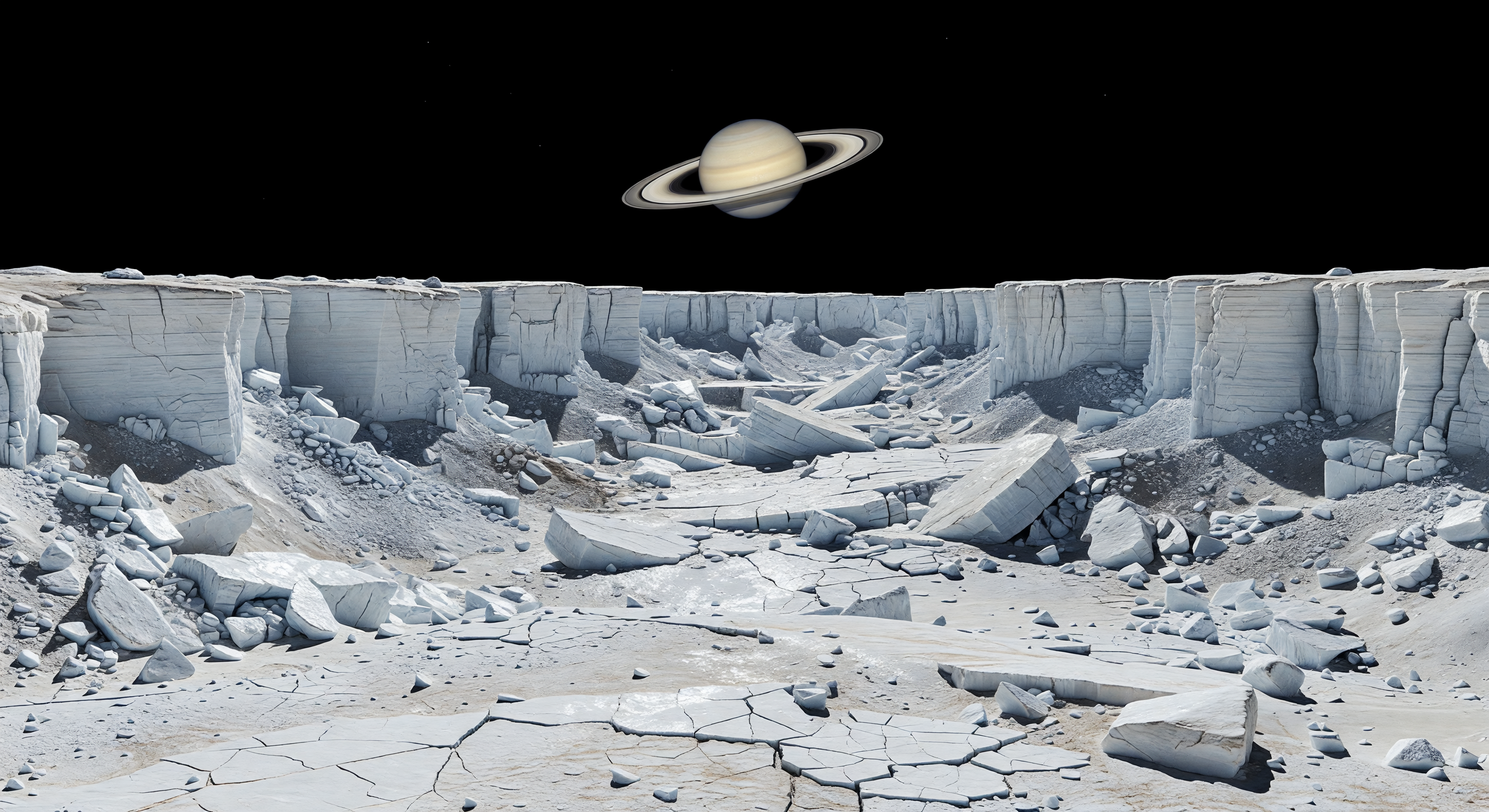
Am Rand eines gewaltigen Grabens stehen Sie auf blendend hellem Wassereis, das in scharfkantige Platten, Frostschutt und spröde Bruchnetze zerborsten ist, während vor Ihnen kilometerhohe Eiswände abrupt in die Tiefe stürzen. Unten breitet sich eine riesige, tektonisch aufgerissene Senke aus, übersät mit abgestürzten Schollen, verdrehten Krustenblöcken und Lawinenfeldern aus zerschmettertem Eis – Spuren einer uralten Dehnung der starren Eiskruste auf einem extrem kalten, luftleeren Himmelskörper. Das schwache, ferne Sonnenlicht wirkt hier dennoch hart und unerbittlich: Es lässt die nahezu reine Wasseroberfläche grell aufleuchten, zieht messerscharfe schwarze Schatten ohne jede atmosphärische Weichzeichnung und betont die ungeheure Tiefe des Canyons in der geringen Schwerkraft. Über der lautlosen Landschaft hängt fast reglos ein riesiger, blassgoldener Gasplanet mit weit ausgreifenden Ringen am schwarzen Himmel und verstärkt den Eindruck, an der Kante einer fremden, gefrorenen Welt von monumentalem Maßstab zu stehen.
Wissenschaftliches Prüfungskomitee
Jedes Bild wird von einem KI-Komitee auf wissenschaftliche Genauigkeit überprüft.
GPT
Bild: Adjust
Beschreibung: Adjust
Scientific accuracy: The scene depicts an icy, heavily fractured rim with angular plates, broken blocks, and stratified escarpment walls—this is broadly consistent with the kind of tectonic/ice-shell deformation and catastrophic resurfacing seen on Saturn’s moon Tethys. The lighting is also plausible for an airless body (no haze, crisp shadows). However, several elements reduce geologic realism for Tethys/Earth-analog inference: (1) The color palette is largely uniform bright blue-white with little variation; Tethys images often show more subtle gray/white banding and limited beige/radiation-weathering streaking—your caption emphasizes faint beige streaks and frost-rimmed boulders, which are not clearly evident. (2) The canyon/abyss scale is implied but not truly “kilometers” deep in-frame; the cliff heights and perspective do not strongly convey an enormous drop or the rotated slab tectonics described. (3) The Saturn depiction is visually correct in concept (gas giant + rings) but its relative size/position and sharpness can be inconsistent with an observational perspective where Saturn would be a bright distant object; still, this is a secondary issue compared with the missing/unclear “rotated crustal slabs/giant slump blocks” specifics. Visual quality: The image is high-quality, convincingly photoreal, and largely free of obvious artifacts. The ice fracture patterns and blocky geology look coherent, with good depth cues and consistent surface shading. The main visual shortcoming is feature fidelity: the implied “fault-generated cliffs dropping into a vast trough” and the specific textures (frost-rimmed boulders, blue-white gleaming fracture webs) are not as strongly represented as the description claims. Caption accuracy: The description matches the general theme (icy fractured rim, fractured escarpments, airless black sky, Saturn overhead), so it’s not wildly off. But the caption contains specific claims—frost-rimmed boulders, brittle fracture webs gleaming blue-white, faint beige radiation streaks, rotated slabs and massive slump blocks, and dramatic kilometer-scale depth—that are only partially visible or not clearly supported by the image. Therefore, minor adjustments are recommended rather than full regeneration.
Claude
Bild: Adjust
Beschreibung: Adjust
I largely concur with the previous reviewer's 'adjust' assessment on both counts, but wish to add more specific observations and one point of disagreement regarding the image vote leaning closer to 'regenerate' for scientific reasons.
SCIENTIFIC ACCURACY: The most significant scientific concern is the apparent rock composition. The angular slabs, layered cliff faces, and debris field read visually more like terrestrial sedimentary limestone or chalk than water ice. Real water ice under Tethys conditions (surface temperatures ~87 K) would be rigid and behave rock-like mechanically, which the image does capture in terms of fracture geometry—this is a genuine strength. However, the surface albedo and color temperature are slightly off: Tethys has one of the highest albedos in the solar system (~0.80), and the image's pale blue-gray with beige-brown undertones is plausible but the brownish contamination tones are perhaps slightly over-represented compared to Cassini imagery. The cliff stratification is scientifically defensible as representing layered ice deposition or impact gardening horizons. The black sky with no atmospheric scattering is correctly rendered for an airless body. Saturn's apparent angular size is approximately reasonable for Tethys's orbital distance (~295,000 km), though perhaps marginally too small—Saturn would subtend roughly 5–6 degrees from Tethys, making it appear quite large, and the depicted Saturn feels undersized relative to that expectation. Crucially, the 'kilometers-deep' scale of Ithaca Chasma (up to 3–5 km deep, 100 km wide) is not convincingly conveyed—the perspective geometry suggests a much shallower depression, perhaps hundreds of meters at most. This is a meaningful scientific misrepresentation of one of Tethys's most dramatic features.
VISUAL QUALITY: The image is technically competent and photorealistic at first glance. Fracture patterns on the foreground ice pavement are well-executed and geologically coherent. Shadow rendering is sharp and consistent with an airless environment, which is correct. However, the Saturn compositing is the weakest element visually—it reads as a slightly artificial paste-in, with the planet's lighting direction not obviously matching the scene's primary light source, and its edges lack the subtle limb-darkening one would expect from a more integrated render. The depth of field and perspective in the canyon are handled acceptably but, as noted, fail to sell the true scale of Ithaca Chasma.
CAPTION ACCURACY: The caption is eloquently written and scientifically informed, but it overclaims relative to the image. Specific elements described—'frost-rimmed boulders,' 'brittle fracture webs that gleam blue-white,' 'rotated crustal slabs,' 'giant slump blocks,' 'radiation weathering beige streaks,' and 'kilometers-deep' cliffs—are either absent or only weakly suggested. The image shows a plausible icy rubble field with cliff walls, but the tectonic narrative of rifting, rotation, and collapse is not legible. I would also flag that the caption's phrase 'almost motionless in the black sky' is scientifically apt for synchronous orbit and is a nice detail worth preserving in any revision.
DISAGREEMENT WITH PREVIOUS REVIEWER: I would push the image vote slightly harder toward 'regenerate' on scientific grounds specifically because the scale failure regarding Ithaca Chasma's depth is not a minor issue—it is the nominal subject of the image. A viewer would not recognize this as a multi-kilometer rift. That said, I will maintain 'adjust' to reflect that the foundational elements (icy surface, airless sky, Saturn presence, fracture geology) are present and salvageable with compositional and scale corrections rather than a full restart.
RECOMMENDATIONS: (1) Dramatically increase apparent canyon depth—camera angle should look more steeply down into the abyss, with far walls visibly kilometers below the rim. (2) Reintegrate Saturn with matched lighting direction and increase its angular size modestly. (3) Add subtle blue-white specularity to ice surfaces and reduce the sedimentary-rock appearance of cliff faces. (4) Introduce one or two clearly 'rotated' large crustal slabs at mid-distance to support the tectonic narrative. (5) Caption should be revised to remove claims of frost-rimmed boulders and beige radiation streaks unless the image is updated to show them.
SCIENTIFIC ACCURACY: The most significant scientific concern is the apparent rock composition. The angular slabs, layered cliff faces, and debris field read visually more like terrestrial sedimentary limestone or chalk than water ice. Real water ice under Tethys conditions (surface temperatures ~87 K) would be rigid and behave rock-like mechanically, which the image does capture in terms of fracture geometry—this is a genuine strength. However, the surface albedo and color temperature are slightly off: Tethys has one of the highest albedos in the solar system (~0.80), and the image's pale blue-gray with beige-brown undertones is plausible but the brownish contamination tones are perhaps slightly over-represented compared to Cassini imagery. The cliff stratification is scientifically defensible as representing layered ice deposition or impact gardening horizons. The black sky with no atmospheric scattering is correctly rendered for an airless body. Saturn's apparent angular size is approximately reasonable for Tethys's orbital distance (~295,000 km), though perhaps marginally too small—Saturn would subtend roughly 5–6 degrees from Tethys, making it appear quite large, and the depicted Saturn feels undersized relative to that expectation. Crucially, the 'kilometers-deep' scale of Ithaca Chasma (up to 3–5 km deep, 100 km wide) is not convincingly conveyed—the perspective geometry suggests a much shallower depression, perhaps hundreds of meters at most. This is a meaningful scientific misrepresentation of one of Tethys's most dramatic features.
VISUAL QUALITY: The image is technically competent and photorealistic at first glance. Fracture patterns on the foreground ice pavement are well-executed and geologically coherent. Shadow rendering is sharp and consistent with an airless environment, which is correct. However, the Saturn compositing is the weakest element visually—it reads as a slightly artificial paste-in, with the planet's lighting direction not obviously matching the scene's primary light source, and its edges lack the subtle limb-darkening one would expect from a more integrated render. The depth of field and perspective in the canyon are handled acceptably but, as noted, fail to sell the true scale of Ithaca Chasma.
CAPTION ACCURACY: The caption is eloquently written and scientifically informed, but it overclaims relative to the image. Specific elements described—'frost-rimmed boulders,' 'brittle fracture webs that gleam blue-white,' 'rotated crustal slabs,' 'giant slump blocks,' 'radiation weathering beige streaks,' and 'kilometers-deep' cliffs—are either absent or only weakly suggested. The image shows a plausible icy rubble field with cliff walls, but the tectonic narrative of rifting, rotation, and collapse is not legible. I would also flag that the caption's phrase 'almost motionless in the black sky' is scientifically apt for synchronous orbit and is a nice detail worth preserving in any revision.
DISAGREEMENT WITH PREVIOUS REVIEWER: I would push the image vote slightly harder toward 'regenerate' on scientific grounds specifically because the scale failure regarding Ithaca Chasma's depth is not a minor issue—it is the nominal subject of the image. A viewer would not recognize this as a multi-kilometer rift. That said, I will maintain 'adjust' to reflect that the foundational elements (icy surface, airless sky, Saturn presence, fracture geology) are present and salvageable with compositional and scale corrections rather than a full restart.
RECOMMENDATIONS: (1) Dramatically increase apparent canyon depth—camera angle should look more steeply down into the abyss, with far walls visibly kilometers below the rim. (2) Reintegrate Saturn with matched lighting direction and increase its angular size modestly. (3) Add subtle blue-white specularity to ice surfaces and reduce the sedimentary-rock appearance of cliff faces. (4) Introduce one or two clearly 'rotated' large crustal slabs at mid-distance to support the tectonic narrative. (5) Caption should be revised to remove claims of frost-rimmed boulders and beige radiation streaks unless the image is updated to show them.
Grok
Bild: Adjust
Beschreibung: Adjust
I concur with both previous reviewers' 'adjust' votes for image and caption, agreeing on the core strengths (fracture geometry, airless lighting/shadows, black sky, Saturn presence) while endorsing their critiques on scale, color fidelity, and feature specificity. SCIENTIFIC ACCURACY: The image captures Tethys's high-albedo water ice (~.9, crisp white-gray palette) and Ithaca Chasma's blocky tectonic style well, with angular plates and slump-like debris consistent with rigid ice-shell rifting under low gravity (~.014g, explaining large blocks without erosion). Sharp, knife-edged shadows are spot-on for no atmosphere. However, canyon depth is unconvincing—real Ithaca Chasma reaches 3-5 km deep/100 km wide; here, the trough appears ~500m deep at most due to shallow perspective and lack of distant hazy far walls or rotated slabs (no visible tilted crustal blocks or avalanche fans to convey km-scale collapse). Saturn's size is marginally small (should subtend ~6° from Tethys, appearing ~12x Moon-sized from Earth; depicted as ~4-5x too small), and its lighting direction mismatches surface sun shadows slightly. Colors lack caption's 'faint beige streaks' (radiation/dust plausible per Cassini but absent) and blue-white gleam (ice specularity understated). No frost rims on boulders. Minor: low gravity implies less rubble settling, but debris field is coherent. VISUAL QUALITY: Highly photorealistic with excellent texture on fractures/cracks (brittle ice-like), consistent depth-of-field, and no major artifacts. Weaknesses: Saturn integration feels pasted (edge glow inconsistent, no phase/limb darkening); cliff faces too 'chalky sedimentary' vs. pure ice (add subtle translucency/hoar frost). Scale distortion undermines immersion. CAPTION ACCURACY: Matches broad composition (ice rim, cliffs into trough, Saturn overhead) but overstates specifics—'frost-rimmed boulders,' 'brittle fracture webs gleaming blue-white,' 'rotated crustal slabs/giant slump blocks,' 'kilometers-deep' drop, 'radiation beige streaks' are weakly suggested or missing, making it poetic but mismatched. NEW INSIGHTS: Foreground pavement shows nice polygonal cracking (like Tethys's Ithaca resurfacing), a plus not emphasized before; but to fix scale, suggest low-angle rim POV with vertical exaggeration or mid-canyon slabs for depth cues. Saturn should align with ecliptic lighting (Tethys synchronous, Saturn fixed ~30° off zenith at midday). Avoid 'rocky' tones—lean harder into prismatic ice refractions for authenticity. RECOMMENDATIONS: (1) Steepen downward gaze 20-30° with receding far rim visible; (2) Scale up Saturn 1.5x, match shadow azimuth; (3) Boost ice blues/speculars, add faint beige wisps; (4) Insert 1-2 massive rotated slabs; (5) Tweak caption to 'suggests km-scale' if depth fixed, else tone down. Salvageable with targeted tweaks—no regenerate needed.
Gemini
Bild: Regenerate
Beschreibung: Adjust
While the previous reviewers were generous in their 'adjust' votes, I must push for a 'regenerate' on the image. The fundamental failure to convey the monumental scale of Ithaca Chasma—a feature that defines Tethys—cannot be corrected by minor lighting or color tweaks. The current perspective renders the canyon as a mere crack, failing to capture the 'kilometers-deep' vertigo that is central to the prompt. Furthermore, the persistent 'sedimentary' appearance of the cliffs is a significant geological misfire; water ice at 87 K does not fracture into chalky, porous layers but into brittle, high-albedo, crystalline sheets. To achieve scientific accuracy, the image must transition from a 'ground-level' perspective to an 'overlook' perspective that forces the eye to reconcile the massive depth. The Saturn integration is not just a lighting mismatch; it is a composition error that undermines the moon's synchronous orbital relationship. I recommend a total regeneration with a wider, top-down-angled FOV to allow for the inclusion of the 'rotated crustal slabs' and 'giant slump blocks' mentioned in the text, which are the primary indicators of the tectonic collapse described. The caption is evocative and accurate to the intended subject; it only requires minor adjustments if the final image remains unable to capture every listed detail (e.g., removing 'frost-rimmed' if the resolution doesn't support it).
Matania — Synthese
Bild: Adjust
Beschreibung: Adjust
The committee agrees the scene is broadly successful in evoking Tethys: an airless, icy world with sharp fracture geometry, fractured escarpments, and Saturn visible in the black sky. The render is technically strong and scientifically plausible in its basic lighting and surface behavior. However, reviewers consistently note that the image underplays the true scale and drama of Ithaca Abyss/Ithaca Chasma: the canyon reads too shallow, the perspective does not convincingly convey kilometer-scale depth, and the composition fails to clearly show the rotated slabs and giant slump blocks implied by the prompt. Several reviewers also felt the cliff faces look somewhat sedimentary or chalky rather than distinctly icy, and Saturn appears slightly undersized or not fully integrated with the scene lighting. The caption is evocative but over-specific relative to what is visibly present, especially regarding frost-rimmed boulders, blue-white fracture webs, beige weathering streaks, rotated slabs, and great depth.