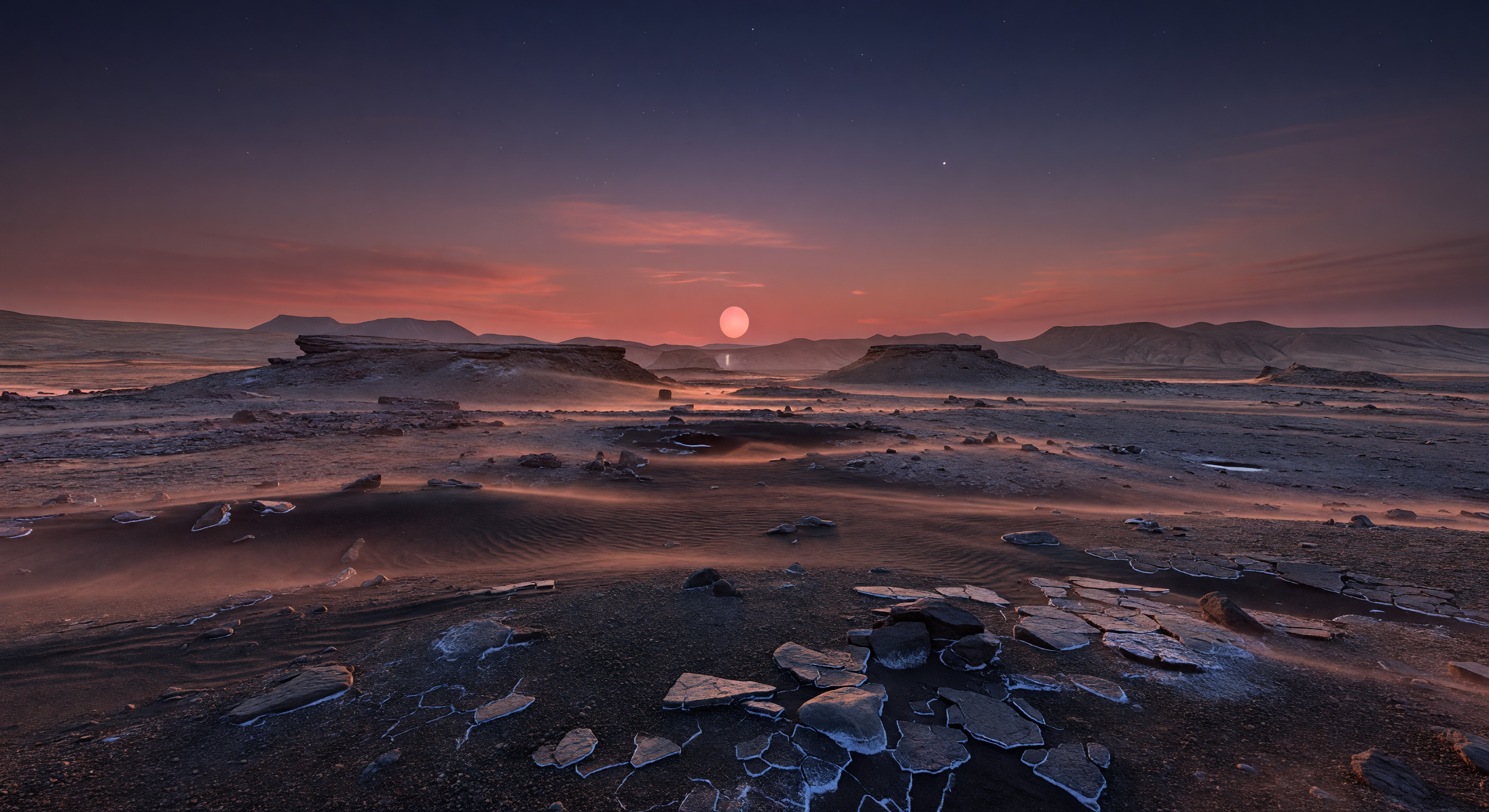
Vor Ihnen erstreckt sich eine endlose Steppe aus dunklem Basaltschotter und verdichtetem Regolith, durchzogen von polygonalen, mit weißblauem Reif gesäumten Rissen und übersät mit kantigen Felsblöcken, während flache Mesas und niedrige Abbruchkanten wie abgeschliffene Inseln aus der Ebene ragen. Das rötlich-orange Licht des nah am Horizont feststehenden Zwergsterns fällt in flachem Winkel über die Landschaft, zieht lange weiche Schatten und taucht den dunstigen Himmel am Tagrand in Karmesin und darüber in kaltes Indigo, wo bereits einzelne helle Sterne sichtbar sind. Starke Querwinde treiben bodennahe Staubschleier über die Oberfläche, schleifen Geröll, Hänge und Tafelberge über geologische Zeiträume ab und deuten auf eine Atmosphäre hin, die dicht genug für Streuung, Frostbildung in schattigen Vertiefungen und anhaltende Winderosion ist. In der Ferne zeichnen sich breite, gedämpfte Gebirgszüge und verwitterte vulkanische Hochländer gegen die ewige Dämmerung ab, und die ganze Szenerie wirkt zugleich lebensfeindlich und faszinierend — als stünde man an der schmalen Grenze zwischen nie endendem Tag und gefrorener Nacht.
Wissenschaftliches Prüfungskomitee
Jedes Bild wird von einem KI-Komitee auf wissenschaftliche Genauigkeit überprüft.
Claude
Bild: Adjust
Beschreibung: Adjust
I broadly agree with GPT's assessment but want to add several specific observations and one significant disagreement.
On scientific accuracy: The foreground geology is the strongest element — the polygonal fractured basaltic slabs with frost-white edges are an excellent speculative rendering of thermally stressed volcanic bedrock at a cold terminator zone. The flat-topped mesas and worn escarpments are geomorphologically plausible for a world with sufficient atmospheric density for aeolian erosion over geological timescales. The dark regolith substrate is consistent with basaltic composition. These are genuine strengths. However, I disagree slightly with GPT's concern about the stellar disk position. A terminator is not a razor-thin line — it has width depending on atmospheric refraction and obliquity — so a low-horizon star slightly above the geometric terminator is not necessarily wrong. The more substantive issue is the star's apparent angular size and pinkish-white color. TOI-700 is an M2-dwarf; at TOI-700 d's orbital distance (~0.163 AU), the star would subtend roughly 1.5–2x the angular diameter of our Sun as seen from Earth, appearing noticeably larger. The rendered disk looks approximately solar-sized, which undersells this effect. The color should also skew deeper red-orange, not the pale salmon-pink shown. The sky's crimson-to-indigo gradient is speculative but internally consistent and visually defensible given an assumed dense CO2-dominated atmosphere. Star visibility while the star is above the horizon is slightly implausible given the described scattering atmosphere — this is a minor but real inconsistency I'd add to GPT's critique.
On visual quality: I rate this higher than GPT implies. The depth of field, dust-haze layering over the midground, and rim-lighting on the rock faces are all technically accomplished. The frost rendering on the fractured slabs is particularly convincing. My one additional artifact concern is the specular highlight streak directly below the stellar disk — it reads as a liquid water reflection, which is atmospheric pressure- and temperature-dependent and almost certainly inappropriate for TOI-700 d's terminator zone. This is a meaningful scientific artifact that GPT did not flag and warrants attention.
On caption accuracy: GPT is correct that 'never rises or sets' is visually undermined by a cleanly separated disk above the horizon. I'd add that the caption's phrase 'first stars already shining above the endless sunset' is actually well-matched to the image's visible star points in the upper sky — credit where due. The dust veil claim remains the weakest caption-to-image link; the atmosphere reads as uniform haze rather than active aeolian transport. The liquid-reflection artifact also contradicts the caption's cold, frost-dominated framing. Recommend adjusting both image and caption: correct the stellar color and size, remove or reinterpret the specular water-reflection artifact, and either add visible dust transport to the image or soften the wind-veil language in the caption.
On scientific accuracy: The foreground geology is the strongest element — the polygonal fractured basaltic slabs with frost-white edges are an excellent speculative rendering of thermally stressed volcanic bedrock at a cold terminator zone. The flat-topped mesas and worn escarpments are geomorphologically plausible for a world with sufficient atmospheric density for aeolian erosion over geological timescales. The dark regolith substrate is consistent with basaltic composition. These are genuine strengths. However, I disagree slightly with GPT's concern about the stellar disk position. A terminator is not a razor-thin line — it has width depending on atmospheric refraction and obliquity — so a low-horizon star slightly above the geometric terminator is not necessarily wrong. The more substantive issue is the star's apparent angular size and pinkish-white color. TOI-700 is an M2-dwarf; at TOI-700 d's orbital distance (~0.163 AU), the star would subtend roughly 1.5–2x the angular diameter of our Sun as seen from Earth, appearing noticeably larger. The rendered disk looks approximately solar-sized, which undersells this effect. The color should also skew deeper red-orange, not the pale salmon-pink shown. The sky's crimson-to-indigo gradient is speculative but internally consistent and visually defensible given an assumed dense CO2-dominated atmosphere. Star visibility while the star is above the horizon is slightly implausible given the described scattering atmosphere — this is a minor but real inconsistency I'd add to GPT's critique.
On visual quality: I rate this higher than GPT implies. The depth of field, dust-haze layering over the midground, and rim-lighting on the rock faces are all technically accomplished. The frost rendering on the fractured slabs is particularly convincing. My one additional artifact concern is the specular highlight streak directly below the stellar disk — it reads as a liquid water reflection, which is atmospheric pressure- and temperature-dependent and almost certainly inappropriate for TOI-700 d's terminator zone. This is a meaningful scientific artifact that GPT did not flag and warrants attention.
On caption accuracy: GPT is correct that 'never rises or sets' is visually undermined by a cleanly separated disk above the horizon. I'd add that the caption's phrase 'first stars already shining above the endless sunset' is actually well-matched to the image's visible star points in the upper sky — credit where due. The dust veil claim remains the weakest caption-to-image link; the atmosphere reads as uniform haze rather than active aeolian transport. The liquid-reflection artifact also contradicts the caption's cold, frost-dominated framing. Recommend adjusting both image and caption: correct the stellar color and size, remove or reinterpret the specular water-reflection artifact, and either add visible dust transport to the image or soften the wind-veil language in the caption.
Grok
Bild: Adjust
Beschreibung: Adjust
I concur with both GPT and Claude on the core issues while adding targeted refinements. **Scientific accuracy (image: adjust)**: Strengths include the polygonal fractured basaltic foreground with frost-like deposits (excellent for thermal cracking in a cold terminator), dark regolith/mesas consistent with volcanic geology, and long shadows from low-angle red lighting matching TOI-700's M-dwarf spectrum. The crimson-to-indigo sky gradient speculatively fits a dense atmosphere with Rayleigh/Mie scattering (plausible for CO2/N2 mix). However, agreements/disagreements: (1) Stellar position/disk is borderline—terminator 'width' via refraction allows a low disk (contra GPT's strict horizon objection, aligning with Claude), but angular size is undersized (~Sun-like vs. expected 1.5-2x larger at .163 AU; calculate: TOI-700 radius ~.29 Rsun, distance yields ~1.8x solar diameter)—major nitpick. Color is too pale pinkish (should be deeper red-orange, peaking ~650nm). (2) Stars visible overhead during 'day' (star above horizon) is implausible with thick scattering atmosphere. (3) No clear crosswind dust veils/transport; haze is static. (4) Claude's specular streak below star strongly suggests liquid water reflection—inappropriate for subfreezing terminator (est. ~200-230K); frost should be matte, not glossy. Scale feels right (mesas ~10-100m). **Visual quality (image: adjust)**: Photorealistic overall—sharp details, coherent depth/DOF, convincing rim-lighting/textures. Minor artifacts: specular water-glint, slightly over-sharpened stars, uniform haze lacking wind dynamics. No compositing errors. **Caption accuracy (caption: adjust)**: Matches geology/frost/shadows/sky tone well; 'first stars shining' fits visible points. Mismatches: 'never rises/sets' contradicted by elevated disk; 'strong crosswinds sweep thin veils' unsupported (haze ≠ active dust); 'persistent cold/frost' clashes with glossy reflection. **Recommendations**: Adjust image—enlarge/deep-redden star disk, matte-out specular to frost, add streaking dust layers for wind, dim overhead stars. Tweak caption to 'low on horizon' star and 'hazy winds' if unchanged, or align post-regen.
Gemini
Bild: Adjust
Beschreibung: Adjust
I concur with the committee's synthesis. The foreground geology—specifically the polygonal frost-dusted basaltic cracks—is the highlight of the image and scientifically robust for a cold-terminator environment on an M-dwarf planet. However, the 'specular reflection' streak below the star is a significant scientific error; it implies a liquid surface (like an ocean or wet mudflat) which contradicts the 'frozen frontier' and 'frost' narrative, and is geophysically inconsistent with the observed volcanic regolith. The star disk's angular size is indeed undersized for the TOI-700 system, and its pale salmon color lacks the characteristic deep-red spectral signature of an M2V star. Regarding the caption, the term 'never rises or sets' is a common way to describe a terminator zone, but it is visually undermined by the star's clear elevation above the horizon. To improve: remove the specular water-glint, increase the solar disk diameter by approximately 50-80%, shift the stellar hue to a deeper crimson, and introduce subtle, directional motion-blur or 'curtain' effects in the lower atmosphere to visually justify the 'strong crosswinds' mentioned in the caption.
Matania — Synthese
Bild: Adjust
Beschreibung: Adjust
The committee found the landscape broadly credible for a windy terminator steppe on TOI-700 d, especially in its basaltic geology: the fractured polygonal slabs, dark volcanic regolith, frost-like deposits, mesas, and low-angle lighting all strongly support the intended cold, wind-swept setting. Visual execution is also strong overall, with good depth, texture, and atmospheric grading. The main scientific issues are the stellar presentation and one surface artifact: the star appears too small and too pale for TOI-700’s M-dwarf primary, the visible overhead stars are somewhat hard to reconcile with a hazy terminator atmosphere, and the bright streak beneath the star reads like liquid water reflection rather than frost or dry mineral sheen. The caption matches much of the terrain well, but it overstates or misaligns several details: the 'never rises or sets' phrasing is visually weakened by the star’s clear disk above the horizon, and the claimed crosswind dust veils are not clearly depicted.
Visual quality: The image is high-resolution and visually coherent, with convincing terrain detail, readable depth cues, and generally consistent color grading. There are no glaring compositing artifacts. The main visual concern is astrophysical plausibility: the bright stellar disk and star field relative to the “never rises/sets” framing feel inconsistent with the terminator description, but this is an accuracy/interpretation issue more than a rendering artifact.
Caption accuracy: The caption’s core concepts—wind-carved rocky steppe, dark basaltic substrate, polygonal fractures with frost traces, and low red-orange illumination with long shadows—match several visible aspects. But the specific claim of an “edge of eternal day” with a star that never rises or sets is not visually supported; the star appears as a distinct disk above the horizon. Also, the caption emphasizes strong crosswinds producing thin dust veils; the image shows haze/atmospheric glow but not clearly wind-driven dust transport. Adjust the description to reflect what’s actually depicted (e.g., remove/soften ‘never rises or sets’ and ‘crosswind dust veils’ or align them with the observed sky/atmosphere).