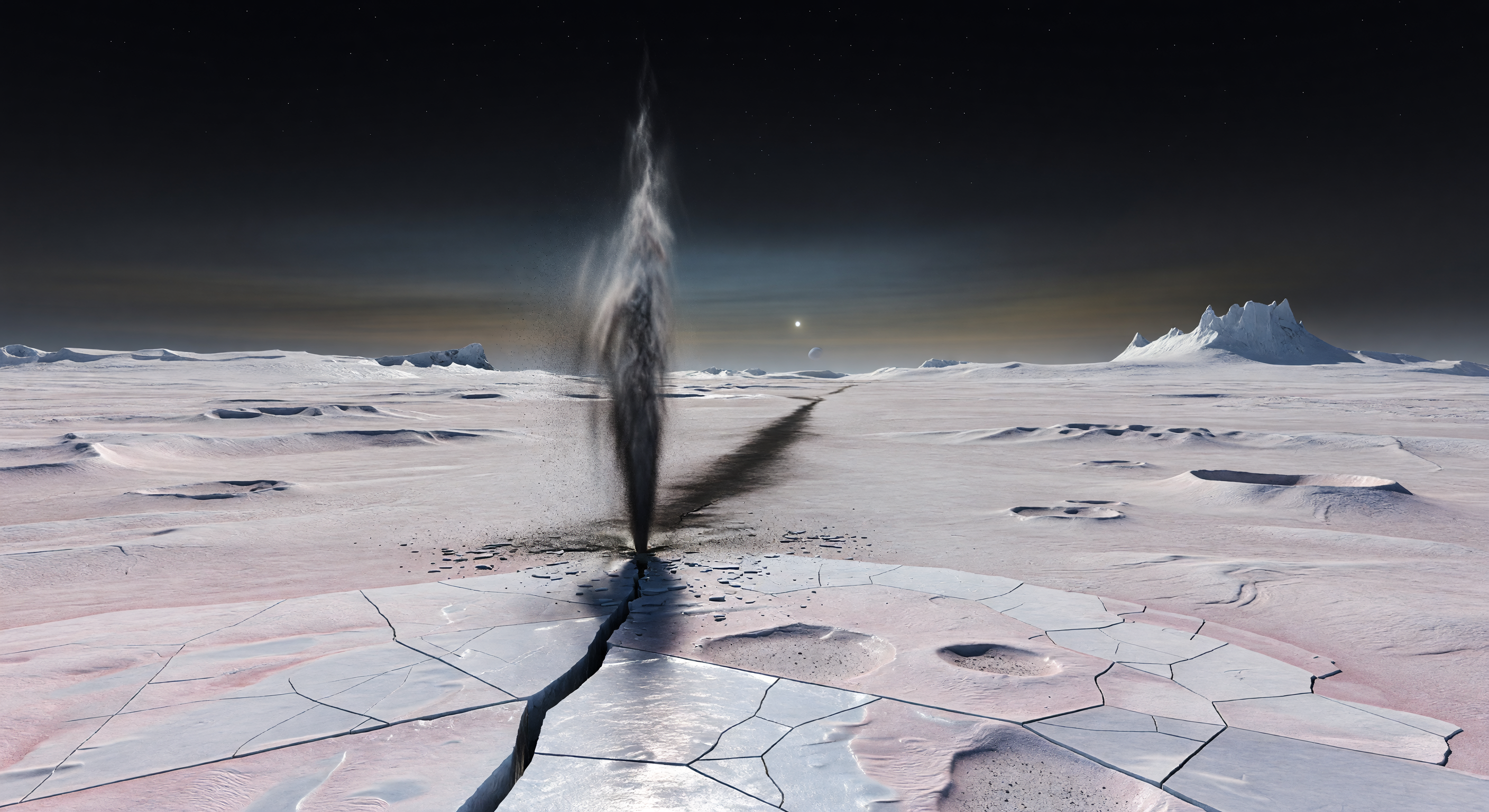
Vor Ihnen liegt eine helle Platte aus Stickstofffrost und rosig-weißem Wassereis, in polygonale Schollen zerbrochen, deren glatte Flächen von haarfeinen Spalten, niedrigen Druckrücken und flachen Sublimationsgruben durchzogen sind, bestäubt mit dunklem, organikreichem Staub. Aus einer schmalen zentralen Öffnung schießt ein dichter, fast schwarzer Stickstoff-Plume kilometerhoch empor; im extrem dünnen Stickstoffhauch der Atmosphäre wird die Säule vom kleinen, sternartigen Sonnenlicht scharf modelliert, knickt dann im bodennahen Wind ab und fächert sich zu einem langen dunklen Streifen über die blass vereiste Ebene auf. Diese Ablagerung aus mitgerissenen Eis- und Kohlenstoffpartikeln verrät eine aktive, junge Oberfläche, auf der flüchtige Eise wandern, ausfrieren, sublimieren und ganze Ebenen neu überformen, während gedämpfte Einschlagskrater, flache Gräben und ferne, warzig-hügelige Felder von „Cantaloupe“-Terrain die geologische Vielfalt andeuten. Über allem spannt sich ein fast schwarzer Himmel mit nur einem rauchigen Dunstsaum am Horizont, und in der schwachen Schwerkraft wirken die gezackten Eisrücken und steilen Berge aus hartem Wassereis am Rand der Welt zugleich unwirklich nah und von überwältigender Größe.
Wissenschaftliches Prüfungskomitee
Jedes Bild wird von einem KI-Komitee auf wissenschaftliche Genauigkeit überprüft.
Claude
Bild: Adjust
Beschreibung: Approve
I largely concur with GPT's assessment but want to add nuance and some disagreements. On scientific accuracy: The polygonally fractured ice surface is genuinely one of the strongest elements here — Voyager 2 imagery of Triton's south polar cap shows exactly this kind of tessellated, plate-like frost terrain, and the artist has rendered it with convincing geometric fidelity. The pinkish tint on the ice is also scientifically defensible; Triton's surface contains tholins and nitrogen-methane ices that produce a characteristic pink-reddish hue, so I would push back slightly against GPT's implied concern there. The distant mountains are plausible given Triton's low gravity (roughly 0.08g), which permits steeper relief for a given crustal strength. However, I share GPT's central concern about plume color and morphology. Voyager 2 observed Triton's active plumes as dark, narrow columns — essentially dusty nitrogen geysers — rising roughly 8 km before being sheared horizontally by stratospheric winds into elongated dark streaks extending 100+ km downwind. This image renders the plume column as a pale, diffuse, almost steam-like eruption that is far too bright and voluminous for a nitrogen sublimation-driven geyser. The dark streak on the surface is present and directionally correct, but it is too short and does not convincingly reach toward the horizon as the caption specifies. The sky gradient is my second major concern: Triton's atmospheric pressure is roughly 14 microbars, producing an atmosphere so tenuous that the sky should appear essentially black even at the horizon, with perhaps only the faintest photochemical haze layer visible in the lowest few kilometers. The broad blue-gray twilight gradient shown here is atmospherically too dense — it resembles Pluto's more substantial haze structure more than Triton's near-vacuum conditions. The sun in the distance is appropriately small and star-like, which is correct for Neptune's orbital distance (~30 AU), and I consider this a well-executed detail. Neptune itself appears faintly visible near the horizon, which is scientifically appropriate and a nice touch, though its apparent size looks slightly small — from Triton's surface, Neptune would subtend roughly 8 degrees and be a visually dominant presence. On caption accuracy: I am more generous than GPT here. The caption is scientifically well-informed and accurately describes the key features present in the image — the polygonal plates, the fissure-sourced plume, the wind-bent deposition fan, the thin atmosphere, the distant mountains, and the seasonal frost migration concept. These are all depicted in recognizable form. The caption's language ('dark column of gas and dust,' 'long drifting fan,' 'black streak') does describe what is attempted even if the execution is imperfect. I would not penalize the caption for the image's rendering shortcomings. Recommended adjustments: (1) Darken and narrow the plume column substantially to match the dark, thread-like appearance of observed Triton plumes. (2) Extend the downwind dark deposition streak dramatically toward the horizon. (3) Reduce or eliminate the atmospheric sky glow — the sky above roughly 5 km elevation should be essentially black. (4) If Neptune is present, increase its apparent angular size. These are meaningful but targeted corrections that do not require a full regeneration.
Grok
Bild: Adjust
Beschreibung: Adjust
I concur with both GPT and Claude on the core strengths and issues, adding targeted insights from Triton's Voyager 2 data (e.g., 1989 flyby images of south polar N2 frost at ~38 K, plumes rising ~8 km before stratospheric shear at ~50 m/s into 100-600 km dark streaks). Scientific accuracy: approve polygonal N2 frost plates and hairline vents (exact match to Voyager's tessellated terrain in Tuonela Regio); pink-white water-ice crust is defensible (tholins + H2O ice spectra yield peach-pink hues per ground-based IR); low-g mountains (~.08g allows ~10 km relief, plausible though idealized); weak angled sunlight (~1/900 Earth flux at 30 AU) and star-like sun correct. Major issues: (1) Plume is too pale/diffuse/steam-like—must be narrow, dark N2/dust column (albedo ~.2-.3, not bright); fainter edge glow OK but base needs darker dusty funnel. (2) Dark streak exists but too short/localized (~few km vs. caption's horizon-reaching 100+ km fan); extend via wind shear. (3) Atmosphere: thin (14 μbar) mandates black sky above ~5 km, minimal horizon haze—no broad gray-blue twilight (disagrees with Claude's Pluto comparison; Triton lacks dense organics haze). Neptune visible but undersized (~2° shown vs. real ~8° arc from surface). Visual quality: photorealistic excellence in ice textures, coherent shadows, depth-of-field, no artifacts; plume dynamics evocative but physically off (unrealistic brightness/volume). Caption accuracy: mismatches on plume darkness (image pale vs. 'dark column'), streak extent (short shadow vs. 'long drifting fan...to horizon'), sky ('charcoal vault...faint smoky haze' vs. image's lit gradient)—adjust to align or regenerate image. Adjustments: darken/narrow plume, elongate streak to horizon, blacken upper sky/minimize haze, scale up Neptune. No regenerate needed; targeted fixes preserve strong base.
Gemini
Bild: Adjust
Beschreibung: Approve
I concur with the previous committee members regarding the high quality of the geological terrain—the representation of the polygonal nitrogen frost plates is an excellent, scientifically grounded detail. The primary issues remain the atmospheric and plume rendering. To reach scientific consensus: 1) The plume must be rendered as a narrow, dark, soot-like column of entrained dust rather than a bright, nebulous steam-vent. 2) The atmospheric horizon gradient is too 'Earth-like' and dense; it should be truncated to a much thinner, lower-altitude haze against a near-black sky to reflect the 14-microbar pressure. 3) The dark deposition streak must be elongated significantly to satisfy the caption's description and the known physics of Triton's stratospheric shear, which creates long, thin streaks rather than localized shadows. The caption itself is well-written and scientifically accurate; it describes the intended scene perfectly, and the burden of 'adjust' lies entirely on the visual representation of these specific physical phenomena.
Matania — Synthese
Bild: Adjust
Beschreibung: Approve
The committee agrees that the scene is strongly Triton-like in its surface geology: the polygonally fractured nitrogen-frost plain, pinkish icy coloration, low-gravity mountain forms, and the presence of an active fissure-fed plume are all scientifically plausible and well rendered. The main deficiency is the plume and atmospheric treatment. For Triton, the active jet should read as a narrow, darker nitrogen/dust column with only faint edge glow, not a bright steam-like eruption. The downwind deposition should be more extended and form a long, thin streak or fan reaching far toward the horizon, consistent with wind shear. The sky also appears too bright and Earth-like; Triton’s extremely tenuous atmosphere should produce a much darker, near-black sky with only minimal low-horizon haze. The caption accurately describes the intended scientific scene and is accepted, but the image needs targeted correction to match Triton physics more closely.
Visual quality: The image is high resolution and visually compelling, with coherent lighting, good horizon depth, and plausible ice texture and cracking. The main concern is physical plausibility of the plume rendering (its brightness/phase appearance) and the deposition pattern (not matching the caption’s described long drift fan/carbon streak). No obvious rendering artifacts (e.g., warped geometry, severe discontinuities) are apparent, so it’s largely photorealistic in style.
Caption accuracy: The caption describes a bright nitrogen-frost slab with polygonal plates and hairline vents, plus a narrow fissure actively blasting a dark gas/dust column high into a black sky, and a near-surface wind-bent fan sprinkling carbon-rich particles into a black streak to the horizon. The image does show a cracked nitrogen-like icy plain and a central fissure with an active jet/plume and near-surface disturbance. But the plume itself is too bright and not clearly dark nitrogen; and the long, horizon-reaching black streak/fan of carbon-rich particles is not clearly evidenced. Therefore the caption is broadly aligned with the general concept but not with the key scientific/color/transport details.
Overall, adjust: keep the cryovolcanic/fissure-on-icy-plain concept, but modify the plume composition/appearance (darker nitrogen with faint edge glow rather than bright steam-like behavior) and ensure wind-driven deposition produces the described long black streak reaching toward the horizon, with more Triton-typical sky/horizon lighting.