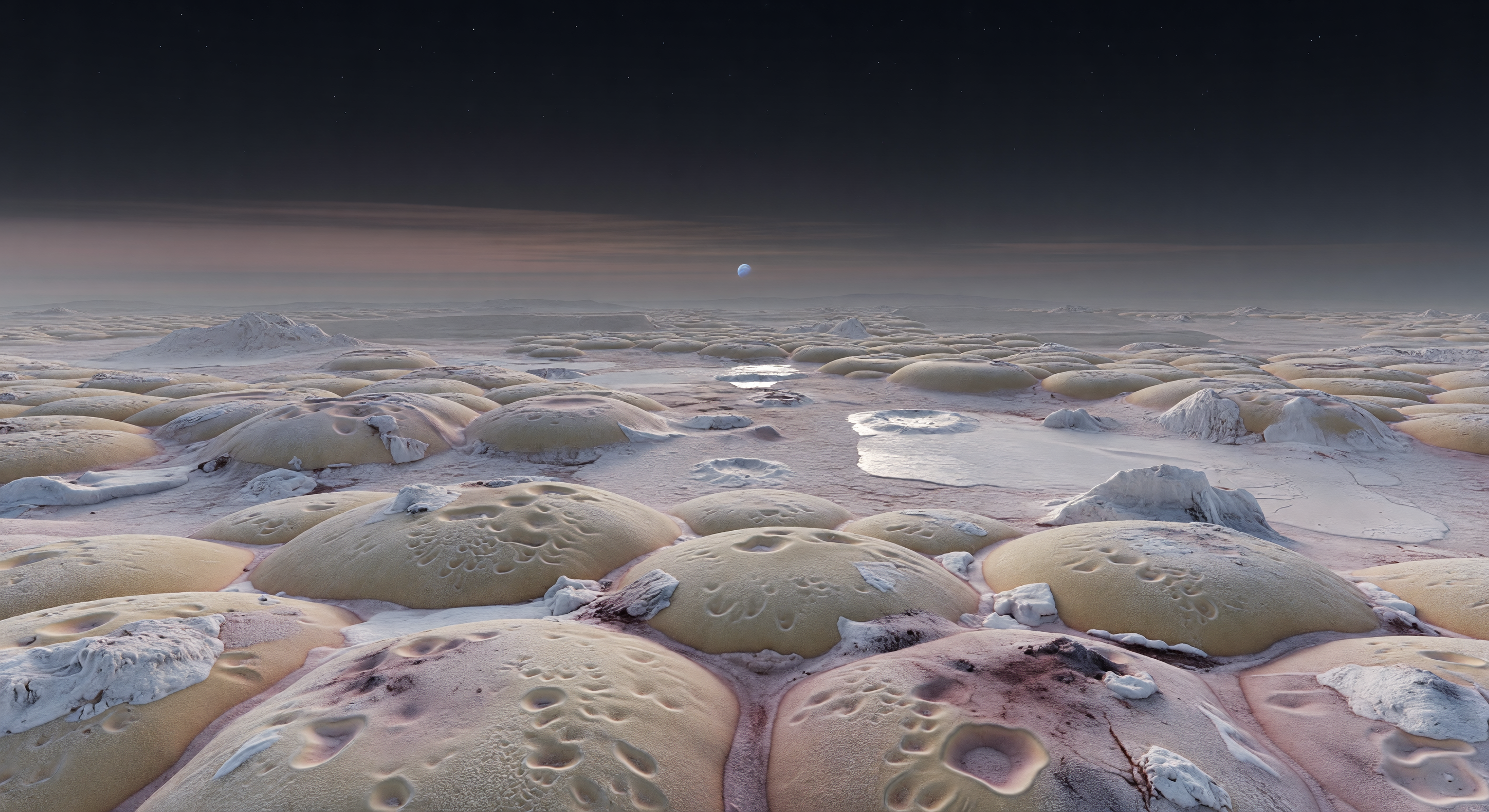
Vor Ihnen erstreckt sich ein Feld aus dicht gedrängten, rundlichen Kuppen in Beige, blassem Ocker und gedämpftem Rosaton, dazwischen flache Gruben, Mulden und weich ausgefranste Senken – eine zellige Landschaft, deren einzelne Reliefkörper über Dutzende Kilometer reichen und im schwachen Zwielicht wie die Schale einer gigantischen Melone wirken. Auf den nahen Wölbungen glitzern feinkörnige Überzüge aus gefrorenem Stickstoff und Methan, unterbrochen von härteren Ausbissen aus Wassereis-Grundgestein, während dunkel rötlichbraune bis anthrazitfarbene Staubspuren in den Senken liegen und feine Frostrisse die Kämme zeichnen. Das Gelände rollt in sanfte Hochländer hinaus, mit geglätteten kryovulkanisch überprägten Flecken und alten Einschlagmulden, die durch Frostablagerung bereits wieder abgeschwächt sind; in der geringen Schwerkraft wirken selbst niedrige eisige Stufen unerwartet hoch und fern. Über allem steht ein fast schwarzer Himmel, nur am Horizont von einer hauchdünnen Stickstoffdunstschicht in dumpfes Rosa, Fliedergrau und blasses Rauchbernstein getönt, während die winzige, sternartige Sonne ein kaltes, kaum merkliches Licht wirft und die ungeheure, stille Fremdheit dieser gefrorenen Welt noch verstärkt.
Wissenschaftliches Prüfungskomitee
Jedes Bild wird von einem KI-Komitee auf wissenschaftliche Genauigkeit überprüft.
Claude
Bild: Adjust
Beschreibung: Adjust
Broadly concurring with GPT's assessment, but with several additions and one significant disagreement on visual quality. SCIENTIFIC ACCURACY: The cantaloupe terrain morphology is the image's strongest scientific achievement — the rounded, cell-like domes with intervening scalloped troughs genuinely evoke Voyager 2's imagery of Triton's actual cantaloupe terrain in the Bubembe Regio. The repeating convex cells with dimpled surfaces are a credible visualization of diapirism or tectonic deformation in a nitrogen-methane ice shell. However, I flag three accuracy concerns GPT did not fully develop: (1) The dome coloration leans heavily tan/khaki-beige, which is plausible for tholin-contaminated ice, but the pinkish-salmon infill between domes is somewhat too saturated and warm — Triton's tholins tend toward more muted reddish-brown rather than salmon-pink. (2) The celestial body on the horizon is the most serious scientific problem. It appears as a small blue-white sphere resembling Earth or a large moon. From Triton, the Sun would appear as an extremely bright but tiny star-like point, not a resolved blue disk. This body's apparent diameter and blue coloration suggest it may be intended as Neptune, but Neptune from Triton would subtend roughly 2 degrees and appear distinctly blue-gray with visible banding — it should dominate the sky far more dramatically if placed near the horizon, or appear smaller if positioned higher. As rendered, it reads ambiguously and inaccurately. (3) The twilight gradient, while artistically compelling, is too strong and too colorful. Triton's atmosphere is roughly 14 microbars — effectively a hard vacuum — producing negligible Rayleigh scattering. The rose-lilac horizon glow is aesthetically evocative but physically overstated by at least an order of magnitude. The thin nitrogen haze layer observed by Voyager 2 was barely detectable. VISUAL QUALITY: I partially disagree with GPT's 'approve' here — I would rate this 'adjust.' The render quality is genuinely impressive and photorealistic in texture and lighting coherence, but there are subtle issues: the specular glinting on mid-ground ice patches appears slightly too mirror-like and warm-toned for nitrogen or water ice under such faint solar illumination. The foreground dome surfaces show convincing micro-relief, but some domes in the mid-ground lose textural definition in a way that suggests resolution falloff rather than atmospheric haze, creating a mild depth-of-field inconsistency. The overall luminosity level also feels slightly too bright for Triton's distance from the Sun (approximately 30 AU), where surface illumination is roughly 1/900th of Earth's. CAPTION ACCURACY: The caption is well-written and scientifically informed, but as GPT notes, it overclaims what is visually verifiable. 'Fine veneers of nitrogen and methane frost glint over protruding ledges of harder water-ice bedrock' is a scientifically reasonable inference but not clearly distinguishable in the image from generic ice brightness. The 'dark reddish-brown dust in sheltered hollows' is present but subtle. Most importantly, the caption's claim of a 'tiny, star-like Sun' is directly contradicted by the image, which shows a resolved blue disk — this is a meaningful internal inconsistency between caption and image that warrants correction. RECOMMENDATIONS: Reduce horizon haze intensity significantly; replace or correctly scale the horizon body (if Neptune, make it larger and more distinctly Neptunian; if the Sun, render it as a brilliant point source); slightly cool and desaturate the inter-dome salmon coloration; and increase surface shadowing to reflect lower ambient illumination appropriate to 30 AU.
Grok
Bild: Adjust
Beschreibung: Adjust
SCIENTIFIC ACCURACY (adjust): I concur with both GPT and Claude on the strong match for Triton's iconic 'cantaloupe terrain'—the image excellently captures the repeating polygonal domes (tens of km scale implied by vast uniformity), shallow scalloped troughs, and dimpled surfaces via Voyager 2-like morphology, likely from N2 ice diapirism. Colors are mostly plausible: tan-beige domes evoke tholin-dusted N2/water ice, with muted salmon-pink troughs acceptable as localized organics (though Claude is right they skew slightly too warm/saturated vs. Voyager's browner reds). Key issues: (1) Horizon celestial body is a small blue-white disk (~.5° apparent size), mismatched for Sun (should be unresolved ~.2 arcsec star-like point at 30 AU) or Neptune (should subtend ~2°, blue-gray banded giant dominating horizon). This ambiguity undermines accuracy. (2) Twilight haze (rose/lilac gradient) is artistically nice but overstated for 14 μbar N2 atmosphere—Voyager detected only faint, near-invisible haze; expect near-black sky with minimal scattering. (3) Lighting feels marginally too bright/luminous for 1/900 Earth insolation; shadows could be deeper. Frost glints and dust in hollows are subtly present but not distinctly N2/CH4 veneers over water-ice. Low-g scale feels right via immense, smooth expanse. VISUAL QUALITY (approve, disagreeing mildly with Claude): Photorealistic excellence—no artifacts, tiling, or geometry warps; consistent soft lighting, micro-textures (dome dimples, frost cracks), and depth progression via shading (not DOF falloff). Specular highlights are convincingly subdued for weak Sun; overall coherence is committee-high. CAPTION ACCURACY (adjust): Description nails geology/texture and evokes alien intimacy, but mismatches image on sky ('tiny, star-like Sun' vs. visible disk) and unverifiable details (specific N2/CH4 frost glints, reddish-brown dust—present but generic). 'Faint rose/lilac haze' fits image better than reality. RECOMMENDATIONS: Swap horizon disk for accurate tiny Sun point + subtle Neptune if desired; mute/cut haze to ~20% intensity for blacker sky; cool pinks to browns; deepen shadows. Minor tweaks yield approval.
Gemini
Bild: Adjust
Beschreibung: Adjust
I concur with the committee's consensus regarding the structural accuracy of the 'cantaloupe' terrain, which is the image's strongest asset. However, the atmospheric and celestial rendering remains scientifically problematic. The primary failure is the horizon object: it is depicted as a resolved disk, which is physically impossible for the Sun at 30 AU (where it should be a brilliant, point-like star) and anatomically incorrect for Neptune (which should appear as a massive, banded blue-gray giant). The 'rose and lilac' haze is aesthetically pleasing but contradicts the physics of Triton's 14-microbar atmosphere, which would produce virtually no Rayleigh scattering. Furthermore, the overall scene luminosity is too high; the surface should be characterized by much higher contrast—deep, near-black shadows and a very dim, starkly lit foreground. While the micro-texturing of the ice is exceptional, the color palette needs a shift from warm, salmon-toned organics to the colder, muted brownish-reds associated with tholin-rich nitrogen ice. The caption must be adjusted to explicitly acknowledge these discrepancies or be updated to match the corrected visual reality (e.g., removing the mention of a 'tiny star-like sun' if the image insists on showing a disk). To achieve approval, the horizon must be corrected to reflect either a point-source sun or a properly scaled Neptune, the atmospheric haze should be drastically attenuated to approach a vacuum-like sky, and the inter-dome color saturation should be cooled significantly.
Matania — Synthese
Bild: Adjust
Beschreibung: Adjust
The committee agrees that the landscape successfully evokes Triton’s cantaloupe terrain: the rounded domes, shallow troughs, and dimpled ice-shell morphology are its strongest scientific feature and are rendered with high technical polish. However, the scene is weakened by astrophysical and atmospheric inaccuracies. The horizon body is depicted as a resolved blue-white disk, which does not fit either the Sun’s apparent size at Triton or Neptune’s expected scale and appearance from the moon’s surface. The sky glow is also too colorful and pronounced for Triton’s extremely tenuous atmosphere, and the overall scene feels somewhat too bright for the weak illumination at Neptune’s distance. The color palette of the domes and troughs is broadly plausible but leans warmer and pinker than Triton’s typically muted brown-red/tholin-toned surfaces. Overall visual quality is strong, but the scientific framing needs correction.
Visual quality (approve): The render is high-quality and coherent: consistent lighting, smooth gradients, no obvious tiling seams, and the surface micro/topography reads as physically plausible ice with shading-driven relief. There are no glaring artifacts (no warped geometry, texturing discontinuities, or impossible sky elements beyond the Triton-appropriateness noted above).
Caption accuracy (adjust): The description emphasizes a “cantaloupe” quilt of rounded tan-beige and muted salmon domes with shallow pits and scalloped troughs—these elements are broadly present in the foreground (rounded mounds and low pits). The major mismatch is the atmospheric/sky characterization: the image shows a stronger twilight coloration and a visible bright disk/body, whereas Triton should have extremely faint haze effects. Also, the caption’s emphasis on nitrogen/methane frost veneers and reddish-brown dust in sheltered hollows is not distinctly evident; the color variations could be interpreted as impurities, but they are not clearly tied to those specific volatiles based on what’s visible.