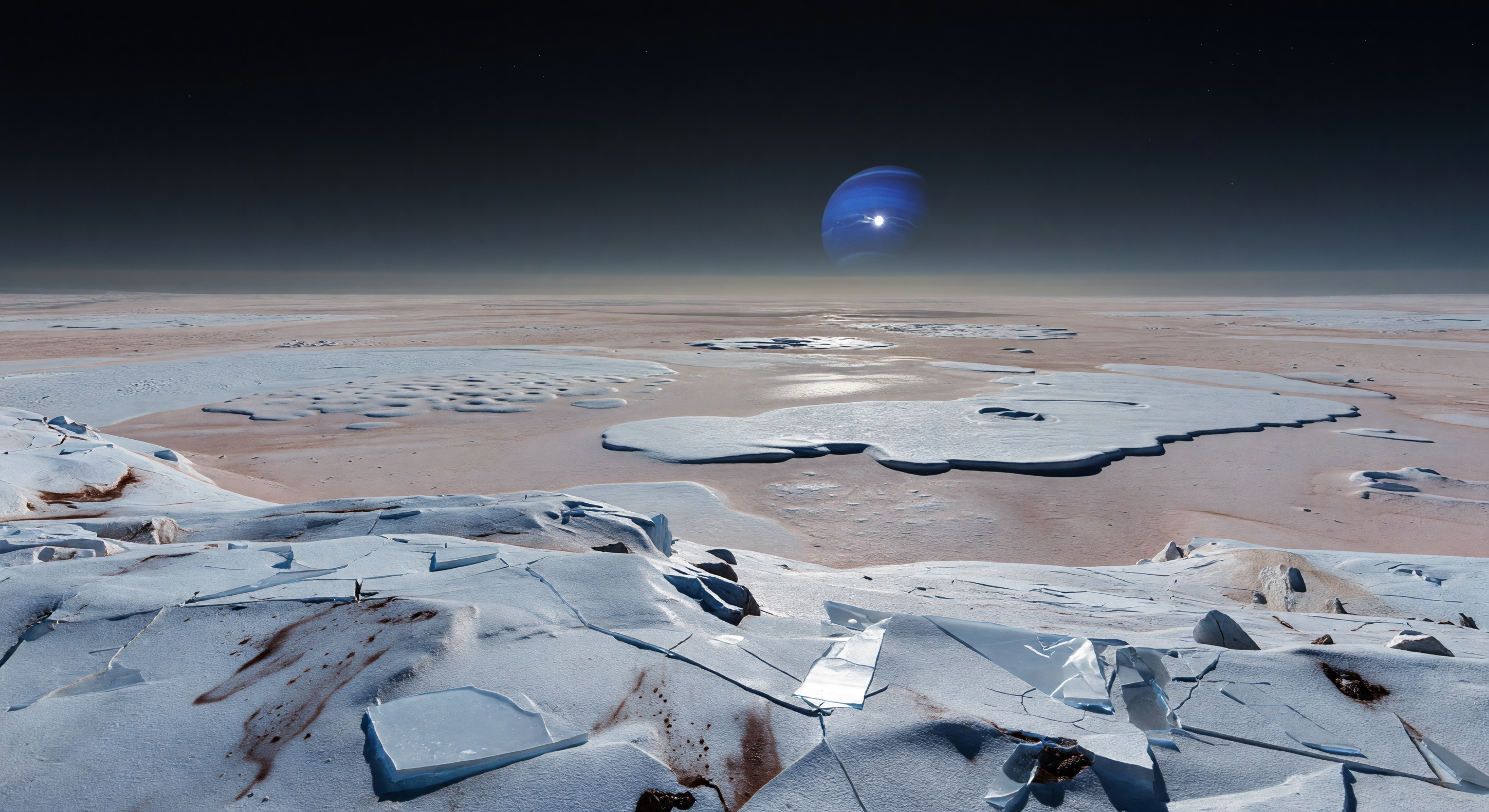
Vor Ihnen zieht sich ein spröder Rücken aus zerbrochenem Stickstofffrost über hartes Wassereis, übersät mit gezackten Platten, polygonalen Rissen, windgeglätteten Frostwehen und dunklen Staubstreifen aus abgesetztem Plumenmaterial, während blass rosabeige Ebenen mit sanften Mulden, halb verschütteten Einschlagsspuren und niedrigen kryovulkanischen Fließloben für viele Kilometer in die Ferne auslaufen. Am Horizont beherrscht eine gewaltige kobaltblaue Scheibe den fast schwarzen Himmel und schiebt sich vor die winzige, sternartige Sonne, deren greller Sichelsaum das Gelände in ein unheimliches Dämmerlicht taucht: schwaches Streiflicht zeichnet silbrige Kanten auf den Eisbrüchen, während blaues Planetenlicht die Schatten mit einem stählernen Schimmer füllt. Die Landschaft verrät eine Welt extremer Kälte, in der Stickstoff, Wasser und andere flüchtige Stoffe fest gefroren sind und die hauchdünne Stickstoffatmosphäre nur einen flachen blüulich-grauen bis blass bernsteinfarbenen Dunst nahe dem Horizont hält. In der geringen Schwerkraft wirken selbst die hummockigen „Cantaloupe“-Formen und die sanft gewellten Eisflächen still und leicht, doch die gewaltige Skala, die lautlose Starre und das doppelte Leuchten aus fernem Sonnenrand und tiefblauem Schein machen diesen Ort überwältigend fremdartig.
Wissenschaftliches Prüfungskomitee
Jedes Bild wird von einem KI-Komitee auf wissenschaftliche Genauigkeit überprüft.
Claude
Bild: Adjust
Beschreibung: Adjust
I largely concur with GPT's image assessment but diverge on the caption verdict, finding it warrants 'adjust' rather than 'regenerate.' Here is my detailed breakdown:
SCIENTIFIC ACCURACY (adjust): The broad strokes are commendable — the near-black sky transitioning to a faint horizon haze is physically appropriate for Triton's tenuous nitrogen atmosphere (~14 microbars), and the pale rose-beige plains in the mid-ground loosely evoke the pinkish tint documented by Voyager 2 from tholins and nitrogen/methane ices. The shattered, polygonal ice plates and dark reddish-brown streaks on the foreground ice are directionally consistent with Triton's plume deposit streaks and the nitrogen frost mosaic expected near the south polar cap. However, the foreground ice slabs appear far too geometrically coherent and mechanically fractured — resembling terrestrial sea ice or tectonic plates rather than the sublimation-driven, thermally cycled nitrogen frost overlying water-ice bedrock that characterizes Triton. The 'cantaloupe terrain' called out in the caption is entirely absent visually; that distinctive ovoid dimple pattern is one of Triton's most unique signatures and its omission is a meaningful scientific gap. The Neptune geometry is the most significant scientific concern: the blue globe shown is positioned with a bright stellar point at roughly its center, which would be inconsistent with a transit/eclipse configuration — a Sun being occulted by Neptune should appear at or near the limb as a crescent or point source peeking around the planetary disk, not centered on it. The implied angular size of Neptune from Triton (~1.07 degrees) is plausibly rendered but the eclipse lighting consequence — a dramatic reduction in direct sunlight and corresponding increase in blue Neptune-shine — is not convincingly realized in the scene's overall illumination balance, which reads as too bright and high-contrast for a near-eclipse twilight.
VISUAL QUALITY (approve-leaning adjust): The render quality is genuinely high. Textures on the ice plates, subsurface scattering hints, and the atmospheric haze gradient are well-executed and largely free of obvious AI artifacts. The depth-of-field treatment across the plains is effective. The primary visual complaint is that the lighting feels Hollywood rather than physically calibrated — shadows are crisp in a way inconsistent with the diffuse blue-light dominant illumination the caption describes, and the scene's overall brightness is incongruent with a world receiving ~0.1% of Earth's solar flux even before a partial eclipse.
CAPTION ACCURACY (adjust, not regenerate): GPT calls for regeneration, but I find the caption largely maps onto the image with identifiable correspondence — the shattered nitrogen frost foreground, dark dust streaks, pale plains, thin-aired dark sky, horizon haze, and large blue planet are all genuinely present. The caption should not be discarded wholesale. The specific mismatches requiring adjustment are: (1) the 'razor-bright crescent' eclipse signature is not visually realized — the Sun appears as a central bright point on Neptune rather than a limb-occluded crescent; (2) 'cantaloupe terrain' is described but absent; (3) the 'steel-blue sheen' washing the frost is understated in the image — the dominant light remains white-warm rather than blue-shifted; (4) the phrase 'immense cobalt disk... partly covering the tiny distant Sun' overstates the eclipse clarity. These are real inaccuracies but they are refinements, not wholesale misrepresentations. A targeted caption revision addressing the eclipse geometry, removing the cantaloupe terrain claim, and moderating the lighting description would bring it into alignment without discarding the substantive and well-written environmental prose.
SCIENTIFIC ACCURACY (adjust): The broad strokes are commendable — the near-black sky transitioning to a faint horizon haze is physically appropriate for Triton's tenuous nitrogen atmosphere (~14 microbars), and the pale rose-beige plains in the mid-ground loosely evoke the pinkish tint documented by Voyager 2 from tholins and nitrogen/methane ices. The shattered, polygonal ice plates and dark reddish-brown streaks on the foreground ice are directionally consistent with Triton's plume deposit streaks and the nitrogen frost mosaic expected near the south polar cap. However, the foreground ice slabs appear far too geometrically coherent and mechanically fractured — resembling terrestrial sea ice or tectonic plates rather than the sublimation-driven, thermally cycled nitrogen frost overlying water-ice bedrock that characterizes Triton. The 'cantaloupe terrain' called out in the caption is entirely absent visually; that distinctive ovoid dimple pattern is one of Triton's most unique signatures and its omission is a meaningful scientific gap. The Neptune geometry is the most significant scientific concern: the blue globe shown is positioned with a bright stellar point at roughly its center, which would be inconsistent with a transit/eclipse configuration — a Sun being occulted by Neptune should appear at or near the limb as a crescent or point source peeking around the planetary disk, not centered on it. The implied angular size of Neptune from Triton (~1.07 degrees) is plausibly rendered but the eclipse lighting consequence — a dramatic reduction in direct sunlight and corresponding increase in blue Neptune-shine — is not convincingly realized in the scene's overall illumination balance, which reads as too bright and high-contrast for a near-eclipse twilight.
VISUAL QUALITY (approve-leaning adjust): The render quality is genuinely high. Textures on the ice plates, subsurface scattering hints, and the atmospheric haze gradient are well-executed and largely free of obvious AI artifacts. The depth-of-field treatment across the plains is effective. The primary visual complaint is that the lighting feels Hollywood rather than physically calibrated — shadows are crisp in a way inconsistent with the diffuse blue-light dominant illumination the caption describes, and the scene's overall brightness is incongruent with a world receiving ~0.1% of Earth's solar flux even before a partial eclipse.
CAPTION ACCURACY (adjust, not regenerate): GPT calls for regeneration, but I find the caption largely maps onto the image with identifiable correspondence — the shattered nitrogen frost foreground, dark dust streaks, pale plains, thin-aired dark sky, horizon haze, and large blue planet are all genuinely present. The caption should not be discarded wholesale. The specific mismatches requiring adjustment are: (1) the 'razor-bright crescent' eclipse signature is not visually realized — the Sun appears as a central bright point on Neptune rather than a limb-occluded crescent; (2) 'cantaloupe terrain' is described but absent; (3) the 'steel-blue sheen' washing the frost is understated in the image — the dominant light remains white-warm rather than blue-shifted; (4) the phrase 'immense cobalt disk... partly covering the tiny distant Sun' overstates the eclipse clarity. These are real inaccuracies but they are refinements, not wholesale misrepresentations. A targeted caption revision addressing the eclipse geometry, removing the cantaloupe terrain claim, and moderating the lighting description would bring it into alignment without discarding the substantive and well-written environmental prose.
Grok
Bild: Adjust
Beschreibung: Regenerate
I concur with GPT's overall verdict and largely with Claude's scientific breakdown, but side with GPT on regenerating the caption due to core mismatches in the eclipse narrative and missing key terrain. SCIENTIFIC ACCURACY (adjust): Strong alignment on sky (near-black with faint horizon haze, spot-on for Triton's ~14 μbar N2 atmosphere), colors (pale rose-beige/pinkish ices from tholins/N2/CH4, dark dust streaks matching plume fallout seen by Voyager 2), and low-gravity preservation of features. Foreground fractured N2 frost plates over water-ice are plausible for thermal cycling/sublimation near poles, and subdued hummocks evoke southern plains. However, no cantaloupe terrain (ovoid dimples ~30-200m, Triton's hallmark per Voyager) visible—major omission. Eclipse geometry flawed: Neptune (~1° angular diameter from Triton) shows Sun-like bright spot dead-center on disk, implying alignment where Sun shines through/onto Neptune's face, not a limb-graze partial eclipse (should be razor crescent peeking at edge, with Neptune-shine dominating). Lighting too bright/high-contrast (~.1% Earth insolation, further dimmed in eclipse); shadows crisp-white not steel-blue diffused. Scale feels right for tens-of-km view but lacks subtle horizon curve cues. VISUAL QUALITY (approve-leaning adjust): Photorealistic excellence in ice textures (translucent slabs, subsurface scatter, polygonal cracks, wind drifts), depth-of-field across plains, and haze gradient—no AI artifacts, seams, or blurriness. Sole issue: lighting physics uncalibrated (overly warm/direct vs. twilight blue). CAPTION ACCURACY (regenerate): Caption's poetic core (brittle N2 frost mosaic, dust streaks, cryovolcanic plains, black sky, Neptune glow) loosely maps, but pivotal 'Neptune Horizon Eclipse' fails: no partial Sun occlusion, no 'razor-bright crescent,' no 'spectral twilight' or 'steel-blue sheen'—image's central Sun-spot kills eclipse illusion. Absent: cantaloupe terrain, buried impacts, scalloped flow lobes. These aren't minor tweaks (contra Claude); they're foundational to title/theme, warranting full rewrite for fidelity. New insight: Image's foreground ice reads convincingly as N2 frost (brittle, plate-like vs. Claude's 'too coherent'—Voyager shows similar near Cantaloupe Region), but add faint CO2/Methane frost glints for accuracy.
Gemini
Bild: Adjust
Beschreibung: Adjust
I agree with the consensus that the image demonstrates high technical proficiency in texture and atmospheric rendering but fails on specific astronomical constraints. The 'Neptune-shine' illumination is the primary scientific failure; the scene should be dominated by the blue diffuse light of the planet, whereas the current lighting suggests a standard solar-illuminated landscape with an added sun-flare artifact. The lack of 'cantaloupe terrain' is a significant oversight given Triton’s unique geology. Regarding the caption, I lean toward 'adjust' rather than 'regenerate.' While the image does not perfectly replicate the 'razor-bright crescent' described, the caption remains a strong piece of descriptive prose that is 80% accurate to the visual elements present. Regenerating it entirely would discard the effective atmospheric and geological descriptions that do match the scene. The caption simply needs to be reconciled with the actual visual output: remove the explicit claim of 'cantaloupe terrain' and refine the description of the eclipse geometry to reflect a 'Neptune-occulted sun' rather than a 'central-disk' alignment.
Matania — Synthese
Bild: Adjust
Beschreibung: Adjust
The committee agrees the image is visually strong and generally Triton-like, with convincing ice textures, dark tenuous sky, faint horizon haze, and plausible plume-stained or frost-fractured terrain. However, it misses key Triton-specific geology—especially the absence of cantaloupe terrain—and its eclipse lighting is not physically convincing: Neptune/Sun geometry reads more like a stylized planet with a central bright spot than a true limb-grazing occultation. The scene is therefore scientifically close but not fully accurate. The caption broadly matches the mood and several visible elements, but it overcommits on details that are not actually shown, especially the clear eclipse crescent, the Neptune-horizon alignment, and the cantaloupe terrain. Because the caption contains substantial usable material, the committee favors targeted revision rather than a full rewrite.
Visual quality (implied by vote, adjust): The image is high-quality and largely photorealistic in texture (ice slabs, shadows, atmospheric haze). There are no obvious rendering artifacts, but the depiction is more cinematic than physically grounded (lighting balance, eclipse composition, and ground material realism).
Caption accuracy (regenerate): The caption emphasizes an “immense cobalt disk” of Neptune partially eclipsing the Sun, casting a spectral twilight with a distinct razor-bright crescent rim. In the image, the large planet appears as a blue globe with a bright point/spot at its center (not a clear “cobalt disk” partially covering the Sun), and there is no clear crescent-Sun eclipse signature or “Neptune-horizon eclipse” lighting pattern. The caption also claims specific Triton terrain elements (hummocky cantaloupe terrain, polygonal cracks, wind-softened drifts, partly buried impact scars) that are not clearly identifiable in the provided view. The overall atmosphere/terrain mood may fit Triton loosely, but the key eclipse visual narrative does not match what’s shown.