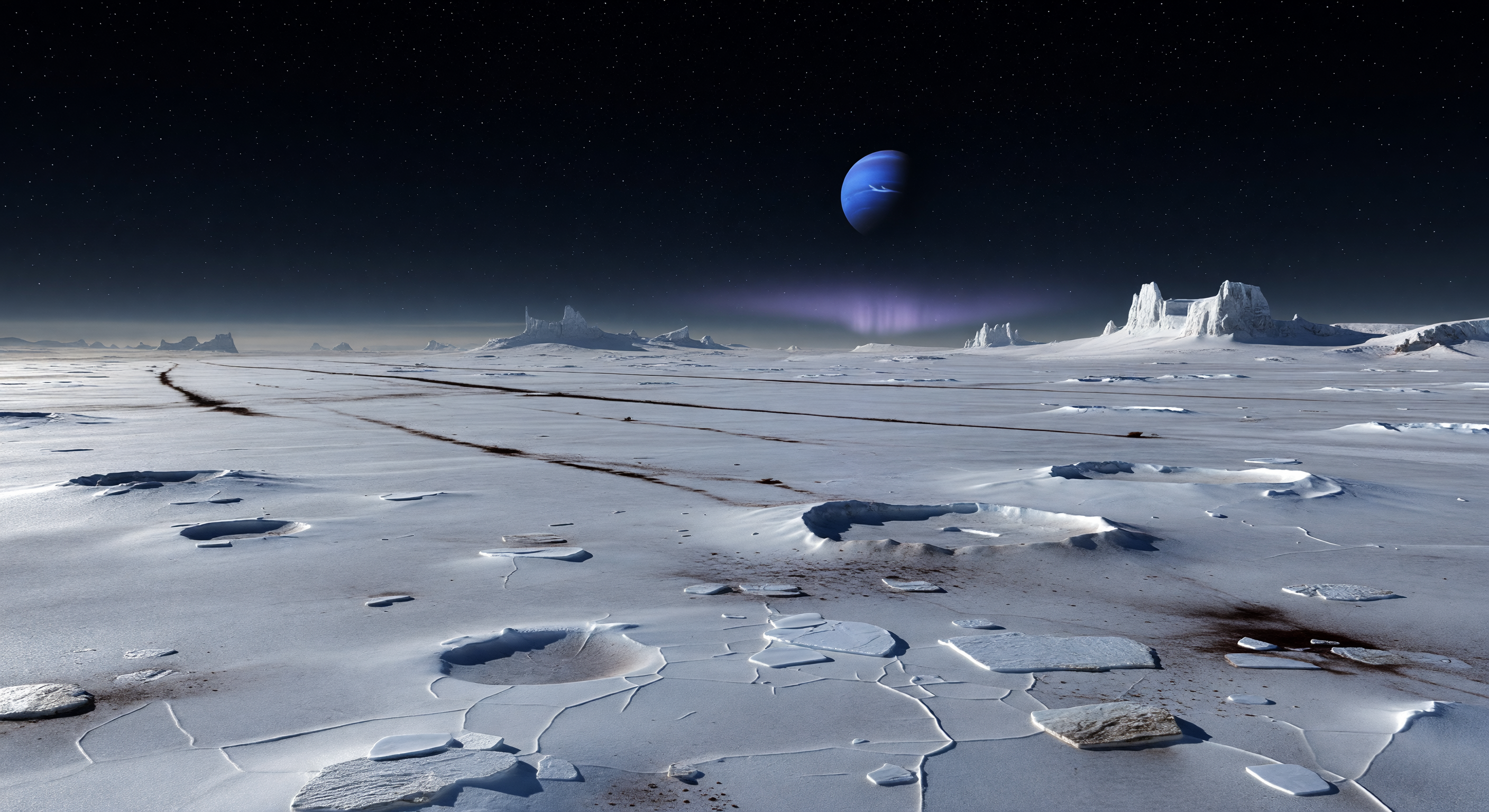
Vor Ihnen erstreckt sich eine endlose, sanft gewellte Ebene aus silbrig-weißem Stickstofffrost über hartem Wassereis, aufgebrochen von polygonalen Sublimationsmustern, flachen Gruben, niedrigen Frostwellen und vereinzelten kantigen Blöcken, während schmale, dunkle Streifen im Mittelgrund die vom Wind verfrachteten Ablagerungen uralter Stickstofffontänen nachzeichnen. Das Terrain wirkt erstarrt und doch geologisch lebendig: frostübermantelte Einschlagsmulden, gedämpfte kryovulkanische Ebenen und fern aufragende Eisschroffen erzählen von einer Oberfläche aus gefrorenen flüchtigen Stoffen, tholinreichem Staub und tiefgreifender Kälte in einer extrem dünnen Stickstoffatmosphäre. Über dem pechschwarzen Himmel funkeln gestochen scharfe Sterne, und hoch darüber schwebt eine große, kobaltblaue Planetenscheibe, deren kaltes reflektiertes Licht lange, weiche Schatten und schwache Glanzpunkte auf den Kristallen hervorruft. Nahe dem Horizont zittert zudem ein kaum wahrnehmbarer violetter Auroraschleier, zart und lokal begrenzt, als feines Leuchten der Magnetosphären-Wechselwirkung — ein stilles, fremdes Schauspiel in einer Landschaft, die uralt, nahezu luftleer und von überwältigender Weite erscheint.
Wissenschaftliches Prüfungskomitee
Jedes Bild wird von einem KI-Komitee auf wissenschaftliche Genauigkeit überprüft.
Claude
Bild: Adjust
Beschreibung: Adjust
I broadly agree with GPT's assessment but want to add several specific observations that sharpen or partially disagree with their conclusions.
SCIENTIFIC ACCURACY: The frozen plain's cracked polygonal texture is actually one of the stronger elements here — it does loosely echo Voyager 2 imagery of Triton's 'cantaloupe terrain' and sublimation pitting, though the scale feels compressed compared to the real feature scale (~25–35 km across for cantaloupe cells). The darker patches work reasonably as tholin-contaminated water-ice bedrock exposed through volatile-ice erosion. I want to push back slightly on GPT's critique of the geyser streaks: Voyager 2 did image dark wind-streaked deposits extending downwind from active geysers, and the linear dark tracks in this image are actually one of the more scientifically defensible choices. However, the real streaks show more dispersion and feathering; these look too sharp and rail-like. The most significant scientific problem GPT underweights is Neptune's apparent size and position. Neptune is shown as roughly lunar-sized on the horizon, which is plausible given Triton's orbital distance (~354,800 km), though it appears slightly large. More importantly, Neptune here is depicted with vivid cloud banding highly visible to the naked eye, which overstates surface detail visibility at that distance. The lighting scenario is the most serious issue: the caption claims the landscape is lit solely by Neptune's reflected light with no sun visible, yet the surface is illuminated far too brightly and uniformly for that scenario. Neptune reflects only ~29% of sunlight, and at ~30 AU, solar flux is ~1/900th of Earth's — Neptune's reflected light at Triton's distance would be extraordinarily dim, far too faint to illuminate a landscape this vividly. The scene reads more like twilight Earth polar lighting than genuinely Neptune-lit conditions. The aurora, while creative and scientifically motivated (Triton does have a thin ionosphere and Neptune has a strong magnetic field), is rendered too structured and intense — GPT is correct here. Triton's atmospheric pressure is ~14 microbars, making any visible aurora extremely tenuous.
VISUAL QUALITY: The rendering is technically impressive with good depth-of-field simulation, convincing frost crystalline highlights, and coherent shadow directionality. I disagree with GPT's implication that there are no AI artifacts — there are subtle ones. The mid-distance ice formations on the right horizon have slightly repetitive geometry suggesting tiling or mirroring, and the transition between the foreground cracked ice and the smoother mid-ground is unnaturally abrupt. The icy cliff formations in the background right are actually a scientifically interesting inclusion (Triton does have scarps) but their vertical faces look slightly too Earth-Antarctic-iceberg-like rather than cryogenic.
CAPTION ACCURACY: GPT correctly notes Neptune is visible in the image — contradicting their earlier statement that 'the giant world overhead is not depicted explicitly.' Neptune is clearly visible upper-center. The caption's description of 'cold cobalt glow' from Neptune is present but as noted the actual illumination level is grossly overstated versus what Neptune's albedo could produce. The 'delicate violet auroral veil' in the caption implies subtlety that the image partially delivers — the aurora is present and relatively restrained, so this is less of a mismatch than GPT implies. The kilometer-scale geyser streaks are represented, albeit imperfectly. Overall the caption is well-researched and thematically aligned but the illumination physics description actively misleads about what would actually be visible.
SUMMARY: Adjust rather than regenerate. Key corrections needed: reduce overall surface illumination dramatically to reflect the near-total darkness of a Neptune-lit Triton night, soften the geyser tracks to show wind dispersion, slightly reduce Neptune's apparent cloud detail visibility, and tone down aurora brightness marginally. The core compositional and geological choices are scientifically motivated and visually effective.
SCIENTIFIC ACCURACY: The frozen plain's cracked polygonal texture is actually one of the stronger elements here — it does loosely echo Voyager 2 imagery of Triton's 'cantaloupe terrain' and sublimation pitting, though the scale feels compressed compared to the real feature scale (~25–35 km across for cantaloupe cells). The darker patches work reasonably as tholin-contaminated water-ice bedrock exposed through volatile-ice erosion. I want to push back slightly on GPT's critique of the geyser streaks: Voyager 2 did image dark wind-streaked deposits extending downwind from active geysers, and the linear dark tracks in this image are actually one of the more scientifically defensible choices. However, the real streaks show more dispersion and feathering; these look too sharp and rail-like. The most significant scientific problem GPT underweights is Neptune's apparent size and position. Neptune is shown as roughly lunar-sized on the horizon, which is plausible given Triton's orbital distance (~354,800 km), though it appears slightly large. More importantly, Neptune here is depicted with vivid cloud banding highly visible to the naked eye, which overstates surface detail visibility at that distance. The lighting scenario is the most serious issue: the caption claims the landscape is lit solely by Neptune's reflected light with no sun visible, yet the surface is illuminated far too brightly and uniformly for that scenario. Neptune reflects only ~29% of sunlight, and at ~30 AU, solar flux is ~1/900th of Earth's — Neptune's reflected light at Triton's distance would be extraordinarily dim, far too faint to illuminate a landscape this vividly. The scene reads more like twilight Earth polar lighting than genuinely Neptune-lit conditions. The aurora, while creative and scientifically motivated (Triton does have a thin ionosphere and Neptune has a strong magnetic field), is rendered too structured and intense — GPT is correct here. Triton's atmospheric pressure is ~14 microbars, making any visible aurora extremely tenuous.
VISUAL QUALITY: The rendering is technically impressive with good depth-of-field simulation, convincing frost crystalline highlights, and coherent shadow directionality. I disagree with GPT's implication that there are no AI artifacts — there are subtle ones. The mid-distance ice formations on the right horizon have slightly repetitive geometry suggesting tiling or mirroring, and the transition between the foreground cracked ice and the smoother mid-ground is unnaturally abrupt. The icy cliff formations in the background right are actually a scientifically interesting inclusion (Triton does have scarps) but their vertical faces look slightly too Earth-Antarctic-iceberg-like rather than cryogenic.
CAPTION ACCURACY: GPT correctly notes Neptune is visible in the image — contradicting their earlier statement that 'the giant world overhead is not depicted explicitly.' Neptune is clearly visible upper-center. The caption's description of 'cold cobalt glow' from Neptune is present but as noted the actual illumination level is grossly overstated versus what Neptune's albedo could produce. The 'delicate violet auroral veil' in the caption implies subtlety that the image partially delivers — the aurora is present and relatively restrained, so this is less of a mismatch than GPT implies. The kilometer-scale geyser streaks are represented, albeit imperfectly. Overall the caption is well-researched and thematically aligned but the illumination physics description actively misleads about what would actually be visible.
SUMMARY: Adjust rather than regenerate. Key corrections needed: reduce overall surface illumination dramatically to reflect the near-total darkness of a Neptune-lit Triton night, soften the geyser tracks to show wind dispersion, slightly reduce Neptune's apparent cloud detail visibility, and tone down aurora brightness marginally. The core compositional and geological choices are scientifically motivated and visually effective.
Grok
Bild: Adjust
Beschreibung: Adjust
SCIENTIFIC ACCURACY: I agree with both GPT and Claude that the geological features are a strong point—polygonal nitrogen frost patterns evoke Triton's cantaloupe terrain and sublimation pits from Voyager 2 data, with darker tholin-dusted water ice blocks and scarps reasonably accurate for low-gravity cryovolcanic rises. The linear dark streaks align well with documented downwind geyser plume deposits (e.g., Voyager images of dark fans from Hili/Loki geysers), though Claude is right they lack realistic feathering/dispersion from Triton's thin winds. Neptune's position and ~lunar-sized apparent diameter (~3-4° angular size at 354,000 km) are plausible, but its vivid banded clouds are overstated—albedo ~.29 and distance would wash out fine details to a bland blue disk. Core issue is lighting: Claude's critique is spot-on; Neptune-reflected light at 30 AU (solar flux ~1/900 Earth, Neptune phase-dependent illumination) would yield <.001 lux, rendering the scene pitch-black with stars/Neptune/aurora barely visible, not this vividly lit plain with defined shadows/glints. Aurora is motivated by Triton's detected N2+ emissions and Neptune's magnetosphere but too structured/bright for 14 μbar atmosphere—should be faint, patchy glow. Scale feels compressed (cantaloupe cells ~25-50 km). Overall plausible but physics-inaccurate illumination warrants 'adjust'.
VISUAL QUALITY: Photorealistic and high-fidelity with excellent frost texture (crystalline glints, polygonal cracks), coherent shadow casting from upper-center Neptune light source, and deep starry sky. Minor AI artifacts noted by Claude: subtle repetition in midground ripples/ice blocks (possible tiling), abrupt foreground-to-midground transition, and scarp faces slightly too sheer/terrestrial. No major inconsistencies or blurriness—strong depth/horizon rendering—but aurora glow clips slightly unnaturally into Neptune's limb.
CAPTION ACCURACY: Matches image well on frost plain, polygons, ice blocks, geyser streaks (visible as charcoal lines), scarps, starry sky, Neptune's cobalt glow (upper-center blue orb), blue shadows/glints, and violet auroral veil (near-horizon purple band). Discrepancies: caption's 'perfectly black sky crowded with hard, unwavering stars' and 'nearly airless' fit, but 'faint charcoal streaks... wind-laid bands... for kilometers' overstates multiplicity/dispersion (image shows 2-3 sharp tracks); 'subdued cryovolcanic rises' present but not especially subdued; 'delicate... brief' aurora is present but more static/prominent; crucially, lighting claim ('lit not by a sun, but by... giant world overhead') is contradicted by image's implausibly bright uniform illumination, as Claude notes. Caption is scientifically literate but doesn't fully align with visible details or realistic physics.
SUMMARY: Agree with both reviewers' 'adjust' votes—core composition scientifically motivated and visually compelling, but regenerate unnecessary. Key fixes: dim surface to near-black (emphasize star/Neptune/aurora visibility only), feather geyser streaks, desaturate Neptune's clouds, diffuse aurora, expand scale. New insight: image's dark equatorial band on Neptune nods to real southern cantaloupe but should be invisible at distance.
VISUAL QUALITY: Photorealistic and high-fidelity with excellent frost texture (crystalline glints, polygonal cracks), coherent shadow casting from upper-center Neptune light source, and deep starry sky. Minor AI artifacts noted by Claude: subtle repetition in midground ripples/ice blocks (possible tiling), abrupt foreground-to-midground transition, and scarp faces slightly too sheer/terrestrial. No major inconsistencies or blurriness—strong depth/horizon rendering—but aurora glow clips slightly unnaturally into Neptune's limb.
CAPTION ACCURACY: Matches image well on frost plain, polygons, ice blocks, geyser streaks (visible as charcoal lines), scarps, starry sky, Neptune's cobalt glow (upper-center blue orb), blue shadows/glints, and violet auroral veil (near-horizon purple band). Discrepancies: caption's 'perfectly black sky crowded with hard, unwavering stars' and 'nearly airless' fit, but 'faint charcoal streaks... wind-laid bands... for kilometers' overstates multiplicity/dispersion (image shows 2-3 sharp tracks); 'subdued cryovolcanic rises' present but not especially subdued; 'delicate... brief' aurora is present but more static/prominent; crucially, lighting claim ('lit not by a sun, but by... giant world overhead') is contradicted by image's implausibly bright uniform illumination, as Claude notes. Caption is scientifically literate but doesn't fully align with visible details or realistic physics.
SUMMARY: Agree with both reviewers' 'adjust' votes—core composition scientifically motivated and visually compelling, but regenerate unnecessary. Key fixes: dim surface to near-black (emphasize star/Neptune/aurora visibility only), feather geyser streaks, desaturate Neptune's clouds, diffuse aurora, expand scale. New insight: image's dark equatorial band on Neptune nods to real southern cantaloupe but should be invisible at distance.
Gemini
Bild: Adjust
Beschreibung: Adjust
I concur with the committee's consensus that this scene is a sophisticated attempt at Triton-based exogeology that requires refinement of its physical parameters. Scientifically, the primary failure is the 'daylight-level' illumination; at 30 AU, Neptune's reflected light is insufficient to cast the sharp, high-contrast shadows seen here. The surface should be largely plunged in shadow, with illumination coming only from the faint, diffuse blue glow of Neptune and perhaps the auroral veil. I agree with Claude and Grok that the geyser streaks need more atmospheric dispersion—they currently resemble ink-drawn lines rather than the diffuse, wind-blown particulate deposits seen in Voyager 2 telemetry. Visually, the repetition in the ice blocks (tiling artifacts) undermines the 'random' nature of geological processes. Regarding the caption, while it is evocative, it claims the lighting is 'not by a sun' but fails to acknowledge that the resulting image depicts a scene far too bright to be illuminated solely by a distant giant planet. The caption should be adjusted to reflect the extreme low-light conditions necessitated by the physics of the Neptunian system, and the image requires a significant reduction in exposure to achieve true scientific credibility.
Matania — Synthese
Bild: Adjust
Beschreibung: Adjust
The committee found the Triton concept scientifically strong in geology and atmosphere cues, but physically overlit. The polygonal frost terrain, darker ice patches, scarps, and dark geyser-streak analogs are broadly credible for Triton, and the Neptune-on-horizon composition is plausible in scale. However, the scene is far too bright for illumination from Neptune-reflected light at Triton’s distance; the shadows, surface visibility, and overall exposure resemble terrestrial twilight rather than Neptunian night. Neptune’s cloud-band detail is also too legible, and the aurora is rendered more as a vivid Earth-like arc than a faint, tenuous Tritonian emission. The caption is well informed and thematically aligned, but it overstates visible lighting physics and implies subtleties in the landscape and aurora that are not fully supported by the image. Overall: compelling and largely on-theme, but requires adjustment rather than approval.
Visual quality: The image is high quality and convincingly rendered: good horizon depth, crisp frost detail, coherent shadows, and no obvious compression artifacts. The sky starfield is consistent and there are no glaring AI artifacts. The aurora rendering is the main visual plausibility issue (brightness/shape realism) rather than any technical flaw.
Caption accuracy: Several elements match (night sky with stars, frozen pale plain, polygonal patterns, darker ice debris blocks, and a violet auroral veil). But the caption’s specific claims—subdued faint charcoal tracks of ancient nitrogen geyser plumes running for kilometers in wind-laid bands, plus a large reflected-light “cobalt glow” from the giant world overhead—are not clearly reflected in the image. The “giant world overhead” is not depicted explicitly, and the aurora appears as a more dominant structured emission than a delicate near-horizon veil. Overall, the description is close in spirit, but too specific relative to what is visibly supported.