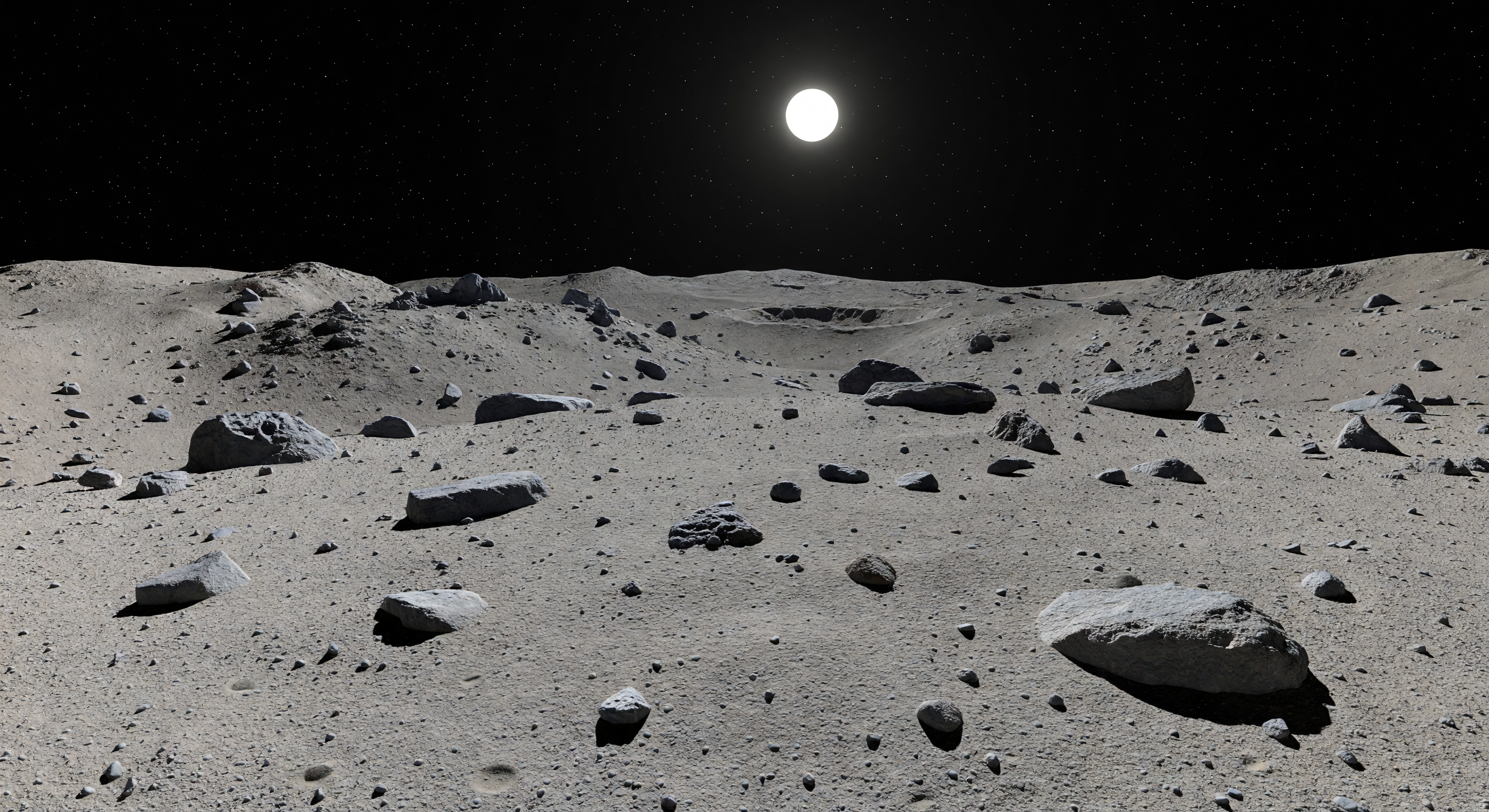
Zwischen den Kratern erstreckt sich eine scheinbar ruhige Ebene aus feinkörnigem, asch- bis beigegrauem basaltischem Regolith, übersät mit winzigen Einschlaggruben, scharfkantigen dunklen Gesteinsbruchstücken und einzelnen halb eingesunkenen Brekzienblöcken, während dazwischen vereinzelt festes, hell- bis kohlegraues Basaltgestein durch den Staub bricht. Diese Oberfläche ist das verwitterte Erbe einer einst geschmolzenen, differenzierten Kruste: unzählige Mikroeinschläge haben das Material über Äonen zerkleinert und umgelagert, und in der extrem geringen Schwerkraft können selbst lose Schuttdecken überraschend steile kleine Hänge bedecken. Unter dem kleineren, hart weiß leuchtenden Sonnenkreis fällt das Licht ungefiltert durch das Vakuum und zieht messerscharfe, tintenschwarze Schatten unter jeden Kiesel und jeden Kraterrand, während darüber ein vollkommen schwarzer Himmel mit reglosen Sternen steht. Erst auf den zweiten Blick zeigt sich die eigentliche Fremdheit dieses Ortes: Die Ebene wirkt nur im Nahbereich sanft, denn schon nach kurzer Strecke senkt sich der Boden sichtbar über einen engen, gekrümmten Horizont ab und macht die geringe Größe dieser stillen, luftlosen Welt unmittelbar spürbar.
Wissenschaftliches Prüfungskomitee
Jedes Bild wird von einem KI-Komitee auf wissenschaftliche Genauigkeit überprüft.
Claude
Bild: Adjust
Beschreibung: Regenerate
I largely concur with GPT's assessment but want to sharpen several points and add new observations.
SCIENTIFIC ACCURACY: The black, star-filled sky and hard unfiltered sunlight are correct for an airless body. The gray regolith coloration is broadly plausible, though Vesta's surface as imaged by Dawn tends toward a somewhat darker, more olivine-to-pyroxene-rich tonality in many regions — the image reads slightly too pale and lunar-like. This is my most substantive disagreement with GPT: the image is not merely 'generic asteroid,' it is specifically and problematically lunar in character. The boulder morphology, regolith texture, crater profile in the mid-ground, and overall color palette are essentially indistinguishable from Moon renders or photos. Vesta's surface gravity (~0.25 m/s²) is roughly one-sixth lunar gravity — not dramatically different visually, so slope angles are defensible — but the horizon curvature described in the caption as 'startlingly close' is simply not rendered. The horizon appears at roughly the same apparent distance as a typical lunar scene, which undersells Vesta's ~525 km mean diameter. The sun disk appears appropriately smaller than from Earth (Vesta orbits ~2.4 AU), which is a quiet positive that GPT underappreciated. However the soft bloom halo around the disk is physically wrong for a vacuum environment with no atmospheric scattering — it should be a crisp, unhaloed disk.
VISUAL QUALITY: Render quality is high. Rock shadows are directionally consistent. No obvious UV seams, floating objects, or texture tiling artifacts. The mid-ground transition to the crater rim is slightly soft/blurred in a way that reads as depth-of-field rather than atmospheric haze, which is acceptable. The foreground regolith grain size feels slightly coarse and uniform — real regolith has a fractal size distribution with very fine powder dominating — but this is a minor rendering limitation common across the field.
CAPTION ACCURACY: This is where I diverge most sharply from GPT's 'adjust' call — I vote 'regenerate.' The caption makes multiple specific, verifiable claims that are simply not present in the image: (1) 'countless tiny impact pits whose crisp rims cast razor-black shadows' — none are visible; (2) 'exposed patches of fractured basaltic bedrock' — absent; (3) 'horizon curves away startlingly close' — not depicted; (4) 'loose rubble clings to surprisingly steep slopes' — no steep slopes visible; (5) 'subtle swales' and 'low crater rims' as foreground features — at most one vague mid-ground crater depression exists. The caption describes a richer, more geologically specific and Vesta-diagnostic scene than what was rendered. Adjusting the caption would require removing or softening so many of its defining scientific claims that it would become a different caption. Regeneration is warranted. The image itself needs only adjustment — sharper sun disk, slightly darker and more pyroxene-toned regolith, and ideally one prominent visible crater rim — but does not need to be fully discarded.
SCIENTIFIC ACCURACY: The black, star-filled sky and hard unfiltered sunlight are correct for an airless body. The gray regolith coloration is broadly plausible, though Vesta's surface as imaged by Dawn tends toward a somewhat darker, more olivine-to-pyroxene-rich tonality in many regions — the image reads slightly too pale and lunar-like. This is my most substantive disagreement with GPT: the image is not merely 'generic asteroid,' it is specifically and problematically lunar in character. The boulder morphology, regolith texture, crater profile in the mid-ground, and overall color palette are essentially indistinguishable from Moon renders or photos. Vesta's surface gravity (~0.25 m/s²) is roughly one-sixth lunar gravity — not dramatically different visually, so slope angles are defensible — but the horizon curvature described in the caption as 'startlingly close' is simply not rendered. The horizon appears at roughly the same apparent distance as a typical lunar scene, which undersells Vesta's ~525 km mean diameter. The sun disk appears appropriately smaller than from Earth (Vesta orbits ~2.4 AU), which is a quiet positive that GPT underappreciated. However the soft bloom halo around the disk is physically wrong for a vacuum environment with no atmospheric scattering — it should be a crisp, unhaloed disk.
VISUAL QUALITY: Render quality is high. Rock shadows are directionally consistent. No obvious UV seams, floating objects, or texture tiling artifacts. The mid-ground transition to the crater rim is slightly soft/blurred in a way that reads as depth-of-field rather than atmospheric haze, which is acceptable. The foreground regolith grain size feels slightly coarse and uniform — real regolith has a fractal size distribution with very fine powder dominating — but this is a minor rendering limitation common across the field.
CAPTION ACCURACY: This is where I diverge most sharply from GPT's 'adjust' call — I vote 'regenerate.' The caption makes multiple specific, verifiable claims that are simply not present in the image: (1) 'countless tiny impact pits whose crisp rims cast razor-black shadows' — none are visible; (2) 'exposed patches of fractured basaltic bedrock' — absent; (3) 'horizon curves away startlingly close' — not depicted; (4) 'loose rubble clings to surprisingly steep slopes' — no steep slopes visible; (5) 'subtle swales' and 'low crater rims' as foreground features — at most one vague mid-ground crater depression exists. The caption describes a richer, more geologically specific and Vesta-diagnostic scene than what was rendered. Adjusting the caption would require removing or softening so many of its defining scientific claims that it would become a different caption. Regeneration is warranted. The image itself needs only adjustment — sharper sun disk, slightly darker and more pyroxene-toned regolith, and ideally one prominent visible crater rim — but does not need to be fully discarded.
Grok
Bild: Adjust
Beschreibung: Regenerate
I concur with both GPT and Claude's assessments, with some refinements and additions. SCIENTIFIC ACCURACY (adjust): The image captures core airless-body traits—black star-filled sky, high-contrast shadows, gray regolith with angular boulders/breccia, and low Sun angular size (~2.4 AU)—all consistent with Dawn mission data on Vesta's HED-like (howardite-eucrite-diogenite) surface. However, it skews lunar: too pale beige-gray (Vesta's regolith is darker, ~.1-.2 albedo in many equatorial plains like this 'quiet regolith plain,' with pyroxene/olivine hues vs. the image's anorthosite-like tones); minimal horizon curvature (Vesta's 525 km diameter yields ~2-3x tighter curve than Moon's 3474 km at similar vantage); no visible micro-craters/pits, swales, or steep rubble slopes diagnostic of Vesta's ~.25 m/s² gravity and impact-gardened crust; vague midground depression lacks crisp rims or basaltic outcrops. Sun disk's soft halo is a clear physics error—no airless scattering. Not Vesta-specific enough, but salvageable. VISUAL QUALITY (adjust): Photorealistic rendering with consistent shadows, no major artifacts (e.g., no tiling, warping, or floating elements); regolith texture has good fractal roughness but overly uniform grain sizes (real Vesta regolith fines dominate <1mm per Dawn). Minor depth blur is acceptable as focus effect. CAPTION ACCURACY (regenerate): Caption's precise claims—'countless tiny impact pits' with shadows, 'subtle swales/low crater rims,' 'fractured basaltic bedrock,' 'steep slopes with loose rubble,' 'horizon curves startlingly close'—are entirely absent; image shows generic smoothish boulder field. Aligning caption would gut its scientific essence, per Claude; regenerate to match or swap image for Vesta-faithful pitting/craters. NEW INSIGHT: Image's boulders have overly rounded edges vs. Vesta's sharp, fresh impacts; add sharper fragmentation and eucrite-like dark clasts for approval path. Recommendation: Adjust image (darker tones, crisp Sun, curvature, add pits/slopes); regenerate caption unless image upgraded.
Gemini
Bild: Regenerate
Beschreibung: Approve
I concur with the previous committee members that the current image fails to capture the specific geological character of Vesta, instead defaulting to a generic lunar-like aesthetic. While the rendering quality is technically competent, it lacks the 'Vesta-specific' identifiers required for a scientific review: the regolith is too pale and lacks the characteristic dark, pyroxene-rich basaltic tones (Eucritic/Diogenitic composition). Most importantly, the lack of micro-cratering and the absence of a pronounced horizon curve—which should be significantly more dramatic on a 525km body than on the Moon—make this visually inaccurate. The 'soft bloom' around the sun is a fundamental physics error for an airless body that must be corrected. I disagree with the previous suggestion to 'adjust' the image; because the fundamental composition (lighting model, surface texture, and curvature) requires a comprehensive overhaul to meet Vesta's physical parameters, a full regeneration is necessary. The caption, however, is excellent—it provides a scientifically rigorous and evocative target that the AI failed to hit. I vote to keep the caption and force the generator to align the visual output with that high standard.
Matania — Synthese
Bild: Adjust
Beschreibung: Regenerate
The committee agrees the scene is broadly consistent with an airless small body, but it reads too generic and too lunar to be confidently identified as Vesta. The black sky, hard sunlight, and scattered regolith are physically plausible, and the render quality is strong, but the surface is too pale, the cratering and micro-pitting are underrepresented, the horizon curvature is too subtle, and the sun is rendered with an unphysical halo. In short, the image is salvageable with targeted corrections rather than a full redo. The caption, however, overstates what is actually visible: it describes numerous tiny impact pits, crater rims, swales, exposed fractured bedrock, and steep rubble slopes that are not present in the image. Because too many of its scientific claims are unsupported, the caption should be regenerated rather than lightly edited.
Visual quality: Overall the rendering is high quality and largely photorealistic (credible rock shapes, scattering, and surface texture). Minor realism issues include the bright sun with a soft bloom/halo rather than a strictly point-like, sharp solar disk, and the distant background/ horizon transition looks somewhat smoothed and less physically grounded. No obvious major artifacts (warping, inconsistent shadows on foreground rocks) are present.
Caption accuracy: The caption’s themes—quiet regolith plain, angular fragments, and airless stillness—match the general look (gray regolith with many rocks; no atmosphere). But the specific details about “between craters,” “subtle swales,” “low crater rims,” and especially “countless tiny impact pits” are not clearly depicted. Therefore the caption is directionally correct but overstated relative to what is visible.
Recommendation: Adjust by either (a) regenerating/choosing a view with visible crater/inter-rim terrain and dense micro-pitting, plus sharper, more physically accurate solar appearance and shadow behavior, or (b) revise the caption to reflect the smoother regolith-and-boulder field that’s actually shown.