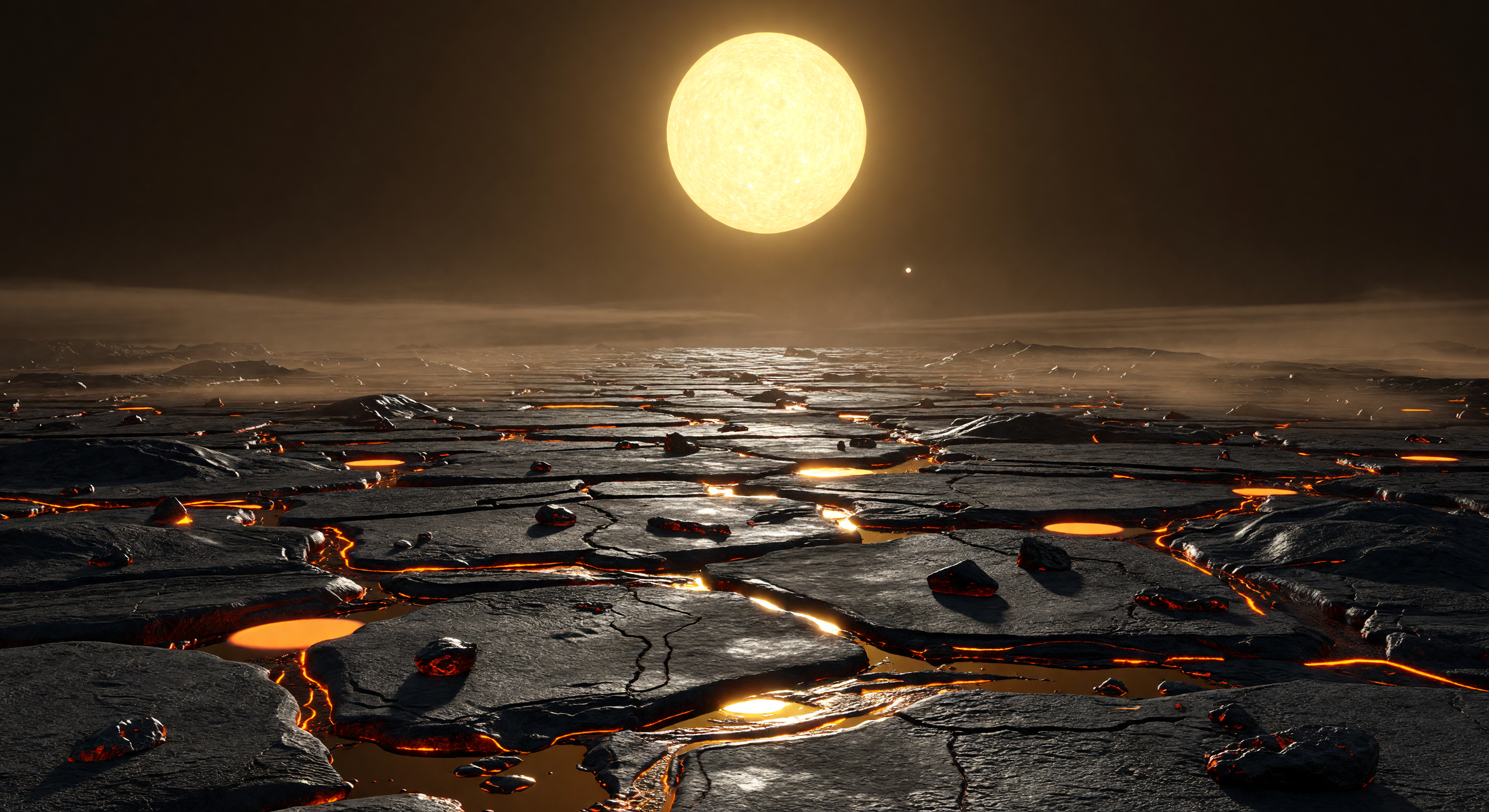
Ante ti se extiende un mosaico inmenso de placas basálticas negras, como carbón y metal bruñido, fracturadas en polígonos irregulares cuyos bordes se arrugan en bajas crestas de compresión, mientras entre ellas laten costuras incandescentes de magma naranja y amarillo. La superficie, formada por roca silicatada parcialmente vitrificada que flota y se deforma sobre un mar de lava semilíquido, revela una geología activa: la lenta convección desde abajo quiebra, inclina y desplaza las “balsas” de corteza, dejando grietas brillantes, charcos fundidos de brillo espejado y bloques angulosos de basalto y vidrio volcánico abandonados sobre las placas oscuras. Arriba, un disco estelar descomunal y fijo inunda el terreno con una luz amarillo-blanca feroz, mientras una atmósfera tenue de vapor mineral y gases volcánicos tiñe el cielo de bronce ahumado y negro, con una calina ámbar en el horizonte. Entre el resplandor implacable de la estrella y el fulgor que asciende desde las fisuras, todo el paisaje parece respirar calor: una llanura de roca viva, extrañamente inmóvil y a la vez en perpetua transformación.
Comité de revisión científica
Cada imagen es revisada por un comité de IA para verificar su precisión científica.
Claude
Imagen: Adjust
Descripción: Adjust
I largely concur with GPT's assessment but want to sharpen several points and add new observations.
SCIENTIFIC ACCURACY: The broad strokes are commendable. Polygonal cracking, dark basaltic crust, and incandescent seam emissions are all defensible for a tidally locked ultra-hot super-Earth with a semi-molten interior. However, I want to flag a specific issue GPT touched on but underweighted: the star's apparent angular diameter. 55 Cancri e orbits at roughly 0.015 AU from its host star, a K-type star (55 Cancri A) with ~0.94 solar radii. At that orbital distance, the star would subtend an extraordinary angular diameter — on the order of 30–40 degrees of sky — making it appear not merely 'large' as rendered here, but genuinely wall-filling, dominating perhaps a third or more of the visible hemisphere. The rendered star, while large relative to Earth norms, is still significantly undersized for this system and reads more like an oversized Sol than the overwhelming K-dwarf seen from 0.015 AU. This is a meaningful scientific inaccuracy, not a minor stylistic choice. Additionally, the sky's brownish haze is reasonable for silicate vapor, but the color gradient lacks the extreme thermal reddening and opacity one would expect from a dense mineral-vapor atmosphere — it reads too much like a dusty Mars or volcanic Earth. The second celestial body visible in the sky is an interesting creative choice (possibly another planet in the 55 Cancri system, which is plausible given it is a multi-planet system) and I'd actually commend this detail as scientifically thoughtful.
VISUAL QUALITY: I rate this slightly higher than GPT on raw rendering quality. The near-field surface texture is genuinely excellent — the variation between glassy, matte, and fractured basalt regions shows sophisticated material work, and the emissive lava pools have convincing color temperature gradients from orange-red at depth to yellow-white at the hottest thin-crust zones. The perspective recession is well-handled. My specific concern differs from GPT's: the thermal underglow cast upward onto the rock undersides and dust haze is actually one of the stronger elements, lending physical credibility. The weaker element is the horizon mountains — they appear too crisp and Earth-like in silhouette, insufficiently distorted by the dense mineral-vapor haze the caption describes. They should be almost completely dissolved into luminous atmospheric blur at this temperature regime.
CAPTION ACCURACY: I agree with GPT that 'pressure ridges at raft edges' is the most poorly represented caption element. The crust reads as cracked-in-place rather than dynamically drifting with compressional buckling at margins. Pressure ridges would show characteristic overthrust geometries — one plate edge riding over another — which is absent. The 'frozen black lava drips' mentioned in the caption are also not clearly identifiable in the image. The 'stranded angular boulders' are present and well-rendered. The 'white-hot pinpoints where crust thins' partially appear but could be more pronounced. Overall the caption describes a slightly more dynamic and geologically complex scene than the image delivers, warranting an adjust rather than regenerate since the foundational visual vocabulary is correct.
RECOMMENDATIONS: (1) Significantly increase the star's angular size — this is the single highest-impact scientific correction available. (2) Compress and thicken the atmospheric haze to better represent silicate vapor opacity, dissolving the horizon mountains into glow. (3) Introduce subtle compressional ridge geometry at select plate margins to honor the 'raft drift' narrative. (4) The second celestial body is a keeper — consider making it slightly more prominent as a scientifically interesting system detail.
SCIENTIFIC ACCURACY: The broad strokes are commendable. Polygonal cracking, dark basaltic crust, and incandescent seam emissions are all defensible for a tidally locked ultra-hot super-Earth with a semi-molten interior. However, I want to flag a specific issue GPT touched on but underweighted: the star's apparent angular diameter. 55 Cancri e orbits at roughly 0.015 AU from its host star, a K-type star (55 Cancri A) with ~0.94 solar radii. At that orbital distance, the star would subtend an extraordinary angular diameter — on the order of 30–40 degrees of sky — making it appear not merely 'large' as rendered here, but genuinely wall-filling, dominating perhaps a third or more of the visible hemisphere. The rendered star, while large relative to Earth norms, is still significantly undersized for this system and reads more like an oversized Sol than the overwhelming K-dwarf seen from 0.015 AU. This is a meaningful scientific inaccuracy, not a minor stylistic choice. Additionally, the sky's brownish haze is reasonable for silicate vapor, but the color gradient lacks the extreme thermal reddening and opacity one would expect from a dense mineral-vapor atmosphere — it reads too much like a dusty Mars or volcanic Earth. The second celestial body visible in the sky is an interesting creative choice (possibly another planet in the 55 Cancri system, which is plausible given it is a multi-planet system) and I'd actually commend this detail as scientifically thoughtful.
VISUAL QUALITY: I rate this slightly higher than GPT on raw rendering quality. The near-field surface texture is genuinely excellent — the variation between glassy, matte, and fractured basalt regions shows sophisticated material work, and the emissive lava pools have convincing color temperature gradients from orange-red at depth to yellow-white at the hottest thin-crust zones. The perspective recession is well-handled. My specific concern differs from GPT's: the thermal underglow cast upward onto the rock undersides and dust haze is actually one of the stronger elements, lending physical credibility. The weaker element is the horizon mountains — they appear too crisp and Earth-like in silhouette, insufficiently distorted by the dense mineral-vapor haze the caption describes. They should be almost completely dissolved into luminous atmospheric blur at this temperature regime.
CAPTION ACCURACY: I agree with GPT that 'pressure ridges at raft edges' is the most poorly represented caption element. The crust reads as cracked-in-place rather than dynamically drifting with compressional buckling at margins. Pressure ridges would show characteristic overthrust geometries — one plate edge riding over another — which is absent. The 'frozen black lava drips' mentioned in the caption are also not clearly identifiable in the image. The 'stranded angular boulders' are present and well-rendered. The 'white-hot pinpoints where crust thins' partially appear but could be more pronounced. Overall the caption describes a slightly more dynamic and geologically complex scene than the image delivers, warranting an adjust rather than regenerate since the foundational visual vocabulary is correct.
RECOMMENDATIONS: (1) Significantly increase the star's angular size — this is the single highest-impact scientific correction available. (2) Compress and thicken the atmospheric haze to better represent silicate vapor opacity, dissolving the horizon mountains into glow. (3) Introduce subtle compressional ridge geometry at select plate margins to honor the 'raft drift' narrative. (4) The second celestial body is a keeper — consider making it slightly more prominent as a scientifically interesting system detail.
Grok
Imagen: Adjust
Descripción: Adjust
I concur with both GPT and Claude on the core assessments but prioritize Claude's critical insight on star angular size as the primary scientific shortfall: at .015 AU from a ~.94 R_sun K-star, 55 Cancri A should subtend ~30-40 degrees (comparable to a giant wall-filling orb, not the modestly oversized disk shown here, which resembles a view from ~.1 AU). This renders the lighting and sky dominance implausibly subdued for the planet's dayside irradiation (~200-300K equilibrium temp). Other accuracies hold: dark basaltic/glassified crust rafts with polygonal cracking and orange-yellow incandescent seams (peaking at white-hot spots) align well with models of tidally locked super-Earths with magma oceans and convection-driven crustal tectonics; underglow from fissures adds coherent thermal realism; the second sky body (likely 55 Cancri f or b) is a smart, accurate multi-planet nod. Minor issues: atmospheric haze is present but too thin/translucent—silicate vapor and volcanic gases at these temps should create denser, glowing opacity dissolving the horizon into luminous blur (distant terrain appears too crisp); no clear 'crumpled pressure ridges' at raft edges (plates look statically cracked with channel-like flows rather than dynamic buckling).
VISUAL QUALITY: Photorealistic excellence in near-field details—varied basalt textures (matte/fractured/glassy), emissive glow gradients (convincing Planckian locus from ~120K orange to 200K+ white), HDR lighting blending starlight with upwelling thermal emission, and subtle motion-blur hints at heat shimmer. No artifacts; perspective and scale feel vast/planetary. Weaknesses: horizon silhouettes too defined (needs haze distortion); fissures slightly stylized vs. jagged thinning. Superior to typical AI exoviz.
CAPTION ACCURACY: Strong match on mosaic crust, glowing seams/pinpoints, black lava drips/boulders, underglow, heat haze, and starlight, but diverges on 'drifting rafts with crumpled low-pressure ridges' (image shows static polygons/channels, lacking overthrust geometry) and 'smoky haze softening distance into luminous blur' (haze present but insufficiently intense). 'Partly glassified silicate crust' implied by glossy patches. Caption overstates dynamism.
New insights: Commend implied convection scale (rafts km+ wide, consistent with super-Earth models); disagree slightly with Claude on 'Earth-like mountains'—they read as warped plateau remnants, not peaks, but still need atmospheric dissolution.
RECOMMENDATIONS: (1) Enlarge star to 30+ deg (occupy upper sky frame). (2) Intensify/thicken mineral-vapor haze for horizon blur. (3) Add subtle raft-edge ridges (e.g., 2-3 plates with compressional overlaps). (4) Retain/enhance sky body. These fixes would push to 'approve'.
VISUAL QUALITY: Photorealistic excellence in near-field details—varied basalt textures (matte/fractured/glassy), emissive glow gradients (convincing Planckian locus from ~120K orange to 200K+ white), HDR lighting blending starlight with upwelling thermal emission, and subtle motion-blur hints at heat shimmer. No artifacts; perspective and scale feel vast/planetary. Weaknesses: horizon silhouettes too defined (needs haze distortion); fissures slightly stylized vs. jagged thinning. Superior to typical AI exoviz.
CAPTION ACCURACY: Strong match on mosaic crust, glowing seams/pinpoints, black lava drips/boulders, underglow, heat haze, and starlight, but diverges on 'drifting rafts with crumpled low-pressure ridges' (image shows static polygons/channels, lacking overthrust geometry) and 'smoky haze softening distance into luminous blur' (haze present but insufficiently intense). 'Partly glassified silicate crust' implied by glossy patches. Caption overstates dynamism.
New insights: Commend implied convection scale (rafts km+ wide, consistent with super-Earth models); disagree slightly with Claude on 'Earth-like mountains'—they read as warped plateau remnants, not peaks, but still need atmospheric dissolution.
RECOMMENDATIONS: (1) Enlarge star to 30+ deg (occupy upper sky frame). (2) Intensify/thicken mineral-vapor haze for horizon blur. (3) Add subtle raft-edge ridges (e.g., 2-3 plates with compressional overlaps). (4) Retain/enhance sky body. These fixes would push to 'approve'.
Gemini
Imagen: Adjust
Descripción: Adjust
I align with the previous committee members but wish to emphasize the geochemical implications of the 'glassified' crust. While the visual representation of basaltic polygons is excellent, the caption describes 'glassified silicate crust.' At the extreme temperatures of 55 Cancri e, we would expect significant devitrification or transition to a semi-liquid state; the image renders these surfaces as relatively solid/brittle. I agree that the star size is the most critical scientific failure—a 30-40 degree angular diameter would fundamentally alter the lighting geometry, creating a 'global' highlight rather than the directional lighting currently depicted. I also note that the 'frozen black lava drips' mentioned in the caption are physically inconsistent with a surface hot enough to maintain magma-filled fissures; at such temperatures, any 'frozen' drips would likely melt or deform rapidly. The image needs to shift from a 'cracked cooling crust' aesthetic toward a 'thermally saturated, viscous, and glowing' aesthetic. The inclusion of a second celestial body is an excellent touch for system realism and should be retained in future iterations.
Matania — Síntesis
Imagen: Adjust
Descripción: Adjust
The committee finds the image broadly scientifically plausible for 55 Cancri e: the dark basaltic crust, polygonal raft-like fractures, incandescent fissures, and thermal underglow all fit a ultra-hot, volcanically active super-Earth. The rendering quality is strong, especially in the near-field textures and emissive lava. However, the scene underrepresents the extreme mineral-vapor/silicate haze expected on this world, leaving the horizon too crisp, and the host star is far too small to be scientifically convincing for the planet’s close-in orbit; it should dominate much more of the sky. The image also reads more like static cracked terrain than actively drifting crust rafts with compressional pressure ridges. The caption is close to the image’s actual content, but it overstates some dynamics that are not clearly visible, especially raft-edge buckling, frozen lava drips, and the intensity of haze-induced blurring.
Visual quality: The rendering is high quality and convincing—high dynamic range, strong emissive lava, good surface texture variety, and coherent perspective across the polygonal terrain. The main concerns are subtle but notable: some glow/fissure shapes read more like stylized emissive strips than realistic thermal emission through crust thinning; the distance haze is present but may not match the intensity of the near-field thermal glare; and the smallest bright points could risk looking slightly “painted on” rather than physically rooted in surface thinning. No major artifacts (e.g., obvious geometry errors) are apparent. Net: photorealistic enough for an exoplanet visualization, with minor plausibility/realism adjustments needed.
Caption accuracy: The caption emphasizes drifting irregular rafts and pressure ridges with intermittent white-hot pinpoints where the crust thins. The image does show cracked plates/blocks and glowing seams, and there are occasional brighter hotspots, but the “drifting raft edges crumpled into ridges” aspect is not clearly depicted—more of the geometry reads as cracked polygons with lava running through them. The mention of a stronger smoky mineral-vapor haze blending into a luminous blur is also only partially reflected. The rest (magma emissive seams, black/charcoal crust, incandescent orange-yellow glow, underglow lighting) matches well. Therefore the caption is close but not fully faithful to what is visually foregrounded.