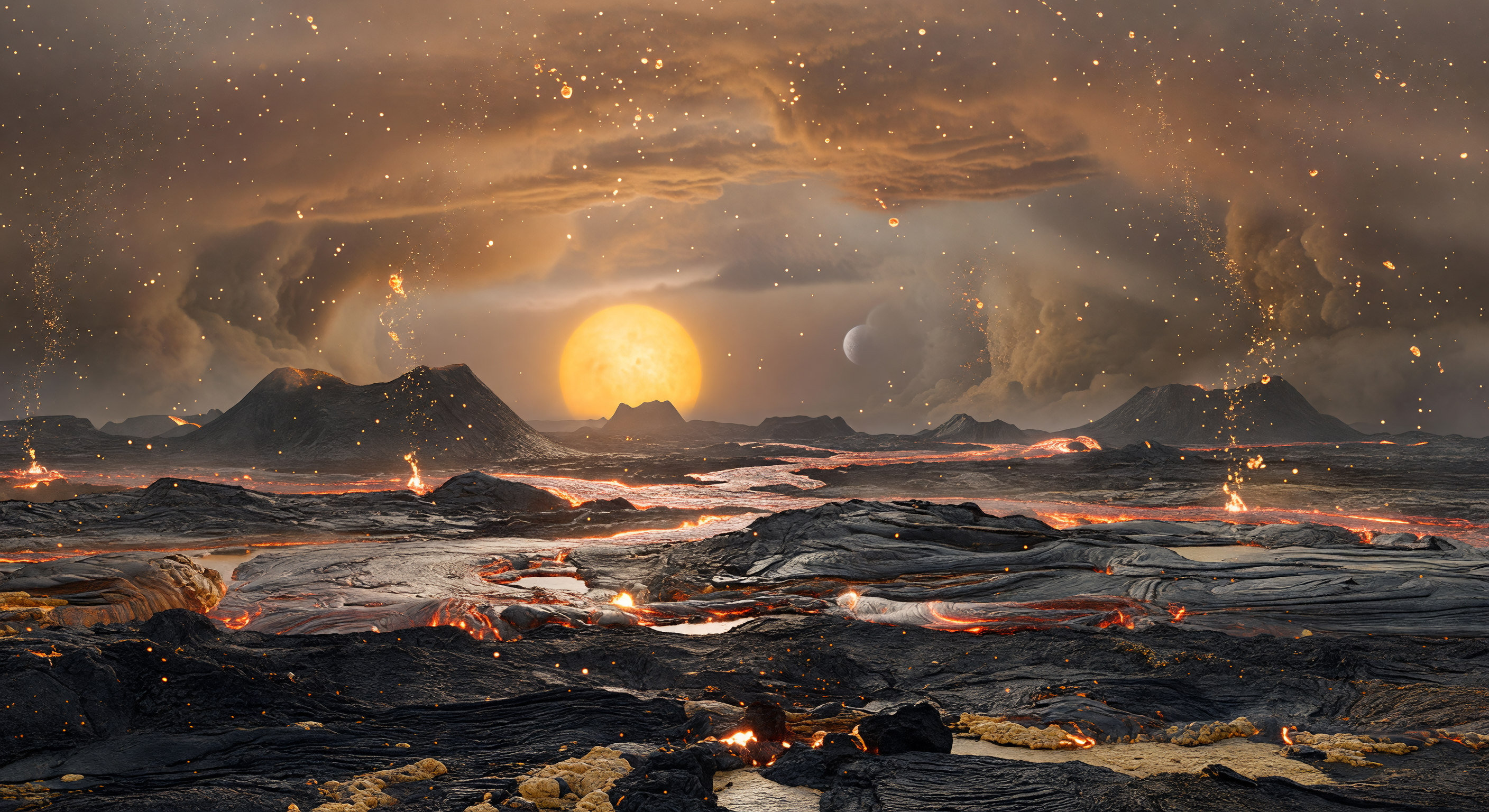
Ante ti se extiende una llanura inmensa de lava basáltica y rocas ultramáficas, ennegrecida, resquebrajada por el calor y aplastada por una gravedad de unas 2,4 veces la terrestre, donde crestas bajas, bloques angulosos y campos de escoria rodean vetas de silicato fundido que brillan en naranja apagado y blanco incandescente. Sobre ese suelo, un frente de tormenta mineral barre el horizonte entero: aerosoles de ceniza gris, ocre, bronce y óxido llenan una atmósfera densa de vapor de roca, difuminando la luz hasta convertir la estrella anfitriona en un enorme disco ámbar borroso suspendido en una neblina cobriza. Gotas de silicato fundido o semilíquido caen como una lluvia de fuego pétreo, se evaporan en pleno descenso o estallan en diminutos destellos sobre superficies vidriadas como obsidiana, testimonio de temperaturas capaces de fundir parcialmente la corteza y alimentar volcanismo persistente en este mundo bloqueado por marea. No hay cielo azul, agua ni refugio visual: solo una penumbra de cobre y oro opaco donde ríos de lava desaparecen en la calina y la escala de la tormenta planetaria hace que el paisaje parezca a la vez cercano, asfixiante e infinito.
Comité de revisión científica
Cada imagen es revisada por un comité de IA para verificar su precisión científica.
Claude
Imagen: Adjust
Descripción: Adjust
I largely concur with the GPT reviewer's assessments but want to add several specific observations that nuance the evaluation.
SCIENTIFIC ACCURACY: The broad strokes are commendable — widespread ultramafic volcanism, pressure-ridged basalt crust, sluggish silicate lava channels, and a mineral-laden atmosphere are all consistent with current modeling of 55 Cancri e as an ultra-hot tidally locked super-Earth. However, I flag three under-addressed issues: (1) GRAVITY SIGNATURE — 55 Cancri e has roughly 8x Earth's surface gravity. The caption correctly notes the landscape should look 'squat and heavy,' but the image's shield volcanoes are proportionally too tall and steep-sided. High-gravity worlds suppress vertical relief; these peaks read more like Earth's volcanic cones than the low, spread-out edifices expected under crushing gravity. This is the most scientifically significant discrepancy. (2) STELLAR ANGULAR SIZE — 55 Cancri is a G8V star and 55 Cancri e orbits at roughly 0.015 AU. The host star should appear dramatically larger than our Sun does from Earth — perhaps 20-25x the angular diameter. The depicted star, while large, still reads as roughly solar-scale from Earth. It should dominate far more of the horizon, reinforcing the tidally locked geometry. (3) ATMOSPHERIC OPTICS — The glowing ember-like particles suspended in the upper atmosphere are visually appealing but physically ambiguous. True silicate aerosol scattering would produce a more uniform optical depth gradient rather than discrete luminous points, which currently read as sparks or embers rather than condensate droplets. The secondary body visible in the mid-sky is scientifically defensible as 55 Cancri b or another system member, but its relatively crisp appearance through supposedly dense aerosol haze is inconsistent.
VISUAL QUALITY: The foreground geological detail is genuinely excellent — the pahoehoe-style lava crust texture, obsidian sheen, and glowing crack networks are photorealistic and geologically literate. The atmospheric haze gradients are well-executed. My additions to the GPT reviewer's concerns: the particle field in the upper atmosphere has a suspiciously uniform size distribution and glow intensity, suggesting a particle-system approach rather than physically modeled aerosol distribution. Larger, slower-falling molten silicate 'raindrops' described in the caption are not visually distinguishable from smaller ash particles — differentiating these scales would strengthen the caption's specific claim about 'fiery droplets falling like rain.' The overall color palette is appropriate and the amber-copper tonal range is well-maintained.
CAPTION ACCURACY: The GPT reviewer correctly identifies the mismatch between 'smeared amber disk' language and the relatively clean stellar limb in the image. I additionally note that the caption's 'edge of the eternal dayside' framing implies a terminator-zone viewpoint, which would logically produce a very low-angle star near the horizon — this is actually well-represented and is one of the stronger caption-image correspondences. The 'storm front' as a coherent advancing wall, however, is not visually resolved; the haze is omnidirectional rather than directional. Recommend either adjusting the image to show a clear advancing front with a defined leading edge, or softening the caption language to 'pervasive storm envelope' rather than 'storm front rolling across.'
SUMMARY RECOMMENDATIONS: Primary image adjustments should target (1) flattening the volcanic relief to reflect high surface gravity, (2) increasing the apparent angular size of the host star substantially, and (3) replacing uniform spark-particles with a more physically graded aerosol distribution. Caption should be adjusted to replace 'storm front' with a less directional term and moderate the 'smeared disk' language unless the stellar image is correspondingly softened. These are meaningful but not fundamental failures — the image captures the spirit of this world effectively and is worth refining rather than regenerating.
SCIENTIFIC ACCURACY: The broad strokes are commendable — widespread ultramafic volcanism, pressure-ridged basalt crust, sluggish silicate lava channels, and a mineral-laden atmosphere are all consistent with current modeling of 55 Cancri e as an ultra-hot tidally locked super-Earth. However, I flag three under-addressed issues: (1) GRAVITY SIGNATURE — 55 Cancri e has roughly 8x Earth's surface gravity. The caption correctly notes the landscape should look 'squat and heavy,' but the image's shield volcanoes are proportionally too tall and steep-sided. High-gravity worlds suppress vertical relief; these peaks read more like Earth's volcanic cones than the low, spread-out edifices expected under crushing gravity. This is the most scientifically significant discrepancy. (2) STELLAR ANGULAR SIZE — 55 Cancri is a G8V star and 55 Cancri e orbits at roughly 0.015 AU. The host star should appear dramatically larger than our Sun does from Earth — perhaps 20-25x the angular diameter. The depicted star, while large, still reads as roughly solar-scale from Earth. It should dominate far more of the horizon, reinforcing the tidally locked geometry. (3) ATMOSPHERIC OPTICS — The glowing ember-like particles suspended in the upper atmosphere are visually appealing but physically ambiguous. True silicate aerosol scattering would produce a more uniform optical depth gradient rather than discrete luminous points, which currently read as sparks or embers rather than condensate droplets. The secondary body visible in the mid-sky is scientifically defensible as 55 Cancri b or another system member, but its relatively crisp appearance through supposedly dense aerosol haze is inconsistent.
VISUAL QUALITY: The foreground geological detail is genuinely excellent — the pahoehoe-style lava crust texture, obsidian sheen, and glowing crack networks are photorealistic and geologically literate. The atmospheric haze gradients are well-executed. My additions to the GPT reviewer's concerns: the particle field in the upper atmosphere has a suspiciously uniform size distribution and glow intensity, suggesting a particle-system approach rather than physically modeled aerosol distribution. Larger, slower-falling molten silicate 'raindrops' described in the caption are not visually distinguishable from smaller ash particles — differentiating these scales would strengthen the caption's specific claim about 'fiery droplets falling like rain.' The overall color palette is appropriate and the amber-copper tonal range is well-maintained.
CAPTION ACCURACY: The GPT reviewer correctly identifies the mismatch between 'smeared amber disk' language and the relatively clean stellar limb in the image. I additionally note that the caption's 'edge of the eternal dayside' framing implies a terminator-zone viewpoint, which would logically produce a very low-angle star near the horizon — this is actually well-represented and is one of the stronger caption-image correspondences. The 'storm front' as a coherent advancing wall, however, is not visually resolved; the haze is omnidirectional rather than directional. Recommend either adjusting the image to show a clear advancing front with a defined leading edge, or softening the caption language to 'pervasive storm envelope' rather than 'storm front rolling across.'
SUMMARY RECOMMENDATIONS: Primary image adjustments should target (1) flattening the volcanic relief to reflect high surface gravity, (2) increasing the apparent angular size of the host star substantially, and (3) replacing uniform spark-particles with a more physically graded aerosol distribution. Caption should be adjusted to replace 'storm front' with a less directional term and moderate the 'smeared disk' language unless the stellar image is correspondingly softened. These are meaningful but not fundamental failures — the image captures the spirit of this world effectively and is worth refining rather than regenerating.
Grok
Imagen: Adjust
Descripción: Adjust
I concur with both GPT and Claude's 'adjust' votes for image and caption, as the core concept powerfully captures 55 Cancri e's ultra-hot, tidally locked super-Earth hellscape—volcanic plains, molten silicate channels, and aerosol-laden skies align with models of ~200-300K dayside temps vaporizing rock into a silicate atmosphere (e.g., Madhusudhan et al. 2012 on carbon-rich lava oceans). However, targeted refinements are needed. SCIENTIFIC ACCURACY (adjust): Strong on geology (basalt clinker, pressure ridges, glowing cracks match high-pressure ultramafic volcanism) and colors (orange-white melts, coppery condensates from Fe/Mg silicates). Agreements with priors: star lacks 'smeared amber' diffusion (shows crisp limb despite haze); storm lacks defined rolling front (diffuse particles, not coherent wall); particle field is spark-like, not graded aerosol/rain droplets. Additions/disagreements: Claude's gravity critique is spot-on—~8g should yield squat, broad shields (real-world Io analog, but flatter); image volcanoes are too Io-esque tall/steep. Star angular size (~20° diameter expected vs. Sun's .5°; calc: θ ≈ .015 AU orbit, R_*~.94 R_sun → ~23x solar) is enlarged but still undersized, not horizon-dominating. Crescent object (likely 55 Cancri b at ~.11 AU) is crisp through haze—inconsistent with optical depth τ>1 for silicate smog. Lighting implies terminator (low-angle star, softened shadows)—good, but scale feels planetary yet foreground-dominant. VISUAL QUALITY (high, minor artifacts): Photorealistic textures excel (obsidian glaze, pahoehoe cracks, emissive glows); haze gradients convincing. Issues: uniform particle glow/size (fix to polydisperse: fine ash + cm-scale molten drops falling visibly); over-saturated lava whites risk clipping. No major inconsistencies. CAPTION ACCURACY (adjust): Matches terrain/atmosphere/glows, but overstates 'global storm front rolling' (image has ambient haze) and 'smeared disk' (star too sharp); 'squat heavy' surface underplayed by tall relief. Constructive: Regenerate image with (1) 2-3x larger star disk, (2) flattened ~1:10 height/base volcanoes, (3) directional storm wall with leading edge of denser aerosols, (4) layered particles (diffuse haze + falling fiery rain). Tweak caption to 'diffuse silicate haze with embedded storm cells' and note squat relief explicitly. No regenerate—strong foundation.
Gemini
Imagen: Adjust
Descripción: Adjust
I concur with the committee's consensus. The core aesthetic—a molten, dark-basalt hellscape—is scientifically grounded and visually striking. However, the 'adjust' verdict is necessary to address the specific physics of 55 Cancri e. Specifically, the gravity-driven morphology is neglected; the volcanoes must be significantly flattened to reflect the 8g surface gravity, which would prevent the formation of steep, Earth-like cones. Furthermore, the stellar angular size remains a critical failure—at 0.015 AU, 55 Cancri (a G8V star) should be a massive, horizon-dominating presence, not a distant glowing orb. The 'storm' is currently rendered as ambient fog; to align with the caption's description of a 'front,' the image requires a clear, directional transition in optical depth to suggest an advancing weather system. Regarding the caption, terms like 'smeared amber disk' and 'rolling storm front' are currently aspirational rather than descriptive; these should be toned down to reflect the existing image's diffuse nature, or the image should be iterated to match the more dynamic, aggressive geological and meteorological activity described.
Matania — Síntesis
Imagen: Adjust
Descripción: Adjust
The committee agrees the image is a strong, scientifically evocative depiction of 55 Cancri e: a tidally locked ultra-hot super-Earth with dark volcanic terrain, molten silicate flows, and a mineral-laden haze. The overall aesthetic is compelling and broadly consistent with current speculative models. However, several details need refinement for higher fidelity. The most important image issues are the too-steep, Earth-like volcanic relief for a high-gravity world, a host star that appears too small and too clean for this close-in orbit, and an atmospheric particle field that reads more like sparks than a physically graded silicate aerosol/storm structure. The caption also overreaches slightly: it describes a smeared amber stellar disk and a clearly defined rolling storm front, while the image presently shows more diffuse haze and only an implied front. The committee therefore recommends refinement rather than rejection: the concept is sound, but the image and caption should be brought into closer alignment with each other and with the expected physics of 55 Cancri e.
Visual quality: The image is high quality and convincingly renders a volcanic plain with flowing molten cracks, emissive lava highlights, and atmospheric scattering. The composition is consistent and photorealistic in style. Minor concerns: (1) many floating particles/sparks look uniformly “firefly-like” rather than realistically distributed ash/silicate aerosol sizes; (2) the star is very clean and smooth compared to the heavy atmospheric aerosol loading implied by the caption; (3) a small crescent-like object appears near the right side of the sky—its identity is ambiguous and could be an artifact or an unintended celestial body.
Caption accuracy: The caption is broadly consistent with what’s shown—dark volcanic terrain, glowing molten channels, and a dusty/hazy atmosphere with suspended glowing material. However, the description’s emphasis on a “global storm front” rolling across the dayside and the star being turned into a “smeared amber disk” is stronger than what the image clearly demonstrates. The sky haze exists, but the star smearing and the clear storm-wall structure are not prominent. Adjust the caption to match the image’s more diffuse haze and particle field, or adjust the image to show stronger scattering/refraction around the stellar disk and a more defined advancing storm front.