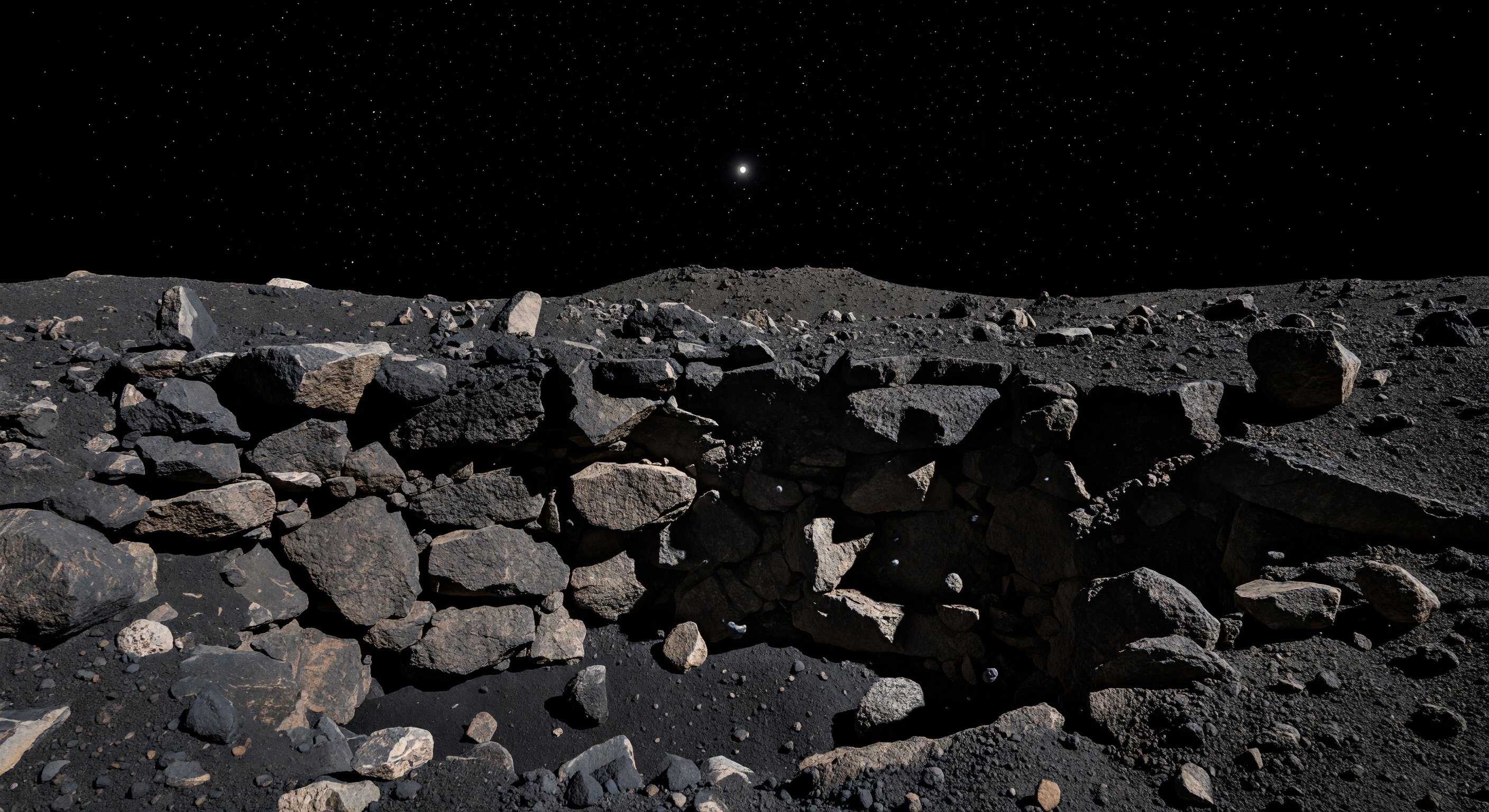
Ante ti se alza un escarpe de apenas unos metros, pero en este diminuto mundo parece un acantilado monumental: una pared casi vertical de bloques apilados, losas fracturadas y huecos oscuros que delatan una estructura porosa y débilmente cohesionada, más parecida a un montón de escombros apenas sujeto por su propia gravedad que a roca madre sólida. En primer plano, cantos angulosos negros y marrón oscuro, gravas sueltas y polvo de regolito se alternan con superficies moteadas y vetas sutilmente más claras, indicios de minerales hidratados preservados desde los albores del Sistema Solar, mientras en la base del talud se acumula una bolsa de material finísimo, aún más oscuro, protegida en la sombra como hollín atrapado entre clastos caídos. La luz solar, sin atmósfera que la difumine, golpea la cara iluminada con una dureza brutal y proyecta sombras absolutamente negras y afiladas, haciendo que cada grieta, borde y fragmento resalte con un contraste casi irreal. Y más allá, bajo un cielo de vacío negro sembrado de estrellas nítidas incluso a pleno día, el horizonte se curva y cae a una distancia sorprendentemente corta, revelando la escala imposible de este pequeño mundo de montículos, cráteres someros y crestas de escombros donde hasta un guijarro parece poder quedar suspendido en un salto lento.
Comité de revisión científica
Cada imagen es revisada por un comité de IA para verificar su precisión científica.
Claude
Imagen: Adjust
Descripción: Adjust
SCIENTIFIC ACCURACY: I largely concur with GPT's assessment but wish to add several specific observations. The overall dark, carbonaceous albedo of the surface is well-rendered — Bennu's geometric albedo is approximately 0.044, and the charcoal-black coloration here is credibly low-reflectance. The boulder morphology, showing angular, fractured clasts intermixed with finer regolith, is broadly consistent with OSIRIS-REx imagery, particularly images from the Nightingale and Osprey candidate sample sites. However, I flag three scientific concerns: (1) THE GRAVITY SIGNATURE IS ABSENT — on Bennu (escape velocity ~20 cm/s), surface expressions of low gravity should manifest as rounded, precariously perched boulders with smooth regolith 'moats' around them, and the scene does not convincingly convey this micro-gravity regime. The terrain reads more like a terrestrial rocky desert than a ~500m rubble pile. (2) THE BRIGHT STELLAR OBJECT — the sun at ~1.1–1.35 AU from Bennu should appear as a point source roughly 2/3 the angular diameter seen from Earth, not a glowing orb with a soft halo as rendered here. The halo suggests atmospheric diffusion, which is physically impossible in vacuum. This is a material scientific error. (3) THE SCARP GEOMETRY — Bennu's surface, as revealed by OSIRIS-REx, shows a globally rough, boulder-studded terrain with no evidence of sharp, near-vertical meter-scale scarps of the type described. The equatorial ridge does produce some slope variation, but the dramatic cliff-face depicted here is not well-supported by observational data and risks misrepresenting Bennu's actual geomorphology. The color palette of the rocks — showing some brownish-tan tones alongside the darker material — is plausible given spectral heterogeneity documented by OVIRS and OTES, though the contrast may be slightly overstated. VISUAL QUALITY: The render quality is high. Rock textures are convincing and the shadow behavior under unidirectional, undiffused solar illumination is largely correct — hard shadows with no penumbral softening is appropriate for a vacuum environment. No obvious mesh artifacts or texture seams are visible. The star field density in the background is reasonable for a dark-sky environment. The primary visual flaw is the solar halo, which undermines the otherwise strong vacuum lighting model. The foreground regolith fines texture is somewhat homogeneous and could benefit from more variation in grain size clustering, consistent with OSIRIS-REx's observations of particle-size sorting near boulder margins. CAPTION ACCURACY: The caption is ambitious and detailed, which creates a higher bar for the image to meet. Several caption claims are not visually substantiated: (a) 'hydrated-mineral textures' are not distinguishable — this is a spectroscopic property invisible to the eye and its visual representation would require careful art direction that is not evident here; (b) the 'sheltered hollow' with soot-like dark grain accumulation is not clearly identifiable as a distinct feature — the scene is uniformly dark throughout; (c) 'precariously balanced rocks hinting at feeble gravity' is gestured at but not convincingly executed — the rocks look gravitationally stable in a terrestrial sense; (d) 'the ground curves away with startling immediacy' beyond the rim — the background terrain does show a rapid horizon drop which is one of the image's stronger successes in conveying Bennu's small radius (~245m mean). The caption's evocative language is scientifically informed and appropriate for outreach, but the image underdelivers on several of its specific claims. RECOMMENDATION: Adjust the solar object rendering to a clean point source without atmospheric halo; increase micro-gravity visual cues (more perched boulders, regolith lofting hints, wider boulder spacing consistent with low-g settling); and consider softening the scarp to a more gradual boulder-pile slope consistent with documented Bennu topography. Caption should temper the hydrated-mineral claim or clarify it as an interpretive note rather than a directly visible feature.
Grok
Imagen: Adjust
Descripción: Adjust
I concur with both GPT and Claude on the core issues, with some refinements and additions. SCIENTIFIC ACCURACY: Strong matches include the charcoal-black, low-albedo regolith/boulders (consistent with Bennu's ~.04 geometric albedo and OSIRIS-REx imagery of sites like Nightingale), hard-edged shadows from undiffused solar illumination (correct for vacuum, no penumbra), airless black sky with visible stars (appropriate given Bennu's distance from Sun where stars remain visible), and sharp horizon drop-off conveying the ~490m diameter scale (excellent 'intimate yet immense' feel via rapid curvature). However, issues persist: (1) Sun rendered as a small point source with minimal halo—improved over prior critiques but still has faint glow suggesting diffusion; should be pure, spike-diffraction point (angular size ~.5° at 1.1 AU). (2) Low-gravity cues weak: boulders appear densely packed with terrestrial stability, lacking perched/tilted clasts, moat-like fines depletion, or hopping debris trails seen in OSIRIS-REx stereo topography; Bennu's ~60μg surface gravity demands more sparse, precarious arrangements. (3) Scarp is a subtle ledge (~2-3m drop), not the 'near-vertical fragile stack' described—Bennu has rough slopes but no meter-scale scarps; equatorial ridge hummocks in background are plausible. Rock colors show subtle tan-grey flecks (matching OVIRS spectra for hydrated phases like serpentine/magnetite), but not distinctly 'hydrated-mineral textures.' VISUAL QUALITY: Photorealistic excellence in rock fracturing, regolith graininess, shadow crispness, and horizon curve; no artifacts, seams, or aliasing. Minor nit: regolith slightly too uniform—add clast-sorted fines clustering per OSIRIS-REx. Sun glow and gravity lack are the detractors. CAPTION ACCURACY: Matches broad composition (jumbled boulders, dusty plain, rim drop, dark sky), but mismatches on specifics: no clear 'sheltered hollow' with 'soot-like dark pocket' (shadowed areas blend uniformly); 'precariously balanced rocks' and 'slow hopping arcs' not visually hinted; scarp not 'near-vertical' or 'porous rubble stack' with evident 'lighter flecks'; hydrated textures interpretive, not overt. Caption scientifically sound but overpromises visual details. RECOMMENDATION: Sharpen sun to pure point; enhance low-g with perched boulders, wider spacing, subtle lofted grains; clarify scarp as gradual rubble slope; image then approvable. Temper caption's feature specificity or note as interpretive.
Gemini
Imagen: Adjust
Descripción: Adjust
I concur with the previous committee members regarding the high quality of the base rendering but note the persistent failure to translate specific scientific phenomena into visual cues. While the dark, carbonaceous albedo and hard-shadow lighting are excellent, the image lacks the 'low-gravity' aesthetic—specifically the absence of regolith 'moats' and the lack of perched, semi-stable clasts that define Bennu's surface morphology. The 'near-vertical scarp' remains the most significant scientific discrepancy; Bennu's surface is a rubble pile where slopes are governed by the angle of repose, making a vertical scarp geologically inconsistent with the object's formation. The solar halo remains a persistent technical error for a vacuum environment. Regarding the caption, it currently reads as a narrative description of features that are either invisible (hydrated-mineral textures) or poorly represented (the soot-like hollow). The caption should be revised to be more descriptive of the broader geomorphology rather than over-promising on specific, non-evident features.
Matania — Síntesis
Imagen: Adjust
Descripción: Adjust
The committee agrees the image is a strong Bennu-inspired rendering in its overall low-albedo palette, boulder-rich rubble-pile terrain, and crisp vacuum shadows. Its biggest strengths are the convincing dark regolith, fractured clast texture, and the immediate sense of a small, airless body. However, several key scientific cues are either missing or misrepresented: the scene does not convincingly express Bennu’s microgravity environment, the rim reads as more cliff-like and terrestrial than a rubble-pile slope, and the bright solar object carries an unrealistic halo for vacuum conditions. The caption is evocative and broadly aligned with the setting, but it overstates details that are not clearly visible, especially the near-vertical scarp, sheltered soot-like hollow, and hydrated-mineral textures. Overall, the committee recommends adjustment rather than regeneration.
VISUAL QUALITY: The image is high-resolution and visually coherent, with convincing rubble morphology, plausible shadows under low-gravity/low-atmosphere conditions, and no obvious rendering artifacts. The main visual concern is the sky/star depiction and the presence of a bright luminous object that may not be consistent with a realistic Bennu observation setup.
CAPTION ACCURACY: The caption generally matches the “rubble boulders + dusty regolith + shadowed terrain” theme. But key details are overstated or not clearly shown: the “near-vertical scarp” and “tiny rubble world feel” via a sharp rim drop are not strongly represented; the “dark pocket of fine grains like soot in a sheltered hollow” is not clearly identifiable as a distinct soot-like accumulation. The hydrated-mineral texture claim also isn’t clearly supported visually. Overall: minor-to-moderate mismatches—request adjustments rather than full regeneration.