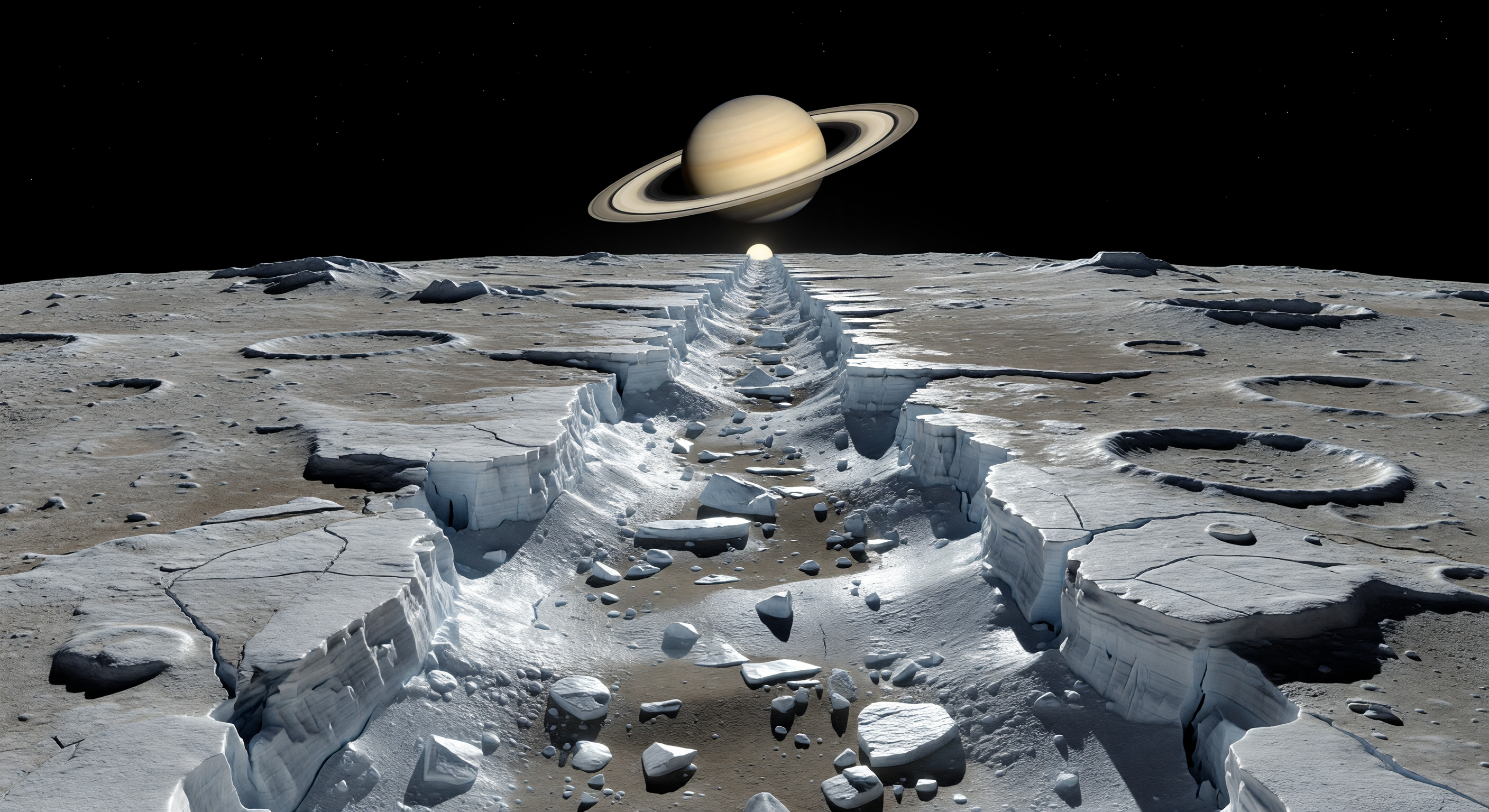
Ante ti se abre una llanura antigua de roca de agua helada, cortada por un graben asombrosamente recto que se hunde hacia un suelo caótico cubierto de bloques angulosos, derrubios y escarcha fracturada. Los escarpes de falla, altos y segmentados, brillan con un blanco azulado bajo la luz rasante de un Sol pequeño y lejano, mientras las sombras negras y nítidas delatan un vacío casi absoluto y la ausencia de atmósfera. Estas formas lineales son la huella de una litosfera helada y frágil que se rompió por extensión tectónica, dejando bancadas de falla, fisuras cruzadas y taludes de derrumbe sobre un terreno salpicado por cráteres antiguos y material oscuro no helado mezclado por impactos. En la baja gravedad, los relieves se conservan abruptos y exagerados, el horizonte se curva sorprendentemente cerca, y sobre el cielo negro se alza el gigante anillado, inmenso y silencioso, haciendo que el paisaje parezca a la vez geológicamente preciso y profundamente ajeno.
Comité de revisión científica
Cada imagen es revisada por un comité de IA para verificar su precisión científica.
GPT
Imagen: Adjust
Descripción: Adjust
Scientific accuracy: The scene shows bright water-ice bedrock with steep, segmented fault-like scarps forming a trough/graben, plus angular boulders, fractured blocks, talus, and small pits—overall consistent with plausible tectonic/impact modification of Dione’s icy surface. Lighting is hard and low-Sun, producing strong shadows, which is broadly plausible for airless icy moons. However, the image includes a very large, distinct Saturn and very prominent rings in a way that can be visually accurate in concept, but the scale/placement relative to the horizon and the implied viewpoint geometry are not well constrained; it risks overstating “motionless Saturn looming enormous” as a physically believable framing. Also, Dione images/analogs often show more varied albedo textures (including wispy/lineated patterns and dark contaminants) rather than uniformly clean, bright ice across all scarps and floors; the description’s “bright, clean ice” is mostly met, but the darker non-ice material is minimal compared with what the caption implies should be lightly dusted and churned up. Visual quality: The image is high-resolution, coherent, and largely photorealistic in terms of ice texture, rock shapes, and crater/talus morphology. Shadows are consistent with a single light direction. Minor concerns: the horizon curvature/“close-curving horizon” feel is somewhat exaggerated by the wide framing, and some fault segmentation/ledge geometry looks slightly more idealized than natural fracturing. Saturn/rings rendering is stylized relative to the ground lighting/scale, suggesting a compositor/artist-driven element rather than a physically matched perspective. Caption accuracy: The caption matches the core geology (faulted trough/graben with steep segmented scarps, angular ice boulders, frost-shattered blocks, talus, pits) and the overall lighting concept. But it over-specifies details not clearly supported by the image, particularly the extent of darker non-ice contaminants (“lightly dusted with darker non-ice contaminants churned up by impacts”)—the surface appears mostly uniformly bright ice with only subtle darkening. The Saturn/rings description also may not correspond precisely to realistic relative scale/placement. Recommendation: Keep the graben/trough and icy fault scarps, but soften claims about contaminant dusting and adjust Saturn/rings scale/geometry to be more physically grounded.
Claude
Imagen: Adjust
Descripción: Adjust
I largely concur with GPT's assessment but want to add several specific observations. On scientific accuracy: the graben morphology is the strongest element—the parallel fault scarps with angular ice blocks, talus accumulation on the trough floor, and relatively flat surrounding plains are consistent with Dione's extensional tectonics as observed by Cassini. The 'bright, clean ice' on scarp faces is actually defensible: freshly exposed fault scarps on icy moons do show higher albedo than surrounding terrain due to excavation of less-contaminated subsurface ice, consistent with Cassini ISS data. However, I disagree slightly with GPT on this point—the image may actually be *too* uniformly bright across the entire scene, including the flat plains, whereas Dione's plains show more varied albedo with the characteristic wispy terrain (bright lineaments on darker substrate) that is one of the moon's defining surface features. This is a meaningful omission. The horizon curvature appears plausible given Dione's ~1,123 km diameter—the close horizon is appropriate and well-rendered. On Saturn: I want to be more critical than GPT here. Saturn's apparent size is problematic. From Dione at ~377,400 km orbital radius, Saturn subtends roughly 1.9–2.0 degrees of arc, which is large by Earth standards but would not appear as dramatically oversized as shown. The depicted Saturn fills perhaps 10–15 degrees of arc, which is a significant exaggeration. Additionally, the rings are shown nearly edge-on with a slight tilt, which is geometrically possible but the ring brightness and color saturation appear inconsistent with the hard, low-angle sunlight illuminating the foreground—the ring system should show more nuanced shadowing from Saturn's body and internal ring structure shadow bands. The sun appears as a bright point just at the horizon directly below Saturn, which is a nice compositional choice but creates an alignment that feels artificially staged. On visual quality: the image is technically impressive and largely photorealistic. Ice texture on the scarp faces is well-executed with appropriate fracture patterns. Shadow consistency is good. However, I note the graben floor appears slightly too flat and clean—in reality, cumulative impact gardening over billions of years would produce a more chaotic, regolith-covered floor with less pristine block faces. The transition between bright ice scarps and darker surrounding plains is also somewhat abrupt. On caption accuracy: the description is well-written and matches the primary geological features accurately. The 'frost-shattered blocks' and 'talus' are clearly visible. 'Small impact pits' are less distinct in the trough floor than implied. The claim about 'darker non-ice contaminants' is partially supported—there is some tonal variation—but the description implies more contamination heterogeneity than is visible. The phrase 'more active interior deep below' is scientifically speculative but not inaccurate given current hypotheses. Overall recommendation: adjust the image to reduce Saturn's apparent angular diameter to a more accurate scale, introduce some of Dione's characteristic wispy terrain albedo variations on the plains, and add slightly more regolith coverage to the trough floor. The caption should be adjusted to temper the contaminant dusting language and clarify Saturn's scale relationship.
Grok
Imagen: Adjust
Descripción: Adjust
I concur with both GPT and Claude on the core strengths: the graben morphology with steep, segmented ice scarps, talus piles, angular boulders, and small pits is photorealistic and scientifically plausible for Dione's extensional tectonics (e.g., similar to Padua Chasma observed by Cassini), and low-angle sunlight casting sharp shadows fits an airless body. The weak gravity preserving sharp relief and close-curving horizon (appropriate for ~1123 km diameter) are well-rendered. However, scientific accuracy needs adjustment: Saturn's apparent size is exaggerated (~10-15° vs realistic ~2° from Dione's orbit), and rings appear overly bright/saturated without proper shadowing from low Sun angle; the Sun-horizon-Saturn alignment feels contrived. Dione's plains lack characteristic wispy terrain (bright lineaments on darker substrate) and show insufficient albedo variation/dark contaminants, making the scene too uniformly bright/icy—real Dione has more heterogeneous regolith from impacts. Trough floor is too clean/flat, missing impact-gardened texture. Visual quality is high-resolution and coherent with excellent ice fracturing and shadow consistency, but minor artifacts include abrupt scarp-plain transitions and slightly idealized fault geometry. No major inconsistencies or blurriness. Caption accuracy: Matches geology, lighting, and horizon well ('faulted trough', 'steep scarps', 'boulders/talus/pits', 'razor-black shadows'), but overstates 'darker non-ice contaminants churned up by impacts' (image has only subtle gray tones, not clear dusting) and implies more visible small pits than shown. 'Looming enormous' Saturn fits the dramatic image but not precise scale. New insight: Image's trough walls show realistic cryo-fracturing, but boulders lack expected micrometeorite rounding—add subtle erosion. Recommendation: Scale down Saturn/rings accurately, add wispy patterns and regolith to plains/floor, enhance contaminant heterogeneity; tweak caption to match visible darkening and pit prominence.
Gemini
Imagen: Adjust
Descripción: Adjust
I concur with the previous committee members that the geological representation of the graben, talus, and fault scarps is excellent and aligns well with Cassini-era observations of Dione’s tectonic features. However, the image suffers from two primary scientific inconsistencies that necessitate an 'adjust' rating: first, the angular diameter of Saturn is significantly overstated; from Dione’s orbital distance, Saturn should appear roughly 2 degrees wide, whereas the image depicts it as a dominant, sky-filling feature. Second, the surface lacks the 'wispy terrain'—the characteristic bright, lineated albedo patterns—that defines Dione’s appearance, rendering the plains too monochromatic. Regarding the caption, it is evocative but scientifically over-promises on the visibility of 'darker non-ice contaminants' and the density of small impact pits, which are largely absent or indistinct in the current visual. I recommend reducing the scale of Saturn to be more physically accurate, adding subtle wispy albedo variations to the plains to ground the location on Dione specifically, and refining the caption to reflect the subtle nature of the surface contamination rather than implying a prominent dusting.
Matania — Síntesis
Imagen: Adjust
Descripción: Adjust
The committee found the scene broadly and impressively consistent with Dione’s icy tectonic landscape: the faulted trough/graben, steep segmented scarps, angular ice blocks, talus, and sharp low-Sun shadows are all scientifically plausible and visually strong. The main issues are not with the core geology but with contextual fidelity: Saturn is rendered far too large and visually dominant for Dione’s sky, the rings are somewhat overstated, and the surface is too uniformly clean and bright. Dione’s characteristic wispy terrain and more varied albedo/regolith texture are underrepresented, making the plains and trough floor feel overly pristine and idealized. The caption is also mostly accurate in its geologic description, but it overstates the visibility of darker non-ice contaminants and small pits, and it echoes the exaggerated Saturn scale too strongly. Overall: strong foundation, but several scientifically important details need refinement.