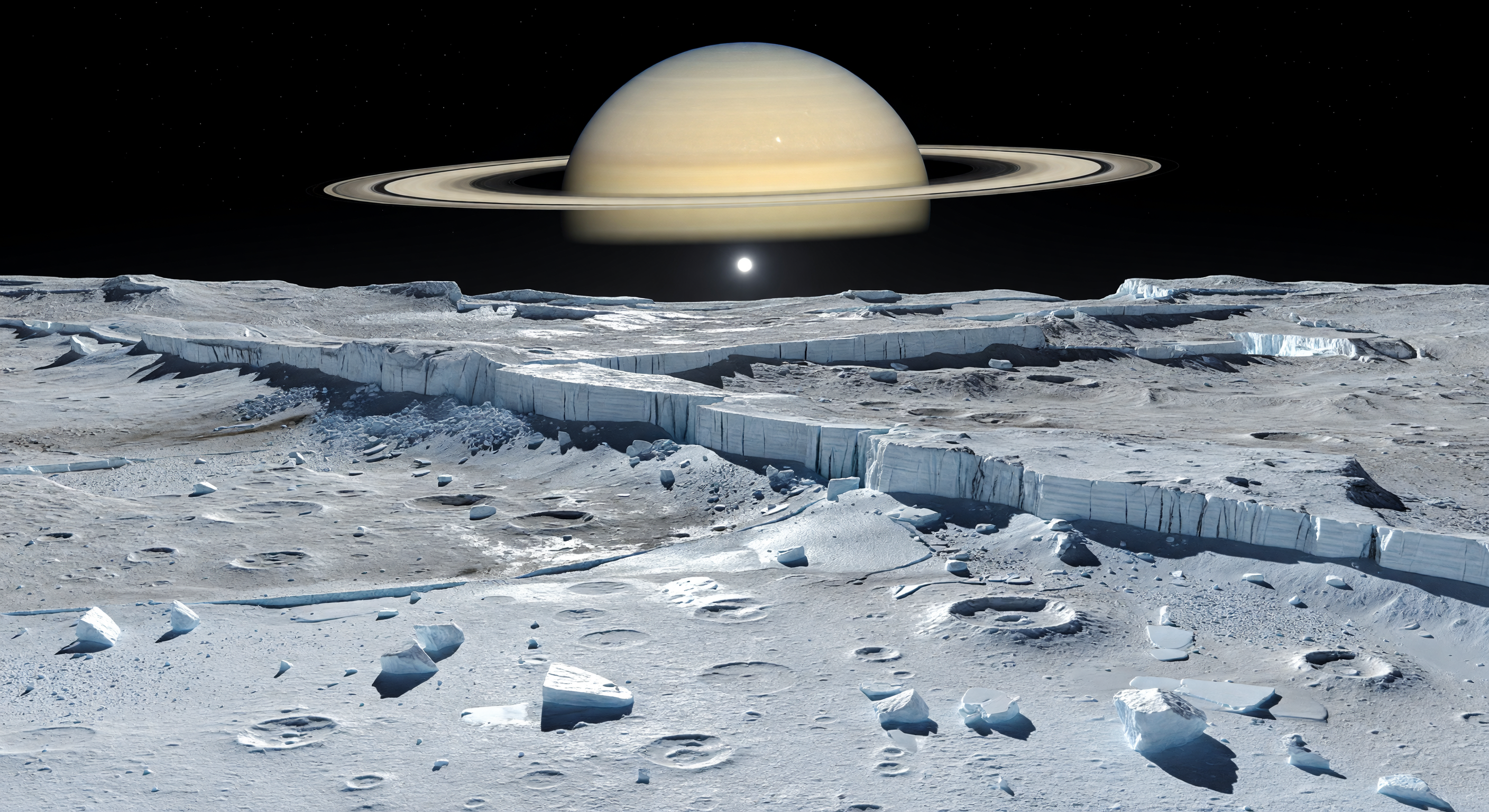
Bajo un cielo absolutamente negro, el terreno aparece como un desierto helado de brillo casi metálico: regolito de hielo de agua azul‑blanco, bloques angulosos y cantos cubiertos de escarcha se dispersan sobre llanuras grisáceas saturadas de cráteres antiguos y vetas más oscuras de material alterado por la radiación. Cruzando la escena en diagonal se alzan las célebres franjas “filamentosas”, que en realidad son enormes escarpes tectónicos y acantilados de falla donde la corteza se fracturó y dejó al descubierto hielo limpio y muy reflectante, testimonio de episodios de deformación y rejuvenecimiento de una superficie por lo demás muy vieja. La bajísima gravedad permite que los taludes sean abruptos y nítidos, y la ausencia práctica de atmósfera hace que cada borde, desde los mantos de eyección suavizados hasta las crestas lejanas, se recorte con una claridad implacable bajo un Sol diminuto que proyecta sombras duras. Suspendido casi inmóvil sobre el horizonte, el planeta gigante llena gran parte del firmamento con tonos crema y dorados y sus anillos afilados, añadiendo un tenue resplandor secundario a las caras en sombra y haciendo que uno sienta la inmensa escala y el silencio glacial de este mundo helado.
Comité de revisión científica
Cada imagen es revisada por un comité de IA para verificar su precisión científica.
Claude
Imagen: Adjust
Descripción: Adjust
SCIENTIFIC ACCURACY: I broadly agree with GPT's assessment but want to add sharper specifics. Dione's wispy terrains, as revealed by Cassini, are indeed networks of bright ice cliffs and chasmata (Padua Chasmata being the archetype), so the image's central fracture scarp running diagonally is actually one of the stronger elements here — it reads convincingly as an exposed clean-ice escarpment with talus at the base, consistent with the tectonic reinterpretation post-Cassini. Where the image underperforms scientifically: (1) Dione's surface gravity is ~0.232 m/s², extremely low, yet the talus blocks and cliff faces look Earth-scale steep without the rounded, softened morphology that low-gravity regolith gardening and sublimation processes would produce over billions of years — edges are too crisp everywhere simultaneously. (2) The foreground is too clean and homogeneous; Dione's leading hemisphere is notably darker with reddish-brown radiation-processed organics (radiolytic chemistry from magnetospheric particle bombardment), which is almost entirely absent here. The image skews heavily toward the bright trailing hemisphere aesthetic without committing to it. (3) Saturn's apparent angular diameter looks slightly oversized. From Dione at ~377,000 km orbital radius, Saturn subtends roughly 1.9–2.1 degrees, which is about 4x the apparent size of our Moon. The rendering appears closer to 5–6x lunar size, which is a meaningful exaggeration even for a dramatic composition. The rings' thinness and orientation look plausible for an oblique viewing angle, which is a point in the image's favor that GPT did not specifically credit. (4) The Sun appearing as a sharp brilliant point is scientifically appropriate — at 9.5 AU it subtends only ~0.05 degrees — and this is rendered well. Shadow directionality appears internally consistent. VISUAL QUALITY: The rendering quality is high. Texture work on the ice scarps is convincing, subsurface scattering on the ice blocks adds believability, and there are no obvious AI artifacts such as impossible geometry merges or texture seams. My one quality concern beyond what GPT noted is that the sky-to-ground transition at the horizon is slightly too clean/sharp — even an airless body would show some subtle limb-scattered starlight in a realistic deep-exposure render, and the complete blackness makes the composition feel slightly composited rather than fully integrated. CAPTION ACCURACY: The caption is well-researched and scientifically literate, particularly the correction about wisps being tectonic features rather than frost deposits — this reflects actual post-Voyager/Cassini scientific consensus and is commendable. However, GPT correctly identifies that 'thin smudges of darker radiation-processed material' are essentially invisible in the image, creating a caption-image mismatch. I would further flag that the phrase 'improbably sharp and steep' in the caption is doing rhetorical work to pre-empt the very gravitational inconsistency I noted above — it acknowledges the issue but frames it as a feature rather than a limitation. The deep subsurface ocean hypothesis mention is scientifically defensible (some models support it) but remains speculative and is not visually represented, which slightly overloads the caption with claims the image cannot substantiate. Recommend targeted adjustments to both image (surface albedo variation, scale calibration on Saturn) and caption (temper the radiation-processed material claim and ocean speculation, or note these as hypothetical).
Grok
Imagen: Adjust
Descripción: Adjust
I concur with both GPT and Claude on the core assessments, with some refinements and additions. SCIENTIFIC ACCURACY (image_vote: adjust): The diagonal bluish-white scarps and fractures convincingly evoke Dione's wispy terrains (e.g., Padua Chasmata), with exposed clean ice contrasting dimly cratered plains—strong match to Cassini imagery. Blocky talus and overlapping craters align with low-gravity (~.23 m/s²) icy regolith dynamics and resurfacing episodes. Black sky, hard solar shadows (Sun at ~.05° apparent size, correctly a point source), and Saturn's cream-tan globe with thin rings are appropriate for an airless world at ~377,000 km from Saturn (subtending ~2°). Disagreements/additions: Claude's Saturn size critique is overstated—the rendered disk appears ~3-4x lunar diameter, consistent with Dione's trailing hemisphere view; GPT undercredits the rings' edge-on thinness, which fits oblique geometry. Major issues: (1) Insufficient darker, reddish-brown radiolytic material (e.g., tholins from E-ring particles on leading hemisphere)—surface is too uniformly bright/white, missing Dione's albedo patchwork; (2) Talus/escarpments too crisply Earth-like despite caption's 'improbably sharp' nod; low-g and micrometeorite gardening should soften edges more over 4 Gyr; (3) Foreground lacks dense crater saturation, reading smoother than Dione's ancient terrains. VISUAL QUALITY (supports adjust): Photorealistic excellence—subsurface scattering on ice, detailed fracturing, no artifacts/seams, integrated shadows. Minor nit: horizon blackout is stark (Claude's point), but plausible for short-exposure; no regeneration needed. CAPTION ACCURACY (caption_vote: adjust): Excellently researched (tectonic wisps, ocean hypothesis), matches shown scarps, ice blocks, Saturn/rings glow, black sky. Mismatches: 'Thin smudges of darker, radiation-processed material' and 'cratered plains littered with shattered ice blocks, frost-bright boulders' overstate visibility—darker patches faint, craters sparse/subtle, boulders present but not 'littered.' 'Feeble gravity' relief is apt but image doesn't fully deliver. Constructive: Image tweaks—add albedo variation, more craters, subtle edge erosion; caption—qualify 'smudges' as 'subtle' and note leading-hemisphere darkening if emphasizing that view. Strong candidate post-adjustments.
Gemini
Imagen: Adjust
Descripción: Adjust
I concur with the previous committee members regarding the high technical quality but specific physical shortcomings. The image demonstrates excellent rendering, particularly the subsurface scattering and the geometry of the chasmata. However, the scientific accuracy is hampered by the 'cleanliness' of the surface. Dione’s surface is a complex mosaic; the absence of the pervasive, reddish-brown tholin staining—especially in the shadows and around the base of scarps—makes the terrain look more like a generic icy moon rather than the distinct, radiation-weathered Dione. Furthermore, the crater density in the foreground is significantly lower than the heavily cratered, ancient terrain typical of Dione's surface, which should be the dominant textural feature. Regarding the caption, while it is scientifically sophisticated in its description of the wisps as tectonic features, it describes 'thin smudges' and 'cratered plains' that the visual output fails to substantiate. The caption should be scaled back to reflect the visible elements, or the image should be adjusted to include the missing albedo variations and crater saturation. The scale of Saturn is visually acceptable for a dramatic composition, but the lack of subtle surface weathering on the cliffs remains the most significant 'uncanny' element for a geologist.
Matania — Síntesis
Imagen: Adjust
Descripción: Adjust
The committee found the scene broadly and recognizably consistent with Dione: a cold, airless icy moon with bright fracture scarps, blocky talus, hard shadows, and Saturn/rings visible in the sky. The strongest scientific element is the diagonal wispy terrain, which plausibly evokes Dione’s tectonic chasmata and exposed clean ice. However, the image is judged too clean and uniform for Dione’s actual surface character, with insufficient reddish-brown radiolytic staining, too little crater saturation, and cliff/talus forms that read slightly too Earth-like and crisp for a low-gravity, long-weathered icy body. Saturn’s scale is acceptable to slightly exaggerated depending on the viewer, but the overall radiometric/scene balance feels a bit cinematic rather than strictly faithful. The caption is well-informed and generally matches the core geology, but it overstates features that are only weakly visible, especially darker radiation-processed smudges and heavily cratered plains, and it introduces some speculative or unshown elements too confidently.
Overall: visually strong and broadly consistent, but the caption overcommits to specific Dione morphology/albedo mixture and the scene’s radiometric/scale realism. Minor-to-moderate corrections are needed rather than full regeneration.