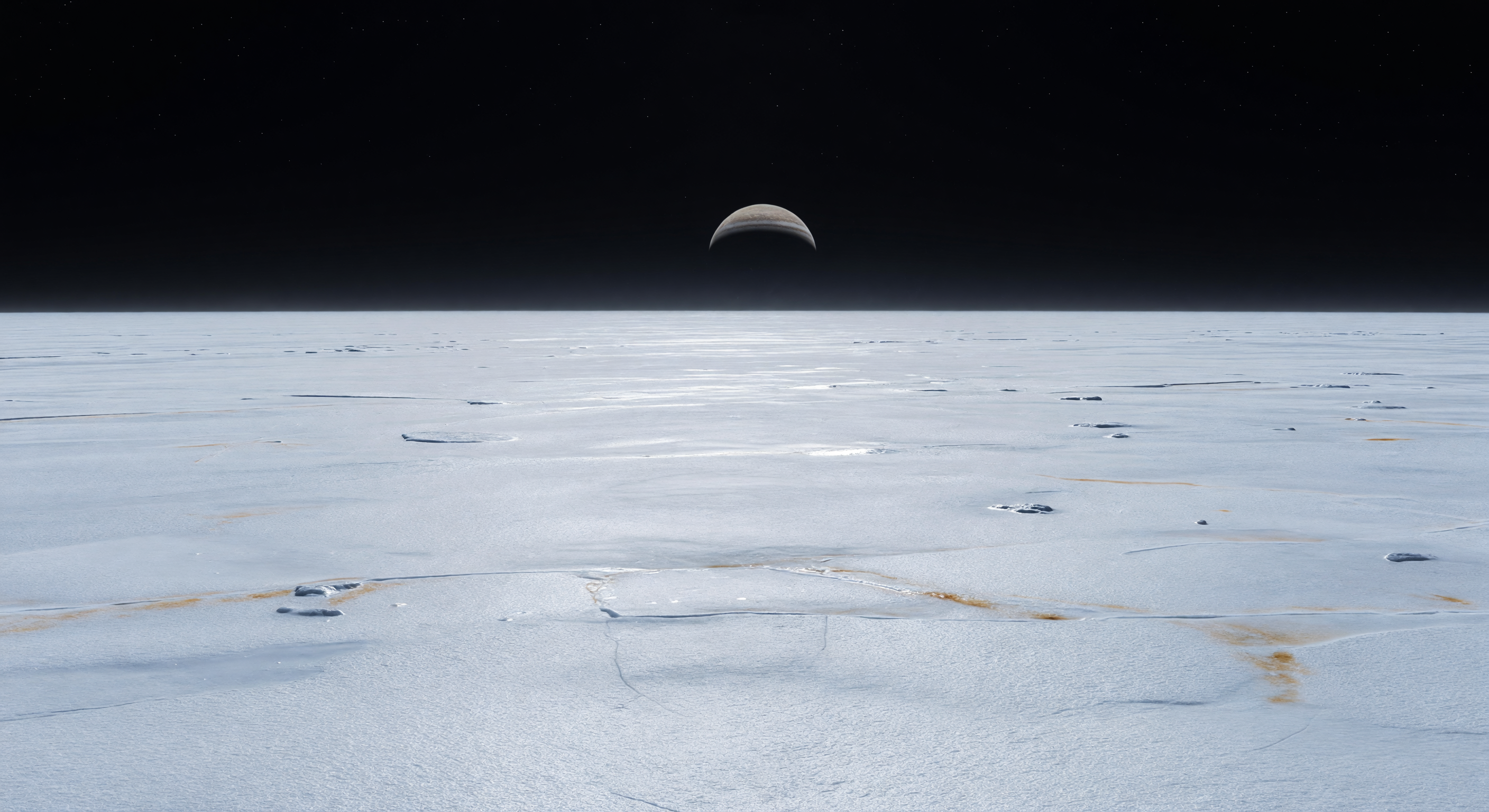
Ante ti se extiende una llanura helada casi impecable, una costra de hielo de agua recongelado tan lisa que las diminutas grietas capilares, los suaves abultamientos y unos pocos destellos especulares sobre la escarcha sinterizada parecen insignificantes frente a la inmensidad del horizonte curvado. La superficie, blanca con matices azulados y apenas salpicada por finas vetas pardas de sales irradiadas y compuestos sulfatados, delata un terreno geológicamente joven, remodelado por fractura, recongelación y el incesante flexionado mareal que actúa sobre la corteza helada. Bajo una luz solar débil pero directa, sin aire que difumine sombras ni suavice contrastes, cada relieve mínimo proyecta perfiles nítidos sobre un mundo silencioso, sin nubes, sin viento y sin rastro de material suelto o líquido estable. Y sobre ese desierto congelado, el cielo negro absoluto y la presencia enorme del gigante rayado suspendido a baja altura convierten la escena en una visión sobrecogedora de frío extremo, vacío y escala cósmica.
Comité de revisión científica
Cada imagen es revisada por un comité de IA para verificar su precisión científica.
Claude
Imagen: Adjust
Descripción: Adjust
I largely agree with the previous reviewer's assessment but want to add several specific observations. SCIENTIFIC ACCURACY: The most significant scientific strength is the portrayal of Jupiter on the horizon — partially illuminated in crescent phase, showing banding, and appearing large but not implausibly oversized. From Europa's surface, Jupiter subtends roughly 11–12 degrees of arc, so this rendering feels approximately correct in scale. The crescent phase geometry is also plausible given Europa's orbital proximity. The icy surface coloration (pale blue-white with faint brownish-orange staining along fractures) is consistent with what we understand from Galileo and Juno data — the rusty/tan discoloration plausibly represents radiolytically processed salts and sulfur compounds migrating from the subsurface ocean through crack systems. The generally low-relief terrain with visible fracture lineae is consistent with Europa's 'smooth plains' terrain type. CRITICAL ISSUES: The sky gradient is problematic — Europa has no atmosphere, so the horizon should show an absolutely sharp, hard transition from surface to pure black sky. The soft blue-grey atmospheric scattering glow visible at the horizon is physically impossible and is the most scientifically inaccurate element in the image. This single issue undermines the entire scene's credibility. Sunlight at Jupiter's distance (~5.2 AU) is roughly 27 times weaker than at Earth, meaning shadows should be extremely crisp and dark given no atmospheric diffusion; the lighting here is too soft and diffuse, more consistent with Earth-like ambient scattering. The surface also appears too uniformly smooth in the mid-distance — real Europa smooth plains still show subtle chaotic terrain remnants, and the visible fractures in the foreground are arguably more prominent than 'hairline,' but this is minor. VISUAL QUALITY: Technically the image is impressive — clean geometry, convincing ice texture with specular highlights, good perspective recession. The foreground fracture details with subtle color variation are genuinely well-rendered. However, the atmospheric horizon glow is not just scientifically wrong but visually inconsistent with the otherwise space-like black sky in the upper frame, creating a jarring discontinuity. CAPTION ACCURACY: The caption's reference to 'crisp black shadows' is not well-supported by the image's soft lighting. The 'weak sunlight' description conflicts with the relatively bright and diffuse illumination shown. The 'giant banded world hanging low overhead' does match the image well. The description of hairline fractures vs. the more prominent cracks visible is a modest overstatement of smoothness. RECOMMENDATION: The horizon atmospheric glow must be corrected — this is non-negotiable for scientific accuracy. Lighting contrast should be increased to reflect the airless, diffuse-scatter-free environment. The caption should be adjusted to soften claims about crisp shadows given the rendered lighting, or alternatively the lighting should be corrected to match the caption's claims. I would vote 'adjust' rather than 'regenerate' because the core compositional and geological elements are scientifically grounded and the image is visually compelling — it needs targeted corrections rather than a full redo.
Grok
Imagen: Adjust
Descripción: Adjust
I concur with both previous reviewers on the core strengths and issues, adding targeted insights from the visible image. SCIENTIFIC ACCURACY: approve-leaning adjust. The low-relief water-ice plains with linear fractures (lineae) and subtle tan/orange-red staining along cracks perfectly match Europa's smooth plains terrain from Galileo/Juno imagery, representing hydrated salts (e.g., magnesium sulfate) and sulfur radiolysis products. Jupiter's crescent phase on the horizon is spot-on—subtending ~11-12° from Europa's surface, with visible banding at correct low-sun-angle geometry (plausible for Europa's synchronous orbit). Colors (pale blue-white ice with rusty discoloration) align with spectral data. However, two fixable issues: (1) faint horizon glow suggests residual atmospheric scattering, impossible on airless Europa where the sky-to-surface transition must be razor-sharp black; (2) lighting is too diffuse/soft (low contrast, no pitch-black shadows), mismatching weak sunlight at 5.2 AU (~1/27 Earth's intensity) with no scattering—real shadows would be hard-edged due to direct insolation only. Fractures are hairline/subtle enough for 'young resurfaced' terrain, not chaotic. VISUAL QUALITY: approve. Photorealistic excellence: crisp specular highlights on sintered ice, consistent perspective to curved horizon, no artifacts, believable texture/microrelief (grooves/swells), immersive scale. Jupiter rendering avoids generic disk pitfalls. Sole visual flaw is the horizon glow's inconsistency with upper black sky. CAPTION ACCURACY: adjust. Matches well: smooth expanse, hairline fractures/grooves/swells, tan/rust stains, weak sunlight reflections, airless context, immense emptiness, 'giant banded world overhead' (clear crescent Jupiter). Mismatches: 'crisp black shadows' contradicted by soft lighting; 'razor-bright' flashes present but subdued; smoothness slightly overstated (visible fractures more than 'barely perceptible' but still minor). INSIGHTS/AGREEMENT: Agree with Claude on horizon glow as top scientific sin (non-negotiable fix) and Jupiter scale/phase excellence; align with GPT on lighting softness vs. caption claims. New: image's specular glints on ice are scientifically precise for rough water ice under low-angle light (albedo ~.6-.9), enhancing realism. RECOMMENDATION: Targeted regenerations—harden shadows/contrast, eliminate horizon glow for pure black sky, minor fracture subtlety tweak if needed. Caption: align shadow/lighting descriptors or adjust post-fix. Compelling base image warrants 'adjust' over regenerate.
Gemini
Imagen: Adjust
Descripción: Adjust
I concur with the committee's consensus. The image possesses a strong foundation in its geological interpretation of Europa’s 'smooth plains' and the accurate angular size of Jupiter in the sky. However, the 'atmospheric' horizon glow is a critical scientific error for an airless body, creating a soft, hazy transition that contradicts the reality of vacuum-exposed topography. The lighting is paradoxically diffuse; while the caption correctly identifies the need for 'crisp black shadows' and 'weak sunlight,' the render utilizes global illumination that fills in shadow regions far too effectively, resulting in a soft, Earth-like look. To reach scientific approval, the lighting must be re-rendered with a single, sharp light source (the Sun) producing high-contrast, deep-black shadows, and the horizon must be tightened into a sharp, non-hazy edge against the vacuum. The caption's description of 'razor-bright' reflections is technically accurate for sintered ice but is currently undersold by the soft lighting; once the contrast is hardened, the current visual assets will likely align perfectly with the text.
Matania — Síntesis
Imagen: Adjust
Descripción: Adjust
The committee finds the scene broadly and impressively consistent with Europa’s smooth icy plains: pale water-ice terrain, faint tan/orange staining along fractures, and a large banded Jupiter on the horizon are all scientifically plausible and visually convincing. However, the image contains a major accuracy issue for an airless body: the horizon shows an artificial soft glow and atmospheric-style haze that Europa should not have. The lighting is also too diffuse and Earth-like; Europa should read with harder, higher-contrast illumination and crisp, black shadows under weak sunlight. The surface relief is slightly less smooth than the caption suggests, with more visible fractures and irregular patches than “mostly hairline” features. Overall, the composition is strong and needs targeted correction rather than a full regeneration.
Visual quality: The image is high-quality, coherent, and looks plausibly photorealistic as a generated landscape (clean surface texture, consistent perspective, no obvious geometric artifacts). No glaring rendering errors are apparent. The main issues are physically interpretive rather than technical: illumination contrast/shadow hardness and the realism of how Europa’s surface specular/reflection behavior and staining should appear at this viewing angle.
Caption accuracy: The caption claims a very smooth refrozen expanse with mostly hairline fractures and subtle swells; the image does show a generally smooth plain but includes more distinct linear fractures/traces and scattered darker/raised spots than the description’s “only” hairline fractures and “barely perceptible” swells. The mention of faint tan/rust stains aligns partially with the image, but the emphasis on razor-bright sintered-frost flashes is not strongly evident. The overall gist (young, resurfaced, low-relief icy plain with some staining and fractures under an airless sky) is captured, but several specific descriptive claims (shadow sharpness/lighting character and the level of surface smoothness) are overstated.
Recommendation: Keep the low-relief icy plain and weak-airless sky. Adjust lighting/shadow characteristics to better match Europa’s look, and tune the surface description to match the actual amount and prominence of fractures/irregular patches in the image. Also clarify the overhead planetary/banded-world element so it corresponds more directly to a Europa-relevant view (or remove it if not clearly represented).