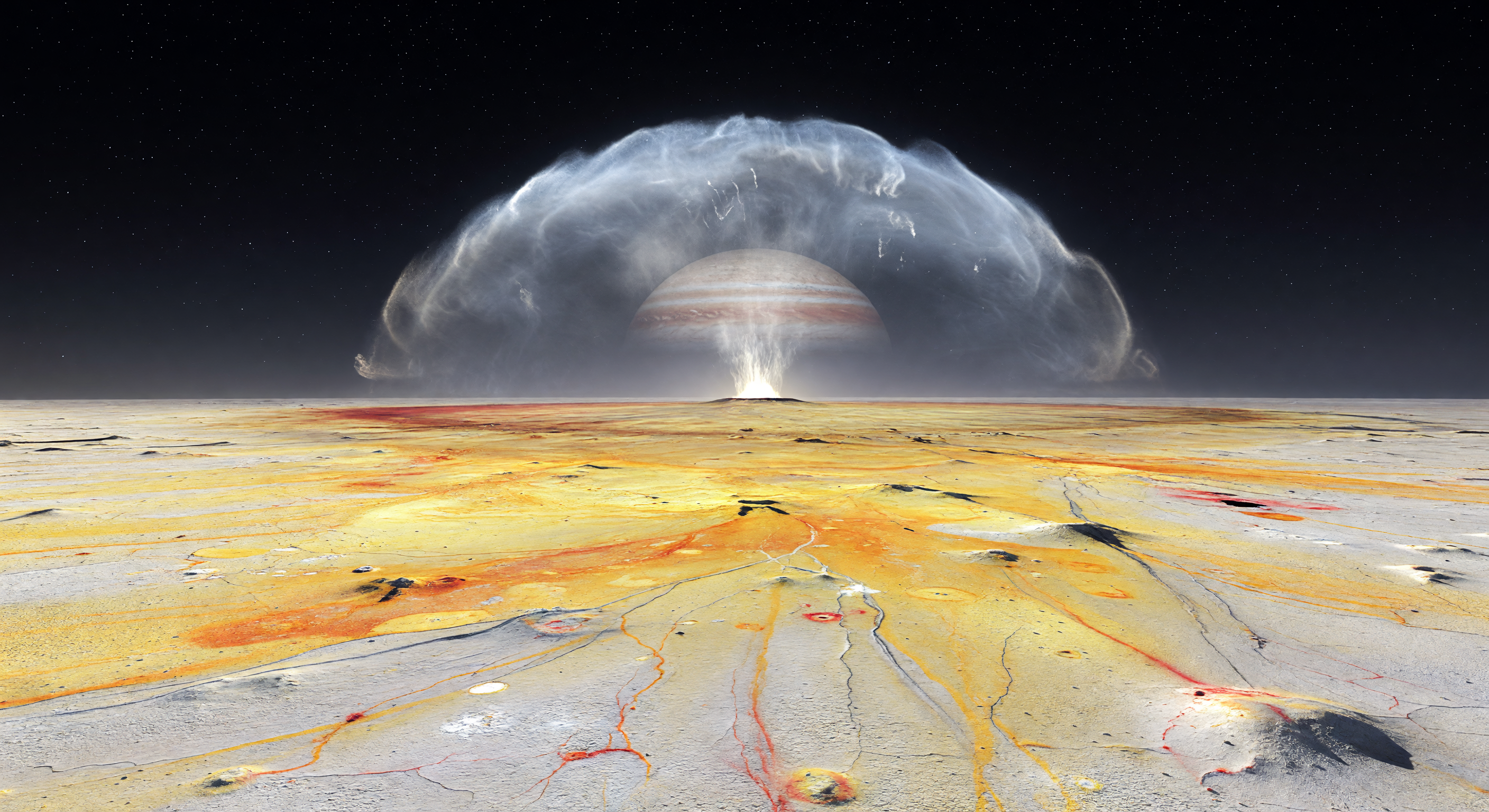
Ante ti se extiende una llanura volcánica inmensa y casi lisa, moteada de amarillos, naranjas, ocres y parches blanquecinos de escarcha de dióxido de azufre, con finas vetas oscuras de ceniza silicatada y delicados halos rojizos depositados por erupciones anteriores. El suelo, costroso y de grano fino, se agrieta en polígonos someros y proyecta sombras largas y durísimas bajo un Sol diminuto que apenas asoma por el horizonte, mientras el cielo permanece negro, casi sin atmósfera que difunda la luz. Muy a lo lejos, más allá del borde bajo del terreno, una abertura volcánica lanza una pluma colosal en forma de paraguas: un arco translúcido blanco a azul pálido que se eleva cientos de kilómetros y cuyo contorno brilla con un filo plateado, revelando capas tenues y filamentos de partículas suspendidas. La ausencia casi total de cráteres recuerda que esta superficie se renueva sin cesar por el calentamiento de marea, haciendo de este paisaje sulfuroso y helado a la vez uno de los escenarios geológicamente más activos y extraños del Sistema Solar.
Comité de revisión científica
Cada imagen es revisada por un comité de IA para verificar su precisión científica.
GPT
Imagen: Adjust
Descripción: Adjust
Scientific accuracy: The scene is broadly consistent with Io’s sulfur-rich plains (yellow/orange/ochre tones and icy-looking frost patches) and its propensity for massive volcanic plumes. The large plume/vent structure is present and lit from below/around the vent in a plausible manner for a sunrise-like geometry. However, several elements conflict with the caption’s specifics: (1) The image shows Io’s horizon with a substantial sky populated by stars and a visible planetary-scale atmosphere/arc haze; Io has essentially no scattering atmosphere—space should be fully dark with minimal haze beyond a very faint exospheric glow. (2) The plume appears as a very broad, symmetric mushroom/cloud structure centered near the surface; Io plumes are typically columnar and then spread depending on local winds and deposition, but the “umbrella” geometry here reads more like an Earth-like convective plume than an Io SO2 plume with more realistic directional plume spreading and deposition patterns. (3) Scale/lighting: the terrain shows strong, Earthlike directional illumination and crisp, razor shadows, but the “tiny rising Sun” and long shadows at the horizon are not clearly encoded by the image; there is no distinct sun-disc or horizon limb geometry matching a true dawn. Visual quality: The image is high-resolution and visually coherent with good texture detail in the ground and convincing plume translucency. There are no glaring AI artifacts (e.g., warped geology or duplicated structures). Minor issues include somewhat over-saturated color contrast and the plume’s overall shape looking slightly stylized/overly smooth for a physical gas/aerosol flow. Caption accuracy: The caption’s emphasis on fine crust polygon cracking, scattered black grains, red-orange and dark fallout staining, and minimal sky is only partially matched. Polygon cracking and color variability are present, but the plume is not clearly a tall, hundreds-of-kilometers limb plume arc into near-total blackness; instead it is a dramatic mushroom-like cloud with stars still visible overhead. Overall, the image captures the general Io volcanic-plume-in-sulfur-plains concept well, but to meet the caption’s stated physical conditions and the “almost no true sky” requirement, it needs adjustment.
Claude
Imagen: Adjust
Descripción: Adjust
I largely concur with GPT's assessment but want to add several specific observations. On scientific accuracy: the surface coloration is genuinely strong — the mottled yellows, ochres, orange sulfur deposits, pale frost patches, and dark volcanic grains are all consistent with Voyager/Galileo/New Horizons imagery of Io. The cracked, polygonal surface texture is plausible given repeated SO2 frost deposition and thermal cycling. The presence of red-orange radial staining around the plume source is accurate, consistent with short-chain sulfur allotropes deposited by Pele-class plumes. However, I must flag a significant problem GPT identified but perhaps understated: Jupiter is rendered as a visually dominant object on the horizon, appearing far too large and luminous relative to what an observer on Io's surface would actually see. From Io, Jupiter subtends roughly 19–20 degrees of arc, which is large, but the rendering here places it in a position and scale that dominates the entire horizon in a way that feels compositionally exaggerated rather than physically calibrated. Additionally, the plume morphology is problematic. Real Io plumes like Pele or Tvashtar form ballistic umbrella structures that are geometrically distinct from the smooth, convective mushroom-cloud shape depicted here, which reads strongly as an Earth-analog nuclear or volcanic cloud with internal convective structure impossible in Io's near-vacuum environment. There is no convective overturning in Io plumes — particles follow purely ballistic trajectories, producing a characteristic ring-deposition annulus rather than a billowing cumulus-like cap. The interior 'wisps and bands' described in the caption and partially visible in the image imply atmospheric turbulence that simply cannot exist at these pressures. The sky treatment is the most scientifically problematic element: visible stars through what appears to be a semi-translucent atmospheric haze arc overhead is inconsistent with Io's ~1 nanobar surface pressure. The transition to black space should be essentially instantaneous above the plume's outermost extent, with zero sky scattering. On visual quality: the image is technically accomplished with no obvious AI deformation artifacts, good ground texture resolution, and convincing sulfurous color gradients. The plume's translucency is aesthetically appealing but physically misleading as noted. The lighting is generally coherent, though the caption's specific 'tiny rising Sun casting razor-sharp shadows' is not clearly realized — shadow geometry is soft and diffuse rather than the extremely hard, near-parallel shadows Io's distant Sun (5.2 AU) would cast. On caption accuracy: the caption describes a scientifically rigorous scenario that the image only partially delivers. The caption correctly anticipates 'almost no true sky — only vacuum' but the image contradicts this explicitly. The 'hundreds of kilometers' plume scale, 'silver-lit outer rim,' and 'translucent white to pale blue arc' are directionally present but the ballistic umbrella geometry is absent. The caption would need revision to acknowledge the convective cloud morphology actually rendered, or the image needs regeneration of the plume structure specifically. My recommendation aligns with GPT: adjust the image primarily targeting plume morphology, sky treatment, and Sun rendering, while adjusting the caption to either match what is shown or explicitly note the artistic departure from strict ballistic plume physics.
Grok
Imagen: Adjust
Descripción: Adjust
I concur with both GPT and Claude's assessments, with additional insights on specific image elements visible in the provided rendering. Scientific accuracy (adjust): Surface geology and colors are highly accurate—mottled yellow/orange/ochre sulfur plains with red-orange fallout staining (short-chain sulfur allotropes from plume deposition), polygonal cracks from thermal/SO2 cycling, low hummocks, black volcanic grains, and frost-white patches align perfectly with Galileo/NASA imagery of regions like Pele or Pillan. Scale feels colossal with low horizon due to Io's ~180km radius. However, major issues persist: (1) Plume morphology is a symmetric, billowing mushroom cloud with convective wisps, resembling an Earth atmospheric explosion rather than Io's ballistic umbrella plumes (SO2 gas/particles follow parabolic trajectories in near-vacuum, forming a flat 'curtain' or ring-like spread, not turbulent billows—see Voyager 1 Pele plume photos). (2) Sky shows starry black space with hazy arc overhead and visible stars through plume, but Io's ~1 nbar exosphere causes no scattering; space must transition abruptly to pure black vacuum beyond the thin plume edge, no 'sky' or star-piercing haze. (3) Prominent Jupiter on horizon is oversized (~20° actual angular size from Io, but here it dominates compositionally like a close moon); at 'dawn' (Io sunrise), Sun should be the key low on horizon with tiny disc (.15° at 5.2AU), razor-sharp parallel shadows from distant point source—not the soft, diffuse shadows seen. No distinct rising Sun disc evident. Lighting geometry mismatches 'limb plume sunrise'—shadows aren't elongated horizon-parallel. Visual quality (adjust): Photorealistic overall, high-res textures on ground (cracks, grains convincing), good color gradients, no major AI artifacts like warping or duplication. Plume translucency is well-rendered but overly smooth/stylized; minor oversaturation in yellows/oranges; Jupiter's bands/texture detailed but scale-inaccurate. Caption accuracy (adjust): Description precisely matches surface details (colors, cracks, grains, fallout, stark vacuum feel) but diverges on plume ('translucent white-to-pale blue arc soaring hundreds km' vs. depicted white mushroom dome), sky ('almost no true sky—vacuum' contradicted by starry/hazy overhead), and sunrise ('tiny rising Sun, razor-sharp long shadows' absent). Caption scientifically spot-on for Io but image needs tweaks to plume shape (make ballistic umbrella), sky (pure black, no haze/stars through plume), Sun addition with hard shadows, and Jupiter scale-down. Agree with prior votes; no regeneration needed as core concept strong—targeted adjustments viable.
Gemini
Imagen: Regenerate
Descripción: Approve
I concur with the previous committee members' observations regarding the fundamental physical inaccuracies, but I am voting to 'regenerate' the image rather than 'adjust.' The current rendering suffers from 'Earth-bias' in its atmospheric physics—specifically, the depiction of convective, mushroom-cloud fluid dynamics that are physically impossible in Io's vacuum environment. While the surface textures are excellent, the plume morphology, the presence of atmospheric scattering/haze, and the incorrect lighting geometry (diffuse shadows vs. the hard, point-source shadows expected at 5.2 AU) are not minor polish issues; they are core structural errors that fundamentally misrepresent Io as a geological entity. To achieve the 'limb plume sunrise' described in the caption—a scientifically rigorous vision of a ballistic SO2 umbrella plume—the image requires a complete reconstruction of the plume's parabolic geometry and the elimination of all atmospheric scattering. The caption itself is scientifically sound and accurate to the intended subject, so it does not require changes; the image must be rebuilt to meet the high standard of the text.
Matania — Síntesis
Imagen: Adjust
Descripción: Adjust
The committee broadly agrees that the image captures Io’s sulfur-rich surface convincingly: the yellow-orange ochre plains, polygonal cracking, frost-like patches, dark volcanic grains, and red-orange fallout staining are all scientifically plausible. The overall composition also successfully evokes a major volcanic plume on Io. However, the rendering introduces several important physical inaccuracies. The plume is depicted as a smooth, billowing, Earth-like mushroom cloud rather than an Io-appropriate ballistic umbrella plume. The sky also shows too much haze and visible starry scattering for Io’s near-vacuum environment, and the sunrise lighting is not rendered with the hard, point-source shadows expected at 5.2 AU. Jupiter’s presence on the horizon appears compositionally exaggerated as well. The caption is scientifically stronger than the image, but it still does not match the rendered scene exactly: it calls for a more explicitly limb-based, translucent plume arc in near-total black vacuum, with sharper dawn geometry than the image provides. Overall, the committee favors adjustment rather than full regeneration because the core concept and surface geology are strong, but the plume, sky, and lighting need correction for scientific fidelity.