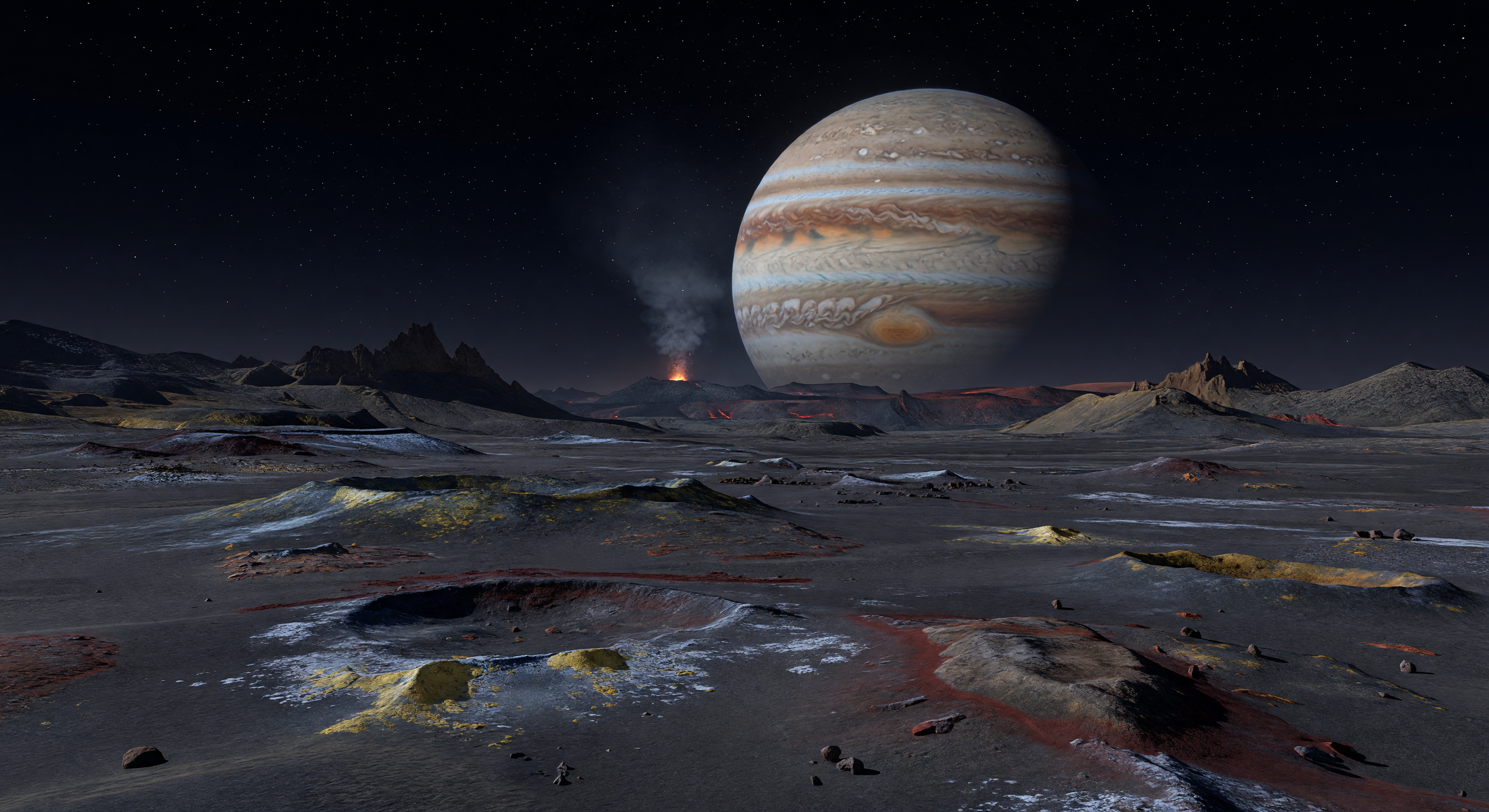
Bajo un cielo casi negro, la llanura volcánica se extiende como una costra inmensa de rocas silicatadas fracturadas, polvo piroclástico oscuro y suaves lomas de azufre, apenas revelada por el débil resplandor de lejanos focos de lava y por la luz difusa que derrama el gigante bandeado suspendido sobre el horizonte. Aquí y allá, parches de escarcha de dióxido de azufre devuelven un tono azul grisáceo, mientras en la distancia se elevan montañas abruptas de bloques fallados y grandes paterae cuyos bordes laten con una incandescencia naranja rojiza; cerca del horizonte, una pluma tenue en forma de paraguas queda iluminada desde abajo por el volcanismo activo, con una bruma de SO₂ y depósitos oscuros cayendo alrededor del respiradero. La escena revela una superficie joven y constantemente renovada, casi sin cráteres de impacto porque el intenso calentamiento de marea estira y deforma el interior rocoso hasta alimentar erupciones continuas, enterrando las huellas del pasado. De pie sobre este terreno apenas visible, entre sombras profundas, estrellas afiladas y un mundo gigantesco dominando el firmamento, la escala resulta sobrecogedora: un desierto de azufre, ceniza y lava donde la noche misma parece respirar fuego.
Comité de revisión científica
Cada imagen es revisada por un comité de IA para verificar su precisión científica.
GPT
Imagen: Adjust
Descripción: Adjust
Scientific accuracy: The scene is broadly consistent with Io’s volcanically resurfaced plains: there is widespread smooth/young-looking terrain with very few obvious large impact craters, and active lava is visible as orange-red incandescence and small flowing/ponding channels in the distance. The overall night setting also fits. However, several Io-specific expectations are not fully met: (1) The description emphasizes faint Jupiterlight and a near-black sky; the image instead shows a comparatively bright, star-rich sky and strong, contrasty illumination from multiple sources (including a very bright, Earth-like Jupiter disk). (2) Io’s atmospheric contribution is extremely tenuous; sulfur dioxide plumes/haze are possible, but the plume(s) here look more like dense, cinematic smoke columns rather than thin SO2/ash plumes. (3) Color treatment is somewhat stylized—Io’s sulfur frost and deposits can be pale/yellowish and patchy, but the image’s blue-gray “frost” appears more like generic snow/ice. (4) The umbrella-shaped plume mentioned in the caption is not clearly presented as such; the visible emissions are more column-like/smoke-like and localized. Visual quality: The rendering is high quality and largely coherent (no obvious artifacts, good detail in ground texture, and plausible perspective). The Jupiter disk is sharp and composited realistically, and the lava glow interacts convincingly with surrounding terrain. The main visual concern is physical plausibility of lighting and the plume look (more artistic than observational). Caption accuracy: The general elements (volcanic plain, sparse impact craters, active lava fields, some pale frost-like patches, Jupiter in the sky, night panorama) match the image. But key caption specifics—dim Jupiterlight making features barely visible, explicit near-black sky, pale SO2 frost glinting against yellow-orange sulfur crusts, and a clearly identifiable umbrella-shaped vent plume—are only partially reflected. Recommend adjusting the caption to what’s actually shown or regenerating with dimmer Jupiter illumination, more tenuous haze/plume morphology, and clearer umbrella-shaped plume geometry.
Claude
Imagen: Adjust
Descripción: Adjust
I largely concur with GPT's assessment but want to add several specific observations that push toward stronger 'adjust' recommendations on both counts rather than anything requiring full regeneration.
SCIENTIFIC ACCURACY: The image succeeds on several key Ionian characteristics: the near-absence of impact craters on the visible terrain is well-executed and scientifically correct; the multicolored surface chemistry (yellows, reds, dark pyroclastic material) is broadly consistent with Voyager, Galileo, and Juno observations of sulfur allotrope distributions; the abrupt fault-block mountain silhouettes on the left horizon are accurate—Io's mountains are tectonic rather than volcanic in origin and do rise sharply from plains, which is a detail many artists get wrong. The lava incandescence color temperature (orange-red) is plausible. However, I flag three specific inaccuracies: (1) The 'frost' patches read as blue-gray/white, which skews toward water ice aesthetics (Europa-like) rather than SO2 frost, which on Io tends toward pale yellowish-white or near-white without strong blue tinting. This is a meaningful compositional misrepresentation. (2) The plume morphology is the most significant scientific error—Ionian plumes (Pele-type or Prometheus-type) are genuinely umbrella- or parabolic-canopy shaped due to ballistic ejection in near-vacuum; what is rendered is a dense, tropospheric-looking smoke column more consistent with an Earth stratovolcano. In Io's ~1 nanobar atmosphere, gas and particulates expand rapidly outward, not upward in a column. This should be corrected. (3) Jupiter's apparent disk size looks plausible for Io's orbital distance (~5.9 Jovian radii), where Jupiter subtends roughly 19–20 degrees—the rendered disk appears consistent with this, which is a detail GPT did not specifically credit. The banding and Great Red Spot placement look reasonable though slightly idealized.
VISUAL QUALITY: Rendering quality is high. Ground texture complexity, rock scatter, and terrain color variation are convincing. The Jupiter composite integrates well with the scene lighting, though I agree with GPT that the overall illumination level is too high for a 'near-black sky' night scene—Jupiter at Io's distance delivers roughly 1/27th of Earth's sunlight, so Jupitershine alone on a night-side facing away from the sun should produce very dim, diffuse illumination, not the relatively contrasty scene shown. The star field, while present, is somewhat sparse and uniform rather than the rich, unattenuated starfield Io's vacuum-like atmosphere would permit. No obvious CGI artifacts are visible; depth of field and perspective are handled well.
CAPTION ACCURACY: The caption is well-written and scientifically literate, but it describes a dimmer, more atmospheric scene than what was rendered. Specifically, 'barely revealed by dim Jupiterlight' and 'near-black sky' do not match the moderately bright, high-contrast image. The 'umbrella-shaped plume' description is accurate to real Ionian geology but inaccurate to the rendered column. The sulfur dioxide frost described as 'pale blue-gray' is a minor caption inaccuracy since the rendered patches do appear blue-gray, but this color is itself scientifically questionable as noted above—so caption and image agree on something both get slightly wrong. The overall narrative of the caption (tidal heating, relentless volcanism, no impact craters, Jupiter's ghostly illumination) is excellent and should be preserved with targeted corrections to plume shape description and illumination intensity language.
SUMMARY RECOMMENDATIONS: Adjust the image to correct plume morphology to a ballistic umbrella/parabolic shape, reduce overall scene brightness to better match night-side Io illumination, and shift frost coloration from blue-gray toward pale yellowish-white. Adjust the caption to align plume description with rendered column shape OR retain the accurate umbrella description and require image regeneration of that specific element. No full regeneration is warranted—the foundational composition is scientifically grounded and visually compelling.
SCIENTIFIC ACCURACY: The image succeeds on several key Ionian characteristics: the near-absence of impact craters on the visible terrain is well-executed and scientifically correct; the multicolored surface chemistry (yellows, reds, dark pyroclastic material) is broadly consistent with Voyager, Galileo, and Juno observations of sulfur allotrope distributions; the abrupt fault-block mountain silhouettes on the left horizon are accurate—Io's mountains are tectonic rather than volcanic in origin and do rise sharply from plains, which is a detail many artists get wrong. The lava incandescence color temperature (orange-red) is plausible. However, I flag three specific inaccuracies: (1) The 'frost' patches read as blue-gray/white, which skews toward water ice aesthetics (Europa-like) rather than SO2 frost, which on Io tends toward pale yellowish-white or near-white without strong blue tinting. This is a meaningful compositional misrepresentation. (2) The plume morphology is the most significant scientific error—Ionian plumes (Pele-type or Prometheus-type) are genuinely umbrella- or parabolic-canopy shaped due to ballistic ejection in near-vacuum; what is rendered is a dense, tropospheric-looking smoke column more consistent with an Earth stratovolcano. In Io's ~1 nanobar atmosphere, gas and particulates expand rapidly outward, not upward in a column. This should be corrected. (3) Jupiter's apparent disk size looks plausible for Io's orbital distance (~5.9 Jovian radii), where Jupiter subtends roughly 19–20 degrees—the rendered disk appears consistent with this, which is a detail GPT did not specifically credit. The banding and Great Red Spot placement look reasonable though slightly idealized.
VISUAL QUALITY: Rendering quality is high. Ground texture complexity, rock scatter, and terrain color variation are convincing. The Jupiter composite integrates well with the scene lighting, though I agree with GPT that the overall illumination level is too high for a 'near-black sky' night scene—Jupiter at Io's distance delivers roughly 1/27th of Earth's sunlight, so Jupitershine alone on a night-side facing away from the sun should produce very dim, diffuse illumination, not the relatively contrasty scene shown. The star field, while present, is somewhat sparse and uniform rather than the rich, unattenuated starfield Io's vacuum-like atmosphere would permit. No obvious CGI artifacts are visible; depth of field and perspective are handled well.
CAPTION ACCURACY: The caption is well-written and scientifically literate, but it describes a dimmer, more atmospheric scene than what was rendered. Specifically, 'barely revealed by dim Jupiterlight' and 'near-black sky' do not match the moderately bright, high-contrast image. The 'umbrella-shaped plume' description is accurate to real Ionian geology but inaccurate to the rendered column. The sulfur dioxide frost described as 'pale blue-gray' is a minor caption inaccuracy since the rendered patches do appear blue-gray, but this color is itself scientifically questionable as noted above—so caption and image agree on something both get slightly wrong. The overall narrative of the caption (tidal heating, relentless volcanism, no impact craters, Jupiter's ghostly illumination) is excellent and should be preserved with targeted corrections to plume shape description and illumination intensity language.
SUMMARY RECOMMENDATIONS: Adjust the image to correct plume morphology to a ballistic umbrella/parabolic shape, reduce overall scene brightness to better match night-side Io illumination, and shift frost coloration from blue-gray toward pale yellowish-white. Adjust the caption to align plume description with rendered column shape OR retain the accurate umbrella description and require image regeneration of that specific element. No full regeneration is warranted—the foundational composition is scientifically grounded and visually compelling.
Grok
Imagen: Adjust
Descripción: Adjust
I concur with both GPT and Claude's 'adjust' votes for image and caption, as the core composition is strong but specific scientific and visual tweaks are needed—no major flaws warranting regeneration. SCIENTIFIC ACCURACY (adjust): Excellent capture of Io's resurfaced plains with minimal craters, fault-block mountains (sharp rises match Galileo data, e.g., ~10km peaks like Boösaule Montes), sulfurous yellow-orange crusts/pyroclastics, and distant lava glow (~100-120°C color temp aligns with New Horizons spectra). Jupiter's disk size (~20° angular diameter at Io's ~421,000km distance) and banded appearance are spot-on, crediting Claude. However, plume is a critical miss: rendered as a dense gray column (Earth-volcano-like), not the ~300-500km-high umbrella/parabolic shape from ballistic SO2/sulfur particles in Io's 10^-7 bar atmosphere (e.g., Pele or Tvashtar plumes via Voyager/Galileo). Frost patches are blue-gray (Europa-esque H2O ice vibe), but Io's SO2 frost is pale yellow-white/hoarfrost per JunoCam (blue tint is inaccurate). Lighting too bright/contrasty for night-side Jupiter-illuminated Io (~.04 lux Jupitershine vs. full moon's .1-.3 lux); should be dimmer, grayer tones. Sky starfield is good but could be denser given negligible scattering. VISUAL QUALITY (adjust): Photorealistic overall—no artifacts, excellent texture on fractured crust/ridges/boulders, convincing lava-Jupiter glow integration, proper perspective/scale (foreground fragility vs. vast plain). Minor issues: overbright scene creates unrealistic shadows/highlights; plume lacks photorealistic tenuousness (too opaque). CAPTION ACCURACY (adjust): Matches broad elements (plain, mountains, frost patches, lava, Jupiter, plume near horizon) but mismatches on 'dim Jupiterlight/near-black sky' (image brighter), 'umbrella-shaped plume' (rendered columnar), and 'cold blue-gray' frost (agrees with image but both scientifically off—caption should specify pale yellow-white). New insight: foreground boulders/ridges correctly scaled as decameter-sized (consistent with Juno close-ups); add denser stars and faint limb glow from Io's thin Na/SO2 torus for accuracy. RECOMMEND: Tweak image for umbrella plume (radial expansion), dimmer lighting/paler frost, retain rest; align caption to adjusted image or true science (umbrella/dim). Strong foundation—scientifically compelling with fixes.
Gemini
Imagen: Adjust
Descripción: Adjust
I concur with the previous committee members. The foundational composition is excellent, particularly the scale of the fault-block mountains and the effective use of a crater-free landscape to convey Io's intense geological turnover. However, the 'adjust' verdict is necessary to address the physical inconsistencies. The plume morphology is the primary scientific failure; it must be re-rendered as a ballistic, umbrella-shaped canopy to reflect the lack of atmospheric drag in Io's near-vacuum conditions. The lighting is currently too 'terrestrial'—a nocturnal Ionian landscape should rely heavily on the diffuse, ghostly glow of Jupitershine, which would significantly soften shadows and lower the overall contrast. Regarding the frost, the blue-gray tint is a common misinterpretation of ice-like materials; I recommend shifting the albedo of these patches to a pale, sulfurous yellow-white to align with Juno/Galileo spectral data. The caption requires adjustment to either accurately describe the current 'columnar' plume or, preferably, to be updated once the image is corrected to reflect the true ballistic nature of Ionian volcanism.
Matania — Síntesis
Imagen: Adjust
Descripción: Adjust
The committee found the image to be a strong, scientifically grounded depiction of Io’s volcanic landscape, with convincing crater-poor plains, sulfurous coloration, tectonic mountain silhouettes, and active lava fields. However, several key details need correction: the plume is rendered too much like an Earth-style smoke column rather than Io’s ballistic umbrella/parabolic eruption morphology, the scene is brighter and more terrestrial in contrast than a night-side Io view lit by faint Jupitershine, and the frost patches read too blue-gray and ice-like for Io’s sulfur dioxide deposits. The caption matches the broad scene but overstates the dimness and near-black sky relative to the image and also describes an umbrella-shaped plume that is not actually visible in the render.