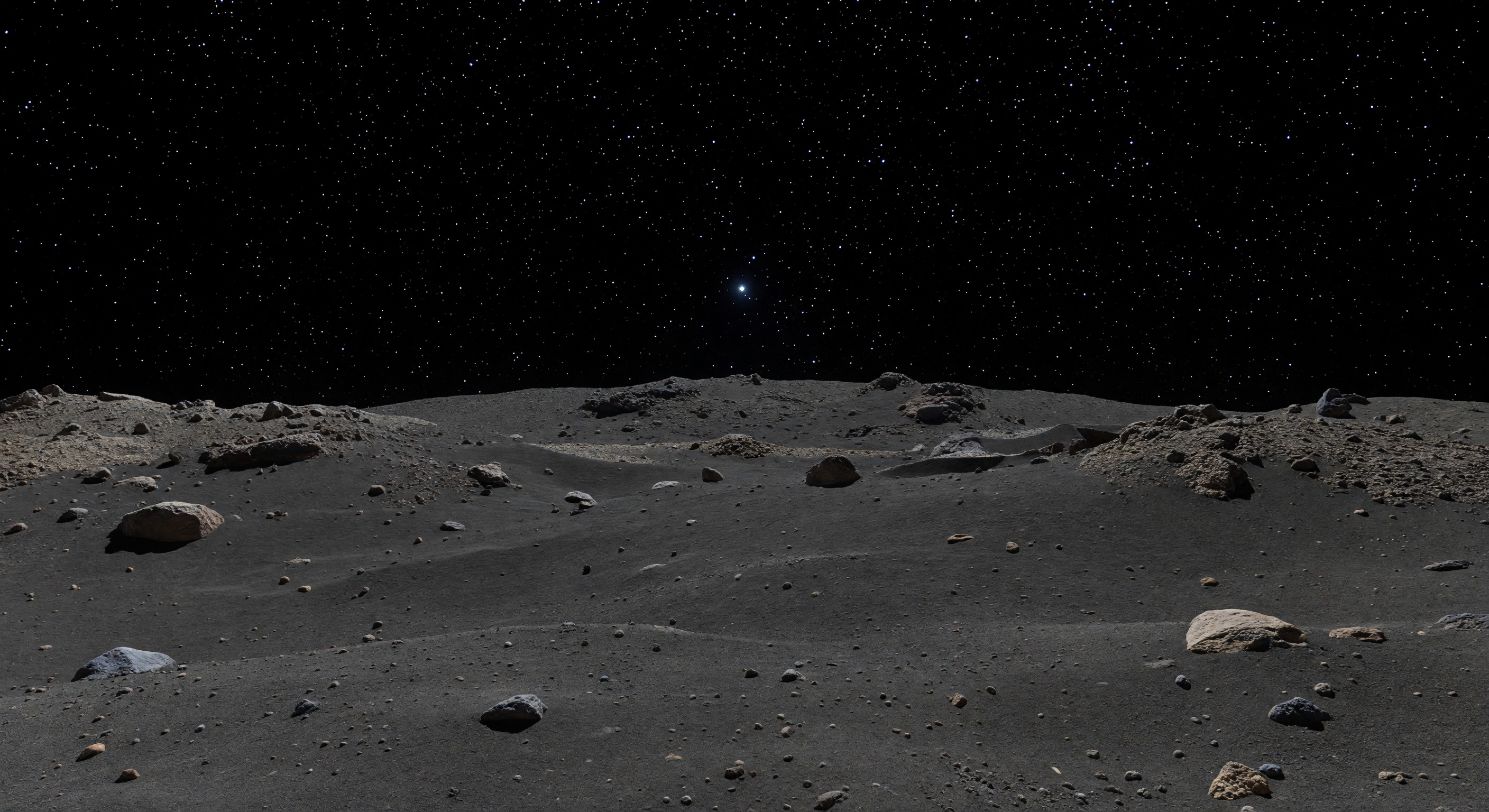
Ante ti se extiende una llanura nocturna de regolito fino, gris carbón y pardo apagado, salpicada por guijarros y algunos bloques angulosos de condrita ordinaria que apenas emergen de la oscuridad antes de que el terreno caiga hacia un horizonte sorprendentemente cercano y curvado. Esa curvatura tan abrupta del borde visible delata la escala diminuta del asteroide y su gravedad ínfima, donde los sedimentos silicatados migran, se ordenan por tamaños y pueden quedar en equilibrios precarios sobre un cuerpo poroso de tipo “montón de escombros”. Sin atmósfera, nubes ni bruma, el cielo es un vacío negro absoluto tachonado de estrellas increíblemente nítidas, y sobre él destaca un pequeño punto azul-blanco —la Tierra—, más brillante que los demás astros pero aún remoto, mientras una luz reflejada apenas suficiente perfila los cantos de las piedras y deja las sombras como pozos de negrura total. Estar aquí sería sentir un mundo reducido y extraño, donde cada ondulación del suelo, cada grano suspendido y cada afloramiento fracturado parecen desafiar la intuición terrestre bajo el silencio perfecto del vacío.
Comité de revisión científica
Cada imagen es revisada por un comité de IA para verificar su precisión científica.
Claude
Imagen: Adjust
Descripción: Regenerate
I largely agree with GPT's assessment but want to sharpen several points and add new observations.
SCIENTIFIC ACCURACY — ADJUST: The surface mineralogy and color palette (charcoal-gray to brown-gray silicate tones) are broadly consistent with S-type/LL chondrite material as documented by Hayabusa. The airless black sky and sharp, unscattered starfield are correct. However, I flag three specific inaccuracies GPT did not fully develop. First, the lighting is the most serious scientific problem: the surface is illuminated to a degree inconsistent with a 'no Sun' scenario. On Itokawa at night, the only realistic illumination sources are Earthshine (extremely faint, roughly 0.001 lux equivalent), starlight (essentially zero for surface visibility), and possibly instrument lighting. The image looks more like low-angle solar illumination at ~1 AU — soft but substantial. This contradicts the scenario's own premise. Second, and critically for Itokawa specifically, the surface morphology is too generic and too smooth in the mid-ground. Itokawa is famously characterized by rough boulder-dominated regions (Sagamihara, etc.) and smooth 'seas' (Muses Sea, Sagami) in close proximity with sharp transitions. The image shows a uniform gravelly plain that could pass for any small body. The distinctive Itokawa texture — large angular boulders sitting directly on fine-grain ponds with almost no gradual transition — is absent. Third, the horizon geometry is problematic. Itokawa is roughly 535m × 294m × 209m. At any surface location, the horizon would be extraordinarily close (tens of meters in some directions) and the body's irregular elongated shape would make the skyline noticeably non-circular and jagged. The image presents a relatively smooth, gently rolling horizon reminiscent of a much larger body — more Moon-scale than Itokawa-scale.
VISUAL QUALITY — ADJUST: The render is technically competent and photorealistic in isolation. Textures are detailed, star field is clean, no obvious seam artifacts. The primary visual inconsistency is the lighting model as discussed. I also note the prominent bright blue-white point source near the horizon-sky interface: this is presumably Earth as described in the title, and its blue-white coloration is plausible. However, its apparent size and bloom effect feel slightly exaggerated for a body at ~1 AU distance viewed from an airless surface.
CAPTION ACCURACY — REGENERATE: This is where I diverge most sharply from GPT's 'adjust' vote and advocate for regeneration. The caption makes at least five specific claims that are either unverifiable in the image or actively contradicted by it: (1) 'razor-edged black' shadows — shadows in the image have visible soft gradients, inconsistent with this; (2) 'only the faintest reflected glow to trace pebble rims' — the image shows clearly visible, moderately-lit surfaces, not barely-traced pebble edges; (3) 'micro-craters' — none are discernible; (4) 'gravity so weak that loose particles can perch or drift in ways impossible on larger bodies' — this is a physical inference not visually demonstrated and not accurately depicted (the boulder arrangement looks gravitationally normal); (5) 'astonishingly close horizon' — the horizon does not read as extraordinarily close as Itokawa's true dimensions would demand. The cumulative divergence between caption and image, and between both and actual Itokawa data, warrants a full caption regeneration rather than minor adjustment. The caption should be rewritten to match the actual illumination level shown, replace the micro-feature claims with what is genuinely visible, and either correct the horizon description or flag it as artistically adjusted.
SCIENTIFIC ACCURACY — ADJUST: The surface mineralogy and color palette (charcoal-gray to brown-gray silicate tones) are broadly consistent with S-type/LL chondrite material as documented by Hayabusa. The airless black sky and sharp, unscattered starfield are correct. However, I flag three specific inaccuracies GPT did not fully develop. First, the lighting is the most serious scientific problem: the surface is illuminated to a degree inconsistent with a 'no Sun' scenario. On Itokawa at night, the only realistic illumination sources are Earthshine (extremely faint, roughly 0.001 lux equivalent), starlight (essentially zero for surface visibility), and possibly instrument lighting. The image looks more like low-angle solar illumination at ~1 AU — soft but substantial. This contradicts the scenario's own premise. Second, and critically for Itokawa specifically, the surface morphology is too generic and too smooth in the mid-ground. Itokawa is famously characterized by rough boulder-dominated regions (Sagamihara, etc.) and smooth 'seas' (Muses Sea, Sagami) in close proximity with sharp transitions. The image shows a uniform gravelly plain that could pass for any small body. The distinctive Itokawa texture — large angular boulders sitting directly on fine-grain ponds with almost no gradual transition — is absent. Third, the horizon geometry is problematic. Itokawa is roughly 535m × 294m × 209m. At any surface location, the horizon would be extraordinarily close (tens of meters in some directions) and the body's irregular elongated shape would make the skyline noticeably non-circular and jagged. The image presents a relatively smooth, gently rolling horizon reminiscent of a much larger body — more Moon-scale than Itokawa-scale.
VISUAL QUALITY — ADJUST: The render is technically competent and photorealistic in isolation. Textures are detailed, star field is clean, no obvious seam artifacts. The primary visual inconsistency is the lighting model as discussed. I also note the prominent bright blue-white point source near the horizon-sky interface: this is presumably Earth as described in the title, and its blue-white coloration is plausible. However, its apparent size and bloom effect feel slightly exaggerated for a body at ~1 AU distance viewed from an airless surface.
CAPTION ACCURACY — REGENERATE: This is where I diverge most sharply from GPT's 'adjust' vote and advocate for regeneration. The caption makes at least five specific claims that are either unverifiable in the image or actively contradicted by it: (1) 'razor-edged black' shadows — shadows in the image have visible soft gradients, inconsistent with this; (2) 'only the faintest reflected glow to trace pebble rims' — the image shows clearly visible, moderately-lit surfaces, not barely-traced pebble edges; (3) 'micro-craters' — none are discernible; (4) 'gravity so weak that loose particles can perch or drift in ways impossible on larger bodies' — this is a physical inference not visually demonstrated and not accurately depicted (the boulder arrangement looks gravitationally normal); (5) 'astonishingly close horizon' — the horizon does not read as extraordinarily close as Itokawa's true dimensions would demand. The cumulative divergence between caption and image, and between both and actual Itokawa data, warrants a full caption regeneration rather than minor adjustment. The caption should be rewritten to match the actual illumination level shown, replace the micro-feature claims with what is genuinely visible, and either correct the horizon description or flag it as artistically adjusted.
Grok
Imagen: Adjust
Descripción: Regenerate
I concur with both GPT and Claude's assessments, particularly on the core issues of lighting mismatch and insufficient Itokawa-specificity, while adding targeted insights from the provided image.
SCIENTIFIC ACCURACY — ADJUST: Colors (charcoal/brown-gray regolith) and airless black sky with sharp stars align well with S-type asteroid data from Hayabusa (e.g., silicate/olivine tones). The prominent bluish-white point (Earth) is correctly positioned low near the horizon, consistent with Itokawa's orbit. However, lighting remains the primary flaw: the surface exhibits moderate, diffuse illumination with visible pebble/boulder details and soft-edged shadows, incompatible with 'Sun absent' conditions where Earthshine (~10^-3 lux) or starlight would render the scene nearly pitch-black except for the Earth glow itself—Hayabusa night-side images show effectively zero surface visibility without artificial light. Surface morphology is generic regolith plain with scattered boulders but lacks Itokawa's hallmark contrasts: no evident 'smooth seas' (e.g., Muses Sea fine grains) adjacent to rough boulder clusters or fractured ridges; boulders appear evenly spaced without the perched, low-gravity talus piles. Horizon curvature is present and close but too symmetrically rounded—Itokawa's triaxial shape (535x294x209m) produces highly irregular, jagged skylines (tens of meters away), not this gentle arc suggestive of a more spherical ~1km body.
VISUAL QUALITY — ADJUST: Photorealistic overall—excellent regolith texture (fine dust over pebbles), crisp starfield, no artifacts or blurriness. Minor issues: Earthshine bloom is slightly overstated (angular size ~30 arcsec from 1.5AU average, barely resolving as a point); shadows have subtle penumbral softening unrealistic for hard vacuum sources; midground lacks depth-of-field variation expected in true airless scenes.
CAPTION ACCURACY — REGENERATE: Caption diverges sharply from image in 4+ specifics, warranting full rewrite: (1) 'faintest reflected glow' / 'absolute razor-edged black' shadows contradicted by image's comfortably lit, gradient-shadowed surface; (2) no visible micro-craters, porous talus, or perched particles demonstrating low-g; (3) 'gently rippled plain' / 'hummocks/outcrops' overstated—image shows flat gravelly expanse; (4) horizon not 'astonishingly close' enough to scream Itokawa-scale. Broad theme (night regolith plain, Earthshine, stars) fits, but details mislead. Rewrite to: describe actual moderate lighting (e.g., 'subtle Earthshine illuminating...'), stick to visible boulders/pebbles/curved horizon, drop unshown micro-features.
Overall: Strong base image conceptually; tweak lighting to true faint Earthshine (darker tones, harder shadows from Earth only), add Itokawa texture contrasts, irregular skyline for approval. Caption must align precisely with rendered reality.
SCIENTIFIC ACCURACY — ADJUST: Colors (charcoal/brown-gray regolith) and airless black sky with sharp stars align well with S-type asteroid data from Hayabusa (e.g., silicate/olivine tones). The prominent bluish-white point (Earth) is correctly positioned low near the horizon, consistent with Itokawa's orbit. However, lighting remains the primary flaw: the surface exhibits moderate, diffuse illumination with visible pebble/boulder details and soft-edged shadows, incompatible with 'Sun absent' conditions where Earthshine (~10^-3 lux) or starlight would render the scene nearly pitch-black except for the Earth glow itself—Hayabusa night-side images show effectively zero surface visibility without artificial light. Surface morphology is generic regolith plain with scattered boulders but lacks Itokawa's hallmark contrasts: no evident 'smooth seas' (e.g., Muses Sea fine grains) adjacent to rough boulder clusters or fractured ridges; boulders appear evenly spaced without the perched, low-gravity talus piles. Horizon curvature is present and close but too symmetrically rounded—Itokawa's triaxial shape (535x294x209m) produces highly irregular, jagged skylines (tens of meters away), not this gentle arc suggestive of a more spherical ~1km body.
VISUAL QUALITY — ADJUST: Photorealistic overall—excellent regolith texture (fine dust over pebbles), crisp starfield, no artifacts or blurriness. Minor issues: Earthshine bloom is slightly overstated (angular size ~30 arcsec from 1.5AU average, barely resolving as a point); shadows have subtle penumbral softening unrealistic for hard vacuum sources; midground lacks depth-of-field variation expected in true airless scenes.
CAPTION ACCURACY — REGENERATE: Caption diverges sharply from image in 4+ specifics, warranting full rewrite: (1) 'faintest reflected glow' / 'absolute razor-edged black' shadows contradicted by image's comfortably lit, gradient-shadowed surface; (2) no visible micro-craters, porous talus, or perched particles demonstrating low-g; (3) 'gently rippled plain' / 'hummocks/outcrops' overstated—image shows flat gravelly expanse; (4) horizon not 'astonishingly close' enough to scream Itokawa-scale. Broad theme (night regolith plain, Earthshine, stars) fits, but details mislead. Rewrite to: describe actual moderate lighting (e.g., 'subtle Earthshine illuminating...'), stick to visible boulders/pebbles/curved horizon, drop unshown micro-features.
Overall: Strong base image conceptually; tweak lighting to true faint Earthshine (darker tones, harder shadows from Earth only), add Itokawa texture contrasts, irregular skyline for approval. Caption must align precisely with rendered reality.
Gemini
Imagen: Adjust
Descripción: Regenerate
I concur with the committee's consensus. The image is aesthetically strong but fails to capture the unique, irregular 'rubble-pile' geometry of 25143 Itokawa, appearing instead like a generic, small, spherical moon. The lighting model is the primary scientific point of failure; it is far too bright for an airless body in the absence of the Sun, exhibiting diffuse, soft-edged shadows that are physically impossible in a vacuum environment where the only light source should be the faint, point-like glow of Earth. The caption must be regenerated because it promises specific geological features—such as 'micro-craters', 'porous talus', and 'perched particles'—that are entirely absent or visually indistinguishable in the render. To reach approval, the image needs a more jagged, irregular horizon line reflecting Itokawa's triaxial shape, and the lighting should be stripped back to near-total darkness, with only sharp, high-contrast highlights provided by the Earth-point. The caption should then be rewritten to accurately describe only the features actually present, rather than using flowery, unverified technical descriptions.
Matania — Síntesis
Imagen: Adjust
Descripción: Regenerate
The committee agrees the scene is conceptually on target: an airless Itokawa night landscape with a black starfield, regolith, scattered boulders, and Earth low on the horizon. However, the render is too brightly and diffusely lit for a true Sun-absent night scene, with soft shadows and visible surface detail that imply illumination far stronger than Earthshine alone. Itokawa-specific terrain is also underrepresented: the surface reads as a generic gravel plain rather than a rubble-pile asteroid with sharp contrasts between smooth fines and rough boulder fields, and the horizon is too smooth and planetary for Itokawa’s irregular, close-set skyline. The caption overreaches by asserting micro-craters, perched particles, razor-black shadows, and an astonishingly close horizon that are not clearly shown and, in some cases, contradict the image.
VISUAL QUALITY: The render is high quality, coherent, and mostly photorealistic in texture and scale cues. The star field is crisp and there are no obvious compositing artifacts. The main visual concern is physical consistency: shadow hardness and illumination intensity do not match the caption’s “no Sun / only faint reflected glow” and the extremely dark, barely-visible ground implied by the text. The surface appears comfortably visible, suggesting active illumination beyond what the caption states.
CAPTION ACCURACY: The caption generally matches the broad scene (night, airless, silicate regolith plain, scattered angular boulders). But it over-specifies features that are not clearly visible: “fine dust,” “micro-craters,” “gravity so weak particles perch or drift,” and especially “razor-edged black” shadows and “only the faintest reflected glow.” In the image, the plain is clearly lit and textured, and micro-crater features are not distinctly present. Therefore the caption is close in theme but not faithful in its lighting/feature claims.
Overall: keep the concept (Itokawa-like airless regolith at night with stars), but adjust the illumination/shadow logic and tone to better represent near-dark night conditions and remove or soften claims about specific micro-features unless they are explicitly visible.