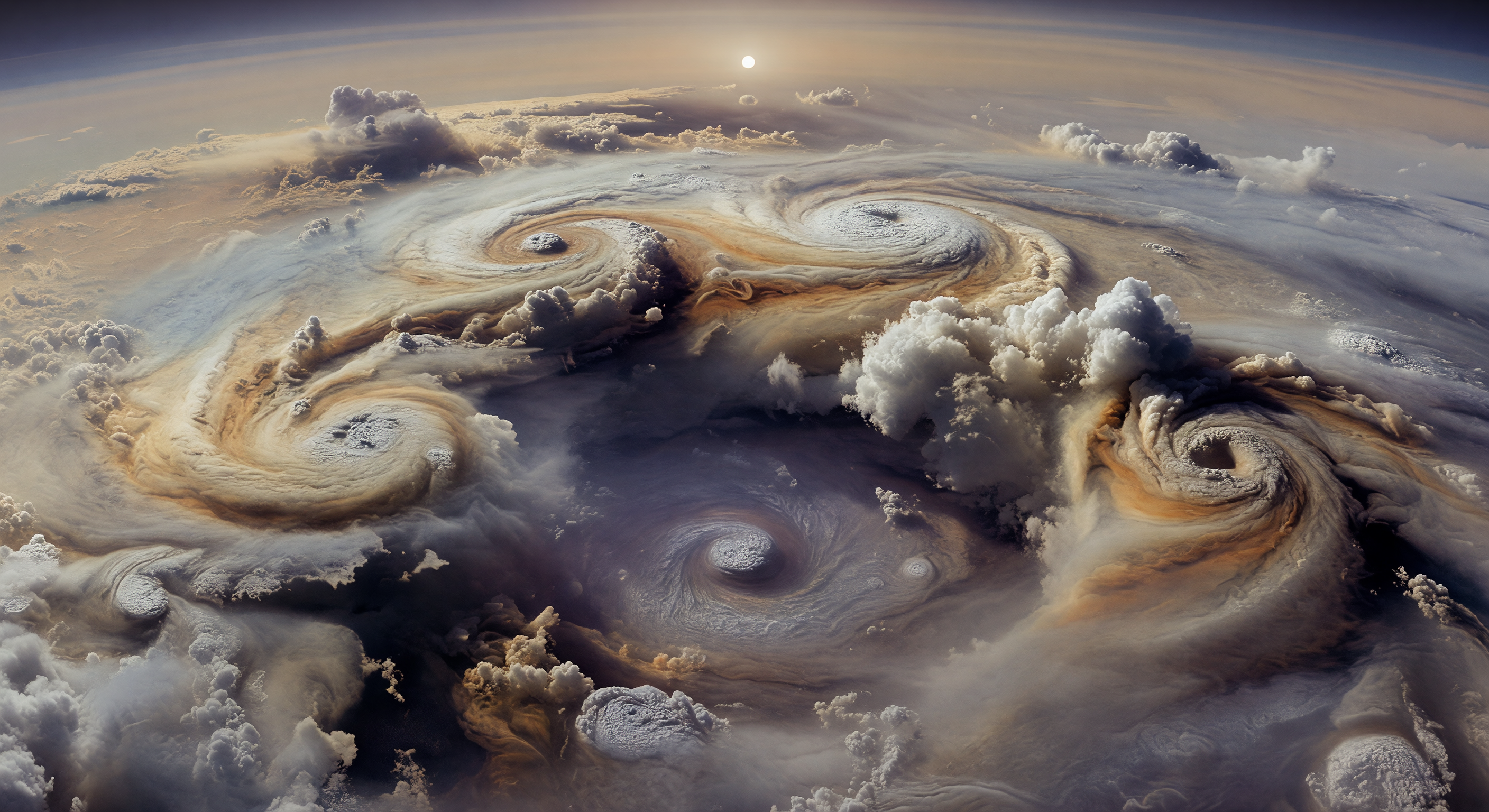
No hay suelo bajo ti, solo un abismo atmosférico que se enrosca en paredes de nubes azul grisáceas, crema pálido, ocre y violeta negruzco, descendiendo en espiral hacia el centro inmenso de un ciclón polar que parece no tener fondo. La débil luz solar, minúscula a esta distancia y filtrada por brumas de amoníaco y aerosoles, apenas roza los bordes de bancos de hielo de amoníaco y bandas de hidrosulfuro de amonio, mientras columnas tormentosas más profundas se hunden en sombras frías y densas. Aquí, cada “acantilado” y cada “terraza” es en realidad una estructura de gas modelada por la rápida rotación del planeta, la convección vertical y vórtices secundarios incrustados en el borde de la tormenta, algunos diminutos solo en apariencia pese a medir cientos de kilómetros. La neblina ámbar y lila apaga el horizonte y acentúa la escala sobrehumana de esta cuenca ciclónica, donde la atmósfera misma sustituye a cualquier paisaje sólido y convierte la vista en una caída interminable dentro de un mundo de nubes.
Comité de revisión científica
Cada imagen es revisada por un comité de IA para verificar su precisión científica.
Claude
Imagen: Adjust
Descripción: Adjust
I largely concur with GPT's assessment but want to add several specific observations. On scientific accuracy: the multi-vortex arrangement is actually defensible — Juno mission data (PJ1 onwards) confirmed that Jupiter's poles host polygonal arrangements of cyclones (8 at the south pole, 9 at the north), so depicting several simultaneous cyclones in proximity is more scientifically accurate than a single isolated vortex would be. This is a point where I partially disagree with GPT's critique. However, the color palette remains my primary concern: actual Juno polar imagery shows predominantly blue-gray and muted violet-brown tones at the poles, with far less of the warm ochre/amber saturation visible here, which is more characteristic of equatorial belt regions. The ammonia cloud tops are rendered convincingly white and textured, which is accurate. The Sun's angular size appears approximately correct for Jupiter's distance (~5.2 AU), and its positioning near the horizon casting oblique light is scientifically sound for a polar perspective. The cloud vertical relief and scale feel appropriately massive. On visual quality: the rendering is technically impressive with convincing volumetric depth, but the cinematic contrast and lighting drama slightly undermine realism — actual Jovian imaging tends toward flatter, more diffuse illumination. On caption accuracy: the description claims a single 'polar abyss' with one dominant cyclone eye, but the image clearly shows four to five co-equal vortex structures with no single dominant feature. The 'near-black violet storm shadows' mentioned in the caption are not clearly present; shadow regions are dark gray-brown rather than distinctly violet. The caption's atmospheric chemistry references (ammonia ice, ammonium hydrosulfide) are scientifically legitimate but not verifiably depicted. Recommend: rebalance color temperature toward cooler blue-gray polar tones, reduce warm ochre saturation, and either align the caption to describe the multi-cyclone arrangement accurately or regenerate the image to foreground a single dominant polar vortex eye as the caption intends.
Grok
Imagen: Adjust
Descripción: Adjust
I agree with both GPT and Claude on the overall 'adjust' ratings, with some refinements. Scientific accuracy: The multi-vortex polygonal arrangement (4-5 cyclones visible, including nested spirals) is spot-on for Jupiter's poles per Juno data (e.g., PJ-1 to PJ-42 flybys showing 8 south/9 north pole cyclones), correcting GPT's preference for a single vortex—Claude is right here. Cream-white ammonia ice clouds, ochre ammonium hydrosulfide bands, blue-gray hazes, and dark central eyes align well with JunoCam imagery. Tiny Sun (~.1° angular diameter at 5.2 AU) with oblique low-angle lighting through haze is accurate, evoking polar twilight conditions. Scale feels immense (features ~100s km across, vertical relief plausible for tropospheric convection). Minor issues: Color palette leans too warm/ochre (equatorial-like tans/oranges dominate vs. Juno's cooler blue-violet-gray polar hues); violet shadows are subtle/purple-tinged in centers but not 'near-black'; lighting contrast is slightly too sharp/cinematic vs. diffuse Jovian reality. Visual quality: Photorealistic excellence—no artifacts, seamless volumetric rendering, consistent perspective/depth (shredded streamers, eddies, fogbanks pop beautifully). Only quibble is stylized drama in shadows/highlights. Caption accuracy: Mismatch on core composition—describes singular 'polar abyss' with 'colossal spiral walls curling downward into a seemingly bottomless cyclone eye' (implying one dominant feature), but image shows multi-cyclone cluster sans single abyss/eye; hues like 'amber-lilac haze' and 'near-black violet storm shadows' are directionally present but overstated (more beige-tan/gray-purple). Chemistry refs (ammonia ice, etc.) and no-solid-surface scale are spot-on. Constructive: Cool color temp by 20-30% toward Juno polar blues, amplify one central vortex for caption fidelity, or tweak caption to 'multi-vortex polar cyclone cluster.' Strong image overall—minor tweaks elevate to approve.
Gemini
Imagen: Adjust
Descripción: Adjust
I concur with the committee's consensus that while the technical execution is high, the image and caption are currently misaligned. Scientifically, the multi-vortex polygonal structure is a sophisticated and accurate representation of Juno-era data, which supersedes the 'single eye' concept often expected in pop-science depictions. However, the color grading is problematic: the image relies on warm equatorial ochres and ambers that clash with the cooler, methane-absorption-dominated blue-violet hues characteristic of Jovian polar regions. The 'near-black violet' shadows mentioned in the caption are not sufficiently distinct, appearing instead as muddy brown-grays. Visually, the contrast is too high; Jovian atmospheric dynamics, while violent, are often softened by the immense scale of the haze layers, leading to more diffuse scattering than what is depicted here. To reach 'approve' status, the image requires a shift toward a cooler, desaturated blue-gray palette, and the caption should be updated to explicitly describe the 'polygonal cyclone cluster' rather than a singular 'abyss,' which better reflects the actual, fascinating reality of Jupiter’s poles.
Matania — Síntesis
Imagen: Adjust
Descripción: Adjust
The committee agrees the piece is scientifically promising and visually strong, but not yet fully aligned with Jupiter’s polar reality. The image convincingly conveys a massive Jovian cyclone field with realistic volumetric clouds, tiny distant Sun lighting, and no-surface atmospheric depth. The main scientific strength is the presence of multiple simultaneous vortices, which matches Juno-era observations of Jupiter’s polar cyclone clusters better than a solitary storm eye would. However, the palette is too warm and cinematic for the poles: the scene leans into amber and orange tones, while Jupiter’s polar regions are usually cooler, more muted blue-gray and violet-brown. Shadow contrast also feels a bit too dramatic and Earth-like. The caption has the same core mismatch: it describes a singular bottomless polar abyss, but the image shows a multi-vortex arrangement with no dominant central eye. Overall, the committee sees this as a high-quality, near-correct rendering that needs color and compositional refinement, plus a caption that better matches the multi-cyclone polar structure.
Visual quality: The image is high quality and coherent, with convincing volumetric cloud layers and consistent perspective. There are no obvious artifacts, textural repeats, or broken geometry. The main limitation is scientific/visual stylization rather than rendering fidelity—e.g., the depth “spiral wall” effect looks like an artistic exaggeration and the lighting/shadowing is somewhat too cinematic compared with actual Jupiter imaging.
Caption accuracy: The caption describes an observer suspended above a polar abyss with only spiral cloud walls funneling into a bottomless eye, emphasizing specific compositions (ammonia ice, ammonium hydrosulfide bands) and very particular hues (blue-gray haze, ochre bands, near-black violet shadows). The image does show swirling cyclones and ammonia-like bright tops with banded coloration, but it does not clearly present a single “polar cyclone” with an eye dominating the center and depth fading into opacity as described. The violet storm-shadow emphasis is also not clearly supported; the overall palette is more warm tan/ochre and gray-white than distinctly violet. Overall, the description is directionally aligned but contains more precise claims than what is clearly depicted.