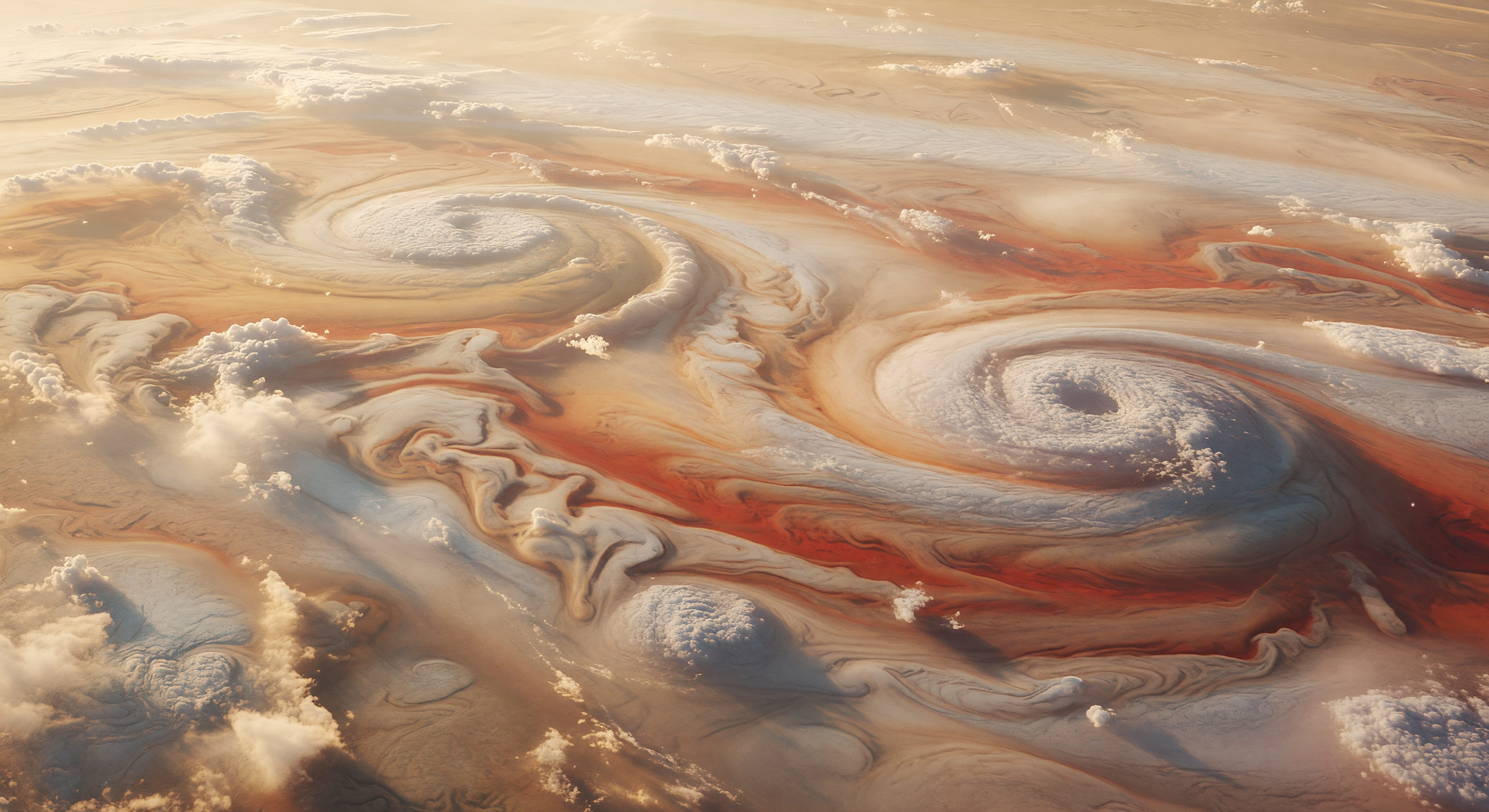
Ante ti no se extiende un suelo, sino un relieve enteramente atmosférico: crestas y vaguadas de nubes de amoníaco helado y de hidrosulfuro de amonio se curvan en enormes arcos anticiclónicos, con bandas color crema, salmón, óxido y rojo ladrillo apagado que desaparecen más allá del horizonte. En el borde de la gran tormenta, paredes nubosas de kilómetros de altura, remolinos festoneados, filamentos desgarrados por la cizalla y hondos huecos en sombra revelan la dinámica brutal de una atmósfera de hidrógeno y helio sin superficie sólida, donde aerosoles rojizos, brumas estratificadas y finos cristales de hielo tiñen y suavizan la luz. El Sol, reducido a un pequeño disco intenso entre la neblina beige dorada, proyecta destellos melocotón sobre las cimas más lisas y largas sombras azul grisáceas en los surcos turbulentos, acentuando la escala continental de esta maquinaria meteorológica. La escena se siente densa, ventosa y cargada de electricidad, como si estuvieras suspendido sobre un océano de nubes vivas cuyo “paisaje” cambia sin cesar bajo una bóveda cremosa y opaca.
Comité de revisión científica
Cada imagen es revisada por un comité de IA para verificar su precisión científica.
Claude
Imagen: Adjust
Descripción: Adjust
I largely concur with GPT's assessment but want to add several specific observations. On scientific accuracy: the broad color palette of cream, salmon, and muted brick-red is broadly consistent with Cassini and Juno imagery of Jupiter's cloud tops, and the anticyclonic swirl morphology is recognizable. However, I flag two specific issues GPT did not emphasize sufficiently. First, the cloud textures have a somewhat 'marbled paint' quality — the fine filamentary structure and turbulent eddies visible in actual Juno close-approach imagery (particularly the polar vortex and GRS approach frames) show much tighter, more chaotic small-scale turbulence than the smooth flowing curves depicted here. The image reads as stylistically Jovian but physically idealized. Second, and critically for the 'Red Spot Rim' title: the two dominant vortex eyes shown are both roughly equal in apparent size and visual weight, which creates ambiguity — neither reads unambiguously as the GRS rim wall. The GRS rim is characterized by a high-speed collar of eastward and westward jets creating a visually distinct boundary; this shear boundary is not convincingly rendered here. On lighting: I partially disagree with GPT's critique. The warm peach illumination is actually defensible — at Jupiter's distance (~5.2 AU), sunlight is roughly 1/27th Earth intensity but the color temperature shift is subtle in cloud-reflected light, and a warm aerosol-scattered haze is physically plausible. The soft diffuse lighting is not strongly Earth-like in a disqualifying way. On visual quality: the image is technically accomplished with no obvious generation artifacts, consistent perspective, and good tonal range. The main weakness is the overly smooth, 'liquid marble' aesthetic that sacrifices physical turbulence realism for visual elegance. On caption accuracy: the caption's reference to 'kilometer-high cloud ramparts' and 'filamentary streamers' is aspirational rather than depicted — the image shows broad sweeping curves, not fine filaments or vertically imposing ramparts. The description of 'shadow-filled vortical hollows' is partially supported by the darker vortex centers but the shadowing does not convincingly suggest vertical depth at the claimed scale. Recommendation: adjust the image prompt to introduce finer turbulent substructure consistent with Juno PJ imagery, clarify one dominant storm structure as the GRS with a visible shear collar, and trim the caption's claims about fine microphysical structure that the image does not visually substantiate.
Grok
Imagen: Adjust
Descripción: Adjust
I agree with both GPT and Claude on the core issues: the image captures a convincingly Jovian aesthetic with anticyclonic swirls, cream-to-rust-red color palette matching JunoCam observations of GRS-adjacent hazes (e.g., ammonium hydrosulfide and phosphorus compounds producing salmon/brick tones), and plausible warm-diffuse lighting from a distant Sun at 5.2 AU (peach hues align with scattered light in thin upper clouds, as seen in Juno PJ34 closeups). The immense scale and lack of solid surface are well-conveyed via the curved horizon and continent-spanning vortices. However, for 'Red Spot Rim' specificity, the image falls short—Claude is spot-on that the two equal-sized vortices dilute focus; neither dominates as the GRS's characteristic elongated oval with sharp shear collar (compare Juno's GRS rim: ~10-20 m/s zonal jets creating filamentary edges). GPT correctly flags weak verticality—no kilometer-scale towers or limb-brightening gradients evident, just smooth marbled flows lacking Juno's chaotic small-scale turbulence (e.g., 100m-scale eddies from shear). New insight: the beige-gold sky vault is present but lacks a discernible 'tiny distant Sun' glow (caption's 'tiny distant Sun glows through aerosol haze' unsupported; appears as uniform haze without point source). Visual quality is excellent—photorealistic, artifact-free, with consistent perspective and dynamic range evoking Cassini/Juno composites—but overly idealized smoothness sacrifices realism. Caption overclaims micro-details (filamentary streamers, ice veils, vortical hollows with depth) not visually matched; it reads more generic storm deck than precise GRS rim. Constructive: approve with prompt tweaks for dominant GRS oval, finer Juno-like turbulence, subtle Sun disk, and stronger vertical shear cues; trim caption to 'sweeping anticyclonic cloud arcs with reddish rims' to fit.
Gemini
Imagen: Adjust
Descripción: Adjust
I concur with the previous committee members regarding the 'marbled' aesthetic, which lacks the characteristic chaotic, high-frequency turbulence revealed by Juno's Perijove (PJ) data. My specific addition to the critique concerns the scale of the fluid dynamics: the image depicts the clouds as a viscous, fluid-like surface, whereas Jovian dynamics are dominated by distinct scale-height differences. The 'ramparts' described in the caption are missing because the image lacks the 'layered' look of convective turret clouds (often called 'popcorn' clouds) that rise above the primary cloud deck. Furthermore, the lighting fails to account for the limb-darkening effect typical of a thick, scattering atmosphere viewed at an angle. While the aesthetic is beautiful, it feels more like an abstract interpretation than a rigorous simulation of the GRS periphery. To improve, the image needs to break up the smooth, continuous flow into discrete cloud-top features (convective plumes) and sharpen the contrast at the shear boundary to define the 'rim' properly. The caption should be scaled back to avoid describing microscopic ice-crystal veils that are not rendered in the visual output.
Matania — Síntesis
Imagen: Adjust
Descripción: Adjust
The committee found the image visually strong and convincingly Jovian in palette, scale, and general anticyclonic cloud morphology, with warm cream-to-salmon tones and coherent storm-like swirls. However, it does not clearly depict the named 'Red Spot Rim' feature with enough specificity: the Great Red Spot or its distinct shear collar/rim is not unambiguous, the two major vortices compete for attention, and the cloud field is rendered in a smooth, marbled style that underplays the fine chaotic turbulence, convective detail, and vertical structure expected in a more rigorous Jupiter depiction. The lighting is plausible in broad terms, but the scene remains more stylized than physically explicit. The caption similarly overreaches by asserting detailed microphysical and structural features—ice veils, filamentary streamers, kilometer-high ramparts, and a distinct storm wall—that are not clearly supported by the image. Overall, the work is aesthetically convincing but scientifically under-specific for this exact location on Jupiter.
Visual quality: The image is high quality, coherent, and aesthetically convincing—no obvious stitching artifacts, warping, or inconsistent perspective. Cloud textures and shadowing are smooth and plausible for a rendered environment. The main issue is physical plausibility rather than technical quality: the “no solid surface” premise is satisfied (it’s all clouds), but the scale/height cues and the distinction of the Red Spot rim are not clearly supported visually.
Caption accuracy: The caption is rich and specific (ammonia-ice/ammonium-hydrosulfide, anticyclonic arcs, filamentary streamers, vortical hollows, and a distinct storm rim). What’s shown does share anticyclonic curvature and reddish rims/swirl edges, but it does not clearly show the “Red Spot Rim” as a named, distinct feature, nor does it evidence the claimed microphysical/vertical structure (ice crystal veils, condensate layers, kilometer-high ramparts) with strong visual correlates. Adjust the caption to match what the image most clearly depicts (a generic massive Jovian storm/anticyclonic complex with banded cloud haze) or modify the image prompt/selection to ensure the Great Red Spot rim is visibly present and recognizable.