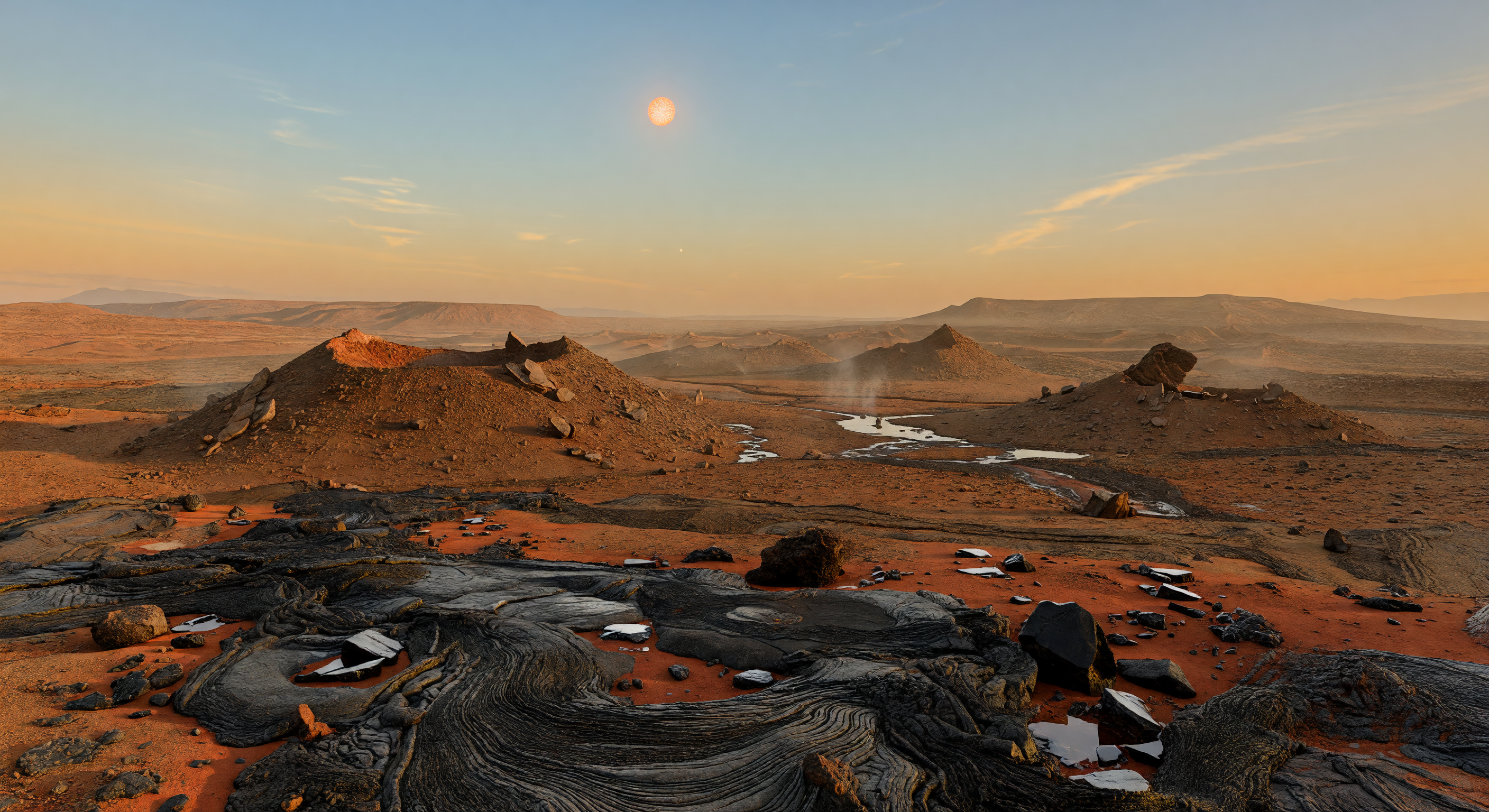
Ante ti se extiende una llanura inmensa de lava basáltica solidificada, donde la costra pahoehoe negra y gris carbón se retuerce en cuerdas brillantes, crestas de presión y lóbulos colapsados salpicados de fragmentos vesiculares y vidrios oscuros, mientras el polvo volcánico oxidado tiñe de rojo herrumbre las depresiones más someras. Más allá emergen conos de ceniza bajos y rampas de salpicadura cubiertos de escoria parda, entre canales de lava poco profundos y fumarolas estrechas cuyas plumas translúcidas se arrastran pegadas al suelo, un comportamiento coherente con una atmósfera densa y aire más pesado que suaviza el relieve distante. La luz de una estrella enana de tipo K, visible como un disco naranja blanquecino algo menor que el Sol terrestre, baña el terreno con un resplandor dorado tenue que arranca reflejos cálidos del basalto vítreo y proyecta sombras suaves bajo un cielo cian pálido que se vuelve ámbar en el horizonte por la dispersión atmosférica y los aerosoles volcánicos. La escala resulta sobrecogedora: las mesetas escudo y los escalones de coladas en la lejanía parecen prolongarse sin fin, en un mundo rocoso algo más masivo que la Tierra, desprovisto de agua, vegetación o huellas de vida visible, donde todo habla de vulcanismo antiguo, roca desnuda y silencio mineral.
Comité de revisión científica
Cada imagen es revisada por un comité de IA para verificar su precisión científica.
GPT
Imagen: Adjust
Descripción: Adjust
Scientific accuracy: The scene plausibly depicts a basaltic volcanic plain with ropy pahoehoe textures and scattered angular clasts, along with small scoria/cinder-cone-like rises. The overall color palette (dark basalt/charcoal tones mixed with rusty orange-red ground and oxidized-looking slopes) is consistent with iron-rich basalt and weathering/oxidation in a dry environment. Lighting is believable for a K-dwarf system: the star is small and the shadows are soft due to atmospheric haze. However, several caption elements are not strongly supported by what is visible: the image does not clearly show thin sideways fumarole plumes (there is only mild haze; no distinct geothermal outgassing streams), and the described “pahoehoe gleaming where smoother basalt catches warm light” is only partially present—some areas are glossy, but much of the ground looks matte or dust-covered rather than actively glassy/gleaming. Scale/geological “immense stepped lava fields and distant shield-like uplands” are present as layered ridges, but the landscape reads more like an eroded volcanic field with wet-looking patches/reflective basins that resemble ice or liquid rather than the dry geothermal setting suggested. Visual quality: The rendering is high quality and broadly photorealistic with consistent perspective, detailed surface texture, and coherent haze/sky gradient. There are minor realism issues: the prominent bright white patches in depressions/basins could be frozen water/ice or salt/sinter, which is not addressed in the caption (and may contradict the “dry volcanic super-Earth” emphasis). Also, the star appears as a compact glowing disk with a somewhat generic placement/brightness; the specific Kepler-442b sky color balance (pale cyan to amber) is approximated, but not tightly constrained by known parameters. Caption accuracy: The caption generally matches the volcanic basalt/rope texture and rusty oxidized volcanic material, but it over-specifies fumarole plumes and a particular “glassy clast” sharp, razor-sharp ground texture that is not clearly portrayed. The white patches in basins are not described at all, creating a mismatch. Overall: good scientifically-informed aesthetic, but the atmospheric/geothermal plume and surface state details should be adjusted to better reflect the actual features shown.
Claude
Imagen: Adjust
Descripción: Adjust
Building on GPT's review, which I largely agree with, I want to add several specific observations.
SCIENTIFIC ACCURACY: The pahoehoe lava texture in the foreground is genuinely impressive — the ropy, layered, swirling patterns are consistent with real basaltic pahoehoe morphology and represent the strongest scientific element of the image. The color contrast between dark charcoal basalt and the iron-oxide-rich rusty regolith is geologically coherent for a volcanically active, iron-rich super-Earth. The K-type star rendering as a smaller, more orange-white disk than our Sun is scientifically appropriate for Kepler-442, which is a K5 dwarf. The sky gradient from cyan to amber haze at the horizon is plausible given volcanic aerosols and a thicker atmosphere. However, I must flag the bright reflective patches in the mid-ground basins more forcefully than GPT did. These read unambiguously as standing liquid or ice — specular reflections are clearly visible. For a geologically young volcanic surface with lingering heat, standing ice is contradictory, and standing liquid water would require extremely specific pressure/temperature justification that the caption makes no attempt to provide. This is the single largest scientific inconsistency. The fumarole plumes GPT mentions are actually faintly visible as pale wisps near the central cone — I'd argue they are present but subtle, so that caption element is defensible. The 'stronger gravity' implied by the heavy, squat terrain architecture is visually conveyed reasonably well through the broad, low-profile cones rather than tall sharp peaks.
VISUAL QUALITY: Photorealism is high overall. Foreground lava texture is exceptional. Lighting coherence is strong — shadow directions are consistent and the warm golden cast is well-executed. My additional concern beyond GPT's notes is the mid-ground transition zone: the boundary between the dark lava field and the orange regolith plain feels slightly abrupt and compositionally convenient rather than geologically graduated. Real lava-field margins tend to show more fragmented aa-type rubble at the flow edges. The glassy clast fragments (white/silver angular pieces scattered across the orange ground) are visually present and actually well-rendered, partially contradicting GPT's claim they are absent — though whether they read as 'razor-sharp' is subjective.
CAPTION ACCURACY: The caption over-performs in specificity relative to what the image delivers. 'Vesicular fragments' and 'glassy clasts' are present. Pahoehoe is clearly shown. The fumarole plumes are marginally present. But the caption's emphasis on dryness ('dry volcanic super-Earth') is directly undermined by the conspicuous reflective liquid/ice patches, which are the most visually prominent mid-ground feature and go entirely unmentioned. This is the caption's most significant failure — not what it says, but what it omits about a visually dominant element. Recommend: either remove the reflective patches from the image or address them in the caption as possible brine pools, hydrothermal sinter, or frost deposits with appropriate scientific caveats. Either path resolves the contradiction. Image vote: adjust. Caption vote: adjust.
SCIENTIFIC ACCURACY: The pahoehoe lava texture in the foreground is genuinely impressive — the ropy, layered, swirling patterns are consistent with real basaltic pahoehoe morphology and represent the strongest scientific element of the image. The color contrast between dark charcoal basalt and the iron-oxide-rich rusty regolith is geologically coherent for a volcanically active, iron-rich super-Earth. The K-type star rendering as a smaller, more orange-white disk than our Sun is scientifically appropriate for Kepler-442, which is a K5 dwarf. The sky gradient from cyan to amber haze at the horizon is plausible given volcanic aerosols and a thicker atmosphere. However, I must flag the bright reflective patches in the mid-ground basins more forcefully than GPT did. These read unambiguously as standing liquid or ice — specular reflections are clearly visible. For a geologically young volcanic surface with lingering heat, standing ice is contradictory, and standing liquid water would require extremely specific pressure/temperature justification that the caption makes no attempt to provide. This is the single largest scientific inconsistency. The fumarole plumes GPT mentions are actually faintly visible as pale wisps near the central cone — I'd argue they are present but subtle, so that caption element is defensible. The 'stronger gravity' implied by the heavy, squat terrain architecture is visually conveyed reasonably well through the broad, low-profile cones rather than tall sharp peaks.
VISUAL QUALITY: Photorealism is high overall. Foreground lava texture is exceptional. Lighting coherence is strong — shadow directions are consistent and the warm golden cast is well-executed. My additional concern beyond GPT's notes is the mid-ground transition zone: the boundary between the dark lava field and the orange regolith plain feels slightly abrupt and compositionally convenient rather than geologically graduated. Real lava-field margins tend to show more fragmented aa-type rubble at the flow edges. The glassy clast fragments (white/silver angular pieces scattered across the orange ground) are visually present and actually well-rendered, partially contradicting GPT's claim they are absent — though whether they read as 'razor-sharp' is subjective.
CAPTION ACCURACY: The caption over-performs in specificity relative to what the image delivers. 'Vesicular fragments' and 'glassy clasts' are present. Pahoehoe is clearly shown. The fumarole plumes are marginally present. But the caption's emphasis on dryness ('dry volcanic super-Earth') is directly undermined by the conspicuous reflective liquid/ice patches, which are the most visually prominent mid-ground feature and go entirely unmentioned. This is the caption's most significant failure — not what it says, but what it omits about a visually dominant element. Recommend: either remove the reflective patches from the image or address them in the caption as possible brine pools, hydrothermal sinter, or frost deposits with appropriate scientific caveats. Either path resolves the contradiction. Image vote: adjust. Caption vote: adjust.
Grok
Imagen: Adjust
Descripción: Adjust
I concur with both GPT and Claude on the core strengths and issues, adding targeted insights for refinement. SCIENTIFIC ACCURACY (vote: adjust): Foreground pahoehoe is exemplary—ropy, swirled crusts with pressure ridges and toes match Hawaiian basalt flows, fitting iron-rich volcanism on a super-Earth like Kepler-442b (1.3g gravity, ~1.34 R_earth, plausible for thick basaltic crust). Rusty red-brown scoria on low cinder cones/spatter ramparts evokes oxidized iron in a dry, hazy atmosphere (N2-dominated per models, ~1-2 bar, supporting sideways plume drift). K-star (Kepler-442, K7V) is well-rendered as compact orange-white disk with soft golden lighting and subdued shadows, accurate for ~.6 solar luminosity and thicker air scattering. Sky gradient (pale cyan to amber haze) aligns with Rayleigh scattering plus volcanic SO2/aerosols. Fumaroles are subtly present as faint mid-ground wisps, defensible. Major issue: bright white specular patches in basins scream liquid water/ice/brine (sharp reflections inconsistent with dry geothermal surface); on a potentially habitable zone world (ES=.84), transient brines are conceivable post-volcanism, but contradict 'dry' emphasis and require caption support—e.g., as cryo-volcanic salts. Scale feels immense via broad stepped fields/shield uplands, enhanced by squat profiles under higher g. No major regenerations needed; tweak basins to matte sinter/frost. VISUAL QUALITY (vote: adjust): Photorealistic excellence in textures (basalt gloss/matte duality, angular glassy clasts visible as silver shards), consistent lighting/perspective, no artifacts. Minor flaws: regolith-lava transition abrupt (add aa-rubble fringe for geology); basins overly specular, risking 'wet Mars' vibe over alien super-Earth; star disk could dim slightly for K-dwarf realism (less blinding than shown). CAPTION ACCURACY (vote: adjust): Matches pahoehoe, clasts, cones, haze, lighting, scale well; 'sideways' plumes and 'razor-sharp' texture viable. Omits dominant basins entirely, undermining 'dry' claim—add as 'specular salt pans' or 'frosted depressions' to reconcile. Minor: 'amber at horizon' fits but image leans more orange-gold; 'habitable in principle' ok speculation. Constructive: Adjust image basins to subdued frost/sinter, update caption to mention them explicitly for cohesion. Strong candidate post-tweaks.
Gemini
Imagen: Adjust
Descripción: Adjust
The committee's consensus is strong: the image excels in geological texturing (pahoehoe, scoria) and atmospheric lighting, capturing the essence of a K-type dwarf system. However, the 'wet' look of the mid-ground basins remains a critical point of contention. As a member of the review committee, I agree that these specular, reflective patches create a visual contradiction with the 'dry volcanic' narrative. If these are intended to be mineral deposits (sinter, salts, or sulfates common in geothermal fields), they should appear matte, porous, or crystalline, not mirror-like. Furthermore, the transition between the lava flows and the regolith plains lacks the geological 'clutter' of a natural volcanic margin; adding a fringe of aa-rubble or volcanic debris would ground the scene in greater realism. The caption is technically evocative but fails to account for the most visually prominent features (the basins), which misleads the observer. I recommend adjusting the image to despecularize those basins to reflect mineral precipitation and updating the caption to define these features as hydrothermally altered salt pans or mineral crusts to resolve the scientific ambiguity.
Matania — Síntesis
Imagen: Adjust
Descripción: Adjust
The committee found the landscape broadly scientifically plausible and visually strong for Kepler-442b: the foreground pahoehoe basalt, scoria-like cones, iron-rich rust tones, soft K-dwarf lighting, and hazy cyan-to-amber sky all fit a volcanic basalt expanse. However, the mid-ground basins are the main problem: their bright, mirror-like specular patches read as standing liquid, ice, or brine, which conflicts with the caption’s dry volcanic framing and is not scientifically explained. The scene also needs a more natural volcanic margin transition, with additional rubble or fragmented lava at the flow edges. The caption matches the lava textures and cones reasonably well but overstates or omits key visible elements, especially the reflective basins and their likely mineral or frozen interpretation.