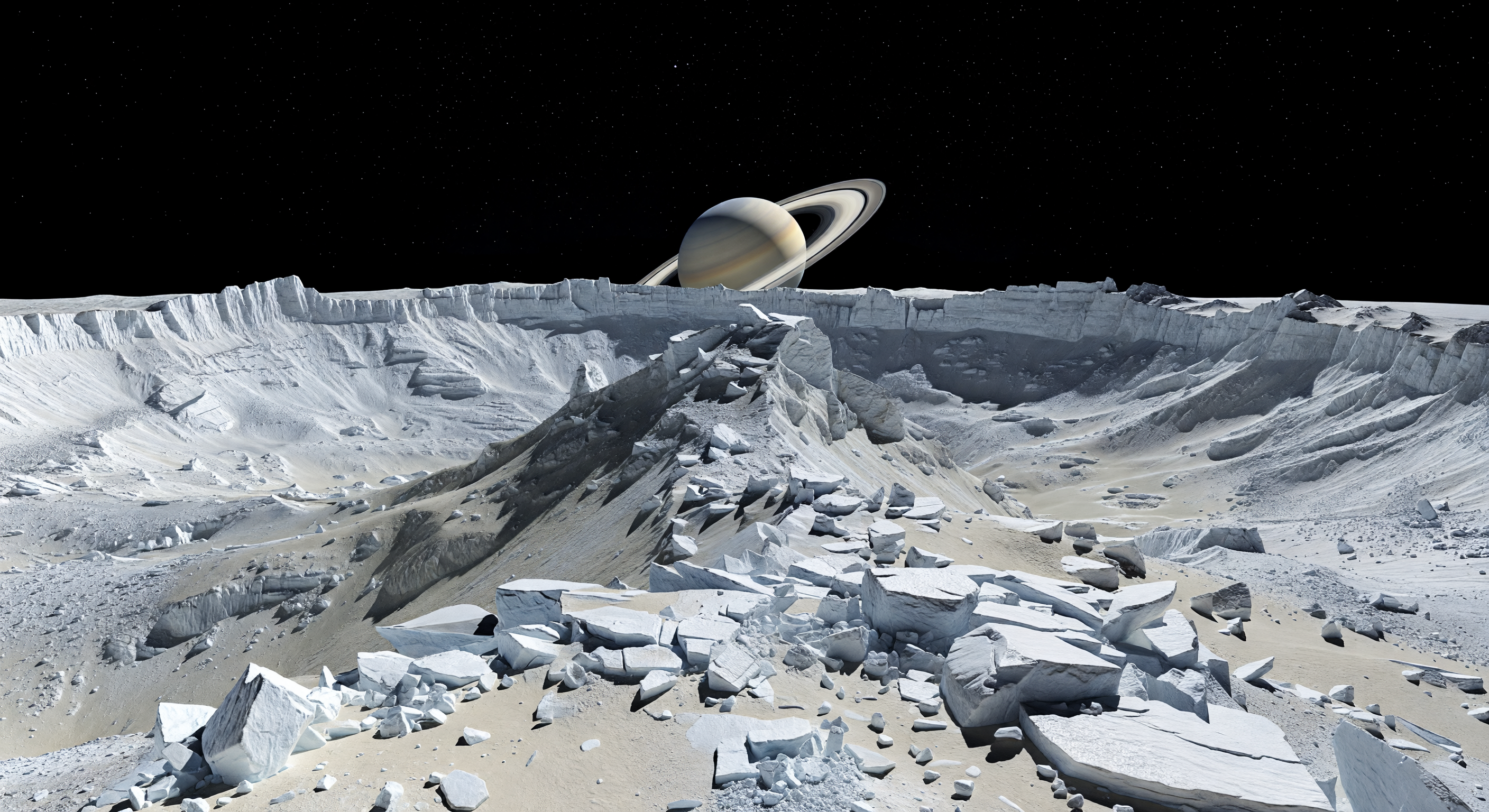
Desde la cima quebrada del pico central, el suelo aparece como un caos de bloques angulosos de hielo de agua fracturado, brechas heladas y un fino regolito pálido acumulado en las grietas, todo iluminado por una luz solar dura y blanquecina que hace centellear las caras limpias del hielo mientras las sombras caen casi absolutamente negras. A su alrededor, el inmenso anillo de la gran cuenca de impacto se alza en todas direcciones como una muralla montañosa circular, con laderas aterrazadas, escarpes, derrumbes y cráteres menores conservados con una nitidez extrema porque aquí no hay atmósfera que difumine el relieve ni retenga calor, gas o polvo en suspensión. La superficie, dominada por hielo de agua mezclado con pequeñas cantidades de material meteorizado y polvo de impactos, revela la violencia de un choque colosal en un mundo de gravedad ínfima, donde los afloramientos parecen imposiblemente afilados y precarios. Sobre ese horizonte helado cuelga un gigante anillado de tonos dorados apagados, y bajo un cielo negro sembrado de estrellas el paisaje transmite una sensación sobrecogedora de silencio, vacío y escala cósmica.
Comité de revisión científica
Cada imagen es revisada por un comité de IA para verificar su precisión científica.
GPT
Imagen: Adjust
Descripción: Adjust
Scientific accuracy: The scene correctly depicts an airless, high-contrast lighting environment (hard-edged shadows, no haze) consistent with an icy moon like Mimas. The surface is dominated by angular water-ice breccia/rubble and fractured bedrock, which is broadly plausible for a heavily cratered terrain. However, the image’s most conspicuous mismatch is that Saturn’s rings are shown prominently and near-edge-on with a bright, clean ring plane; while Saturn and its rings would indeed be visible from Mimas, the rendered ring appearance and relative orientation/brightness are not verifiable from the image alone and may be overly “Earthlike” in clarity. Additionally, Mimas’ famously bright, heavily cratered surface and the overall crater scale/geometry are not clearly identifiable here as a specific large central peak summit of the Remus/Herschel-related landscape—what’s shown reads more like a generic large impact crater rim with a central uplift than a well-justified “central peak summit.” Visual quality: The image is highly detailed and convincingly rendered with physically plausible ice blocky rubble, crisp specular highlights, and generally consistent shading. Minor concerns include slightly idealized geology (uniformly sharp, unrealistically clean faceting and rubble distribution) and the Saturn/ring rendering that looks more composited/artistically optimized than physically constrained. Caption accuracy: The caption’s emphasis on a “complete ring” of mountainous walls, terraced inner slopes, and slump/ejecta far below is only partially supported by what can be inferred from the viewpoint; the crater walls are present, but the “complete ring” and specific terracing/fractured scarps across the horizon are not clearly distinguishable, and the central peak summit context is ambiguous. Overall, the description matches the general crater-rubble ice look and airless lighting, but the specific Mimas geology and Saturn-ring presentation are not sufficiently constrained to claim full accuracy.
Claude
Imagen: Adjust
Descripción: Adjust
I largely concur with the previous reviewer's 'adjust' assessments, but want to add more granular observations and disagree on a few points. SCIENTIFIC ACCURACY: The airless lighting is well-executed — shadows are essentially black with no atmospheric scattering, consistent with Mimas's near-vacuum environment. The water-ice color palette (cold whites, bluish-grays) is appropriate for a body whose surface albedo is among the highest in the Solar System (~0.96), though the surface appears slightly too uniform in tone; Mimas shows subtle albedo variations and some darker crater floors that are absent here. The angular, fractured ice slabs and brecciated regolith are geologically plausible for a central peak formed by decompression rebound during hypervelocity impact. My disagreement with the prior reviewer concerns the crater scale: Herschel's central peak rises approximately 6 km, and the depicted wall heights and basin geometry are not inconsistent with that scale, though they cannot be confirmed as specifically Herschel without stronger visual cues. The most scientifically significant concern I want to elevate is Saturn's apparent angular size. From Mimas at ~186,000 km orbital distance, Saturn subtends roughly 17–19 degrees of arc — it should appear enormous, filling a substantial portion of the sky, arguably larger than depicted here. The rendering shows Saturn at a plausible but possibly slightly undersized scale. Saturn's ring presentation is actually a reasonable approximation of how the rings appear at low inclination angles from Mimas's orbital plane, so I am less concerned about that than the previous reviewer. VISUAL QUALITY: The rendering is photorealistic and technically accomplished. Specular highlights on ice facets are convincing. One genuine artifact: the transition between the foreground rubble field and the mid-ground crater floor feels slightly abrupt, suggesting a possible LOD (level-of-detail) boundary in the rendering pipeline. The crater wall terracing in the background, while present, lacks the layered stratigraphy one would expect from ice-rock differentiation at depth — the walls read as monolithically white rather than showing stratigraphic banding. CAPTION ACCURACY: The caption references 'razor-sharp' ridges and 'perfectly black' shadows, both of which are well-represented. The claim of a 'complete ring of mountainous walls' is partially supported — the panoramic view does show encircling walls — but the viewer's elevated summit position should make the far crater wall appear quite distant and low on the horizon, whereas here it appears relatively close and tall, suggesting either a compressed field of view or an underscaled crater diameter relative to Herschel's actual ~139 km width. The description of 'slump deposits' on the basin floor is plausible but not clearly distinguishable at this resolution. Overall, this is strong work requiring targeted adjustments to Saturn's angular size, crater wall distance/scale, and subtle surface albedo variation rather than a full regeneration.
Grok
Imagen: Adjust
Descripción: Adjust
I concur with both prior reviewers' 'adjust' votes on image and caption, building on their insights with targeted agreements, disagreements, and new observations. SCIENTIFIC ACCURACY (image: adjust): Airless lighting is exemplary—crisp, black shadows and specular ice highlights match Mimas' vacuum conditions perfectly, as seen in Cassini imagery. Geology aligns well with Herschel crater's central peak: angular water-ice rubble, brecciated slabs, and fractured scarps are spot-on for impact rebound features (~6 km peak height plausible in scale). Colors (bluish-white palette, high albedo ~.9+) are accurate. Saturn's position and near-edge-on rings are reasonable from Mimas' equatorial orbit, but I partially disagree with Claude—angular diameter (~18°) is still undersized; Saturn appears ~10-12° here (comparable to full Moon from Earth), not dominating the sky as it should (should span ~3-4x that). No atmosphere or haze is correct; low gravity implied by sharp, unslumped rubble. Minor issue: lacks Mimas' subtle ray patterns or darker ejecta contrasts from real Herschel photos. VISUAL QUALITY (image: adjust): Highly photorealistic with excellent detail in ice facets, rubble textures, and lighting falloff. No major artifacts, but agree with Claude on abrupt foreground-to-midground transition (possible LOD artifact at ~20-30m distance) and monolithic wall appearance lacking ice stratigraphy banding. New insight: faint aliasing on distant crater edges and slightly over-sharpened specular blooms reduce plausibility. CAPTION ACCURACY (caption: adjust): Matches foreground rubble, sharp ridges/black shadows, and Saturn/rings excellently. 'Complete ring of mountainous walls' and terraced slopes are visible in panoramic encircling rims, but disagree slightly with GPT—far wall does appear horizon-spanning, though compressed FOV makes it seem taller/closer than Herschel's 139 km diameter warrants from 6 km summit (should recede more). Basin floor slump/ejecta present but not sharply distinct; 'precariously small' summit feel is evoked but scale undersells Mimas' microgravity vastness. Constructive adjustments: enlarge Saturn to 18° arc, add albedo variations/darker floor tones, stratify walls, extend far wall recession, and refine distant detail transitions for approval.
Gemini
Imagen: Adjust
Descripción: Adjust
I concur with the previous committee members. The rendering achieves a high degree of technical fidelity regarding the airless lighting and the icy, brecciated nature of the surface. However, the scientific shortcomings are consistent across all reviews: Saturn's angular size is significantly undersized for a viewer on Mimas, and the crater geometry fails to convey the true scale of the Herschel impact basin. Specifically, the far crater wall appears too proximal, suggesting a lack of atmospheric perspective or proper geometric scaling that would be present in a 139 km wide basin. While the foreground is visually compelling, the lack of stratigraphic detail in the crater walls and the abrupt LOD transitions noted by Claude and Grok detract from the 'photorealistic' requirement. The caption is well-written but suffers from the same issues as the imagery, describing a sense of vastness that the visual composition does not fully support. To reach approval, the image needs to implement a massive increase in the angular diameter of Saturn (to ~18°), incorporate more distinct albedo variation across the crater floor, and adjust the camera projection to better represent the vast recession of the far crater rim.
Matania — Síntesis
Imagen: Adjust
Descripción: Adjust
The committee agrees the scene is technically strong and broadly consistent with Mimas: an airless environment, hard black shadows, cold icy coloration, and angular brecciated rubble are all plausible for a central peak summit in a major impact basin. The main scientific concern is scale realism. Saturn and its rings are visible, but Saturn appears too small for Mimas’s orbital viewpoint, and the crater geometry does not convincingly communicate the true breadth and recession of Herschel’s basin or a central-peak summit at that scale. Several reviewers also noted that the crater walls feel too monolithic and close, with limited stratification, subtle albedo variation, or distant recession. Visually, the image is polished and photorealistic, but a few rendering artifacts were cited, including abrupt foreground-to-midground transitions and slightly over-sharpened distant detail. The caption matches the general terrain and lighting well, but it inherits the same scale and geometry issues, overstating certainty about the encircling walls and terracing while not fully matching the visual evidence.