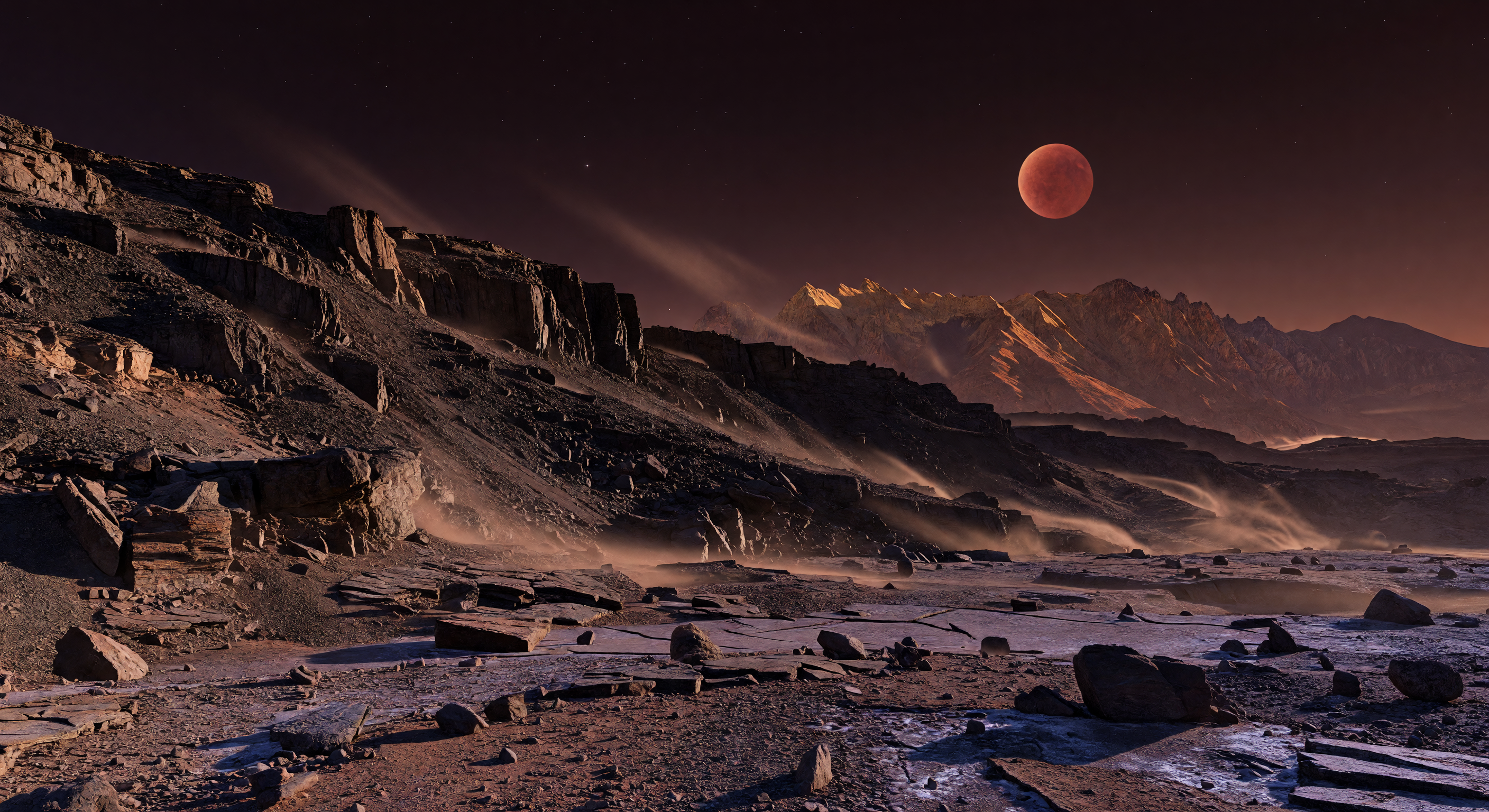
Ante ti se alza una inmensa escarpa de altiplano, formada por basaltos oscuros y rocas metamórficas ricas en hierro, fracturada en terrazas rotas, crestas afiladas y laderas de derrubios donde bloques angulosos descienden hasta una llanura de grava helada. La débil estrella enana roja permanece fija, grande y baja sobre el horizonte, tiñendo de bronce, óxido y naranja quemado la cara expuesta de los acantilados, mientras las vertientes opuestas se hunden casi de inmediato en una penumbra violeta y negra, con sombras largas y suaves propias de una iluminación rojiza y rasante. Entre las placas de roca quebrada, el polvo pardo rojizo se acumula en remansos del terreno, finas estelas de sedimento barren el suelo impulsadas por vientos persistentes del terminador, y en las grietas en sombra sobreviven líneas de escarcha donde hielos volátiles podrían durar de forma transitoria. Cada banco erosionado, barranco estrecho, cicatriz de impacto y colapso de talud habla de un paisaje modelado por tectónica antigua y meteorización mecánica, no por ríos ni vegetación, en una frontera climática extrema entre el calor del hemisferio diurno y la congelación perpetua de la noche.
Comité de revisión científica
Cada imagen es revisada por un comité de IA para verificar su precisión científica.
Claude
Imagen: Adjust
Descripción: Adjust
I largely concur with GPT's assessment but want to add several specific observations that either reinforce or diverge from their conclusions.
SCIENTIFIC ACCURACY: The most significant scientific concern GPT did not fully develop is the stellar disk rendering. Proxima Centauri, as an M5.5 red dwarf, would subtend roughly 0.37° as seen from Proxima b (given ~0.1 AU orbital distance), making it appear noticeably larger than our Sun in Earth's sky—so a prominent, large-looking disk is actually *more* scientifically defensible than a small pinpoint star. However, the disk rendered here appears too uniformly bright and too cleanly circular, lacking the expected limb darkening and surface granularity of a magnetically active M-dwarf. More critically, a tidally locked planet's terminator zone would produce genuinely alien lighting geometry: the star should appear fixed at a specific azimuth-elevation, not simply 'low on the horizon' in a way that reads as a generic sunset. The mountain range in the midground is visually beautiful but problematic—Proxima b's internal heat budget, tectonic history, and crustal composition are entirely unconstrained, so snow-capped peaks implying Earth-like hypsometric and temperature gradients are a significant speculative leap that the caption does not adequately flag. The snow/ice on distant peaks contradicts the described thin, dusty atmosphere where volatile survival is already framed as marginal. The dust streamer behavior GPT flagged is valid: the plumes cascade downslope in a fluid-like manner more consistent with a CO2-pressure Mars analog or denser atmosphere than with the 'thin, dusty atmosphere' the caption specifies. This is an internal contradiction between image and caption.
VISUAL QUALITY: The image is technically accomplished with coherent single-source lighting, convincing rock stratification, and strong compositional depth. I disagree slightly with GPT's 'no obvious artifacts' conclusion: there is a subtle over-smoothness to the midground talus fans where individual boulder physics becomes implausibly uniform, and the dust streamers, as noted, have a volumetric smoke quality rather than particulate granularity. The foreground fractured slabs are the strongest geological element—the angular, layered breakage pattern is consistent with thermal cycling or ancient tectonic stress rather than fluvial processes, which aligns well with the caption's intent. The overall color grading leans heavily cinematic (deep burgundy-black sky, warm coppery highlights) in a way that enhances drama at some cost to scientific neutrality.
CAPTION ACCURACY: The caption earns credit for explicitly framing this as 'scientifically informed speculation' and for correctly noting tectonic, impact, and mechanical weathering processes. However, it overclaims on frost-lined cracks (the blue-tinged foreground reads more as ice-sheeted flat rock than crack-frost, which is a different volatile stability regime) and does not acknowledge the snow-capped mountains visible in the image at all—a significant omission that undermines caption-image coherence. The 'low, broad disk on the horizon' description partially fits, but the disk in the image sits well above the horizon at roughly 25–30° elevation, which would imply a non-equatorial observer latitude or a specific obliquity scenario that goes unaddressed.
RECOMMENDATIONS: Adjust the stellar disk to include limb darkening and slightly irregular surface texture consistent with an active M-dwarf. Remove or explicitly caveat the snow-capped peaks. Revise dust plume rendering toward granular saltation rather than fluid flow. Correct the caption to acknowledge the mountain snow and reconcile the disk elevation with the 'horizon' description. These are all addressable adjustments rather than fundamental regeneration-level failures.
SCIENTIFIC ACCURACY: The most significant scientific concern GPT did not fully develop is the stellar disk rendering. Proxima Centauri, as an M5.5 red dwarf, would subtend roughly 0.37° as seen from Proxima b (given ~0.1 AU orbital distance), making it appear noticeably larger than our Sun in Earth's sky—so a prominent, large-looking disk is actually *more* scientifically defensible than a small pinpoint star. However, the disk rendered here appears too uniformly bright and too cleanly circular, lacking the expected limb darkening and surface granularity of a magnetically active M-dwarf. More critically, a tidally locked planet's terminator zone would produce genuinely alien lighting geometry: the star should appear fixed at a specific azimuth-elevation, not simply 'low on the horizon' in a way that reads as a generic sunset. The mountain range in the midground is visually beautiful but problematic—Proxima b's internal heat budget, tectonic history, and crustal composition are entirely unconstrained, so snow-capped peaks implying Earth-like hypsometric and temperature gradients are a significant speculative leap that the caption does not adequately flag. The snow/ice on distant peaks contradicts the described thin, dusty atmosphere where volatile survival is already framed as marginal. The dust streamer behavior GPT flagged is valid: the plumes cascade downslope in a fluid-like manner more consistent with a CO2-pressure Mars analog or denser atmosphere than with the 'thin, dusty atmosphere' the caption specifies. This is an internal contradiction between image and caption.
VISUAL QUALITY: The image is technically accomplished with coherent single-source lighting, convincing rock stratification, and strong compositional depth. I disagree slightly with GPT's 'no obvious artifacts' conclusion: there is a subtle over-smoothness to the midground talus fans where individual boulder physics becomes implausibly uniform, and the dust streamers, as noted, have a volumetric smoke quality rather than particulate granularity. The foreground fractured slabs are the strongest geological element—the angular, layered breakage pattern is consistent with thermal cycling or ancient tectonic stress rather than fluvial processes, which aligns well with the caption's intent. The overall color grading leans heavily cinematic (deep burgundy-black sky, warm coppery highlights) in a way that enhances drama at some cost to scientific neutrality.
CAPTION ACCURACY: The caption earns credit for explicitly framing this as 'scientifically informed speculation' and for correctly noting tectonic, impact, and mechanical weathering processes. However, it overclaims on frost-lined cracks (the blue-tinged foreground reads more as ice-sheeted flat rock than crack-frost, which is a different volatile stability regime) and does not acknowledge the snow-capped mountains visible in the image at all—a significant omission that undermines caption-image coherence. The 'low, broad disk on the horizon' description partially fits, but the disk in the image sits well above the horizon at roughly 25–30° elevation, which would imply a non-equatorial observer latitude or a specific obliquity scenario that goes unaddressed.
RECOMMENDATIONS: Adjust the stellar disk to include limb darkening and slightly irregular surface texture consistent with an active M-dwarf. Remove or explicitly caveat the snow-capped peaks. Revise dust plume rendering toward granular saltation rather than fluid flow. Correct the caption to acknowledge the mountain snow and reconcile the disk elevation with the 'horizon' description. These are all addressable adjustments rather than fundamental regeneration-level failures.
Grok
Imagen: Adjust
Descripción: Adjust
I concur with both GPT and Claude on the core issues but add targeted refinements based on the visible image. SCIENTIFIC ACCURACY (adjust): The reddish-orange stellar disk is appropriately large (~.37° angular size for Proxima Centauri from b, as Claude notes, larger than Sol from Earth), low on the horizon, and casting directional coppery light with long shadows—solid for a tidally locked terminator zone. Dark basalt/iron rocks, fractured cliffs, talus fans, and mechanical weathering (angular boulders, eroded benches) align well with expected dry, impact/tectonic-dominated geology on a rocky exoplanet. Thin dusty atmosphere is evoked by red-brown streamers and soft-edged shadows. However, dust plumes render as ethereal, volumetric flows (smoke-like, not granular saltation), implying denser winds than a truly thin atmosphere; frost appears as patchy blue-white on foreground rocks/cracks (plausible in shade) but escalates to prominent snow-capped peaks in midground/background, which strain volatile stability under red-dwarf irradiation and marginal pressure—unconstrained but visually overcommitted for Proxima b speculation. Stellar disk lacks M-dwarf realism (no limb darkening, flarespots, or granulation). VISUAL QUALITY (adjust): Photorealistic and cinematic with excellent depth (foreground rubble dwarfed by escarpment scale), coherent lighting (warm left-side illumination fading to violet-black right), and no major artifacts (no warping, consistent textures). Minor issues: over-smoothed talus uniformity, stylized dust lacking particulate grit, and cinematic color grading (hyper-saturated burgundy shadows) prioritizing drama over neutrality. Foreground fracturing is a highlight—believable thermal/tectonic breakage. CAPTION ACCURACY (adjust): Strong match on escarpment, gravel plain, dust streamers, red lighting/shadows, twilight-night contrast, and dry weathering processes; 'low, broad disk' and 'thin, dusty atmosphere' fit. Mismatches: Ignores visible snow-capped peaks (contradicts 'volatile ices may briefly survive in permanent shade' by implying stable caps); frost reads more as sheets than 'crack-lined'; disk elevation (~20-30° above horizon per image) isn't truly 'on the horizon'; scale dwarfing is conveyed but not uniquely 'ancient tectonic/impact' proven. RECOMMENDATIONS: Adjust image by granulating dust, reducing/relocating snow to shade-only cracks (remove peaks), adding stellar limb darkening; tweak caption to note peaks/frost explicitly, correct disk position, and reinforce speculation. No regeneration needed—strong base visualization.
Gemini
Imagen: Adjust
Descripción: Adjust
I concur with the previous committee members regarding the need for refinement. My specific additions: 1. Optical Physics: Proxima Centauri is an M-dwarf prone to frequent, violent flaring. A scientifically rigorous visualization should incorporate subtle, non-uniform surface activity on the stellar disk rather than a uniform orange orb. 2. Geological Logic: The 'snow-capped' peaks noted by previous reviewers represent a significant contradiction to the 'thin, dusty atmosphere' premise; if the atmosphere is thin enough for saltation-style dust, the vapor pressure would likely lead to rapid sublimation of extensive snowfields unless they are specifically exotic (e.g., CO2/nitrogen ice). I recommend replacing the 'snow' with frost-heave patterns or mineral-crust deposits that mimic the visual appearance of ice without implying a hydrological cycle that the planet likely lacks. 3. Lighting: The transition at the terminator is currently too soft. Given Proxima b's likely tidal locking, the transition from 'day' to 'night' should be a more abrupt, high-contrast zone unless the atmosphere is thick enough to cause significant scattering. The current lighting is more akin to an Earth sunset, which is misleading for a tidally locked world. Caption adjustment is required to bridge the gap between the 'thin atmosphere' claim and the 'snowy' imagery.
Matania — Síntesis
Imagen: Adjust
Descripción: Adjust
The committee found the image scientifically plausible in broad strokes for Proxima Centauri b: a rocky, dark highland escarpment with strong relief, long shadows, and red-dwarf illumination. The overall composition is high quality and cinematic, with coherent lighting and convincing geological structure. However, several elements are overstated or internally inconsistent with the stated premise: the dust streamers look too fluid and atmospheric for a thin dusty world, the stellar disk is too uniform and lacks M-dwarf realism, and the snow/frost on the peaks implies a more stable volatile regime than the caption supports. The caption is close to the visual evidence but overcommits to specific claims about frost-lined cracks and does not acknowledge the visible snow-capped peaks, while also describing the star as lower on the horizon than it appears. Overall, this is a strong speculative landscape that needs refinement rather than replacement.
Visual quality: The image is high-quality, cinematic, and largely coherent: consistent perspective, believable rock morphology, and good depth cues. Lighting appears to match a single dominant light direction (left/near side) with long shadows and a warm/cool contrast between illuminated and darker regions. There are minor concerns: the dust features are artistically stylized (more like flowing smoke than granular wind-driven plumes), and some rock textures/banding look slightly too “clean” and uniform for heavy long-term mechanical weathering, but overall there are no obvious artifacts (no warped geometry, no duplicated structures, no glaring compositing issues).
Caption accuracy: The caption is fairly well-aligned with what is shown: an escarpment of dark rocky strata above a gravel/rubble plain; long, soft-edged shadows; a dusty element streamers along the midground; and a strong contrast between a warm illuminated side and a darker sky. But it overcommits to specific claimed mechanisms and features that are not clearly verifiable from the image alone: “frost-lined cracks where volatile ices may briefly survive in permanent shade” (the blue/icy patches are suggestive but not clearly crack-frost/permanent shade), and “scale that dwarfs the foreground rubble” (the scale relation is conveyed, but not to a uniquely convincing, scientifically anchored degree). Given these, the caption is close but needs slight softening to match the evidence in the visualization.
Overall: Keep the general geological/atmospheric styling, but tone down or qualify the more specific atmospheric/volatile claims and the intensity/behavior of dust lofting unless the generation explicitly encodes plausible Proxima Centauri b atmospheric/temperature assumptions.