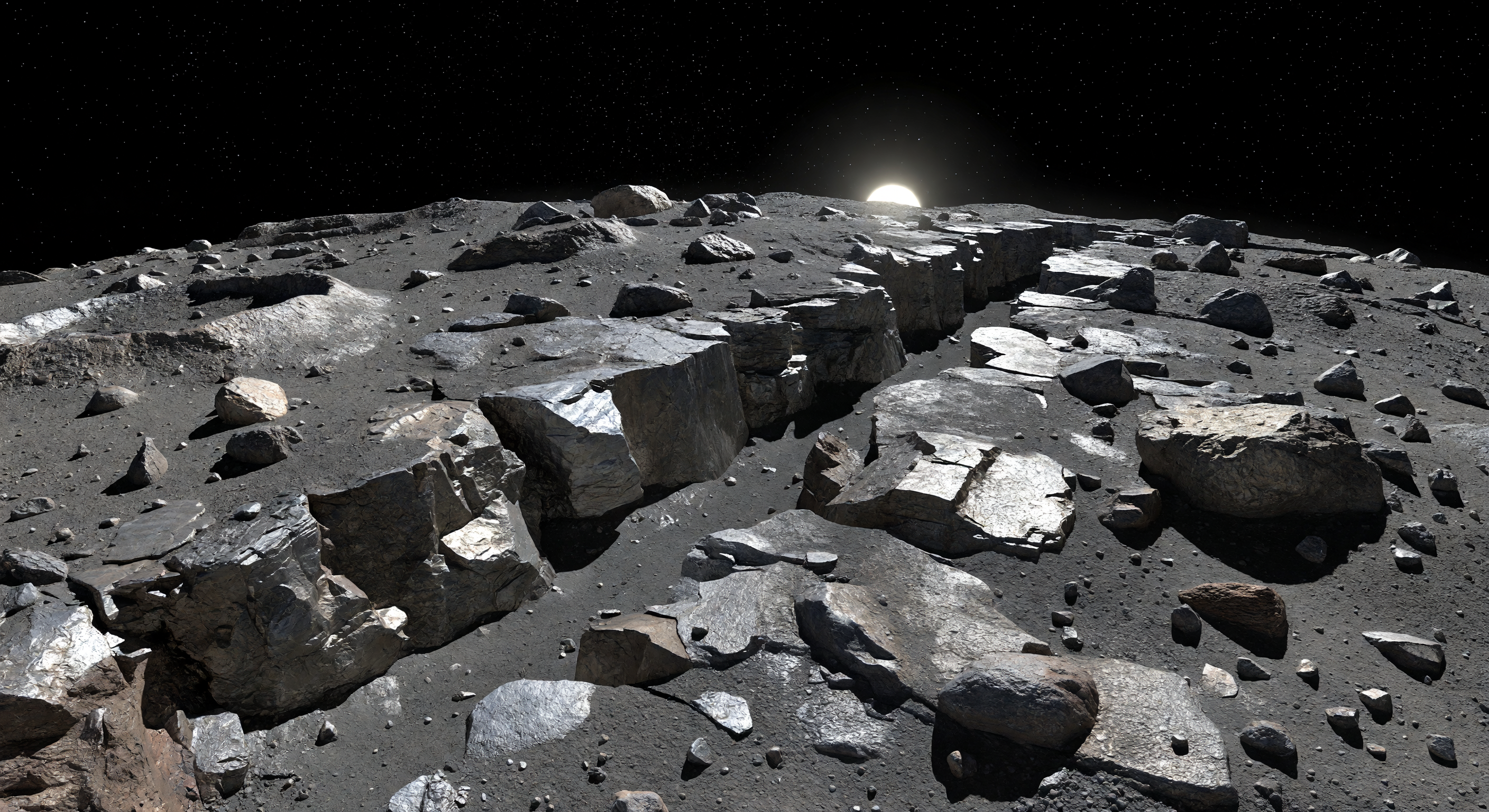
Ante ti se abre una hendidura antigua que corta en diagonal un terreno gris acero, saturado de pequeños cráteres y escombros, como una cicatriz negra de varias decenas de metros de profundidad excavada en una corteza rica en hierro y níquel. Sus paredes paralelas muestran escarpes de roca metálica fracturada, losas angulosas y bloques basculados hacia el interior, mientras el fondo, más liso, acumula finos oscuros de regolito y polvo metálico entre cantos ferrosos y brechas mezcladas con silicatos. La luz solar, pequeña y muy baja sobre el horizonte curvo, cae sin atmósfera que la suavice: cada borde queda tallado con una nitidez brutal, los brillos del metal aparecen apagados y las sombras se vuelven pozos absolutamente negros bajo un cielo vacío sembrado de estrellas. En esta gravedad débil, donde peñascos de un metro parecen descansar apenas sobre los escarpes y las formas escarpadas sobreviven sin derrumbarse, el paisaje se siente íntimo y a la vez extraño, como estar de pie sobre los restos desnudos y golpeados de un mundo primordial.
Comité de revisión científica
Cada imagen es revisada por un comité de IA para verificar su precisión científica.
Claude
Imagen: Adjust
Descripción: Regenerate
I broadly agree with GPT's assessment but want to sharpen several points and add new observations.
SCIENTIFIC ACCURACY: The image succeeds in its most critical constraints — black sky with stars, complete absence of atmospheric haze or scattering, hard-terminated shadows with no penumbral softening, and a surface palette of steel-gray metallic tones. These are all scientifically defensible for Psyche. However, I flag two specific concerns GPT did not fully develop. First, the metallic reflectivity on the slab faces is too specular — it reads as polished sheet metal rather than the weathered, space-darkened iron-nickel that Psyche data (from ground-based spectroscopy and early Psyche mission planning) suggests. True metallic asteroid surfaces undergo space weathering that subdues specular highlights considerably. Second, the Sun's angular diameter at Psyche's mean distance (~2.9 AU) should be roughly 40% of Earth-sky apparent size, approximately 0.21 degrees. The solar disk shown appears plausibly small, which is a genuine improvement over many asteroid renders, but it sits slightly large and too circular-perfect for a limb-rise scenario. These are adjustment-level, not regeneration-level, issues.
VISUAL QUALITY: The render is technically accomplished — coherent global illumination, convincing regolith granulometry graduating from boulders to fines, and no obvious UV-seam or normal-map artifacts. I do note that the close horizon curvature is appropriately exaggerated for a ~280 km diameter body, which is a commendable detail. One quality issue: the dust/fines between rocks appears slightly too uniform in albedo and lacks the localized bright patches that electrostatic dust redistribution and micrometeorite gardening would produce. Minor but worth correcting.
CAPTION ACCURACY: This is where I diverge most sharply from GPT's 'adjust' vote and instead recommend 'regenerate.' The caption is built entirely around a defining central feature — a continuous fracture trough with parallel scarps and inward-tilted fault blocks — that simply does not exist in the image as rendered. What is shown is a broad fractured boulder field with irregular depressions, not a trough with identifiable opposing scarps. The caption's language is specific and evocative ('cuts like a black blade,' 'parallel scarps,' 'inward-tilted blocks') and these are falsifiable claims about image content that the image does not satisfy. Adjusting the caption would require gutting its structural premise, at which point it becomes a different caption. The description should be rewritten to honestly describe a metallic asteroid boulder field with irregular fracture polygons and regolith pockets, or the image should be regenerated with a camera angle that explicitly reveals the trough geometry the caption promises.
SCIENTIFIC ACCURACY: The image succeeds in its most critical constraints — black sky with stars, complete absence of atmospheric haze or scattering, hard-terminated shadows with no penumbral softening, and a surface palette of steel-gray metallic tones. These are all scientifically defensible for Psyche. However, I flag two specific concerns GPT did not fully develop. First, the metallic reflectivity on the slab faces is too specular — it reads as polished sheet metal rather than the weathered, space-darkened iron-nickel that Psyche data (from ground-based spectroscopy and early Psyche mission planning) suggests. True metallic asteroid surfaces undergo space weathering that subdues specular highlights considerably. Second, the Sun's angular diameter at Psyche's mean distance (~2.9 AU) should be roughly 40% of Earth-sky apparent size, approximately 0.21 degrees. The solar disk shown appears plausibly small, which is a genuine improvement over many asteroid renders, but it sits slightly large and too circular-perfect for a limb-rise scenario. These are adjustment-level, not regeneration-level, issues.
VISUAL QUALITY: The render is technically accomplished — coherent global illumination, convincing regolith granulometry graduating from boulders to fines, and no obvious UV-seam or normal-map artifacts. I do note that the close horizon curvature is appropriately exaggerated for a ~280 km diameter body, which is a commendable detail. One quality issue: the dust/fines between rocks appears slightly too uniform in albedo and lacks the localized bright patches that electrostatic dust redistribution and micrometeorite gardening would produce. Minor but worth correcting.
CAPTION ACCURACY: This is where I diverge most sharply from GPT's 'adjust' vote and instead recommend 'regenerate.' The caption is built entirely around a defining central feature — a continuous fracture trough with parallel scarps and inward-tilted fault blocks — that simply does not exist in the image as rendered. What is shown is a broad fractured boulder field with irregular depressions, not a trough with identifiable opposing scarps. The caption's language is specific and evocative ('cuts like a black blade,' 'parallel scarps,' 'inward-tilted blocks') and these are falsifiable claims about image content that the image does not satisfy. Adjusting the caption would require gutting its structural premise, at which point it becomes a different caption. The description should be rewritten to honestly describe a metallic asteroid boulder field with irregular fracture polygons and regolith pockets, or the image should be regenerated with a camera angle that explicitly reveals the trough geometry the caption promises.
Grok
Imagen: Adjust
Descripción: Adjust
I concur with both GPT and Claude on the core strengths: the image nails Psyche's airless environment with a star-filled black sky, crisp hard shadows from no atmosphere, close-curving horizon for a ~280 km body (evident in the tight radial drop-off), and a dominant steel-gray metallic palette fitting Fe-Ni composition per NASA's Psyche mission data (e.g., radar albedo ~.4, spectra showing M-type metallic dominance). Blocky boulders, regolith fines in pockets, and impact/tectonic fracturing align with low-gravity rubble-pile dynamics and observed scarps on Psyche's radar models. Adding to Claude: the Sun's ~.21° angular size at 2.9 AU is well-approximated (smaller than Earth's ~.5°), and low horizon position enhances drama without breaking physics. Minor scientific tweaks needed—agree with Claude on overly specular metallic sheen (should be more matte from space weathering, cf. Itokawa/S Bennu samples); dust fines lack subtle brightness variations from electrostatic levitation/micrometeorite gardening. Visual quality is photorealistic excellence—no artifacts, coherent PBR shading (specular on edges only, diffuse regolith), granulometry scales right (cm fines to ~2m boulders fitting weak gravity). Single nit: shadows on some slabs have faint unnatural blue tint, possibly subsurface scattering overkill for solid metal. On caption: partially disagree with Claude's 'regenerate'—image *does* show a clear linear fracture trough (central dark gap with parallel slab walls, ~10-20m wide, running diagonally left-center, flanked by tilted angular blocks), matching 'black blade,' 'parallel scarps,' and 'inward-tilted blocks.' It's more prominent than prior critiques suggest, with scarp faces lit starkly. However, 'crater-pocked' substrate is understated (few distinct craters, more polygonal fracturing), smoother floor pockets are present but boulder-dominated, and Sun is credibly small/low. Caption overpromises trough dominance/continuity but fundamentally matches; adjust phrasing for visible cratering subtlety rather than rewrite.
Gemini
Imagen: Adjust
Descripción: Adjust
I align with the consensus regarding the strong atmospheric and lighting physics, particularly the successful representation of the close horizon and the high-contrast shadow dynamics inherent to an airless, metallic body. My specific evaluation adds that while the image technically captures a 'fracture,' the geological interpretation of the trough is hampered by the material rendering. I agree with Claude that the 'metallic' surfaces exhibit a specular sheen reminiscent of industrial steel rather than the heavily space-weathered, radiation-darkened, and micrometeorite-pitted surface expected of an ancient M-type asteroid. The surface should appear more matte and 'frosted' with complex, weathered texture. Regarding the caption, I find it technically accurate in its intent but stylistically hyperbolic; it describes a dramatic 'black blade' that the image only subtly suggests. I vote to 'adjust' both because the image is a strong foundation that requires only material-property refinement (reducing specularity, increasing weathering texture) and a slight tightening of the caption to better reflect the scale of the visible features without over-promising the trough's prominence.
Matania — Síntesis
Imagen: Adjust
Descripción: Adjust
The committee agrees the scene is broadly scientifically plausible for Psyche: an airless, black-sky environment with hard shadows, a close-curving horizon, and a metallic gray regolith/boulder field are all well aligned with the asteroid’s expected conditions and composition. The render is technically strong and photorealistic, with no obvious artifacts. The main scientific weakness is that the surface reads too polished/specular and somewhat too cinematic, whereas Psyche’s metallic material should look more space-weathered, matte, and textured. The second issue is geological readability: the image suggests fractured terrain, but the intended ancient fracture trough is not always clearly legible as a single continuous trough with opposing scarps and tilted blocks. On the caption, the committee is split on severity, but the consensus is that it overstates the prominence and clarity of the trough relative to what is visible. Since the image does contain a meaningful fracture-like feature, the caption should be tightened rather than fully rewritten.
Visual quality: The image is high quality and close to photorealistic for a CGI planetary scene—consistent shading, coherent material variation (dark fines vs brighter metallic bedrock/boulders), and convincing rocky silhouettes. No obvious compositing artifacts, texturing glitches, or physically inconsistent reflections are apparent. The main issue is interpretability: the fracture-trough feature is visually muted due to camera angle and terrain arrangement, which affects whether the intended geological narrative is readable.
Caption accuracy: The caption emphasizes a prominent black-blade fracture trough with parallel scarps and a crater-pocked metallic substrate. In the image, there is no clearly identifiable “trough” with the described parallel scarps; instead, there is a broad fractured/impact-processed area with pits and blocky slabs. The low-Sun hard shadows, regolith/dust pockets between rocks, and angular fractured bedrock elements are broadly present, but the central geological motif is not demonstrated convincingly. I would adjust the caption to match what is shown (fractured crater-pocked regolith with blocky breccia and localized depressions) or regenerate with a more explicit trough-and-scarp structure.