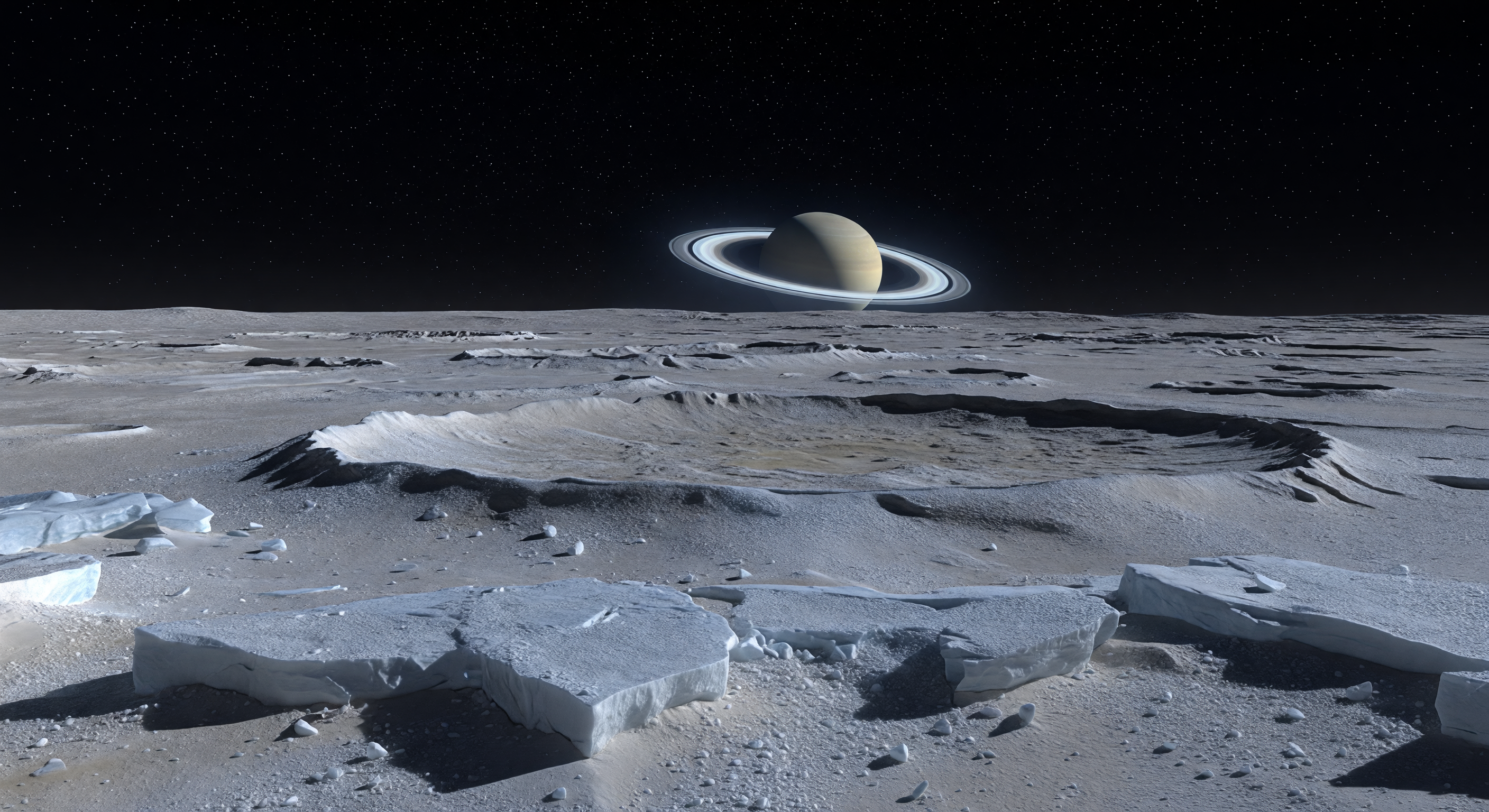
Bajo un cielo negro y perfectamente vacío, sembrado de estrellas nítidas, la llanura polar helada se extiende hasta un horizonte remoto donde apenas sobresalen bordes bajos de cráteres y antiguas cicatrices de impacto, todos dibujados por una débil claridad espectral. El terreno, formado por roca de hielo de agua endurecida y cubierto por un regolito pálido de fragmentos meteóricos, muestra bloques angulosos, escarcha brillante y suaves ondulaciones de eyección craterizada en tonos blanco azulado, gris y un leve beige grisáceo de impurezas no heladas. Sin atmósfera, viento ni líquidos, nada suaviza este paisaje criogénico: las sombras caen casi en negro absoluto dentro de las depresiones, mientras la escasa iluminación procede sólo del fulgor de un gigante anillado y de la luz reflejada por sus anillos, que bañan la superficie con destellos plateados y azulados. La baja gravedad prolonga la vista y acentúa la sensación de inmensidad silenciosa, como si uno estuviera de pie sobre una reliquia congelada del Sistema Solar exterior, esculpida durante eones por impactos y lenta meteorización espacial.
Comité de revisión científica
Cada imagen es revisada por un comité de IA para verificar su precisión científica.
Claude
Imagen: Adjust
Descripción: Adjust
I broadly agree with GPT's assessment but want to add several specific observations that sharpen the critique.
SCIENTIFIC ACCURACY: The ice block morphology is the most scientifically problematic element. The angular, slab-like ice fragments in the foreground resemble terrestrial sea ice or fractured glacial ice sheets — implying relatively recent tectonic or thermal fracturing activity. Rhea is geologically inert; its surface has not experienced significant endogenic resurfacing. These features should instead be impact ejecta blocks, more irregular and randomized in orientation, not the quasi-planar, stacked-slab geometry shown. Rhea's surface reflectance (geometric albedo ~0.949) is among the highest in the Solar System, meaning even faint Saturnshine would illuminate it noticeably — so the lighting intensity is arguably defensible, though the blue-silver color temperature is slightly too cool and cinematic. Saturn's angular size is plausible from Rhea (~1.7° apparent diameter) and the rendering is not obviously wrong in scale, though the rings appear slightly too face-on and luminous. The cratered terrain is present but subdued; GPT is correct that the caption's promised 'overlapping craters' are not visually prominent. The starfield density looks reasonable for an airless body.
VISUAL QUALITY: Photorealism is high. The main artifact is the aforementioned sea-ice slab appearance, which reads as a CGI shortcut rather than authentic regolith and ejecta geology. Shadows are consistent with a single dominant light source, which is accurate. No perspective distortions or texture tiling artifacts are visible.
CAPTION ACCURACY: The caption is evocative and scientifically literate in vocabulary but overclaims on geological detail ('overlapping craters, subdued ejecta hummocks') that the image does not clearly deliver, while the 'angular ice blocks' claim ironically matches the image but describes the wrong geologic process for Rhea. 'Tan-gray non-ice impurities' are not distinctly visible. Caption and image need mutual adjustment to reconcile these discrepancies rather than a full regeneration.
SCIENTIFIC ACCURACY: The ice block morphology is the most scientifically problematic element. The angular, slab-like ice fragments in the foreground resemble terrestrial sea ice or fractured glacial ice sheets — implying relatively recent tectonic or thermal fracturing activity. Rhea is geologically inert; its surface has not experienced significant endogenic resurfacing. These features should instead be impact ejecta blocks, more irregular and randomized in orientation, not the quasi-planar, stacked-slab geometry shown. Rhea's surface reflectance (geometric albedo ~0.949) is among the highest in the Solar System, meaning even faint Saturnshine would illuminate it noticeably — so the lighting intensity is arguably defensible, though the blue-silver color temperature is slightly too cool and cinematic. Saturn's angular size is plausible from Rhea (~1.7° apparent diameter) and the rendering is not obviously wrong in scale, though the rings appear slightly too face-on and luminous. The cratered terrain is present but subdued; GPT is correct that the caption's promised 'overlapping craters' are not visually prominent. The starfield density looks reasonable for an airless body.
VISUAL QUALITY: Photorealism is high. The main artifact is the aforementioned sea-ice slab appearance, which reads as a CGI shortcut rather than authentic regolith and ejecta geology. Shadows are consistent with a single dominant light source, which is accurate. No perspective distortions or texture tiling artifacts are visible.
CAPTION ACCURACY: The caption is evocative and scientifically literate in vocabulary but overclaims on geological detail ('overlapping craters, subdued ejecta hummocks') that the image does not clearly deliver, while the 'angular ice blocks' claim ironically matches the image but describes the wrong geologic process for Rhea. 'Tan-gray non-ice impurities' are not distinctly visible. Caption and image need mutual adjustment to reconcile these discrepancies rather than a full regeneration.
Grok
Imagen: Adjust
Descripción: Adjust
I concur with both GPT and Claude's assessments, with some refinements and additions for precision. SCIENTIFIC ACCURACY (image: adjust): The airless, icy regolith surface with craters and low-gravity horizon distance aligns well with Rhea's ~.33g and impact-dominated geology (e.g., Cassini ISS images show subdued, overlapping craters like those in Inktomi crater). Lighting from Saturnshine is conceptually sound—Rhea's high albedo (~.95) would reflect faint illumination effectively, and Saturn's ~1.7° angular diameter from Rhea matches the large horizon-spanning scale. However, issues persist: (1) Foreground ice blocks exhibit stacked, planar 'sea ice' fracturing (sharp edges, horizontal layering), inconsistent with Rhea's randomized impact ejecta boulders (e.g., more tumbled, irregular shapes seen in high-res Cassini mosaics); (2) Saturn's rings appear excessively face-on and luminous for a 'polar' view—Rhea's ~45° inclination means rings would be more edge-on/thinner from polar latitudes, reducing glow; (3) Bluish color temperature is too cool (Saturnshine should skew warmer yellow from Saturn's spectrum + ring diffusion). Stars are appropriately dense, sky black, no atmosphere artifacts. VISUAL QUALITY (image: adjust): Excellent photorealism—no artifacts, consistent single-source shadows, sharp textures, proper perspective. Sole issue is the stylized ice morphology, which undermines geological authenticity without breaking coherence. CAPTION ACCURACY (caption: adjust): Description is scientifically evocative and mostly matches (e.g., 'angular ice blocks,' frozen plain, Saturn looming), but mismatches image emphasis—'low worn crater rims,' 'overlapping craters,' 'subdued ejecta hummocks' are present but not 'dominant' or 'barely revealed' in foreground (ice slabs steal focus); 'faint tan-gray impurities' barely discernible; 'near-perfect black' hollows contradicted by visible fill light. Suggest image tweaks: randomize ice blocks to ejecta-like, edge-on rings, warmer lighting. Caption tweaks: tone down unsubstantiated geology, align with visible ice emphasis while noting impact origins.
Gemini
Imagen: Adjust
Descripción: Adjust
I concur with the previous committee members regarding the 'sea-ice' morphology error. Rhea's surface is dominated by impact-generated regolith; the foreground rocks should be irregular, rounded, or sub-angular debris rather than the planar, stratified slabs currently depicted, which imply terrestrial-style glaciology. I further agree that the lighting is too blue-shifted; while Rhea has high albedo, Saturnshine is characterized by the reflected light of a gas giant, which should lean more toward a warm, muted gold or neutral pale yellow rather than the 'cinematic blue' utilized here. The ring inclination is also physically inconsistent with a polar view, where the rings should appear as a much narrower, sharper line rather than a broad, luminous disc. The caption is well-written but suffers from 'feature-inflation'—it promises a density of cratering and ejecta hummocks that the current image composition does not support. To reach approval, the image needs a shift in rock morphology and lighting temperature, and the caption should be trimmed to reflect only the features clearly visible in the foreground.
Matania — Síntesis
Imagen: Adjust
Descripción: Adjust
The committee found the scene broadly plausible for Rhea’s airless icy surface under Saturnshine, with strong, coherent photorealism and no major rendering artifacts. However, several scientific details feel stylized rather than faithful: the foreground ice blocks read too much like terrestrial sea ice, the lighting is overly cool and cinematic, and Saturn’s rings appear too bright and too face-on for a polar view. The caption is well-written and broadly aligned, but it overstates geological features not clearly visible in the image and should be tightened to match the foreground more closely.
Visual quality: The image is high resolution, coherent, and photorealistic in style. There are no obvious rendering artifacts (no warped geometry, inconsistent perspective, or gross texture errors). The main issues are artistic/physical stylization: Saturnshine intensity and ring visibility/brightness seem too strong relative to the “near-perfect black” low-light environment described, and the overall color grading is more cinematic than physically measured.
Caption accuracy: The description broadly matches what is shown: icy frozen ground, an airless night sky, and Saturn with rings as the illumination source. But it overstates specific geological characteristics (“low worn crater rims barely revealed,” “overlapping craters, subdued ejecta hummocks”)—these are not clearly the dominant, explicitly readable features in the foreground—and the “only illumination” claim is hard to verify from the image because the scene has noticeable fill/overall brightness. Therefore, minor adjustments are needed to align wording with what’s actually emphasized visually.