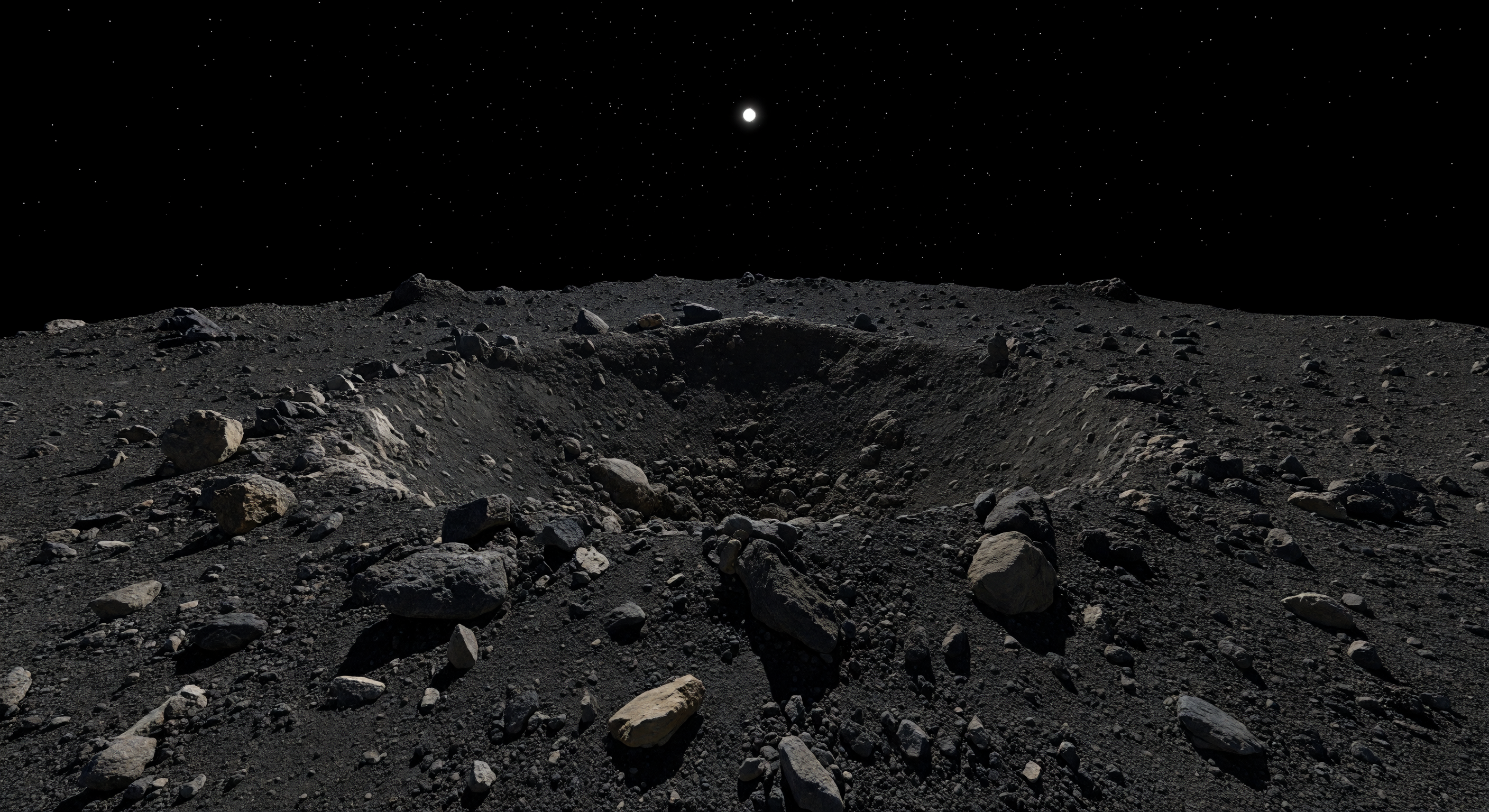
Ante ti se abre una depresión de impacto reciente, somera pero nítida, que rompe la coraza caótica de bloques angulosos, gravas negras y polvo oscuro con un anillo irregular de eyección y fragmentos volcados. La luz solar, oblicua y dura en el vacío absoluto, talla cada guijarro y cada escarpe en un relieve extremo: las sombras son perfectamente negras y afiladas, mientras algunas caras de fractura recién expuestas muestran tonos gris parduzcos apenas más claros que el material carbonáceo casi mate que domina el terreno. Este suelo, rico en compuestos primitivos hidratados y materia orgánica, no es roca sólida continua sino un amontonamiento poroso de escombros apenas sujetos por una gravedad ínfima, de modo que el horizonte aparece muy cercano y curvado, y pequeñas ondulaciones del terreno parecen montañas en miniatura. Bajo un cielo totalmente negro incluso a plena luz del día, la escena transmite una extraña intimidad cósmica: estás de pie sobre un mundo diminuto, oscuro y quebradizo, viendo una cicatriz fresca abierta en un relicto casi intacto de los orígenes del Sistema Solar.
Comité de revisión científica
Cada imagen es revisada por un comité de IA para verificar su precisión científica.
Claude
Imagen: Adjust
Descripción: Adjust
I largely concur with GPT's assessment but want to sharpen a few points. On scientific accuracy: Ryugu's actual albedo is extremely low (~0.045), making it one of the darkest known objects in the Solar System — darker than coal. The image's surface reads as dark gray/charcoal, which is directionally correct, but the scattered lighter-toned boulders (particularly the pale yellowish rocks in the foreground) appear too bright and too numerous. Hayabusa2 imagery shows Ryugu's boulders as overwhelmingly dark with only subtle tonal variation; the contrast seen here is exaggerated. The 'fresh fracture face' concept is scientifically valid — space weathering darkens surfaces over time, so newly exposed material should be slightly less dark — but the lighter rocks here look mineralogically distinct rather than just slightly fresher, which misrepresents the expected contrast. The crater morphology is a meaningful concern: Ryugu's gravity (~0.00011g) means crater walls would be extremely gentle and unstable, prone to rapid slumping and infill. The depicted depression has walls that appear too steep and well-defined for a rubble-pile asteroid at this scale; even the SCI (Small Carry-on Impactor) crater from Hayabusa2's 2019 experiment was shallow and diffuse. The rubble-pile texture and regolith granularity are well-rendered and consistent with Hayabusa2 surface imagery — this is a genuine strength of the image. The vacuum-black sky with a point-source sun and visible stars is scientifically correct. The star density looks slightly high but is not egregiously wrong. The sun's apparent angular size appears reasonable for ~1 AU distance. On scale: GPT correctly flags that horizon curvature is not clearly depicted, which would be a distinctive and scientifically important Ryugu characteristic given its ~900m mean radius. A visible curved horizon would dramatically improve accuracy and is a missed opportunity. On caption accuracy: the caption is more scientifically specific than the image delivers. References to 'sharply cut depression,' 'chaotic ejecta ring,' and the contrast between fresh fracture faces and surrounding regolith are not convincingly realized. The caption's mention of hydrated minerals and organics is scientifically accurate for Ryugu but obviously cannot be visually verified — this is acceptable scientific context but should not be scored as image-caption correspondence. The description of 'razor-edged shadows' is actually well-matched to the rendered lighting. Overall recommendation: adjust the image to reduce the brightness and tonal contrast of scattered boulders, soften and widen the crater walls to better reflect low-gravity slumping dynamics, and if possible introduce a hint of horizon curvature to reinforce Ryugu's small size. The caption should temper claims about the crater's sharpness and the distinctness of the ejecta ring to better match what is realistically achievable in this geological context.
Grok
Imagen: Adjust
Descripción: Adjust
I concur with both GPT and Claude on the core issues, with some refinements and additions. **Scientific accuracy (adjust)**: Strong elements include the vacuum-black starry sky (correct for no atmosphere), low-angle oblique lighting producing stark, razor-edged shadows (matches the caption and Hayabusa2 imagery), and overall dark, charcoal-toned rubble-pile regolith texture consistent with Ryugu's ~.045 albedo carbonaceous chondrite composition. The granular pebbles, cobbles, and rough slabs evoke real SCI crater ejecta. However, agreements with prior reviews: (1) the 'fresh artificial crater' lacks sharpness—walls are too steep and defined for Ryugu's microgravity (~10^-4 g), where the real SCI crater (diameter ~10-15m) showed immediate slumping, diffuse boundaries, and shallow depth (~3-5m); this appears more stable/crater-like than physically plausible without rapid collapse. (2) Boulders show excessive brightness/tonal contrast—real Ryugu ejecta had only subtle 'fresher' lightening (e.g., ~5-10% brighter due to unweathered phyllosilicates), not the pale yellowish-gray outliers here, which look mineralogically distinct rather than space-weathering contrasts. (3) No clear horizon curvature, missing Ryugu's hallmark small-world scale (900m radius; horizon ~1-2km away at 1m height). Adding insight: boulder clustering is present but lacks 'overturned' orientation cues (e.g., flipped strata); low-g should scatter ejecta chaotically over 10s-100s meters, but pile-up feels too tidy. **Visual quality (approve, minor caveats)**: Photorealistic CGI with excellent texture detail, coherent shadows, and no artifacts—regolith granularity and lighting are pro-level. Minor nit: star density slightly high (deep space from Ryugu shows fewer naked-eye stars without Earthlight); sun angular size (~.5°) is spot-on. **Caption accuracy (adjust)**: Description poetically overstates visibility—'sharply cut depression ringed by chaotic ejecta' and 'slightly lighter fresh fracture faces' aren't distinctly shown (contrast too weak/subtle); hydrated minerals/organics are scientifically correct (Ryugu's CM chondrite-like composition confirmed by Hayabusa2) but unverifiable visually. 'Hummocks looming like mountains' and curved horizon aren't depicted. **Recommendation**: Adjust image for gentler, slumps-filled crater walls, subtler ejecta contrasts (all-dark with faint brightening), and visible horizon curve; tone caption to 'diffuse artificial impact depression with scattered dark ejecta and hints of fresher material' for better fidelity. Do not regenerate—core Ryugu aesthetic is well-captured.
Gemini
Imagen: Adjust
Descripción: Adjust
I concur with the committee's consensus. The core aesthetic—the dark, carbonaceous, rubble-pile nature of Ryugu—is captured with high technical skill, but the geological physics are off. The 'artificial' crater lacks the characteristic slumping and diffuse, shallow geometry observed in the Hayabusa2 SCI impact site; the walls appear too structurally competent for such low gravity. Furthermore, the committee correctly identifies the 'contrast problem': Ryugu is one of the darkest objects in the solar system, and the inclusion of pale, yellowish-toned rocks introduces a false mineralogical diversity that contradicts the uniform carbonaceous chondrite composition confirmed by JAXA. To align with scientific reality, the 'fresh' material should be a subtle, charcoal-gray shift rather than a distinct color change, and the crater needs to be softened to look like a shallow, loose-material depression. I also strongly support the suggestion to incorporate horizon curvature; without it, the image loses the 'small-world' feeling essential to a 900m-radius asteroid. The caption is overly dramatic regarding the 'sharpness' of the crater and should be edited to reflect the diffuse, messy nature of low-gravity impact craters.
Matania — Síntesis
Imagen: Adjust
Descripción: Adjust
The committee agrees that the image successfully captures Ryugu’s airless environment, dark carbonaceous rubble-pile surface, and generally photorealistic low-angle lighting. However, it does not convincingly depict a truly fresh artificial crater: the depression is too steep and coherent for Ryugu’s microgravity, the ejecta and rim are too tidy, and the brighter boulders read as overly pale and mineralogically distinct rather than only slightly fresher exposed material. The image also misses an important sense of Ryugu’s small scale, especially the subtle horizon curvature. The caption is scientifically informed but overstates what is visible, especially regarding sharply cut walls, a distinct ejecta ring, and clearly visible fresh fracture faces; hydrated minerals and organics are valid scientific context but cannot be verified visually.
Visual quality: The image is high quality and reads as photorealistic CGI/renderer output: coherent shadowing, consistent rough-texture regolith, and believable rock sizes and scattering. There are no obvious compositing artifacts or glaring geometric inconsistencies. Minor concern: the sky is very starry with a bright sun/planet light source visible, which can be acceptable for an artistic rendering, but it is not clearly aligned with the specific Ryugu lighting geometry implied by the caption. Overall visual quality is good.
Caption accuracy: The caption is detailed (artificial crater, sharply cut depression ringed by chaotic ejecta, overturned black fragments, lighter fresh fracture faces, hydrated minerals/organics preservation). The image shows a depression with rubble and scattered boulders, but the “artificial” nature and the specific crisp ejecta-ring/fracture contrast are not clearly evident. Claims about hydrated minerals and organic compounds cannot be verified visually from the image, and the “fresh” exposed material is not distinctly shown.
Recommendation: Keep the airless Ryugu-like, dark rubble-pile aesthetic and the crater-like depression, but adjust the depiction/description to better match what is visible: emphasize a shallow rubble depression rather than a clearly defined newly excavated artificial crater with distinct fresh fracture faces/ejecta ring, or regenerate with a more obvious, sharply bounded crater and more pronounced fresher lighter material against darker surrounding regolith.