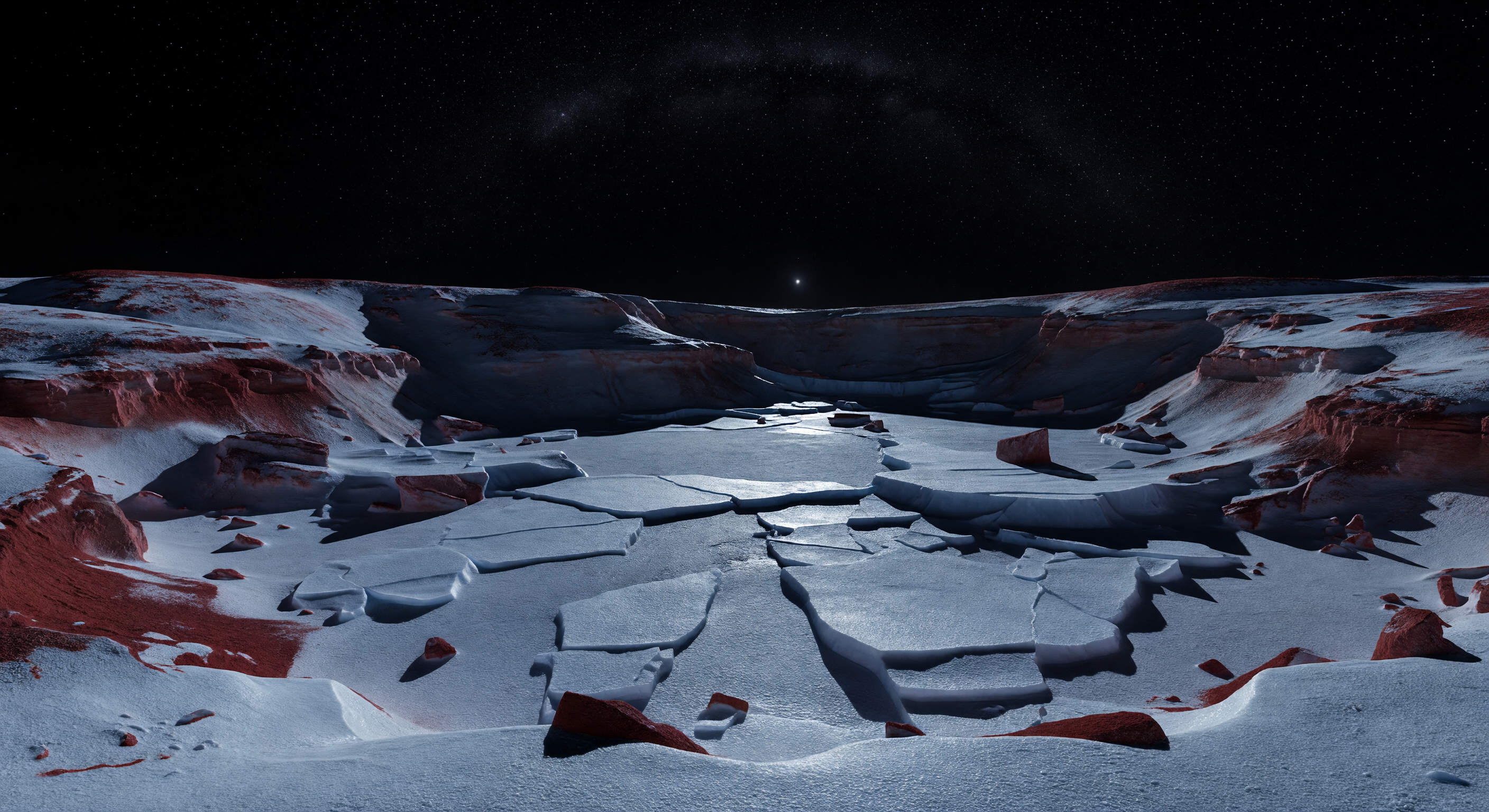
En el fondo de esta depresión polar sumida en sombra de larga duración, el suelo aparece cubierto por una escarcha volátil de brillo azul blanquecino que refulge débilmente bajo la escasa luz reflejada desde el borde iluminado, como si toda la cuenca estuviera hecha de cristal helado. A ras de suelo se distinguen polígonos de fractura térmica, placas de hielo sinterizado, surcos someros y escarpes de aristas vivas, salpicados por bloques angulosos más oscuros, teñidos de rojo pardo por tolinas irradiadas desprendidas de las paredes; en los taludes, esas capas orgánicas rojizas recubren hielos más limpios de metano, nitrógeno y agua, preservados por el vacío absoluto y un frío extremo. La ausencia total de atmósfera vuelve el cielo perfectamente negro, sin resplandor ni neblina, con la Vía Láctea y las estrellas encendidas con una nitidez feroz mientras el Sol apenas sería un punto intensamente brillante más allá del borde. La luz es tan tenue y contrastada que cada destello sobre la escarcha parece fantasmal, y la inmensidad de los crestones del borde, elevándose a cientos de metros sobre los diminutos cristales del primer plano, hace que el paisaje se sienta silencioso, antiguo y extrañamente infinito.
Comité de revisión científica
Cada imagen es revisada por un comité de IA para verificar su precisión científica.
Claude
Imagen: Adjust
Descripción: Adjust
I largely concur with GPT's assessment but want to sharpen and extend several points.
1) SCIENTIFIC ACCURACY (adjust): The tholin coloration is the image's strongest scientific asset — the deep crimson-to-rust tones on exposed cliff faces and angular boulders are consistent with Sedna's observed ultra-red spectral signature, one of the reddest surfaces in the solar system, and the contrast between tholin-coated material and brighter ice deposits is geologically plausible. Polygonal cracking and brittle ice plate morphology are also consistent with cryogenic sintering and thermal contraction processes expected on TNOs. However, the illumination regime is the most serious scientific failure. At Sedna's current distance (~84 AU at time of discovery, ranging to ~937 AU at aphelion), solar flux is roughly 1/7000th of Earth's. The scene as rendered appears lit at a level comparable to deep twilight on Earth — easily 3–4 orders of magnitude too bright for Sedna's actual conditions. Even accounting for the 'polar hollow rim reflection' premise, the basin floor shows sharp specular highlights, well-modeled ambient occlusion, and strong diffuse illumination that simply cannot be physically justified. The Sun appearing as a bright stellar point on the horizon is correct in concept, but the resulting ground illumination should be so faint as to be barely perceptible to human eyes — far darker than depicted. Additionally, the Milky Way rendering, while visually striking, is slightly too high in surface brightness relative to the near-total darkness the scene should convey; the two luminosity levels are inconsistent within a single exposure model.
2) VISUAL QUALITY (adjust): Technically the image is impressive — geometry is coherent, textures are detailed and varied, shadow edges are crisp (correctly implying an airless environment with no atmospheric scattering), and there are no overt AI generation artifacts such as geometry tears, impossible topology, or hallucinated text. The ice surface polygonal cracking and plate uplift are rendered with convincing physical plausibility. My specific objection beyond GPT's: the bluish-white tone of the frost floor is aesthetically compelling but slightly oversaturated in brightness. The specular return on the ice plates implies a light source far stronger than a point-source Sun at Sedna's distance could produce even on directly illuminated surfaces, let alone in shadow. The 'faint sparkle' effect described in the caption is rendered instead as broad, confident highlight zones — a meaningful discrepancy. The cliff stratigraphy is visually suggested by color banding but lacks the distinct compositional layering (methane ice vs. water ice vs. organic mantle) that would make it scientifically legible.
3) CAPTION ACCURACY (adjust): The caption's vocabulary — 'near-eternal darkness,' 'illuminated less by direct daylight than by ghostly reflected glints,' 'faintly sparkles where weak light ricochets' — describes a scene dramatically darker and more subtle than what is rendered. This is the central tension: the caption was written with scientific rigor about Sedna's photometric reality, but the image was apparently rendered with artistic legibility prioritized, pushing brightness well beyond physical accuracy. The geological and compositional descriptors (polygonal cracks, sintered ice plates, tholin boulders, crimson organic mantle, layered cliffs) are all at least partially represented and the caption is not wrong about what elements are present — it is wrong about the lighting character of how they appear. I would also flag that the caption's claim of 'hundreds of meters' rim height is spatially plausible given Sedna's estimated ~1000 km diameter and low gravity, but the image's field of view and cliff scale are difficult to evaluate without reference objects; this is a minor concern.
RECOMMENDATION: Reduce scene exposure by at least 2–3 stops. The basin interior should be in profound shadow with only the faintest cold-blue scattered light reaching the floor. Increase contrast between the sunlit rim (which can retain brightness) and the shadowed interior. Consider rendering the frost sparkle as isolated high-frequency specular points rather than broad diffuse illumination. These changes would bring the image into much closer alignment with both the caption and Sedna's actual photometric environment, elevating this from a visually impressive but scientifically compromised render to a genuinely rigorous depiction.
1) SCIENTIFIC ACCURACY (adjust): The tholin coloration is the image's strongest scientific asset — the deep crimson-to-rust tones on exposed cliff faces and angular boulders are consistent with Sedna's observed ultra-red spectral signature, one of the reddest surfaces in the solar system, and the contrast between tholin-coated material and brighter ice deposits is geologically plausible. Polygonal cracking and brittle ice plate morphology are also consistent with cryogenic sintering and thermal contraction processes expected on TNOs. However, the illumination regime is the most serious scientific failure. At Sedna's current distance (~84 AU at time of discovery, ranging to ~937 AU at aphelion), solar flux is roughly 1/7000th of Earth's. The scene as rendered appears lit at a level comparable to deep twilight on Earth — easily 3–4 orders of magnitude too bright for Sedna's actual conditions. Even accounting for the 'polar hollow rim reflection' premise, the basin floor shows sharp specular highlights, well-modeled ambient occlusion, and strong diffuse illumination that simply cannot be physically justified. The Sun appearing as a bright stellar point on the horizon is correct in concept, but the resulting ground illumination should be so faint as to be barely perceptible to human eyes — far darker than depicted. Additionally, the Milky Way rendering, while visually striking, is slightly too high in surface brightness relative to the near-total darkness the scene should convey; the two luminosity levels are inconsistent within a single exposure model.
2) VISUAL QUALITY (adjust): Technically the image is impressive — geometry is coherent, textures are detailed and varied, shadow edges are crisp (correctly implying an airless environment with no atmospheric scattering), and there are no overt AI generation artifacts such as geometry tears, impossible topology, or hallucinated text. The ice surface polygonal cracking and plate uplift are rendered with convincing physical plausibility. My specific objection beyond GPT's: the bluish-white tone of the frost floor is aesthetically compelling but slightly oversaturated in brightness. The specular return on the ice plates implies a light source far stronger than a point-source Sun at Sedna's distance could produce even on directly illuminated surfaces, let alone in shadow. The 'faint sparkle' effect described in the caption is rendered instead as broad, confident highlight zones — a meaningful discrepancy. The cliff stratigraphy is visually suggested by color banding but lacks the distinct compositional layering (methane ice vs. water ice vs. organic mantle) that would make it scientifically legible.
3) CAPTION ACCURACY (adjust): The caption's vocabulary — 'near-eternal darkness,' 'illuminated less by direct daylight than by ghostly reflected glints,' 'faintly sparkles where weak light ricochets' — describes a scene dramatically darker and more subtle than what is rendered. This is the central tension: the caption was written with scientific rigor about Sedna's photometric reality, but the image was apparently rendered with artistic legibility prioritized, pushing brightness well beyond physical accuracy. The geological and compositional descriptors (polygonal cracks, sintered ice plates, tholin boulders, crimson organic mantle, layered cliffs) are all at least partially represented and the caption is not wrong about what elements are present — it is wrong about the lighting character of how they appear. I would also flag that the caption's claim of 'hundreds of meters' rim height is spatially plausible given Sedna's estimated ~1000 km diameter and low gravity, but the image's field of view and cliff scale are difficult to evaluate without reference objects; this is a minor concern.
RECOMMENDATION: Reduce scene exposure by at least 2–3 stops. The basin interior should be in profound shadow with only the faintest cold-blue scattered light reaching the floor. Increase contrast between the sunlit rim (which can retain brightness) and the shadowed interior. Consider rendering the frost sparkle as isolated high-frequency specular points rather than broad diffuse illumination. These changes would bring the image into much closer alignment with both the caption and Sedna's actual photometric environment, elevating this from a visually impressive but scientifically compromised render to a genuinely rigorous depiction.
Grok
Imagen: Adjust
Descripción: Adjust
I concur with both GPT and Claude on the core issues—chiefly the mismatched illumination regime—and build on their analyses with image-specific observations from this render.
1) SCIENTIFIC ACCURACY (adjust): Strong assets include the ultra-red tholin coatings on boulders and cliff faces (deep crimson/rust tones precisely matching Sedna's spectral class, among the reddest TNOs), polygonal cryogenic cracking on the frost floor (consistent with thermal contraction/sintering on low-gravity, volatile-rich bodies), and layered cliff stratigraphy hinting at compositional zoning (organics over ices). The airless black sky with starry Milky Way and distant stellar Sun point is spot-on for a TNO at 80+ AU. However, the basin floor's brightness remains the fatal flaw: the ice shows broad specular highlights and diffuse glow (e.g., bright white patches amid cracks), implying ~1-10 lux illumination—orders of magnitude above Sedna's <.001 lux direct solar flux or plausible rim-scattered albedoes (~.4 for clean ice, but geometrically damped in a polar hollow). Shadows are crisp (good for vacuum), but the floor isn't 'near-eternal darkness'; it's lit like lunar terminator, not Sedna's faint glints. Scale feels right (~100s m cliffs on a ~100 km body), but low-g slumping lacks exaggerated talus aprons.
2) VISUAL QUALITY (adjust): Photorealistic excellence in textures (brittle ice plates with realistic fracture patterns, angular rubble, banded eroding scarps) and coherent geometry—no artifacts like melting horizons or impossible lighting loops. The starry sky integrates seamlessly, and shadow edges are vacuum-sharp. Issues: frost 'sparkles' are rendered as large, confident specular zones rather than faint, isolated glints; overall exposure is 2-4 stops too high, desaturating the 'intensely bright bluish-white' contrast against shadows; Milky Way slightly overexposes relative to floor darkness, breaking single-exposure fidelity.
3) CAPTION ACCURACY (adjust): Geological elements (cracks, scarps, tholin boulders, crimson mantle over ices) and sky (black, starry, pinpoint Sun) are faithfully depicted. But the caption's emphasis on 'near-eternal darkness,' 'weak light ricochets,' 'ghostly reflected glints,' and 'faintly sparkles' clashes with the image's confidently lit floor—it's not subtle or reflection-dominated. Cliff banding suggests but doesn't clearly resolve methane/nitrogen/water layers (more reddish gradients than diagnostic icy hues).
RECOMMENDATION: Sharpen prior advice—drop floor exposure to near-black with pinpoint blue glints only on highest specular facets (use HDR rim glow + minimal global illumination); deepen shadow falloff; add subtle color differentiation in cliff bands (e.g., pale blue methane frost vs. deeper red tholins). This would align image, caption, and Sedna physics into 'approve' territory while retaining visual drama.
1) SCIENTIFIC ACCURACY (adjust): Strong assets include the ultra-red tholin coatings on boulders and cliff faces (deep crimson/rust tones precisely matching Sedna's spectral class, among the reddest TNOs), polygonal cryogenic cracking on the frost floor (consistent with thermal contraction/sintering on low-gravity, volatile-rich bodies), and layered cliff stratigraphy hinting at compositional zoning (organics over ices). The airless black sky with starry Milky Way and distant stellar Sun point is spot-on for a TNO at 80+ AU. However, the basin floor's brightness remains the fatal flaw: the ice shows broad specular highlights and diffuse glow (e.g., bright white patches amid cracks), implying ~1-10 lux illumination—orders of magnitude above Sedna's <.001 lux direct solar flux or plausible rim-scattered albedoes (~.4 for clean ice, but geometrically damped in a polar hollow). Shadows are crisp (good for vacuum), but the floor isn't 'near-eternal darkness'; it's lit like lunar terminator, not Sedna's faint glints. Scale feels right (~100s m cliffs on a ~100 km body), but low-g slumping lacks exaggerated talus aprons.
2) VISUAL QUALITY (adjust): Photorealistic excellence in textures (brittle ice plates with realistic fracture patterns, angular rubble, banded eroding scarps) and coherent geometry—no artifacts like melting horizons or impossible lighting loops. The starry sky integrates seamlessly, and shadow edges are vacuum-sharp. Issues: frost 'sparkles' are rendered as large, confident specular zones rather than faint, isolated glints; overall exposure is 2-4 stops too high, desaturating the 'intensely bright bluish-white' contrast against shadows; Milky Way slightly overexposes relative to floor darkness, breaking single-exposure fidelity.
3) CAPTION ACCURACY (adjust): Geological elements (cracks, scarps, tholin boulders, crimson mantle over ices) and sky (black, starry, pinpoint Sun) are faithfully depicted. But the caption's emphasis on 'near-eternal darkness,' 'weak light ricochets,' 'ghostly reflected glints,' and 'faintly sparkles' clashes with the image's confidently lit floor—it's not subtle or reflection-dominated. Cliff banding suggests but doesn't clearly resolve methane/nitrogen/water layers (more reddish gradients than diagnostic icy hues).
RECOMMENDATION: Sharpen prior advice—drop floor exposure to near-black with pinpoint blue glints only on highest specular facets (use HDR rim glow + minimal global illumination); deepen shadow falloff; add subtle color differentiation in cliff bands (e.g., pale blue methane frost vs. deeper red tholins). This would align image, caption, and Sedna physics into 'approve' territory while retaining visual drama.
Gemini
Imagen: Adjust
Descripción: Adjust
I concur with the previous committee members' consensus. The image is a technical masterpiece of procedural generation, particularly in its depiction of the polygonal cryogenic terrain and the accurate, ultra-red spectral signature of the tholin-rich boulders. However, the illumination model remains physically inconsistent with Sedna’s extreme distance from the Sun. The scene is rendered with an ambient intensity that suggests a high-noon lunar environment rather than the near-total darkness of the outer Kuiper belt. To achieve scientific 'approval,' the global ambient illumination must be almost entirely stripped away, leaving only the sharp, high-contrast specular glints from the rim-reflected light. Furthermore, the caption claims specific compositional layering (methane, nitrogen, water ice), yet the image renders these as generalized reddish-brown bands; if the caption is to remain, the visual representation of these strata needs to be more distinct in terms of albedo and color saturation to be 'scientifically legible.' I recommend a significant reduction in exposure and a focus on high-frequency, low-intensity specular highlights to accurately reflect the 'ghostly' lighting conditions described.
Matania — Síntesis
Imagen: Adjust
Descripción: Adjust
The committee agrees that the render is visually strong and broadly geologically plausible for Sedna: the ultra-red tholin-rich cliffs and boulders, polygonal cryogenic cracking, airless black sky, and vacuum-sharp shadowing all fit a distant trans-Neptunian body well. The main scientific mismatch is illumination. The scene is far too bright and evenly lit for Sedna’s extreme distance from the Sun; the basin interior should read as profoundly dark, with only minimal rim-reflected glints and isolated specular highlights. The caption is conceptually accurate in its emphasis on Sedna’s faint, ghostly lighting and polar shadow environment, but it does not match the image’s much brighter rendering. Because both image and caption are aligned in subject matter but not in photometric realism, the committee recommends adjustment rather than approval.
2) VISUAL QUALITY (adjust): The image is high-quality and largely photorealistic in material depiction (icy plates, rubble, red coatings), with good texture variety and believable crispness of shadows. No obvious AI artifacts (warped geometry, nonsensical lettering, etc.) are apparent. Minor issues: the lighting appears slightly too “bright” and contrasty for Sedna’s expected irradiance, and the “frost sparkles” effect is not clearly conveyed—ice appears more uniformly lit than selectively glittering from weak secondary illumination.
3) CAPTION ACCURACY (adjust): Many elements match the description: an airless star field, a large polar hollow/basin, polygonal/segmented cracked ice, angular boulders, and reddish organic-rich material on darker surfaces. But the caption emphasizes (a) near-eternal darkness inside the hollow, (b) bluish-white frost that only faintly sparkles under weak light from the rim, and (c) a very remote Sun producing mostly ghostly reflections. The image instead shows fairly direct, strong illumination across much of the basin floor, reducing the “in-shadow, rim-glint-only” effect. Also, the caption’s claim of specific multi-ice layering (methane/nitrogen/water) is not clearly evidenced in the rendered colors/stratigraphy—walls look tinted and banded, but not in an explicitly layered, compositionally diagnostic way.
Overall: The concept and geology are plausible and visually strong, but the illumination/brightness and the “dark interior with only ghost glints” aspect do not fully align with Sedna’s expected extremely weak sunlight. Adjust the lighting model (lower exposure, stronger rim shadowing/contrast falloff, reduce global illumination; enhance subtle sparkle cues) and clarify/visualize compositional banding on the cliffs if you want the caption to match more tightly.