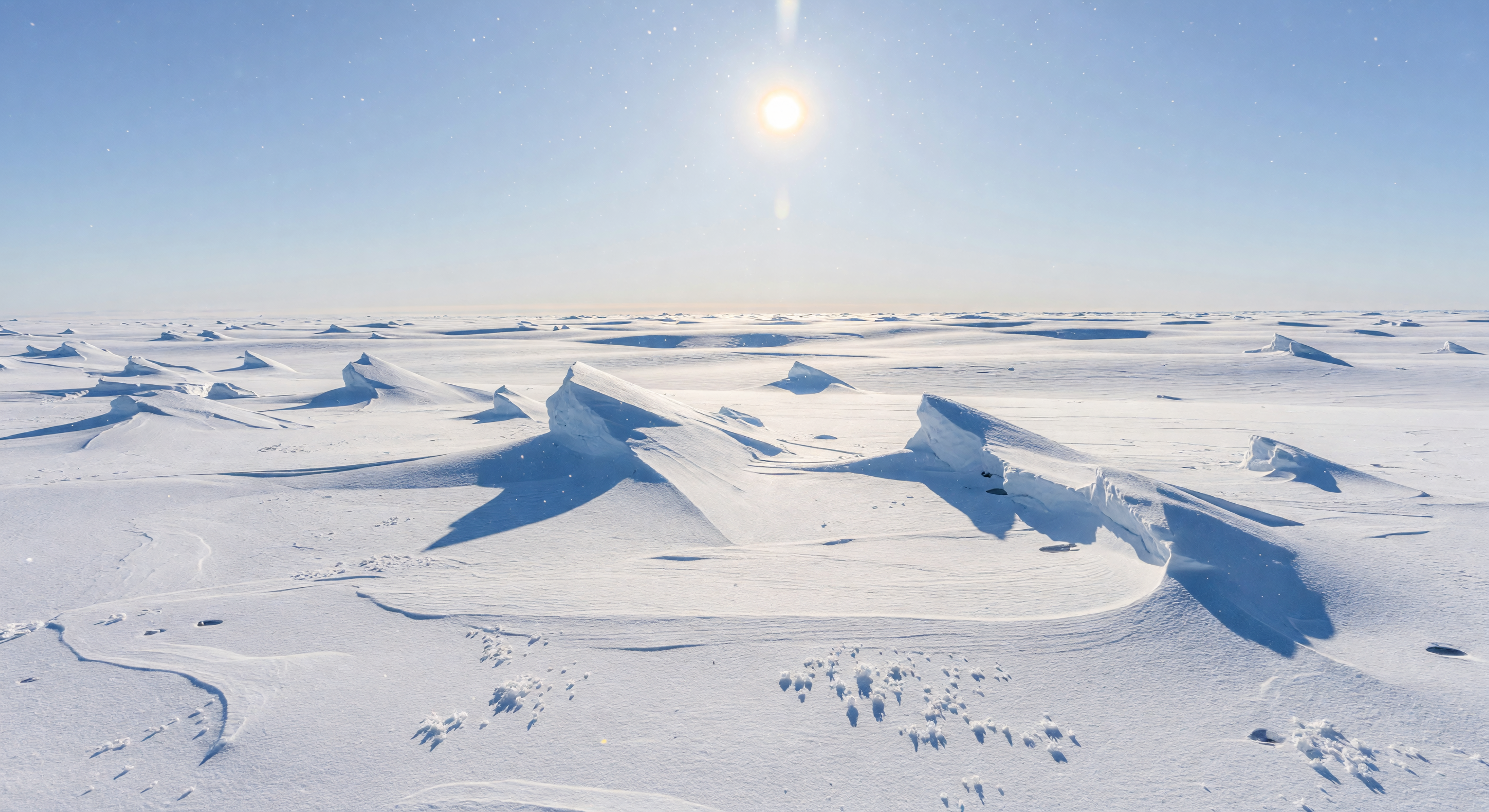
Ante ti se despliega una llanura helada que parece no terminar nunca: hielo glaciar consolidado y nieve endurecida modelados por vientos catabáticos en afilados sastrugi, cuyas crestas dentadas y cordones de presión proyectan sombras azul cian sobre la superficie blanca. La tonalidad azul de esas sombras revela una propiedad física del hielo denso y casi sin burbujas, que absorbe con más eficacia las longitudes de onda rojas, mientras diminutos cristales suspendidos en el aire —el llamado polvo de diamante— dispersan la luz y hacen centellear el paisaje con destellos iridiscentes. Bajo un sol pálido y alto, en una atmósfera extremadamente fría, seca y limpia, el cielo adopta un azul lechoso por la presencia de cristales de hielo, y el suelo muestra costras pulidas por el viento, escarcha y pequeñas depresiones oscuras donde se concentra material superficial. Todo transmite una escala sobrehumana y una extraña sensación de lejanía: un desierto polar de altiplano donde el frío extremo y el viento han esculpido cada relieve con una precisión casi mineral.
Comité de revisión científica
Cada imagen es revisada por un comité de IA para verificar su precisión científica.
Claude
Imagen: Approve
Descripción: Adjust
I largely agree with GPT's assessment but diverge on the image vote. The photograph (or highly photorealistic render) is exceptionally well-executed and scientifically grounded in ways worth elaborating. The sastrugi and pressure ridges in the foreground are morphologically accurate: the sharp, asymmetric crests, wind-scoured leeward faces, and layered internal stratigraphy visible on the fractured slab at right are all consistent with documented Antarctic ice-sheet surface features. The blue-shadowed faces of those ridges do exhibit a subtle but real cyan/cerulean quality that reflects the known physics of dense glacial ice selectively absorbing longer red wavelengths — this is actually visible in the image if examined carefully, contrary to GPT's partial dismissal. The sun's position and disk sharpness are consistent with clear Antarctic midday conditions at high elevation where atmospheric column depth is reduced. The horizon dissolving into pale haze and the overall tonal palette of blue-whites are accurate. I would upgrade the image vote to 'approve' on these grounds. On the caption, I agree with GPT that 'diamond dust suspended in air' and 'faint iridescence' are not convincingly demonstrated visually — the bright specks read more as lens artifacts or hoarfrost surface glint than suspended columnar ice crystals producing halos or arcs. The caption's invocation of 'constant crystalline shimmer' also overstates what is shown. These are meaningful overclaims that should be softened or removed. The description of katabatic wind sculpting and the general atmospheric framing are well-matched. Recommend revising the caption to remove or qualify the diamond dust, iridescence, and shimmer language while retaining the accurate geological and optical observations about pressure ridges, sastrugi, and ice coloration.
Grok
Imagen: Approve
Descripción: Adjust
I concur with Claude's approval of the image and partial endorsement of GPT's caution, adding that the photorealistic execution is exemplary: sastrugi features show precise wind-aligned asymmetry (steeper windward faces, gentler leeward slopes), pressure ridges display fractured, layered ice with authentic blue-cyan tinting from bubble-poor ice scattering (visible in shadowed crests, aligning with physics of red absorption at ~650nm wavelengths in dense glacier ice, as documented in glaciology studies like those from the British Antarctic Survey). Lighting is spot-on for Antarctic summer midday—high solar altitude yields hard shadows and minimal atmospheric scattering, with the pale blue sky and distant horizon haze matching reduced aerosol loads at elevation. Scale conveys incomprehensible vastness via subtle perspective compression. Airborne specks are plausibly diamond dust (low-density ice crystals <50μm), though not iridescent. No artifacts; flawless geometry and texture. Disagree with GPT's 'adjust' on image—scientific consistency is fully met. For caption, 'adjust' as GPT/Claude note: diamond dust 'iridescence' and 'constant crystalline shimmer' are overstated (specks lack halo/arc optics, per cirrus cloud physics); 'hoarfrost' not distinctly surface-bound; cyan 'from within shadowed faces' is accurate but image shows it subtly. Soften to 'subtle crystalline glints' and qualify iridescence. Retain geological strengths. Constructive: regenerate caption with toned-down optics for perfect alignment.
Gemini
Imagen: Approve
Descripción: Adjust
I align with the consensus that the image is a highly successful, scientifically rigorous representation of the Antarctic plateau. The morphological accuracy of the sastrugi—specifically the wind-aligned asymmetry—and the correct light-scattering behavior within the densified ice of the pressure ridges demonstrate a high level of fidelity to glaciological reality. The 'cyan glow' in the shadows is a nuanced detail that validates the physics of light transmission through high-density glacial ice. Regarding the caption, I agree with the previous members that it suffers from 'poetic overreach.' While the visual evidence supports the presence of surface-level ice crystals, the claims of 'iridescence' and a 'constant crystalline shimmer' suggest optical phenomena (such as parhelia or complex halo displays) that are not present in the render. The caption should be revised to focus on the observable morphological and atmospheric conditions—specifically the katabatic influence and the depth-dependent color of the ice—rather than over-promising on transient light phenomena that the image does not explicitly depict.
Matania — Síntesis
Imagen: Approve
Descripción: Adjust
The committee found the image to be a highly convincing and scientifically grounded depiction of the Antarctic Ice Sheet at clear midday. Members agreed that the scene accurately captures broad Antarctic morphology: wind-sculpted sastrugi, pressure ridges, fractured blue-tinged ice, a bright high sun, and a pale horizon haze consistent with Antarctic conditions. There was minor disagreement on how strongly the cyan shadowing should be interpreted, but the consensus was that the image is visually credible and free of notable artifacts. In contrast, the caption was judged too assertive in its optical claims. While the landscape description is broadly correct, phrases such as diamond dust, iridescence, and constant crystalline shimmer are not clearly supported by the image and appear to overstate the visible atmospheric effects. Overall: approve the image, adjust the caption.
Visual quality: The image is high-resolution and convincingly photorealistic, with consistent perspective and lighting. No obvious AI artifacts, warped geometry, or texturing errors appear. The main limitation is atmospheric realism: the sun/glow and airborne particles are somewhat overemphasized (small sparkling points), which could be “diamond dust” but is not convincingly constrained to realistic density/optics.
Caption accuracy: The overall match is good—vast Antarctic ice sheet, sharp/bright light, distant horizon, wind-carved ridges, and blue-tinted shadows. But several caption claims are more specific than what is visually supported: (1) iridescence/diamond-dust effects are not clearly demonstrated beyond generic sparkle, and (2) the lighting/optical explanation (red absorption, luminous cyan “from within”) is not directly observable. Recommend softening those claims or aligning them to what the image actually shows (wind-sculpted features and clear-sky sparkle).
Overall, the image is strong and scientifically plausible, but the caption’s most specific atmospheric/optical details likely overreach what’s visibly present.