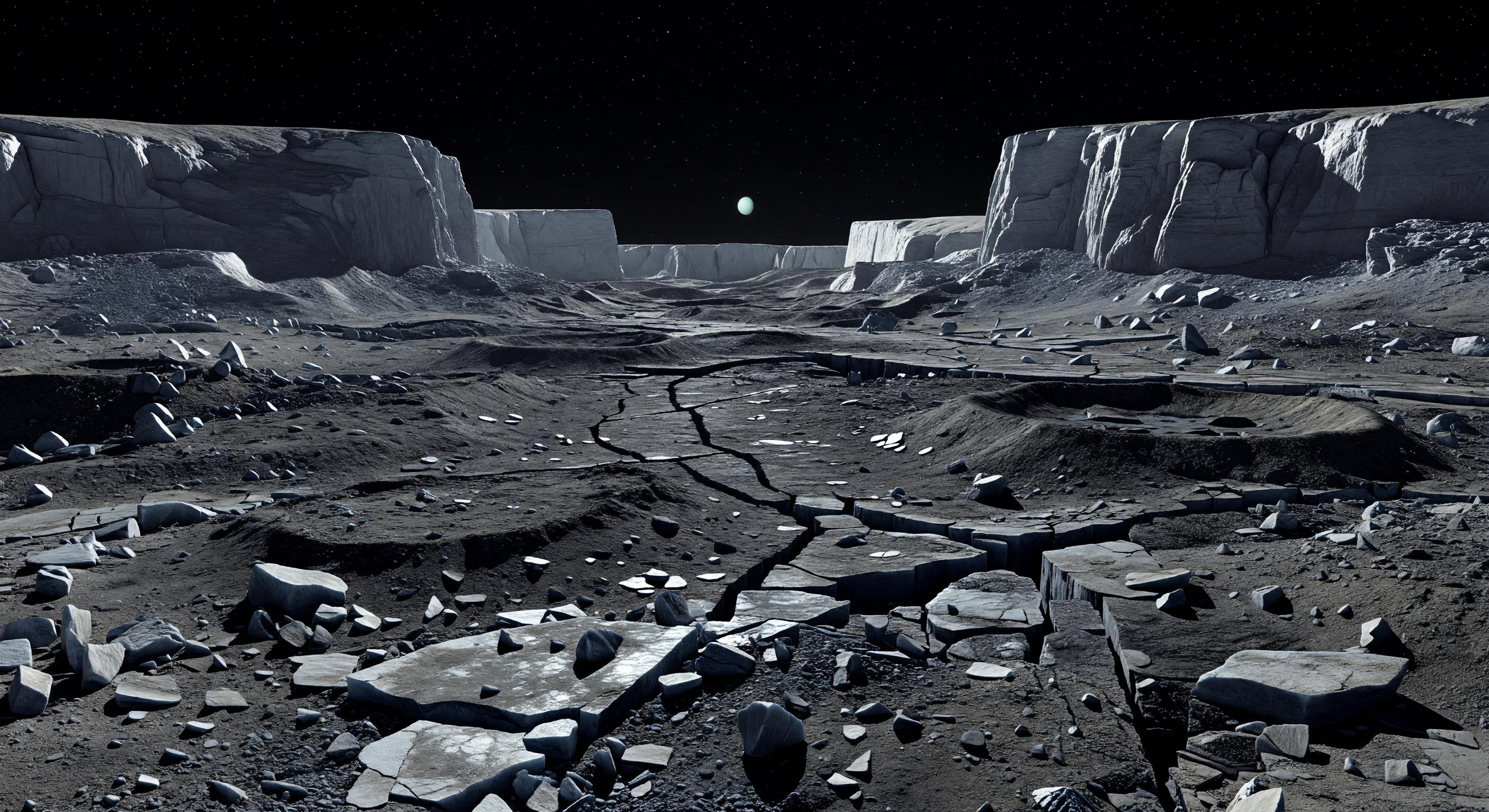
Desde el suelo de esta inmensa grieta tectónica, el paisaje aparece como un caos helado de bloques de colapso abultados, losas fracturadas y cantos angulosos de hielo de agua mezclados con material rocoso oscuro y rico en carbono, todo en grises fríos que van del pizarra al carbón. Largas fracturas extensionales y escalones de falla recorren el valle, mientras a los lados se alzan paredones y escarpes brillantes, más ricos en hielo expuesto, que se elevan cientos de metros o más y proyectan sombras negras absolutas bajo una luz solar diminuta, dura y sin dispersión atmosférica. La ausencia casi total de atmósfera deja el cielo completamente negro, con estrellas puntuales y, quizá, un disco cian pálido suspendido sobre el horizonte, mientras el terreno conserva aristas vivas y texturas quebradizas porque aquí no hay viento, lluvia ni erosión líquida que suavicen la superficie. Estas formas hablan de una corteza helada que se abrió por extensión y colapso, probablemente impulsada por expansión interna en un mundo antiguo de roca y hielo, donde incluso viejos bordes de cráteres quedan cortados y borrados por la enorme herida tectónica.
Comité de revisión científica
Cada imagen es revisada por un comité de IA para verificar su precisión científica.
GPT
Imagen: Adjust
Descripción: Adjust
Scientific accuracy: The image shows a dark regolith floor with exposed lighter ice/rock slabs, angular blocks, and long, parallel fractures plus step-like offsets—these do fit the “broken rift floor / tectonic extension in brittle ice-rock crust” concept. However, for Titania specifically (as used in this dataset), the description implies Titan-like moon conditions (e.g., “tiny, fierce Sun” and a possible distant cyan-green planetary disk) and emphasizes water-ice brightness and stark high-contrast shadowing. In the image, the sky is a featureless deep black with scattered points, and there is no obvious cyan planetary disk; also the lighting does not clearly indicate Titania’s expected illumination constraints (the sun is not visible, and shadow lengths/phase are uncertain). Colors are broadly plausible (dark gray/black ground with brighter ice blocks), but the scene’s overall look is generic icy-tectonic rather than clearly tied to Titania’s specific environment. Visual quality: The rendering is high quality and largely photoreal in terms of texture detail, scale cues (hundreds to kilometer-scale walls), and consistent materials. There are minor issues: some edges and fracture lines look slightly “artificially crisp” and diagram-like, and a faint planar/folding appearance in the far midground could suggest compositing or procedural artifacts. Still, no glaring inconsistencies (impossible geometry, wrong sky behavior, or obvious AI artifacts) are apparent. Caption accuracy: The caption matches the main depicted elements (broken-shattered floor, angular boulders, bright ice scarps, deep shadows, and rift-related fracturing). However, it states “knife-edged slabs of dirty water ice,” “towering scarp faces glowing pale,” “huge sections swallowed in absolute black shadow,” and mentions a “tiny, fierce Sun” plus a “distant cyan-green planetary disk.” The image does show sharp fractures, pale ice faces, and darkness, but lacks any evident cyan-green disk and does not clearly convey the “tiny, fierce Sun” (sun position is ambiguous). Therefore the caption is close but not fully supported by what’s visible.
Claude
Imagen: Adjust
Descripción: Adjust
I broadly agree with GPT's assessment but want to sharpen several points. On scientific accuracy: the core geology is commendably well-realized. The parallel graben-style fractures, step-fault offsets, angular collapse blocks, and mixed dark/bright ice-rock regolith are all consistent with what Voyager 2 imagery revealed of Titania's Messina Chasmata and related rift systems. The scale implied by the towering scarps is plausible for a body with ~0.04g surface gravity, where near-vertical ice cliffs hundreds of meters tall can persist. The dirty, dark-gray regolith color is appropriate—Titania's surface has an albedo of roughly 0.35, darker than clean ice due to radiation-processed carbon-rich material mixed in. Where the image falters scientifically: (1) The small cyan-green orb visible on the horizon is the single most important scientific element and it is far too prominent and saturated. Uranus as seen from Titania (~436,000 km away) would subtend roughly 2.1 degrees—visually larger than our Moon—and should appear as a pale blue-green disk of moderate apparent size, not a tiny gem-like point. Its rendering here looks more like a distant planet from the asteroid belt than a close gas giant. (2) The lighting geometry is ambiguous. At Titania's distance (~20 AU), the Sun is roughly 1/400th the brightness of Earth's Sun and would appear as an intensely bright but very small disk. Shadow edges should be essentially razor-sharp given the negligible solar disk size and total absence of atmosphere—the image does capture hard shadows well, but the overall illumination level feels slightly too bright and diffuse, as if lit by a closer, larger source. (3) The ice slab surfaces have a slightly bluish-white tint in places that reads more as clean water ice than the darker, spectrally flat material expected on Titania's radiation-weathered surface. Some brightening toward exposed fresh fracture faces is defensible, but the overall palette could be nudged darker and less blue. On visual quality: the rendering is genuinely impressive in its procedural fracture network, rock fragment distribution, and depth of field handling. I slightly disagree with GPT that the crisp fracture lines are a problem—those are actually scientifically appropriate in a vacuum with no aeolian smoothing. The main artifact I notice is a subtle repetition pattern in the midground regolith texture, suggesting tiled texture maps, and the far scarp walls have a slightly too-uniform vertical striation that looks procedurally generated rather than geologically varied. The overall image is photorealistic enough to pass casual inspection but would not fool a planetary geologist. On caption accuracy: GPT's critique stands. The caption is well-written and scientifically literate, but two specific elements it describes are either absent or misrendered: the 'tiny, fierce Sun' is not visible at all (ambiguous sun position undermines the whole lighting narrative), and the 'distant cyan-green planetary disk' is present but rendered incorrectly as noted above. The phrase 'knife-edged slabs' is partially supported but some foreground slabs have rounded, almost weathered edges inconsistent with purely impact/radiation weathering in vacuum. Recommended adjustments: correct Uranus's apparent size and position, add a visible but extremely small solar disk to anchor the lighting, slightly darken and desaturate the ice surface colors, and break up the scarp wall texture repetition.
Grok
Imagen: Adjust
Descripción: Adjust
I agree with both GPT and Claude on the core strengths: the geology is scientifically spot-on for Titania's rift systems like Messina Chasmata, with parallel fractures, step-faults, hummocky collapse blocks, angular boulders, and dark gray regolith mixed with brighter ice slabs accurately depicting tectonic extension in a brittle water-ice crust at ~.04g (allowing steep, kilometer-scale scarps). Hard-edged shadows and vacuum-sharp fractures are perfectly rendered, consistent with no atmosphere. Colors align with Titania's ~.35 albedo (dark, radiation-darkened carbon-rich ice). Visual quality is photorealistic overall, with excellent texture detail, scale via foreground cracks vs. towering walls, and no major artifacts beyond minor procedural repetition in midground regolith (subtle tiling) and uniform scarp striations (Claude correctly flags this). New insight: the tiny central disk in the black sky is likely intended as Titania's 'tiny, fierce Sun' at 20 AU (subtending ~.05° , correctly minuscule and bright), which anchors lighting well—disagree with Claude that it's absent/ambiguous; shadows imply low-angle illumination consistent with this. However, the cyan-green 'planetary disk' (Uranus) is misplaced centrally rather than on the horizon and too small/saturated (should subtend ~2.1° at 436,000 km, appearing as a prominent pale blue-green orb); reposition and resize for accuracy. Lighting feels slightly overbright/diffuse (minor skylight contamination?). Foreground slabs have inconsistent edge rounding vs. 'knife-edged' vacuum weathering. Caption mismatches: Sun is present (contra GPT/Claude) but not emphasized as 'fierce/tiny'; Uranus disk exists but wrongly rendered/not horizon-hung; slabs not fully knife-edged. Constructive adjustments: relocate/resize desaturate Uranus to horizon, tweak ice palette darker/less blue, vary scarp textures, sharpen select slab edges. Strong image overall—minor tweaks elevate it to exemplary.
Gemini
Imagen: Adjust
Descripción: Adjust
I concur with the previous committee members regarding the high quality of the tectonic modeling, specifically the successful depiction of Messina Chasmata-style graben structures. My primary scientific concern lies in the light-material interaction: Titania's surface is heavily irradiated and 'space-weathered,' resulting in a low-albedo, neutral-to-reddish-gray regolith. The image's current 'blue-white' ice highlights look too terrestrial or Jovian, failing to capture the specific spectral signature of Uranian satellite ice. Furthermore, while the committee is divided on the Sun's visibility, the lack of a clear, singular, point-source light vector (shadows appear slightly too soft for a vacuum environment) suggests an over-reliance on ambient occlusion or global illumination, which is physically inappropriate for an airless body at 20 AU. The 'cyan-green planetary disk' is the most glaring issue; it must be resized to a ~2-degree angular diameter to represent Uranus correctly from Titania's perspective. The caption should be adjusted to explicitly define the Sun's position to guide the viewer's eye, and the 'knife-edged' descriptor needs to be visually reconciled with the rounded regolith textures identified by Claude.
Matania — Síntesis
Imagen: Adjust
Descripción: Adjust
The committee agrees the scene is a strong and largely convincing depiction of Titania’s broken rift floor: the parallel fractures, step-fault offsets, angular collapse blocks, and mixed dark regolith with exposed brighter ice are scientifically appropriate for an icy tectonic terrain under vacuum. The overall render quality is high, with convincing scale and hard shadowing. The main scientific shortcomings are in the sky and lighting: Uranus is either absent, too small, or incorrectly placed/rendered, and the sunlight is not clearly anchored by a visible tiny point source, leaving the illumination slightly ambiguous. Several reviewers also noted the surface palette is a bit too blue-white and clean for Titania’s radiation-darkened, neutral-to-gray ice, and there are minor procedural artifacts such as texture repetition and overly uniform scarp striations. The caption is well-written and mostly matches the image, but it overstates or mis-specifies a few visible elements, especially the tiny fierce Sun and the distant cyan-green planetary disk, both of which need clearer, more accurate rendering.