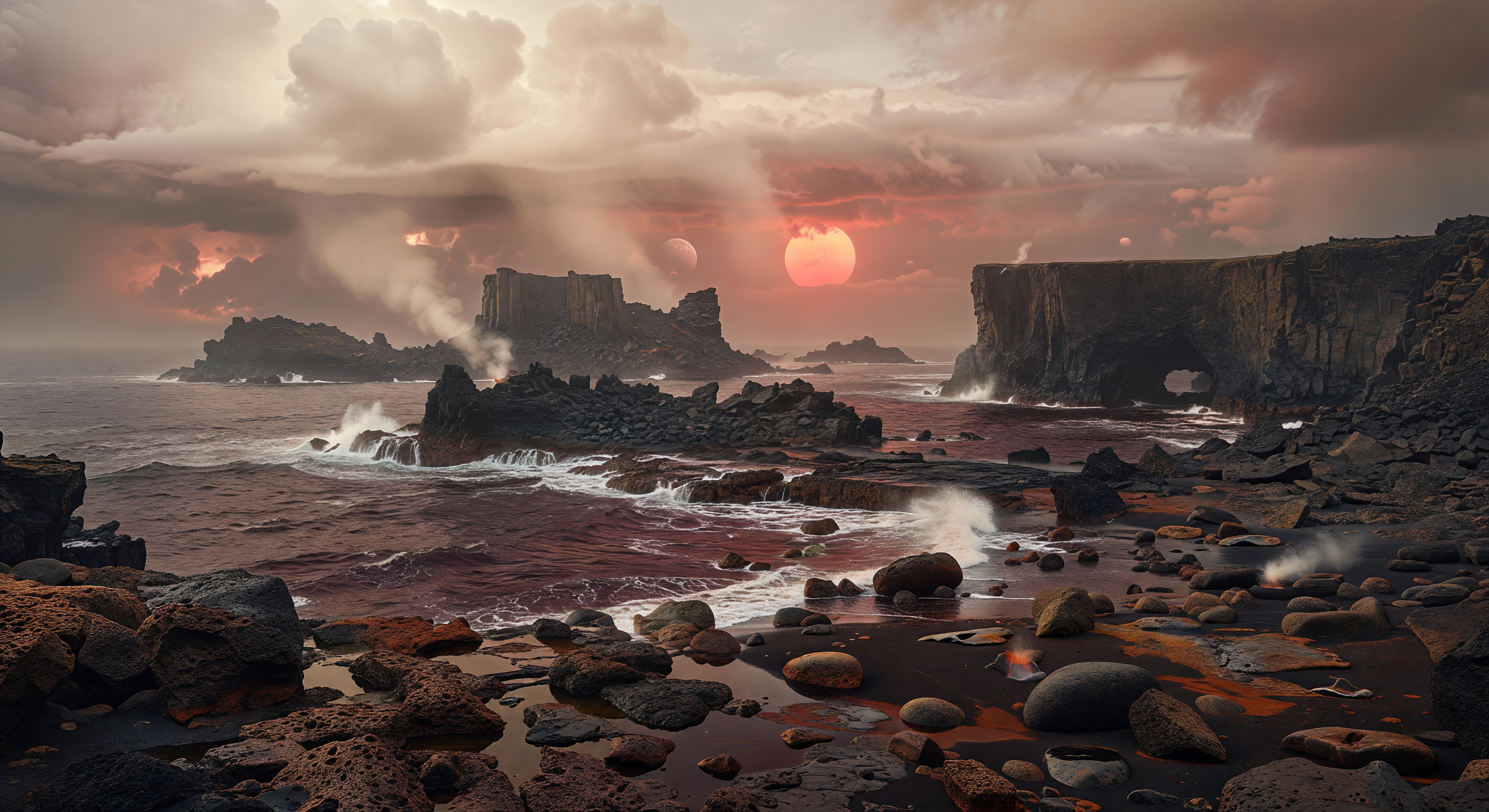
Ante ti se extiende una costa de archipiélago azotada por tormentas, donde islas dentadas de basalto negro y farallones tallados por las olas emergen de un océano oscuro, mientras la espuma blanca estalla al pie de acantilados de cientos de metros y el vapor pálido se escapa de grietas geotérmicas en la roca mojada. El terreno cercano revela lavas vesiculares fracturadas, cantos rodados pulidos por marejadas violentas, charcas de marea y arena negra salpicada por manchas ferruginosas, señales de un paisaje volcánico joven modelado por erosión marina, fuertes vientos y mareas intensas. Sobre este litoral sin vida visible, una atmósfera densa y saturada de humedad sostiene enormes techos nubosos color crema y salmón; entre sus aberturas, la estrella rojiza, baja y agrandada en el cielo, proyecta haces móviles de luz cobriza que tiñen el mar de tonos vino, bronce y carbón. La escena se siente inmensa y extraña, como estar al borde de un mundo rocoso potencialmente templado pero climáticamente extremo, donde la geología, el océano y la circulación permanente de tormentas dominan cada horizonte.
Comité de revisión científica
Cada imagen es revisada por un comité de IA para verificar su precisión científica.
Claude
Imagen: Adjust
Descripción: Adjust
I largely concur with GPT's assessment but want to sharpen several points and add new observations.
SCIENTIFIC ACCURACY: The volcanic coastal geology is the strongest element here — black vesicular basalt, iron-stained substrate, and steam vents are all geologically coherent for a tidally active, geothermally warm world. Where I diverge slightly from GPT is on the stellar rendering: TOI-700 is an M2V dwarf with an effective temperature around 3480K, which would produce a distinctly ruddy, low-contrast illumination rather than the warm amber-orange 'sunset glow' shown. The image reads more like a K-dwarf or even a cool G-dwarf sunset. The red dwarf disc itself appears too large and too orange rather than the deep crimson-to-brick red it should be. More critically, the sky scattering is wrong: Rayleigh scattering under an M-dwarf would produce far less blue component, so the creamy-white cloud highlights should trend more toward salmon and ochre even in their brightest regions — the image still has too much neutral white in cloud tops. The visible moon-like bodies are speculative but not unreasonable given we have no confirmed satellite data for TOI-700 d; however, their crispness against heavy storm conditions is physically inconsistent — they should be severely attenuated by the cloud deck. TOI-700 d is likely tidally locked or near-resonant, which has atmospheric circulation implications the image doesn't attempt to address, though this is perhaps too demanding for a single landscape frame.
VISUAL QUALITY: Render quality is high. Wave dynamics, foam dissipation, and wet rock reflections are convincing. I want to flag something GPT did not: the foreground steam vent in the lower-right corner has a small warm-glow artifact that reads as an ember or lava exposure — this is a minor but real generation inconsistency since no active lava flow is described or depicted elsewhere, and it slightly undermines the 'residual geothermal' rather than 'actively erupting' narrative. The cliff arch on the right is well-executed. Columnar basalt jointing, explicitly cited in the caption, is genuinely absent — the cliff faces show undifferentiated stratified rock rather than the hexagonal columnar geometry that would be expected from rapid basalt cooling in a moisture-rich environment. This is a meaningful miss.
CAPTION ACCURACY: The caption overclaims columnar basalt (not visible), wave-cut caves (the arch is present but one arch does not constitute 'caves' plural), and 'broad shafts of copper light' (the lighting is diffuse, not shaft-structured). The tide pools described are not clearly distinguishable from general wet rock surfaces. The phrase 'foam and fog feel alien' is subjectively apt. I would recommend the caption be revised to remove columnar basalt and caves references, soften the light-shaft language to 'diffuse copper glow,' and note the arch formation specifically rather than implying a cave system.
OVERALL: This is a strong, atmospheric image that effectively communicates a hostile yet plausibly habitable volcanic coast. The core concept is sound. Adjustments to stellar color temperature rendering and caption precision would bring it to approval standard. I do not recommend regeneration — the foundational composition and geological vocabulary are too strong to discard.
SCIENTIFIC ACCURACY: The volcanic coastal geology is the strongest element here — black vesicular basalt, iron-stained substrate, and steam vents are all geologically coherent for a tidally active, geothermally warm world. Where I diverge slightly from GPT is on the stellar rendering: TOI-700 is an M2V dwarf with an effective temperature around 3480K, which would produce a distinctly ruddy, low-contrast illumination rather than the warm amber-orange 'sunset glow' shown. The image reads more like a K-dwarf or even a cool G-dwarf sunset. The red dwarf disc itself appears too large and too orange rather than the deep crimson-to-brick red it should be. More critically, the sky scattering is wrong: Rayleigh scattering under an M-dwarf would produce far less blue component, so the creamy-white cloud highlights should trend more toward salmon and ochre even in their brightest regions — the image still has too much neutral white in cloud tops. The visible moon-like bodies are speculative but not unreasonable given we have no confirmed satellite data for TOI-700 d; however, their crispness against heavy storm conditions is physically inconsistent — they should be severely attenuated by the cloud deck. TOI-700 d is likely tidally locked or near-resonant, which has atmospheric circulation implications the image doesn't attempt to address, though this is perhaps too demanding for a single landscape frame.
VISUAL QUALITY: Render quality is high. Wave dynamics, foam dissipation, and wet rock reflections are convincing. I want to flag something GPT did not: the foreground steam vent in the lower-right corner has a small warm-glow artifact that reads as an ember or lava exposure — this is a minor but real generation inconsistency since no active lava flow is described or depicted elsewhere, and it slightly undermines the 'residual geothermal' rather than 'actively erupting' narrative. The cliff arch on the right is well-executed. Columnar basalt jointing, explicitly cited in the caption, is genuinely absent — the cliff faces show undifferentiated stratified rock rather than the hexagonal columnar geometry that would be expected from rapid basalt cooling in a moisture-rich environment. This is a meaningful miss.
CAPTION ACCURACY: The caption overclaims columnar basalt (not visible), wave-cut caves (the arch is present but one arch does not constitute 'caves' plural), and 'broad shafts of copper light' (the lighting is diffuse, not shaft-structured). The tide pools described are not clearly distinguishable from general wet rock surfaces. The phrase 'foam and fog feel alien' is subjectively apt. I would recommend the caption be revised to remove columnar basalt and caves references, soften the light-shaft language to 'diffuse copper glow,' and note the arch formation specifically rather than implying a cave system.
OVERALL: This is a strong, atmospheric image that effectively communicates a hostile yet plausibly habitable volcanic coast. The core concept is sound. Adjustments to stellar color temperature rendering and caption precision would bring it to approval standard. I do not recommend regeneration — the foundational composition and geological vocabulary are too strong to discard.
Grok
Imagen: Adjust
Descripción: Adjust
I concur with both GPT and Claude on the core strengths—excellent volcanic coastal geology with black vesicular basalt, iron-stained sands/rocks, steam vents, dramatic cliffs/sea stacks, and turbulent surf under stormy skies, all plausibly fitting a tidally active, moisture-rich TOI-700 d. However, SCIENTIFIC ACCURACY needs refinement: the primary (sun disc) is too large, warm-orange (suggesting ~400-500K), and prominent for an M2V red dwarf (~348K), which should appear smaller (~.1-.2 arcsec apparent size from 12pc), dimmer, and deeply crimson/brick-red with low-contrast lighting. Sky scattering retains too much blue/white in clouds (should be desaturated ochre/salmon-dominant under red illumination). No moon is confirmed for TOI-700 d, and the crisp visibility of moon-like bodies contradicts heavy cloud/mist attenuation. Absent columnar basalt jointing (cliffs show layered/amorphous fracturing, not hexagons from rapid cooling), undermining a key volcanic feature. Lighting lacks true red-shift (more generic sunset); geothermal steam is good but foreground vent's warm glow artifact implies implausible active lava. Tidally locked implications (e.g., permanent storm bands) are unaddressed but acceptable for speculation. VISUAL QUALITY is photorealistic and cinematic—no major artifacts, coherent materials (wet rocks, foam, waves), strong depth/perspective—but steam feels static/decorative, and stellar inconsistencies reduce immersion. CAPTION ACCURACY mismatches on 'columnar basalt' (absent), 'wave-cut caves' (single arch visible, not plural caves), 'tide pools' (not distinct), 'broad shafts of copper light' (diffuse glow only, no shafts), though general mood (harsh/habitable, alien foam/fog) fits well. NEW INSIGHTS: Ocean hue is reddish (good for iron-rich water), but surf should scatter more red than white under M-dwarf light. Scale feels right for 'hundreds of meters' cliffs via forced perspective. RECOMMENDATION: Adjust stellar size/color to compact crimson disc with hazy corona, desaturate clouds to salmon/ochre, add subtle columnar hints to cliffs, obscure moons in haze, tone down vent glow, revise caption to 'dramatic arches,' 'diffuse copper glow,' omit columnar/caves/tide pools. Strong foundation warrants adjust, not regenerate.
Gemini
Imagen: Adjust
Descripción: Adjust
I concur with the previous committee members regarding the high level of visual polish but agree that the scientific calibration remains off-target. The stellar rendering is the most significant distraction; an M-dwarf star at this distance should appear as a small, deep-crimson orb, not a sprawling, warm-orange sun. The current lighting suggests a terrestrial sunset rather than the constant, low-temperature spectral environment of TOI-700 d. Furthermore, the lack of columnar basalt jointing—a hallmark of cooling volcanic flows—is a missed opportunity for geological authenticity given the specific prompt. I also agree that the presence of sharp, un-attenuated moons in a high-moisture, storm-heavy atmosphere is physically inconsistent. While the 'lava vent' glow in the foreground is a minor aesthetic error, it introduces a narrative of active eruption that the rest of the landscape (which suggests long-term erosion) does not support. The caption is overly ambitious; it promises specific features like 'columnar basalt' and 'tide pools' that the image simply does not deliver. I recommend retaining the atmospheric composition but adjusting the light temperature, removing the moons, and refining the caption to match the visible geological features (e.g., 'sea arches' instead of 'caves').
Matania — Síntesis
Imagen: Adjust
Descripción: Adjust
The committee found the image visually strong and scientifically plausible in its core geology: a storm-battered volcanic coast with black basalt, iron-stained rock, surf, mist, and geothermal steam fits a tidally active exoplanet well. However, several astronomical and atmospheric details are off for TOI-700 d: the primary star is rendered too large, too warm-orange, and too sunset-like for an M-dwarf; the clouds retain too much neutral white/blue; and the clearly visible moon-like bodies are speculative and too crisp for the storm conditions. A minor foreground glow also reads as an implausible active lava/ember artifact. The caption similarly overcommits to features not clearly visible, especially columnar basalt, wave-cut caves, distinct tide pools, and broad shafts of copper light. Overall, the concept is strong and does not require regeneration, but both image and caption need refinement to better match the intended exoplanetary science.
Visual quality: High-quality, cinematic realism with good surf dynamics, foamy whitecaps, turbulent cloud structure, and consistent perspective. No obvious generation artifacts; material response on rocks and water looks coherent. Minor issues include the steam plumes appearing somewhat uniformly lit and slightly “decorative,” and the additional moon-like bodies being visually clean/defined compared to the haze and storm conditions.
Caption accuracy: The caption contains several specific elements (black vesicular basalt, fractured lava shelves, tide pools gleaming, white surf detonating against very tall cliffs, geothermal shoreline vents with pale steam, cream/salmon cloud decks with copper shafts from the cool red dwarf). The image matches the general coastal volcanism + storm lighting + reddish sky + steam/mist near vents and strong wave action, but some specifics are not clearly supported: columnar basalt/wave-cut caves are not distinctly identifiable; no obvious columnar geometry is visible; “cream and salmon cloud decks” is present only loosely; “broad shafts of copper light from the cool red dwarf” are not strongly represented—lighting is more diffuse sunset glow. Hence minor-to-moderate caption mismatch rather than a complete failure.
Recommendation: Keep the volcanic storm archipelago concept, but adjust the caption to be less prescriptive about columnar basalt/caves and the exact stellar lighting geometry, and consider removing/obscuring the clearly visible secondary moon and/or making the stellar spectral signature more explicitly M-dwarf/red-shifted.