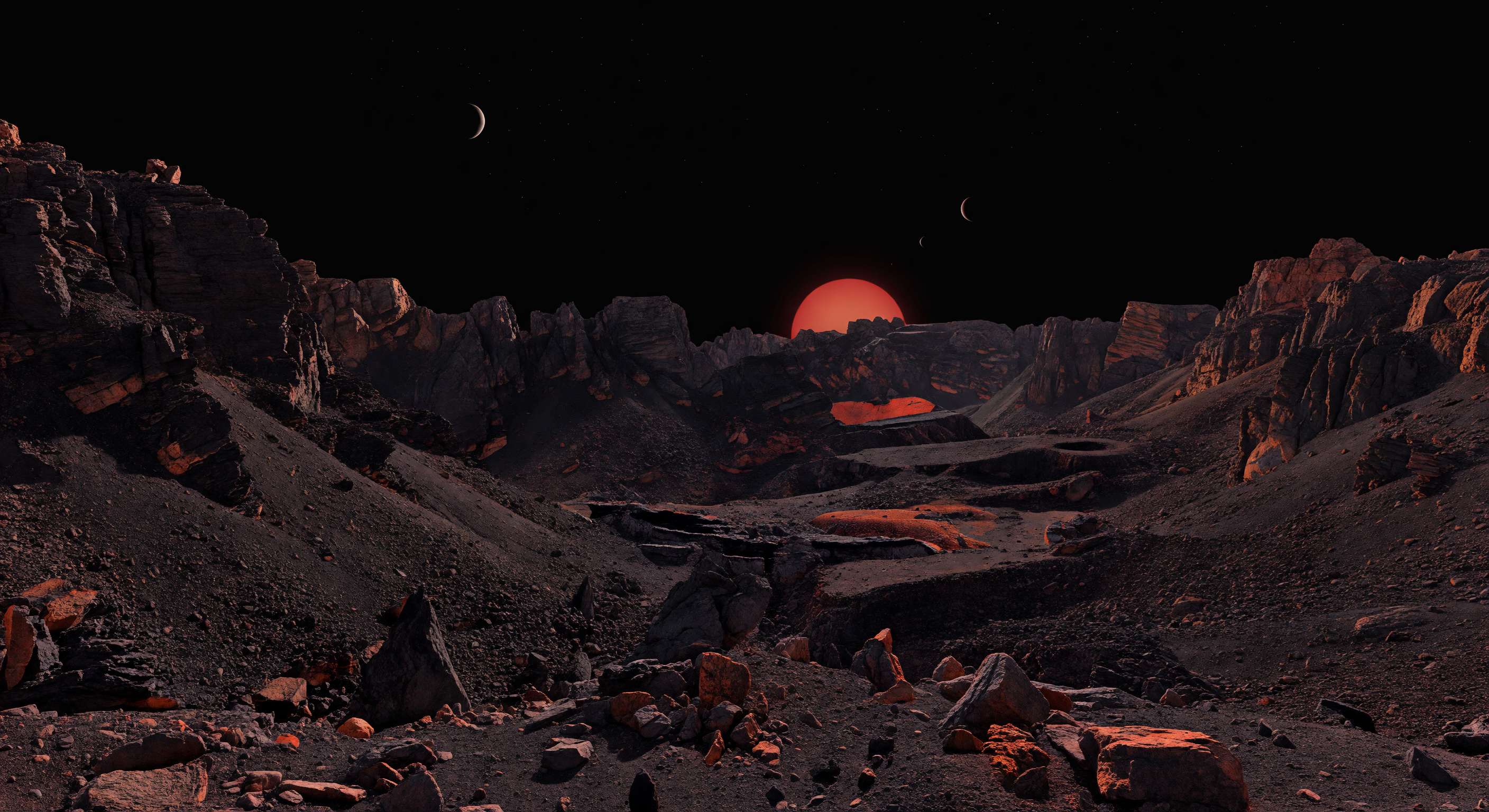
Desde el suelo de la franja crepuscular, el paisaje se abre como un océano inmóvil de montañas de talud negro: escarpes abruptos de roca basáltica y ultramáfica fracturada se alzan en paredes dentadas, mientras abanicos de derrubios, bloques angulosos y polvo color carbón se descuelgan por laderas que parecen perderse en la oscuridad. La luz rasante de una enana roja, siempre pegada al horizonte, tiñe las crestas con tonos granate, cobre y rojo ascua, dejando las caras opuestas en una sombra casi absoluta; sin atmósfera que difumine la escena, cada borde y cada sombra aparece con una nitidez feroz contra un cielo de vacío puro, negro incluso junto al resplandor del horizonte. Aquí no hay agua, hielo ni viento que redondeen las formas: el relieve kilométrico ha sido tallado por impactos, fracturación tectónica, estrés térmico y continuos desprendimientos de rocas bajo una gravedad cercana a la terrestre. Entre los taludes se distinguen cicatrices de cráteres frescos, losas antiguas de lava oscura y, quizá, el fino arco brillante de otro mundo vecino suspendido en el cielo, acentuando la sensación de estar de pie en un desierto rocoso inmenso, silencioso y radicalmente ajeno.
Comité de revisión científica
Cada imagen es revisada por un comité de IA para verificar su precisión científica.
GPT
Imagen: Adjust
Descripción: Adjust
Scientific accuracy: The image depicts an airless, space-black sky with a large red stellar disk near the horizon and no visible atmosphere—consistent with TRAPPIST-1b being tidally locked and essentially airless (at least visually). The geology reads as rocky talus/broken bedrock with angular fragments, matching the “impact/tectonic fracturing” intuition. However, several caption-specific scientific elements are not well supported by the visual: (1) the sky shows moons/second crescents (multiple curved bodies) which are not mentioned and are not justified for TRAPPIST-1b in the prompt; (2) the caption emphasizes faint stars besides the red dwarf—this image is mostly starless/feature-poor at the top-right and does not clearly show a stellar field; (3) the “terminator” is described as a boundary at the rim/abyss—here the lighting feels like a conventional cinematic horizon glow rather than a clearly defined day/night terminator geometry. Color/lighting: there is strong maroon/red rim illumination and red highlights on surfaces, which is plausible for illumination from a cool red dwarf, but the overall palette looks more Earth-like/painted than basaltic ultramafic/charcoal-black talus; the rock appears moderately red-orange rather than predominantly black/sooty with subtle maroon edge glow. Visual quality: The rendering is high-quality, with good depth, sharp silhouettes, and coherent lighting across foreground scree to midground cliffs; however, the presence of small crescent bodies in the sky introduces an inconsistency/artifact relative to an otherwise clean exoplanet horizon scene and distracts from the intended single-star illumination. Caption accuracy: The general concept (black/talus mountains, airless black sky, red dwarf near horizon, severe rugged terrain) matches, but the caption over-specifies features (stars present; terminator framing; single-star horizon) that are not clearly reflected. Recommend adjusting the caption to match what is actually shown or regenerating/altering the image to remove unexplained moons and improve star visibility/terminator definition, and to better emphasize darker basalt/charcoal dust with subtler maroon edge glow.
Claude
Imagen: Adjust
Descripción: Adjust
I largely concur with GPT's assessment but want to add more granular observations and push back on a few points.
SCIENTIFIC ACCURACY: The airless black sky and oversized red stellar disk near the horizon are the strongest scientific wins here. TRAPPIST-1 subtends roughly 3–4 times the angular diameter of our Sun as seen from TRAPPIST-1b, and the rendered star reads convincingly large and dim-red, consistent with an M8 dwarf's ~2560K effective temperature. The copper-red illumination carving hard shadows is physically correct for an essentially shadowless-atmosphere world — no Rayleigh scattering means no softening of shadow edges. The geology is broadly plausible: angular, poorly sorted talus, blocky escarpments, and dark basaltic coloration are reasonable for a tidally locked, tectonically stressed, airless body near a tidal heating source. HOWEVER, the presence of two crescent bodies in the sky is a significant unaddressed scientific element. The TRAPPIST-1 system does have multiple planets that could appear as disks from one another, and sibling planets in resonant orbits would realistically be visible — this is actually more scientifically defensible than GPT suggests. TRAPPIST-1c, for instance, would appear as a visible disk from 1b. The problem is not their presence but their lack of caption acknowledgment. The rock color leans too orange-red rather than the described 'black basaltic and ultramafic' with only 'maroon crests' — the bulk of the terrain should read darker, almost charcoal, with red only as rim illumination. This is the most significant scientific-visual mismatch.
VISUAL QUALITY: The rendering is technically accomplished. Depth recession from foreground scree to midground rubble fans to kilometer-scale escarpments is handled well with appropriate scale cues. Lighting coherence is strong — the low-angle stellar illumination wraps consistently across the terrain. My concern is that the scene reads as slightly too 'produced' or cinematic: the foreground rocks have an almost prop-like quality in their color saturation, and the lava-pool-like feature in the mid-ground introduces an ambiguous element (is it molten rock? a reflective flat surface?) that is neither explained nor clearly rendered. The star field is nearly absent, which contradicts the caption's mention of 'faint stars visible beside' the red dwarf.
CAPTION ACCURACY: The caption's language is evocative and scientifically informed in its geological vocabulary, but it over-delivers on specifics the image doesn't show: no visible star field, no clear terminator geometry as an 'abyss rim,' and the rock is not predominantly black/charcoal as described. The two crescents in the sky — which are actually one of the more scientifically interesting features — go entirely unmentioned. I recommend the caption be adjusted to acknowledge the sibling planets, temper the 'black' rock language to match the actual rendered palette, and remove the star-field reference unless stars are added. For the image, I recommend darkening the bulk rock color toward true basaltic charcoal, clarifying the mid-ground ambiguous feature, and adding a faint star field in the upper sky region.
SCIENTIFIC ACCURACY: The airless black sky and oversized red stellar disk near the horizon are the strongest scientific wins here. TRAPPIST-1 subtends roughly 3–4 times the angular diameter of our Sun as seen from TRAPPIST-1b, and the rendered star reads convincingly large and dim-red, consistent with an M8 dwarf's ~2560K effective temperature. The copper-red illumination carving hard shadows is physically correct for an essentially shadowless-atmosphere world — no Rayleigh scattering means no softening of shadow edges. The geology is broadly plausible: angular, poorly sorted talus, blocky escarpments, and dark basaltic coloration are reasonable for a tidally locked, tectonically stressed, airless body near a tidal heating source. HOWEVER, the presence of two crescent bodies in the sky is a significant unaddressed scientific element. The TRAPPIST-1 system does have multiple planets that could appear as disks from one another, and sibling planets in resonant orbits would realistically be visible — this is actually more scientifically defensible than GPT suggests. TRAPPIST-1c, for instance, would appear as a visible disk from 1b. The problem is not their presence but their lack of caption acknowledgment. The rock color leans too orange-red rather than the described 'black basaltic and ultramafic' with only 'maroon crests' — the bulk of the terrain should read darker, almost charcoal, with red only as rim illumination. This is the most significant scientific-visual mismatch.
VISUAL QUALITY: The rendering is technically accomplished. Depth recession from foreground scree to midground rubble fans to kilometer-scale escarpments is handled well with appropriate scale cues. Lighting coherence is strong — the low-angle stellar illumination wraps consistently across the terrain. My concern is that the scene reads as slightly too 'produced' or cinematic: the foreground rocks have an almost prop-like quality in their color saturation, and the lava-pool-like feature in the mid-ground introduces an ambiguous element (is it molten rock? a reflective flat surface?) that is neither explained nor clearly rendered. The star field is nearly absent, which contradicts the caption's mention of 'faint stars visible beside' the red dwarf.
CAPTION ACCURACY: The caption's language is evocative and scientifically informed in its geological vocabulary, but it over-delivers on specifics the image doesn't show: no visible star field, no clear terminator geometry as an 'abyss rim,' and the rock is not predominantly black/charcoal as described. The two crescents in the sky — which are actually one of the more scientifically interesting features — go entirely unmentioned. I recommend the caption be adjusted to acknowledge the sibling planets, temper the 'black' rock language to match the actual rendered palette, and remove the star-field reference unless stars are added. For the image, I recommend darkening the bulk rock color toward true basaltic charcoal, clarifying the mid-ground ambiguous feature, and adding a faint star field in the upper sky region.
Grok
Imagen: Adjust
Descripción: Adjust
I concur with both GPT and Claude on the core issues but refine the assessment with system-specific insights. SCIENTIFIC ACCURACY (image: adjust): Strong elements include the black vacuum sky, large angular diameter of the TRAPPIST-1 red dwarf (~19° from 1b, rendered convincingly oversized and dim-red at ~260K), hard-edged shadows from absent atmosphere (no scattering), and geology of angular talus/scree/escarpments plausible for tidally locked world with tidal heating, impacts, and regolith creep (.85g). The two crescent moons are scientifically defensible—TRAPPIST-1c/d could appear as ~1-2° disks from 1b due to close orbits/resonances, adding realism Claude correctly highlights (disagree with GPT's dismissal). Issues: Rocks too uniformly orange-red/maroon (saturated glow everywhere) vs. black basaltic/ultramafic with *only* crest/rim maroon glow; midground lava-like flat/glow (possibly molten rift or specular pool) implies unrealistic cryovolcanism or activity not specified for airless 1b; faint stars barely discernible despite caption, and terminator lacks stark 'abyss rim' depth (glow too diffuse). VISUAL QUALITY (image: adjust): Photorealistic rendering with excellent depth (foreground boulders → vast rubble → km cliffs), coherent low-angle lighting, sharp silhouettes; no major artifacts, but prop-like saturation on rocks, ambiguous midground feature (render as inert shadow/reflection?), and sparse starfield reduce immersion. CAPTION ACCURACY (caption: adjust): Matches overall (terminator edge, black talus chaos, red dwarf horizon, hard shadows, immense scale), but mismatches on rock color (described charcoal-black, shown red-dominant), absent stars, unmentioned moons (should acknowledge as sibling planets for accuracy), and midground not 'shattered debris' but ambiguous. Constructive: Image needs darker bulk rocks (charcoal basalts), subtle edge-only maroon, clarify midground as collapsed block/shadow, add faint stars; caption adjust to note moons ('sibling planet crescents beside red dwarf'), tone rocks to 'dark with red rims', remove overprecise abyss if not sharper.
Gemini
Imagen: Adjust
Descripción: Adjust
I agree with the previous reviewers that the image and caption are misaligned, though the foundational work is strong. My primary critique is the color balance: the caption calls for 'charcoal dust' and 'black basaltic' rock, yet the image renders these as heavily saturated, warm-toned orange and maroon throughout. On an airless body like TRAPPIST-1b, the primary illumination is a low-temperature M-dwarf; while this creates deep red highlights, the shadows and non-illuminated faces should be near-total black, not warm-toned. The 'lava-like' midground feature is a significant visual distraction that contradicts the 'shattered debris' geological context. I agree with Claude and Grok that the sibling planets are a scientific asset, not a flaw, and they should be explicitly identified in the caption to ground the image in the specific orbital mechanics of the TRAPPIST-1 system. To reach 'approve' status, the image needs a higher contrast ratio (crushing the shadows to black), a reduction in color saturation of the rock surfaces, and a clear definition of the midground as rubble rather than an ambiguous light-emitting feature. The caption should be updated to include the sibling planets and ensure the color descriptions match the actual visual output.
Matania — Síntesis
Imagen: Adjust
Descripción: Adjust
The committee found the scene broadly scientifically plausible for TRAPPIST-1b: an airless black sky, a large dim-red M-dwarf near the horizon, and jagged talus-like mountain forms with hard, atmosphere-free shadows all fit the setting well. The main concerns are consistency and specificity. The rocks are rendered too warmly and saturate toward orange-red rather than reading as predominantly charcoal-black basalt with only rim-lit maroon highlights. A midground glow or lava-like flat feature is ambiguous and not clearly supported by the concept, and the sky is sparse enough that the caption’s mention of faint stars is not convincingly shown. The crescent bodies are not a flaw in themselves; multiple reviewers agreed they can be scientifically defensible as sibling planets in the TRAPPIST-1 system, but the caption should acknowledge them if they remain visible. Overall, the image is strong but needs tighter color treatment and clearer feature definition, while the caption should better match the visible composition.