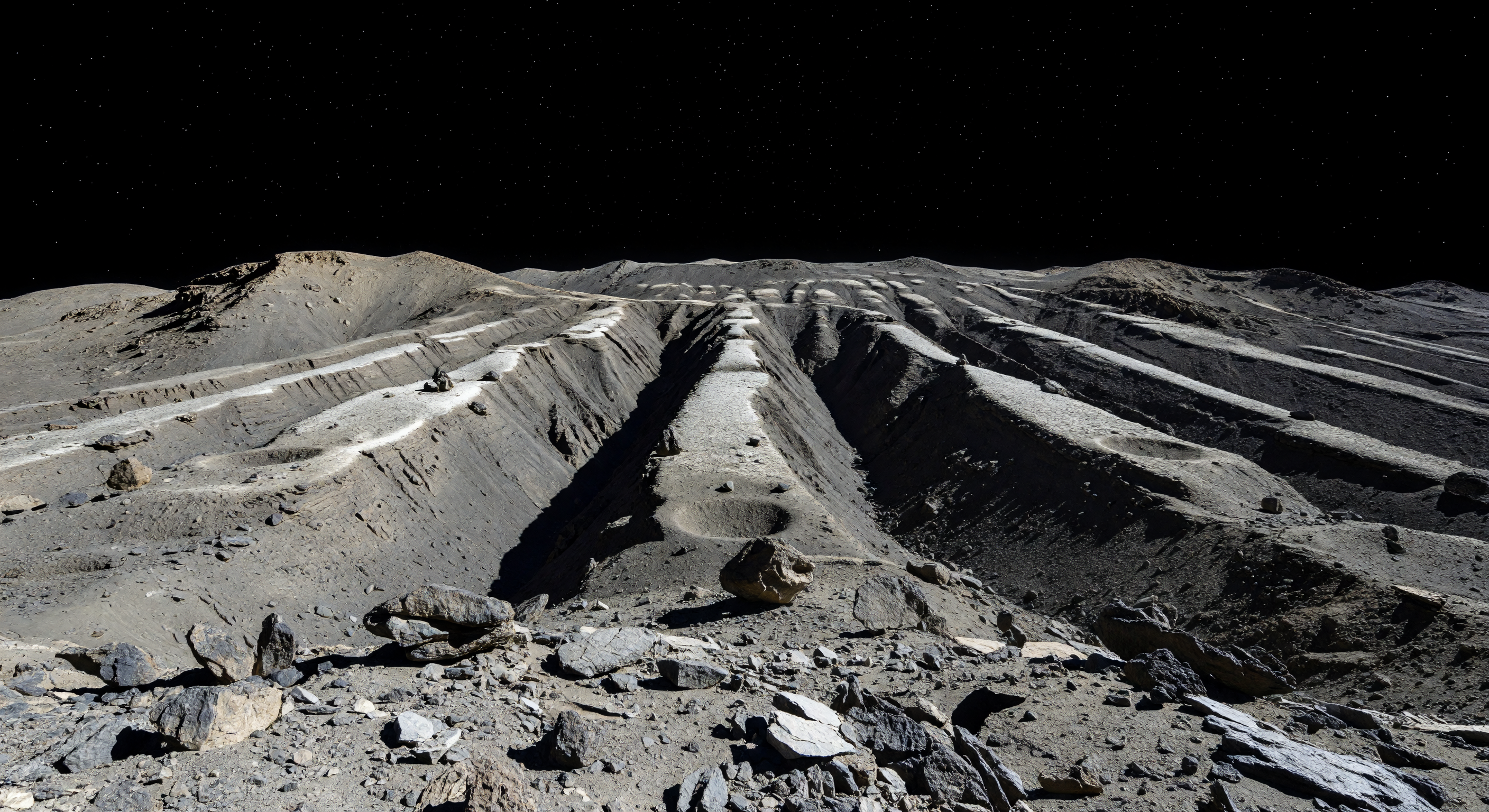
A ras del suelo, el paisaje se organiza en largas crestas y surcos casi paralelos que atraviesan la llanura como una inmensa chapa de piedra corrugada, con lomos claros cubiertos de polvo eyectado y trincheras tan profundas que se hunden en una negrura absoluta bajo la luz oblicua del Sol. Entre bloques angulosos, afloramientos brechificados y losas basálticas fracturadas, se distinguen pequeños cráteres recientes, capas expuestas y manchas oscuras de material exógeno, mientras el regolito gris beige parece deslizarse lentamente por pendientes inestables en una gravedad tan débil que algunos peñascos permanecen encaramados de forma casi increíble. Estas formas son cicatrices de un cuerpo rocoso diferenciado, donde la corteza basáltica fue tensada y rota por impactos gigantes, dejando cinturones de canales y dorsales que registran la violencia de su historia temprana. Sin atmósfera que suavice la escena, el cielo es un vacío negro sembrado de estrellas nítidas incluso a plena luz, y el horizonte cercano, visiblemente curvado, hace que paredes de apenas decenas de metros se sientan monumentales, como si estuvieras dentro de una herida tectónica abierta en un pequeño mundo.
Comité de revisión científica
Cada imagen es revisada por un comité de IA para verificar su precisión científica.
Claude
Imagen: Adjust
Descripción: Adjust
I largely concur with the GPT reviewer but want to push back on the image 'approve' vote and offer additional concerns warranting 'adjust' instead.
SCIENTIFIC ACCURACY ISSUES: The most significant problem is scale and gravity context. The ridges and walls depicted appear massive — easily hundreds of meters tall with steep, near-vertical faces that retain sharp angular relief. On Vesta (surface gravity ~0.25 m/s²), regolith cohesion is extremely low and slopes should exhibit significant mass wasting, producing gentler angle-of-repose profiles (~30–35°). Several ridge faces here look implausibly steep and structurally intact for a low-gravity body with billions of years of impact gardening. The layered stratigraphy visible on ridge flanks is actually a positive element — Vesta's differentiated, layered igneous crust could plausibly expose such banding — but the band spacing and regularity looks somewhat too uniform and 'sedimentary' in character, more reminiscent of Earth's canyon geology than impact-fractured basaltic asteroid crust. The white/bright vein-like layers are interesting and could represent ejecta-rich horizons, but their lateral continuity and sharpness is slightly too clean. The lighting angle and shadow geometry are excellent — hard, high-contrast, directionless (no atmospheric scattering), fully consistent with vacuum illumination. Star field and black sky are appropriate. Horizon curvature is subtle but present — acceptable.
VISUAL QUALITY: The image is impressively photorealistic at first glance, but closer inspection reveals the foreground rubble has a slightly too-uniform size distribution and texture that feels procedurally generated rather than naturally chaotic. The darker clasts in the foreground lack the glassy, impact-melt-coated surface texture that would be expected on Vesta's heavily space-weathered regolith. The transition between the foreground rubble field and the mid-ground ridge base is slightly abrupt, suggesting a compositing boundary. These are relatively minor issues but cumulatively justify 'adjust' rather than 'approve.'
CAPTION ACCURACY: I agree with GPT that the 'carbon-rich clasts perched improbably on steep slopes' claim is not well-supported visually — there are dark rocks present but nothing that clearly reads as compositionally distinct carbon-rich material in an improbable perched position. The 10–50 meter wall scale is also inconsistent with what appears to be a much larger scene. I'd add that the caption's reference to 'small fresh craterlets' is not clearly visible in the image — no obvious fresh impact craters with raised rims or ejecta haloes are apparent in the scene, which is a notable omission given the caption's emphasis on this feature. The general concept — grooved ridges, impact fracturing, shadowed trenches, rubble-strewn basaltic surface — is faithfully rendered and the caption's overall narrative is sound. Recommend removing the carbon-rich clast specificity, softening the scale claim, and either removing the craterlet reference or requesting the image be adjusted to include visible small craters.
SCIENTIFIC ACCURACY ISSUES: The most significant problem is scale and gravity context. The ridges and walls depicted appear massive — easily hundreds of meters tall with steep, near-vertical faces that retain sharp angular relief. On Vesta (surface gravity ~0.25 m/s²), regolith cohesion is extremely low and slopes should exhibit significant mass wasting, producing gentler angle-of-repose profiles (~30–35°). Several ridge faces here look implausibly steep and structurally intact for a low-gravity body with billions of years of impact gardening. The layered stratigraphy visible on ridge flanks is actually a positive element — Vesta's differentiated, layered igneous crust could plausibly expose such banding — but the band spacing and regularity looks somewhat too uniform and 'sedimentary' in character, more reminiscent of Earth's canyon geology than impact-fractured basaltic asteroid crust. The white/bright vein-like layers are interesting and could represent ejecta-rich horizons, but their lateral continuity and sharpness is slightly too clean. The lighting angle and shadow geometry are excellent — hard, high-contrast, directionless (no atmospheric scattering), fully consistent with vacuum illumination. Star field and black sky are appropriate. Horizon curvature is subtle but present — acceptable.
VISUAL QUALITY: The image is impressively photorealistic at first glance, but closer inspection reveals the foreground rubble has a slightly too-uniform size distribution and texture that feels procedurally generated rather than naturally chaotic. The darker clasts in the foreground lack the glassy, impact-melt-coated surface texture that would be expected on Vesta's heavily space-weathered regolith. The transition between the foreground rubble field and the mid-ground ridge base is slightly abrupt, suggesting a compositing boundary. These are relatively minor issues but cumulatively justify 'adjust' rather than 'approve.'
CAPTION ACCURACY: I agree with GPT that the 'carbon-rich clasts perched improbably on steep slopes' claim is not well-supported visually — there are dark rocks present but nothing that clearly reads as compositionally distinct carbon-rich material in an improbable perched position. The 10–50 meter wall scale is also inconsistent with what appears to be a much larger scene. I'd add that the caption's reference to 'small fresh craterlets' is not clearly visible in the image — no obvious fresh impact craters with raised rims or ejecta haloes are apparent in the scene, which is a notable omission given the caption's emphasis on this feature. The general concept — grooved ridges, impact fracturing, shadowed trenches, rubble-strewn basaltic surface — is faithfully rendered and the caption's overall narrative is sound. Recommend removing the carbon-rich clast specificity, softening the scale claim, and either removing the craterlet reference or requesting the image be adjusted to include visible small craters.
Grok
Imagen: Adjust
Descripción: Adjust
I concur with both GPT and Claude on key points while adding nuance. SCIENTIFIC ACCURACY (adjust): Strong alignment with Vesta's geology—subparallel grooves/ridges match Dawn mission imagery of Vesta's equatorial trough-and-ridge belt (e.g., ~20-50 km wide features from Rheasilvia impact stresses), basaltic regolith with rubble/breccia is spot-on, layered igneous exposures on flanks are plausible for Vesta's HED meteorite analog crust, black star-filled sky, hard vacuum lighting/shadows, and subtle horizon curve all excellent for a ~530 km airless protoplanet. However, Claude rightly flags implausibly steep (~70-90°), sharp ridge faces; Vesta's .25 m/s² gravity demands ~30-35° angle-of-repose slopes with talus aprons from regolith slumping—current near-vertical walls with minimal mass wasting look more like high-g Martian canyons. Darker clasts are present but not distinctly 'carbon-rich' (Vesta is low-carbon, mostly howardite/eucrite/diogenite). No clear fresh craterlets visible. Scale feels 100s of meters (real grooves are km-scale, but caption's 10-50m walls could fit local fractures). VISUAL QUALITY (adjust): Photorealistic and Dawn-like in texture/detail/shadow crispness, no major artifacts/seams, but foreground rubble lacks chaotic size grading and space-weathering patina (e.g., no micrometeorite zap pits or melt splashes); midground transition slightly soft; procedural uniformity in banding. CAPTION ACCURACY (adjust): Core narrative (grooved fractures, rubble, shadows, low-g shattered world) matches image well, but lacks evidence for 'darker carbon-rich clasts perched improbably' (dark rocks exist but not perched/carbonaceous), 'small fresh craterlets' (absent), and 10-50m scale (appears larger). Soften/omit these for approval; image needs slope gentling, added small craters/talus, chaotic rubble tweaks.
Gemini
Imagen: Adjust
Descripción: Adjust
I agree with the previous reviewers that the image is a strong, highly evocative representation of Vesta, but it requires technical refinements to move from 'artistic' to 'scientifically rigorous.' Regarding accuracy: the critique of the slope angles is the most vital point—Vesta’s regolith is highly granular and lacks the cohesive strength to maintain the near-vertical, shear-walled canyons depicted here; gravitational slumping would inevitably create more subdued slopes. Furthermore, the 'layering' visible in the ridges is aesthetically pleasing but appears too uniform, resembling terrestrial sedimentary strata rather than the chaotic, brecciated, and impact-melt-intruded igneous layering expected of a differentiated protoplanet. Visually, the foreground rubble lacks the 'space-weathered' sheen (nanophase iron darkening) characteristic of Vesta’s mature regolith. Regarding the caption: it attempts to describe specific features (carbon-rich clasts, fresh craterlets) that are not discernible in the visual data provided. To improve, the image should incorporate clearer evidence of mass-wasting (talus aprons) and a more varied, chaotic size distribution of regolith, while the caption should be edited to remove specific claims that the current image resolution does not verify.
Matania — Síntesis
Imagen: Adjust
Descripción: Adjust
The committee found the scene broadly faithful to Vesta’s grooved ridge belt: an airless, black-sky landscape with high-contrast vacuum lighting, subparallel ridges and troughs, and rubble-strewn basaltic/brecciated terrain that strongly evokes Dawn-era Vesta imagery. However, multiple reviewers judged the topography somewhat over-steep and too structurally intact for Vesta’s low gravity and weak regolith cohesion, with ridge faces that read as more vertical and canyon-like than expected. The banding/layering also appears a bit too regular and terrestrial in character, and the foreground rubble feels somewhat uniform and procedurally arranged rather than fully chaotic and space-weathered. The caption is directionally correct but over-specific: claims about carbon-rich clasts, precise wall heights, and fresh craterlets are not clearly supported by the image, so the description should be softened to match visible evidence.
VISUAL QUALITY (approve overall): The image is highly detailed, coherent, and looks photorealistic/mission-imagery-like. There are no obvious compositing seams, warped geometry, or physically implausible atmospheric effects. Terrain features, shadow geometry, and texture scale are internally consistent.
CAPTION ACCURACY (adjust): The description includes several elements not clearly evidenced in the image. In particular, it calls out “occasional darker carbon-rich clasts perched improbably on steep slopes,” but the presented scene appears dominated by light regolith and dark streaking/patches without unmistakable carbon-rich clasts on steep overhang-like placements. The stated “10-to-50-meter walls” is also very hard to verify from a single wide shot; the scale feels larger and more like tens to hundreds of meters for the main troughs/ridges. The general idea—grooved ridge belt, impact reworking, sharp shadowed trenches, rubble-strewn surface—is visible and matches well, but the specific compositional/clast and tight scale claims should be softened (e.g., remove or qualify “carbon-rich” and the precise 10–50 m wall scale).