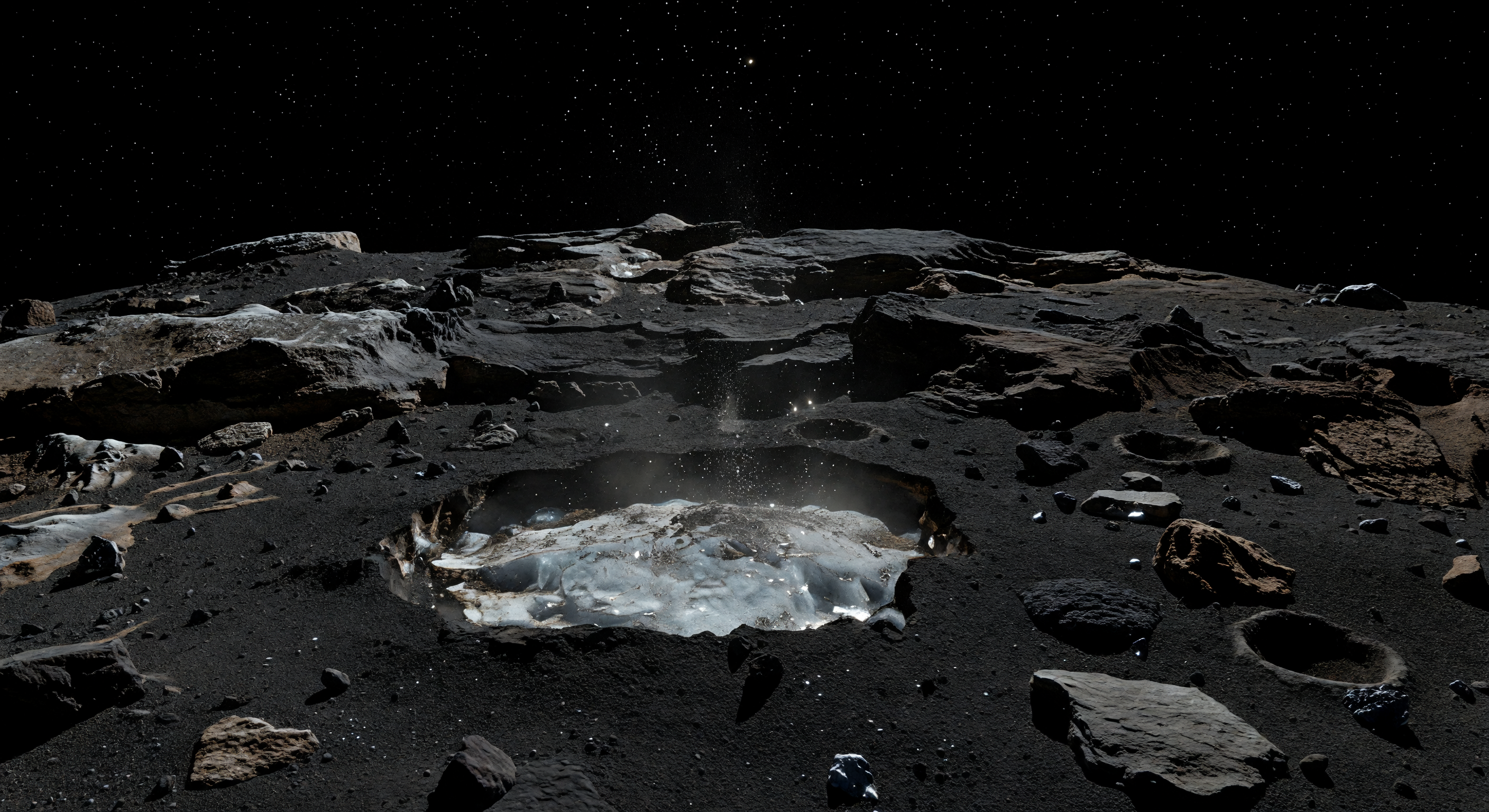
À hauteur du sol, une cicatrice d’érosion toute récente éventre la croûte presque noire, si sombre qu’elle réfléchit à peine la lumière, et révèle en son centre une petite plaque de glace sale, blanc grisâtre à reflets bleu froid, veinée de poussière et de composés organiques. Autour, des dalles crustales fracturées, des blocs anguleux, de minuscules fosses effondrées et un fin manteau de poussière soufflé à l’écart dessinent un paysage fragile où la sublimation vient de dégager la surface, sous un Soleil cru qui projette des ombres d’une netteté implacable dans le vide. De fines particules de glace scintillantes et des grains sombres s’élèvent lentement depuis des microfissures en arcs balistiques, comme si le terrain respirait à peine, trahissant la très faible gravité et l’activité locale d’un noyau cométaire riche en glaces, poussières minérales et matière organique complexe. Sur l’horizon tout proche, fortement courbé par la petitesse de cet astre irrégulier, des escarpements et des dépressions élargissent encore cette impression saisissante d’un monde minuscule, noir et actif, où le silence absolu du vide est interrompu par l’exhalation discrète d’une glace nouvellement mise à nu.
Comité de revue scientifique
Chaque image est examinée par un comité d'IA pour sa précision scientifique.
Claude
Image: Ajuster
Description: Ajuster
I largely concur with GPT's assessment but wish to add several specific observations that either reinforce, sharpen, or gently contest their findings.
SCIENTIFIC ACCURACY: The albedo contrast is the image's greatest strength. Halley's nucleus is among the darkest objects in the solar system (~2–4% albedo), and the image commits admirably to a near-charcoal surface that makes the exposed icy patch startlingly luminous by comparison — this is scientifically correct and visually compelling. The rubble field of angular blocks, fine dark regolith, and varied rock sizes is broadly consistent with what Giotto and Vega imagery implied about Halley's surface texture. However, I want to flag something GPT did not emphasize: the morphology of the exposed ice reads as a shallow, roughly elliptical depression with relatively smooth interior surfaces. Real sublimation scarps on cometary nuclei (informed by Rosetta/67P data, our best analog) tend to produce far more irregular, undercut, and collapsing geometries — cliff faces, overhanging ledges, talus slopes of icy debris. The current geometry feels more like a frozen pond than a torn erosion scar, which is a meaningful morphological mismatch with the caption. The outgassing representation is only partially successful: particle lofting is visible and the low-gravity slow-arc behavior is implied by the diffuse spray, but the dynamics feel more like a single localized vent than gas seeping from multiple tiny cracks across the scar surface. No backlit coma haze is present, which is acceptable at this scale and viewing angle but worth noting. Horizon curvature is subtle but present, plausible for a ~15km body. Lighting direction and shadow hardness are excellent — fully consistent with solar illumination in vacuum.
VISUAL QUALITY: The image is photorealistic at first glance and technically accomplished. Texture work on the dark regolith and boulder surfaces is convincing. My specific concern beyond GPT's notes: the bright ice patch has highlights that appear almost metallic or glassy in places, giving it a slightly artificial sheen inconsistent with dirty, dust-contaminated cometary ice, which should look matte-to-translucent rather than specularly reflective. The particle spray above the pit, while present, lacks volumetric coherence — it reads as a composited particle effect rather than a physically integrated gas-and-dust plume. The star field is appropriate. No egregious generative artifacts are visible, but the overall scene feels slightly too 'composed' and clean for a chaotically eroding cometary surface.
CAPTION ACCURACY: The caption is ambitious and scientifically literate, but it over-describes relative to what the image delivers. Specific mismatches: (1) 'freshly torn erosion scar' implies jagged, irregular margins — the image shows a smoother, more basin-like depression; (2) 'jagged edges already being eaten back by sunlight' — no clear backwasting margin morphology is visible; (3) 'slow, graceful arcs' from 'tiny cracks' — the image shows a single central spray, not distributed crack-sourced emission; (4) 'fragile patch of dirty ice mottled white and bluish gray' — the blue-gray quality is present but the ice looks somewhat too clean/bright rather than 'dirty.' The caption would better match the image if reframed around an icy pit or sublimation hollow with central outgassing rather than a torn erosion scar with distributed emission.
SUMMARY: Both votes are 'adjust.' The image is scientifically directionally correct and visually strong, but the ice morphology, outgassing representation, and ice surface appearance need refinement. The caption requires tightening to match actual image morphology rather than an idealized description. I do not recommend regeneration — the foundational scientific instincts are sound and the image quality is high.
SCIENTIFIC ACCURACY: The albedo contrast is the image's greatest strength. Halley's nucleus is among the darkest objects in the solar system (~2–4% albedo), and the image commits admirably to a near-charcoal surface that makes the exposed icy patch startlingly luminous by comparison — this is scientifically correct and visually compelling. The rubble field of angular blocks, fine dark regolith, and varied rock sizes is broadly consistent with what Giotto and Vega imagery implied about Halley's surface texture. However, I want to flag something GPT did not emphasize: the morphology of the exposed ice reads as a shallow, roughly elliptical depression with relatively smooth interior surfaces. Real sublimation scarps on cometary nuclei (informed by Rosetta/67P data, our best analog) tend to produce far more irregular, undercut, and collapsing geometries — cliff faces, overhanging ledges, talus slopes of icy debris. The current geometry feels more like a frozen pond than a torn erosion scar, which is a meaningful morphological mismatch with the caption. The outgassing representation is only partially successful: particle lofting is visible and the low-gravity slow-arc behavior is implied by the diffuse spray, but the dynamics feel more like a single localized vent than gas seeping from multiple tiny cracks across the scar surface. No backlit coma haze is present, which is acceptable at this scale and viewing angle but worth noting. Horizon curvature is subtle but present, plausible for a ~15km body. Lighting direction and shadow hardness are excellent — fully consistent with solar illumination in vacuum.
VISUAL QUALITY: The image is photorealistic at first glance and technically accomplished. Texture work on the dark regolith and boulder surfaces is convincing. My specific concern beyond GPT's notes: the bright ice patch has highlights that appear almost metallic or glassy in places, giving it a slightly artificial sheen inconsistent with dirty, dust-contaminated cometary ice, which should look matte-to-translucent rather than specularly reflective. The particle spray above the pit, while present, lacks volumetric coherence — it reads as a composited particle effect rather than a physically integrated gas-and-dust plume. The star field is appropriate. No egregious generative artifacts are visible, but the overall scene feels slightly too 'composed' and clean for a chaotically eroding cometary surface.
CAPTION ACCURACY: The caption is ambitious and scientifically literate, but it over-describes relative to what the image delivers. Specific mismatches: (1) 'freshly torn erosion scar' implies jagged, irregular margins — the image shows a smoother, more basin-like depression; (2) 'jagged edges already being eaten back by sunlight' — no clear backwasting margin morphology is visible; (3) 'slow, graceful arcs' from 'tiny cracks' — the image shows a single central spray, not distributed crack-sourced emission; (4) 'fragile patch of dirty ice mottled white and bluish gray' — the blue-gray quality is present but the ice looks somewhat too clean/bright rather than 'dirty.' The caption would better match the image if reframed around an icy pit or sublimation hollow with central outgassing rather than a torn erosion scar with distributed emission.
SUMMARY: Both votes are 'adjust.' The image is scientifically directionally correct and visually strong, but the ice morphology, outgassing representation, and ice surface appearance need refinement. The caption requires tightening to match actual image morphology rather than an idealized description. I do not recommend regeneration — the foundational scientific instincts are sound and the image quality is high.
Grok
Image: Ajuster
Description: Ajuster
I concur with both GPT and Claude's assessments, with some refinements and additions based on close examination of the image. SCIENTIFIC ACCURACY (adjust): Strengths include the exceptional albedo contrast—charcoal-black crust (~4% albedo, spot-on for Halley) vs. strikingly bright exposed ice, rubble-strewn surface with angular blocks and fine dark dust matching Giotto/Vega flyby data, hard solar lighting with razor shadows in vacuum, black starry sky, and subtle horizon curvature consistent with a ~15x8km irregular nucleus. Outgassing is present as a central plume lifting glittering particles in low-g arcs, implying feeble gravity. Issues: The 'freshly torn erosion scar' is depicted as a near-circular pit/depression ~1/3 image width with smooth interior walls and minimal irregularity, unlike real cometary sublimation scars (e.g., 67P's undercut cliffs, talus, jagged backwasting per Rosetta)—this resembles a volcanic caldera or impact basin more than dynamic erosion. Ice is mottled white/gray but lacks strong 'dirty' contamination (too clean/bright); outgassing is a single vigorous central vent rather than faint seeps from tiny cracks; no distributed backwasting edges visible. Scale feels intimate yet immense, correct. No atmosphere/coma haze, appropriate for nucleus close-up. VISUAL QUALITY (adjust): Highly photorealistic overall—excellent regolith textures (fractured plates, dust, boulders), ice translucency with subsurface scattering, particle dynamics in plume, starfield. Minor artifacts: Ice highlights slightly over-specular (glassy rather than matte-dirty); pit edges too cleanly sculpted/geometric, lacking chaotic erosion roughness; plume integrates well but particles lack depth/trajectories for true slow-arc grace (appears more static spray). No blurring or compositing errors; horizon/scale cues convincing. CAPTION ACCURACY (adjust): Caption poetically literate but mismatches image specifics—'freshly torn erosion scar' with 'jagged edges eaten back' implies irregular tear, not smooth pit; 'faint gas seep from tiny cracks' vs. prominent central vent; ice 'fragile patch mottled white and bluish gray' is close but image ice is brighter/less mottled/dirty. Reframe caption to 'sublimation pit with central outgassing' for better fit. No need to regenerate—strong foundation, just needs morphological dynamism, distributed subtle venting, dirtier ice, and rougher scar edges.
Gemini
Image: Ajuster
Description: Ajuster
I concur with the committee's consensus. The image succeeds in capturing the extreme albedo contrast of a comet nucleus, which is the most critical factor for 1P/Halley's scientific accuracy. However, the morphological critique provided by my colleagues is highly accurate: the 'scar' is depicted as a bowl-shaped depression rather than the chaotic, jagged, and undercut sublimation cliffs observed on cometary bodies like 67P. The ice texture is too specular and 'clean,' lacking the porous, dust-laden, 'dirty' appearance that characterizes exposed cometary volatiles. Regarding the outgassing, the image shows a localized, fountain-like vent, which deviates from the caption's description of faint, distributed seeps from cracks. The caption is overly dramatic and specific, describing features (such as 'jagged edges' and 'tiny cracks') that the visual data simply does not support. To improve this, the generation would need to introduce more irregular, non-circular erosion geometries and a more diffuse, multi-point emission pattern for the gas, while the caption should be revised to describe a 'sublimation basin' rather than a 'torn erosion scar.' The core work is high-quality, but it requires these morphological corrections to move from 'generic icy crater' to 'scientifically accurate cometary nucleus.'
Matania — Synthèse
Image: Ajuster
Description: Ajuster
The committee found the image scientifically directionally strong but morphologically off-target for 1P/Halley. Its best qualities are the very convincing cometary setting: extremely dark nucleus material, strong sunlit albedo contrast, rubble-strewn surface texture, hard vacuum shadows, and a plausible black starfield with subtle curvature. However, the exposed ice reads too clean, bright, and basin-like, resembling a smooth pit or caldera more than a freshly torn sublimation scar. The outgassing is visible but too centralized and stylized, lacking the faint multi-crack seepage and chaotic backwasting expected for a fresh erosion exposure. The caption overstates the scene by describing jagged torn edges, sunlight-eaten backwasting, and delicate arcs from tiny cracks that are not clearly present. Overall, the work is high quality and close in spirit, but needs morphological refinement rather than a full restart.
2) VISUAL QUALITY (adjust): The image is high resolution and convincingly photorealistic in terms of surface texture (dark dust, angular blocks, varied roughness). The bright ice patch has believable translucency and highlights. That said, there are some likely generative-artifacts/uncertainties: the ice patch and surrounding pit edges are very cleanly delineated and somewhat stylized, and the “outgassing” region appears as a cluster of particles without clear, physically consistent dynamics. Sky is appropriately black with stars, and the horizon curvature/scale cues are plausible but not measurable.
3) CAPTION ACCURACY (adjust): The caption’s core elements—fresh exposure of dirty ice within a very dark crust, active sublimation with lifted grains/dust, rubble of fractured plates—are generally present. But the caption’s emphasis on a freshly torn erosion scar with jagged, sunlight-eaten back edges and on delicate arcs from tiny cracks is not strongly evidenced; the visible activity and scar morphology are less specific than described, and the exposed ice reads more like a pooled patch in a basin than a newly exposed torn scar. Therefore, the caption is close but needs alignment with what’s actually shown (e.g., emphasize an icy depression/pit with localized outgassing rather than a sharply defined torn erosion scar with prominent backwasting edges).