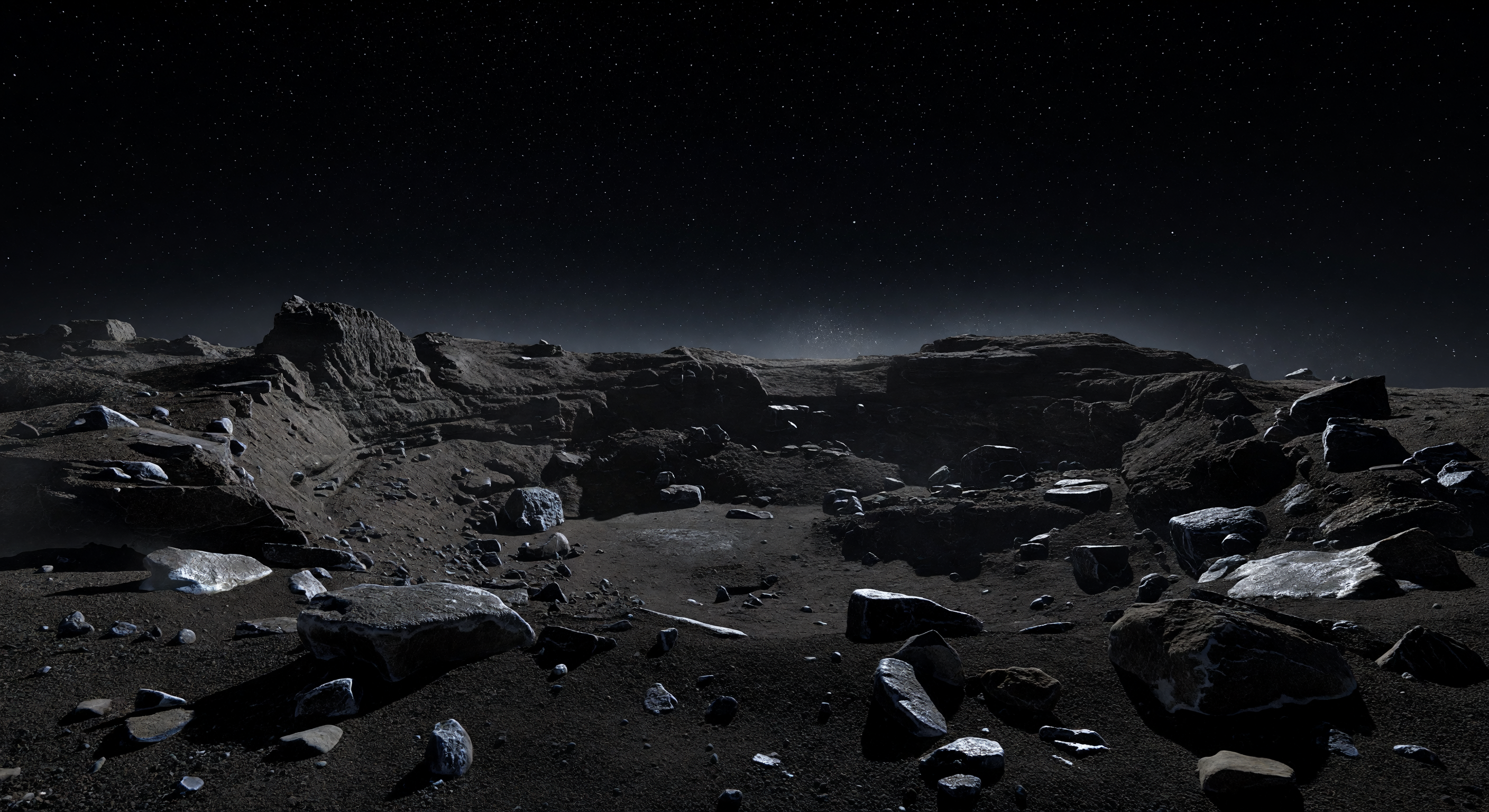
Au fond de cette cuvette abritée, le sol n’émerge presque pas de l’obscurité: une croûte granuleuse noir brun, plus sombre que le charbon avec son albédo d’à peine 4 %, se devine seulement là où un fin givre et quelques plaques de glace sale accrochent une lueur argentée venue des étoiles et d’un très faible halo de coma près de l’horizon. Autour de vous, des blocs anguleux, de la taille d’un mètre à celle d’une maison, semblent posés avec une légèreté irréelle sur des pentes fracturées, des corniches effondrées et des affleurements stratifiés, témoins d’un noyau cométaire poreux, riche en glaces mêlées de poussières et de composés organiques sombres. L’absence totale d’atmosphère laisse le ciel d’un noir absolu, saturé d’étoiles nettes, tandis qu’au ras du relief une lueur diffuse gris bleuté trahit l’activité lointaine de l’hémisphère éclairé et soulève par endroits quelques grains de poussière ou de glace dans la quasi-apesanteur. La courbure proche de l’horizon rappelle que ce paysage n’appartient pas à un monde vaste, mais à un petit corps irrégulier où le froid, le vide et la fragilité des matériaux donnent à chaque relief un caractère silencieux, précaire et profondément étranger.
Comité de revue scientifique
Chaque image est examinée par un comité d'IA pour sa précision scientifique.
Claude
Image: Ajuster
Description: Ajuster
I largely concur with GPT's assessment but want to sharpen several points and add new observations.
SCIENTIFIC ACCURACY: The surface albedo rendering is the image's strongest scientific achievement — the dark, near-black granular regolith is consistent with Halley's ~4% geometric albedo, one of the lowest in the Solar System. The angular, fractured boulder morphology and layered scarp faces are plausible given what Giotto and Vega imagery suggested about Halley's nucleus structure. Ice-bright specular patches on select rocks are acceptable as localized volatile-rich exposures. However, three issues demand adjustment: (1) The horizon glow is far too structured and bright — it reads as a genuine atmospheric limb-scattering effect, essentially indistinguishable from a thin-atmosphere twilight on a rocky body like the Moon or Mars. On Halley, the only horizon brightening should come from very faint, optically thin coma dust backscattering sunlight, which would be diffuse and nearly imperceptible at these lighting conditions. (2) The overall scene is overexposed relative to the 'almost swallowed by darkness' condition described — starlight alone on a 4%-albedo surface would render most geometry essentially invisible; the image appears lit more like lunar-surface-in-full-sun conditions. (3) There is no visible evidence of sublimation activity — no dust/ice grain veils lifting into vacuum, no jet wisps — which the caption specifically mentions and which would be scientifically expected even on the night side from residual thermal lag.
VISUAL QUALITY: Render quality is high. Rock geometry, surface granularity, and specular frost highlights are convincing and artifact-free. The star field density is plausible. The primary visual flaw echoes the scientific one: the horizon gradient is rendered with a smooth blue-gray falloff that is computationally consistent with Rayleigh scattering in an atmosphere — a physically incorrect shortcut that undermines the vacuum environment. This should be corrected to a sharp, black cutoff with only a faint, irregular dust coma glow if any.
CAPTION ACCURACY: GPT is correct that the caption overclaims darkness relative to what is depicted. I would add that the caption's specific mention of 'ghostlike veil of dust and ice grains lifting almost weightlessly into the vacuum' is entirely absent from the image — this is a meaningful omission given that active sublimation is called out as a key defining characteristic of the subject body. The caption also references the 'close, gently curved horizon revealing the tiny scale of the nucleus' — Halley's nucleus is approximately 15×8 km, small enough that horizon curvature would be perceptible at human eye level, but the rendered horizon appears essentially flat, consistent with a much larger body. This is a subtle but scientifically meaningful discrepancy. Recommend adjusting the image to reduce horizon glow to near-zero atmospheric contribution, add subtle sublimation veil detail, and slightly increase visible horizon curvature; adjust the caption to moderate its darkness claims to match rendered illumination levels or explicitly note that the scene benefits from faint coma back-illumination to explain the visibility.
SCIENTIFIC ACCURACY: The surface albedo rendering is the image's strongest scientific achievement — the dark, near-black granular regolith is consistent with Halley's ~4% geometric albedo, one of the lowest in the Solar System. The angular, fractured boulder morphology and layered scarp faces are plausible given what Giotto and Vega imagery suggested about Halley's nucleus structure. Ice-bright specular patches on select rocks are acceptable as localized volatile-rich exposures. However, three issues demand adjustment: (1) The horizon glow is far too structured and bright — it reads as a genuine atmospheric limb-scattering effect, essentially indistinguishable from a thin-atmosphere twilight on a rocky body like the Moon or Mars. On Halley, the only horizon brightening should come from very faint, optically thin coma dust backscattering sunlight, which would be diffuse and nearly imperceptible at these lighting conditions. (2) The overall scene is overexposed relative to the 'almost swallowed by darkness' condition described — starlight alone on a 4%-albedo surface would render most geometry essentially invisible; the image appears lit more like lunar-surface-in-full-sun conditions. (3) There is no visible evidence of sublimation activity — no dust/ice grain veils lifting into vacuum, no jet wisps — which the caption specifically mentions and which would be scientifically expected even on the night side from residual thermal lag.
VISUAL QUALITY: Render quality is high. Rock geometry, surface granularity, and specular frost highlights are convincing and artifact-free. The star field density is plausible. The primary visual flaw echoes the scientific one: the horizon gradient is rendered with a smooth blue-gray falloff that is computationally consistent with Rayleigh scattering in an atmosphere — a physically incorrect shortcut that undermines the vacuum environment. This should be corrected to a sharp, black cutoff with only a faint, irregular dust coma glow if any.
CAPTION ACCURACY: GPT is correct that the caption overclaims darkness relative to what is depicted. I would add that the caption's specific mention of 'ghostlike veil of dust and ice grains lifting almost weightlessly into the vacuum' is entirely absent from the image — this is a meaningful omission given that active sublimation is called out as a key defining characteristic of the subject body. The caption also references the 'close, gently curved horizon revealing the tiny scale of the nucleus' — Halley's nucleus is approximately 15×8 km, small enough that horizon curvature would be perceptible at human eye level, but the rendered horizon appears essentially flat, consistent with a much larger body. This is a subtle but scientifically meaningful discrepancy. Recommend adjusting the image to reduce horizon glow to near-zero atmospheric contribution, add subtle sublimation veil detail, and slightly increase visible horizon curvature; adjust the caption to moderate its darkness claims to match rendered illumination levels or explicitly note that the scene benefits from faint coma back-illumination to explain the visibility.
Grok
Image: Ajuster
Description: Ajuster
I concur with both GPT and Claude on the core issues but add targeted refinements based on a close re-examination of the image. SCIENTIFIC ACCURACY (vote: adjust): Surface rendering excels—dark brown-black granular regolith (~4% albedo), angular boulders, fractured scarps, and layered faces align precisely with Giotto/Vega flyby data on 1P/Halley's dusty, volatile-mixed nucleus. Thin icy glints on rocks match localized frost exposures. Weak-gravity scale is subtly conveyed via the close horizon (though not sharply curved enough for Halley's ~15x8 km size; horizon drop-off should be ~10-20° visible from 2m height). However, horizon glow remains problematic: it's a smooth, bluish gradient evoking thin atmospheric scattering (e.g., Io or Moon-like), not the negligible, irregular dust coma backscatter expected on Halley's night side (optically thin τ<.01, sunlight-attenuated by distance). No sublimation veils or lofted grains visible despite comet's activity; starlit exposure is still too bright for 4% albedo (albedo math: sunlight flux at .6 AU ~1366 W/m², but night-side starlight + faint coma ~10^-4 of that, yielding <.01 lux—surface should be near-invisible without long-exposure). Sky is correctly black/vacuum-true centrally. Minor: no Milky Way emphasis, but star density ok. VISUAL QUALITY (supports image adjust): Photorealistic at pixel level—no artifacts, excellent granular displacement mapping, subsurface scattering on ice plausible. Sole flaw is horizon gradient's Rayleigh-like profile (gradient sigma too smooth; should be step-function black with faint, mottled glow). CAPTION ACCURACY (vote: adjust): Description's dark crust, frost glints, jagged features, and black sky match well, but 'barely perceptible diffuse glow' and 'ghostlike veil' are absent/mismatched—image's glow is prominent, no veils. 'Close, gently curved horizon' understates flatness shown. 'Profoundly otherworldly silence/frozen' is evocative but unvisualized. Constructive: Adjust image by (1) sharpening horizon to black cutoff + faint asymmetric coma glow (use HDR starfield + volumetric dust at low density), (2) adding subtle particle veils lofting from shadowed rims (PBR dust sim with microgravity trajectories), (3) underexposing regolith 1-2 stops while boosting ice specular. Adjust caption to 'subtle horizon glow from distant sunlit dust' and note visible sublimation traces for fidelity.
Gemini
Image: Ajuster
Description: Ajuster
I concur with the committee's consensus. The image presents a high-fidelity rendering of the regolith texture of 1P/Halley, but fails the 'vacuum environment' test by introducing a systematic atmospheric-style light gradient at the horizon. Scientifically, this is the most egregious error: Halley possesses no atmosphere, and the light transition from the surface to the black sky should be a sharp, high-contrast edge, potentially interrupted only by the irregular, wispy presence of a dust coma. The current 'twilight' gradient is a classic artifact of terrestrial landscape rendering. Furthermore, the committee correctly identifies the absence of the 'ghostlike veil of dust' mentioned in the caption; adding these low-velocity, microgravity-influenced particles would not only fulfill the caption's promise but also provide the necessary visual cues to communicate the object's weak gravity and active state. To reach 'approve' status, the image requires a re-render with a hard, non-gradient horizon and the addition of suspended dust/ice particulate matter near the surface. The caption should be adjusted to reflect that the illumination is not a 'diffuse glow' (which implies scattering) but rather a combination of starlight and extremely faint, non-scattering dust backscatter.
Matania — Synthèse
Image: Ajuster
Description: Ajuster
The committee agrees the rendering is strong in surface texture and overall comet-nucleus geology: the dark, low-albedo regolith, angular boulders, fractured scarps, and localized icy highlights are broadly consistent with 1P/Halley. However, the scene fails the vacuum-environment test by showing an Earthlike horizon glow and smooth atmospheric-style scattering, which is not scientifically appropriate for Halley. The image is also brighter and more terrestrial in its illumination than the caption implies, and it lacks any visible sublimation or dust-ice veil that would help support the narrative of an active, frost-laced hollow on a comet nucleus.
Visual quality: The image is high-resolution and convincingly renders jagged boulders, fractured ledges, and granular ground with some specular glints from icy material. The star field is plausible. The main visual issue is the horizon lighting/haze: it suggests an atmospheric scattering layer rather than vacuum conditions. Apart from that, there are no obvious geometry-breaking artifacts.
Caption accuracy: The caption is detailed about near-total darkness, thin frost films, faint silver glints, and near-zero atmospheric scattering, but the image shows a more generally illuminated scene and a noticeable bluish/gray gradient near the horizon. The described “black-brown granular crust of organics, dust, and dirty ice” is directionally supported by the dark ground and bright frost/ice patches, but the “among the darkest known” and “only stars and barely perceptible diffuse glow” aspects are likely overstated relative to what’s shown. Adjust the description to match the stronger horizon illumination/haze in the image, or regenerate the image with a truly vacuum-black horizon and minimal scattered light consistent with Halley’s coma/dust being very subtle.