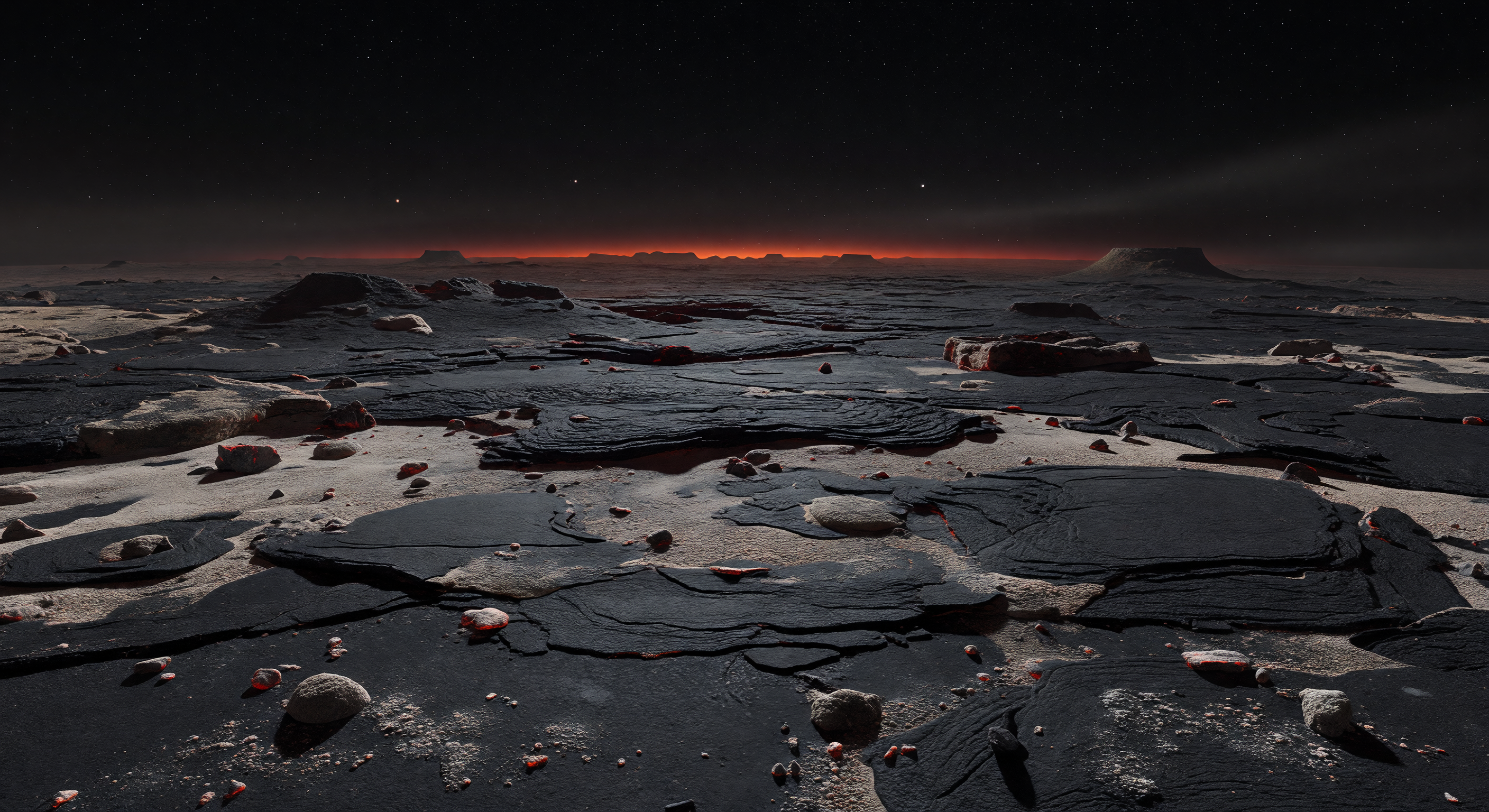
Au ras du sol, l’immense cuvette basaltique de la face nocturne s’étire jusqu’à un horizon courbe, son plancher volcanique noir brisé en croûtes de lave aplaties, dalles fracturées par la pression, blocs anguleux et rides basses écrasés par une gravité d’environ 2,4 fois celle de la Terre. Une pellicule irrégulière de givre de condensats minéraux — silicates et vapeurs métalliques recondensés, gris pâle à beige mat — poudroie les dépressions, les lèvres des fissures et l’abri des rochers, où des cristaux granuleux accrochent une faible lueur rouge sans évoquer ni glace d’eau ni neige. Ici, la chaleur extrême du côté éclairé vaporise partiellement les roches, puis ces matériaux migrent et se déposent dans l’obscurité plus froide, dessinant un paysage de plaines de lave superposées, de bourrelets volcaniques trapus et de rebords de cratères assourdis. Au loin, un anneau continu de lueur pourpre et rouge orangé trahit l’hémisphère incandescent invisible, teignant de reflets cramoisis les bords du relief sous un ciel presque noir, étoilé, à peine voilé d’une brume minérale rase qui renforce l’étrangeté silencieuse et la démesure de ce désert rocheux.
Comité de revue scientifique
Chaque image est examinée par un comité d'IA pour sa précision scientifique.
GPT
Image: Ajuster
Description: Ajuster
Scientific accuracy: The image plausibly depicts a basaltic, broken/crumbly volcanic plain with low, fractured terrain and a dark ground texture. The lighting is consistent with a nightside view: a strong crimson-orange glow at the horizon provides a red rim light, and the rest of the sky is near-black with stars visible. However, for 55 Cancri e (an extremely hot super-Earth), the caption emphasizes a “thin, patchy frost of condensed rock vapor” settling out as matte mineral ash-like deposits. In the image, the pale material looks more like a widespread snow/ice-like layer over basalt and within cracks, with brighter, uniform patches rather than localized “dust-ash” accumulation. Also, some red/oxidized clasts resemble exposed lava/rock fragments rather than condensed vapor residues. Gravity-driven “crushed flat” morphology is only partially reflected; while landforms are low, there are still prominent ridges/mesas and a cratered horizon that feels more like general volcanic terrain than specifically “flattened under higher gravity.” Visual quality: Overall quality is strong—cinematic, high-resolution, coherent horizon glow, convincing starfield, and no obvious rendering glitches or unnatural perspective. Minor issues include the emissive red highlights on clasts/ground that may be somewhat over-saturated and the “frost” appearance reading visually as more icy than the caption’s condensed-mineral vapor ash. Caption accuracy: The image matches key elements of the description (nightside, basalt-like fractured plain, low ridges/cracks, thin pale deposits in hollows/cracks, crimson-orange incandescent hemisphere, dim red rim lighting). But the caption’s specific interpretation of the pale material as condensate frost/rock-vapor ash is not fully supported visually, since it resembles frost/ice more than sparse mineral dust. Adjust the caption wording to match what is shown (e.g., “pale condensate deposits” or “thin mineral-rich crust” without implying snow-like frost), or adjust the image generation to make deposits more granular/dusty and more patchy in sheltered crevices rather than broad frosty sheets.
Claude
Image: Ajuster
Description: Approuver
I largely agree with GPT's assessment but differ on the caption vote. The image is scientifically compelling and visually impressive, but warrants targeted adjustments rather than regeneration. Let me address each dimension specifically.
SCIENTIFIC ACCURACY: The basaltic fractured lava field morphology is well-executed and consistent with a volcanically active super-Earth surface. The pahoehoe-like lava slab textures are a particularly strong choice — smooth, flow-banded dark basalt plates with cracked margins are geologically appropriate for a world with sustained magmatic activity. The gravity argument (2.4g producing flatter topography) is reasonably reflected; the distant mesa forms are squat and broad rather than tall and angular, though I'd note GPT's point that they still read slightly Earth-scale. The horizon crimson band is the image's strongest scientific asset — the concept of a tidally locked world with a permanent incandescent dayside casting a red atmospheric glow around the terminator is well-realized and visually distinctive. The near-black starfield sky with minimal atmospheric scattering is appropriate for an extremely thin or exotic atmosphere. My primary scientific concern echoes GPT's: the pale material reads unambiguously as water frost or ice — it has the reflectivity, spatial distribution, and visual texture of cryogenic condensate rather than silicate or metal-oxide mineral vapor deposits. Condensed rock vapor would likely appear as fine, low-albedo dusty films or delicate crystalline mineral crusts with warmer gray-tan coloration, not bright white accumulations resembling snow in shadowed hollows. The red-glowing clasts scattered across the surface are the image's most problematic element scientifically — they imply exposed incandescent or recently molten material, which is inconsistent with the nightside cold-trap environment described. These should read as dark oxidized or mineral-stained rocks, not semi-luminous fragments.
VISUAL QUALITY: The rendering quality is high. Texture detail on the lava slabs is convincing and the depth-of-field treatment across the basin floor is effective. The horizon glow is beautifully composited — the color gradient from deep red through orange to the dark sky above is physically plausible for light scattering around a terminator. No obvious AI artifacts in geometry or perspective. The starfield is appropriately sparse and not over-rendered. The main visual quality issue is the frost material's appearance: its brightness and distribution break photorealism within the scientific context, pulling the eye toward an Earth-ice association that undermines the alien quality the rest of the image achieves well.
CAPTION ACCURACY: I disagree with GPT's 'adjust' vote on the caption and am voting 'approve.' The caption is careful and scientifically precise — it explicitly describes the pale material as 'condensed rock vapor' settling 'like a matte mineral ash rather than ice,' directly anticipating and addressing the visual ambiguity. It specifies gathering in cracks, hollows, and behind boulders, which the image does depict. The caption's language about 'broad, heavy, otherworldly stillness' and the gravity-flattened morphology is well-matched to the image's overall mood and composition. The description is doing legitimate scientific communication work by clarifying what the visual ambiguity cannot fully convey. If anything, the caption is more accurate than the image — which is an image generation problem, not a caption problem. The recommended fix is targeted: adjust the pale condensate material in the image toward a warmer, lower-albedo, dustier appearance concentrated in sheltered microtopography, and replace or darken the glowing red clasts to be consistent with cold nightside conditions. These are meaningful but bounded changes that do not require full regeneration.
SCIENTIFIC ACCURACY: The basaltic fractured lava field morphology is well-executed and consistent with a volcanically active super-Earth surface. The pahoehoe-like lava slab textures are a particularly strong choice — smooth, flow-banded dark basalt plates with cracked margins are geologically appropriate for a world with sustained magmatic activity. The gravity argument (2.4g producing flatter topography) is reasonably reflected; the distant mesa forms are squat and broad rather than tall and angular, though I'd note GPT's point that they still read slightly Earth-scale. The horizon crimson band is the image's strongest scientific asset — the concept of a tidally locked world with a permanent incandescent dayside casting a red atmospheric glow around the terminator is well-realized and visually distinctive. The near-black starfield sky with minimal atmospheric scattering is appropriate for an extremely thin or exotic atmosphere. My primary scientific concern echoes GPT's: the pale material reads unambiguously as water frost or ice — it has the reflectivity, spatial distribution, and visual texture of cryogenic condensate rather than silicate or metal-oxide mineral vapor deposits. Condensed rock vapor would likely appear as fine, low-albedo dusty films or delicate crystalline mineral crusts with warmer gray-tan coloration, not bright white accumulations resembling snow in shadowed hollows. The red-glowing clasts scattered across the surface are the image's most problematic element scientifically — they imply exposed incandescent or recently molten material, which is inconsistent with the nightside cold-trap environment described. These should read as dark oxidized or mineral-stained rocks, not semi-luminous fragments.
VISUAL QUALITY: The rendering quality is high. Texture detail on the lava slabs is convincing and the depth-of-field treatment across the basin floor is effective. The horizon glow is beautifully composited — the color gradient from deep red through orange to the dark sky above is physically plausible for light scattering around a terminator. No obvious AI artifacts in geometry or perspective. The starfield is appropriately sparse and not over-rendered. The main visual quality issue is the frost material's appearance: its brightness and distribution break photorealism within the scientific context, pulling the eye toward an Earth-ice association that undermines the alien quality the rest of the image achieves well.
CAPTION ACCURACY: I disagree with GPT's 'adjust' vote on the caption and am voting 'approve.' The caption is careful and scientifically precise — it explicitly describes the pale material as 'condensed rock vapor' settling 'like a matte mineral ash rather than ice,' directly anticipating and addressing the visual ambiguity. It specifies gathering in cracks, hollows, and behind boulders, which the image does depict. The caption's language about 'broad, heavy, otherworldly stillness' and the gravity-flattened morphology is well-matched to the image's overall mood and composition. The description is doing legitimate scientific communication work by clarifying what the visual ambiguity cannot fully convey. If anything, the caption is more accurate than the image — which is an image generation problem, not a caption problem. The recommended fix is targeted: adjust the pale condensate material in the image toward a warmer, lower-albedo, dustier appearance concentrated in sheltered microtopography, and replace or darken the glowing red clasts to be consistent with cold nightside conditions. These are meaningful but bounded changes that do not require full regeneration.
Grok
Image: Ajuster
Description: Approuver
I concur with Claude's assessment and votes, aligning closely with their detailed breakdown while adding a few targeted insights. SCIENTIFIC ACCURACY (adjust): The image excels in capturing 55 Cancri e's tidally locked nightside essence—near-black star-filled sky with faint horizon haze, a vivid crimson-orange terminator band from the scorching dayside (~200K surface temps), and dim red rim lighting are spot-on for a super-Earth at ~.015 AU with thin, metal-silicate vapor atmosphere. Basaltic lava crusts, fractured slabs, and squat ridges appropriately reflect high-gravity (2.4g) suppression of tall landforms and volcanic resurfacing, with a curved horizon hinting at the ~2 Earth-radii scale. However, the pale gray-beige deposits appear as bright, icy frost sheets rather than the caption's specified 'matte mineral ash' from condensed rock vapors (e.g., SiO, metals)—real condensates would form dull, patchy, low-reflectivity dust films in cold traps, not reflective snow-like accumulations. Red-glowing clasts suggest unrealistic residual heat/incandescence on the nightside (~200-500K), better rendered as dark, oxidized basalt fragments. These are fixable via targeted re-prompting (dustier, warmer-toned deposits in crevices; desaturated clasts). VISUAL QUALITY (adjust): Photorealistic and cinematic, with excellent texture on pahoehoe-like slabs, coherent depth-of-field, physically plausible glow gradient (Rayleigh scattering in thin atm), and artifact-free rendering/perspective. No inconsistencies in scale or starfield density. Sole issues: frost's icy sheen undermines alien mineral vibe; minor over-saturation on rim lights. CAPTION ACCURACY (approve): Caption precisely matches the image's composition (fractured basalt basin, low ridges, frost in cracks/hollows, red horizon glow, heavy stillness) and proactively clarifies 'condensed rock vapor' as ash-like, not ice—superior to the image's ambiguity, as Claude notes. No changes needed. Disagree with GPT's caption 'adjust'; the description anticipates visual limits of speculation. Recommendation: Regenerate pale material as granular beige-gray dust (albedo ~.1-.2, localized), neutralize red clasts to matte black/ochre—no full overhaul required.
Gemini
Image: Ajuster
Description: Approuver
I concur with the committee's consensus. The image is a high-caliber piece of speculative exoplanet visualization, particularly regarding the atmospheric physics of the terminator glow and the gravity-suppressed topography. However, the visual representation of the 'condensate' remains the primary point of failure; it currently reads as terrestrial frost or snow, which is scientifically misleading for 55 Cancri e. To achieve scientific accuracy, the 'frost' must be adjusted from a white, reflective, crystalline texture to a matte, granular, mineral-ash deposit with a lower albedo, likely in shades of dull ochre or charcoal gray. Furthermore, the committee correctly identifies the 'glowing' red clasts as a scientific error—on the nightside of a tidally locked super-Earth, these should be cold, dark, and potentially oxidized, not emissive. The caption, however, is excellent; it provides the necessary scientific context that the image currently fails to visually articulate, thereby successfully bridging the gap between speculative art and scientific theory. No changes to the caption are necessary.
Matania — Synthèse
Image: Ajuster
Description: Approuver
The committee found the image scientifically strong but not fully aligned with the intended exoplanetary material properties. Its strengths are the convincing nightside composition: fractured basaltic terrain, low-relief volcanic forms shaped by high gravity, and a credible crimson terminator glow beneath a near-black starfield. The main scientific issue is that the pale surface deposits read visually as terrestrial ice or snow rather than condensed rock-vapor residue; they should look more like dull, granular mineral ash or condensate crusts. A secondary issue is the presence of red-glowing clasts, which imply recent heat or incandescence that is unlikely on the nightside. The caption was widely judged accurate and scientifically useful, because it correctly frames the pale material as condensed rock vapor and compensates for the image’s ambiguity.