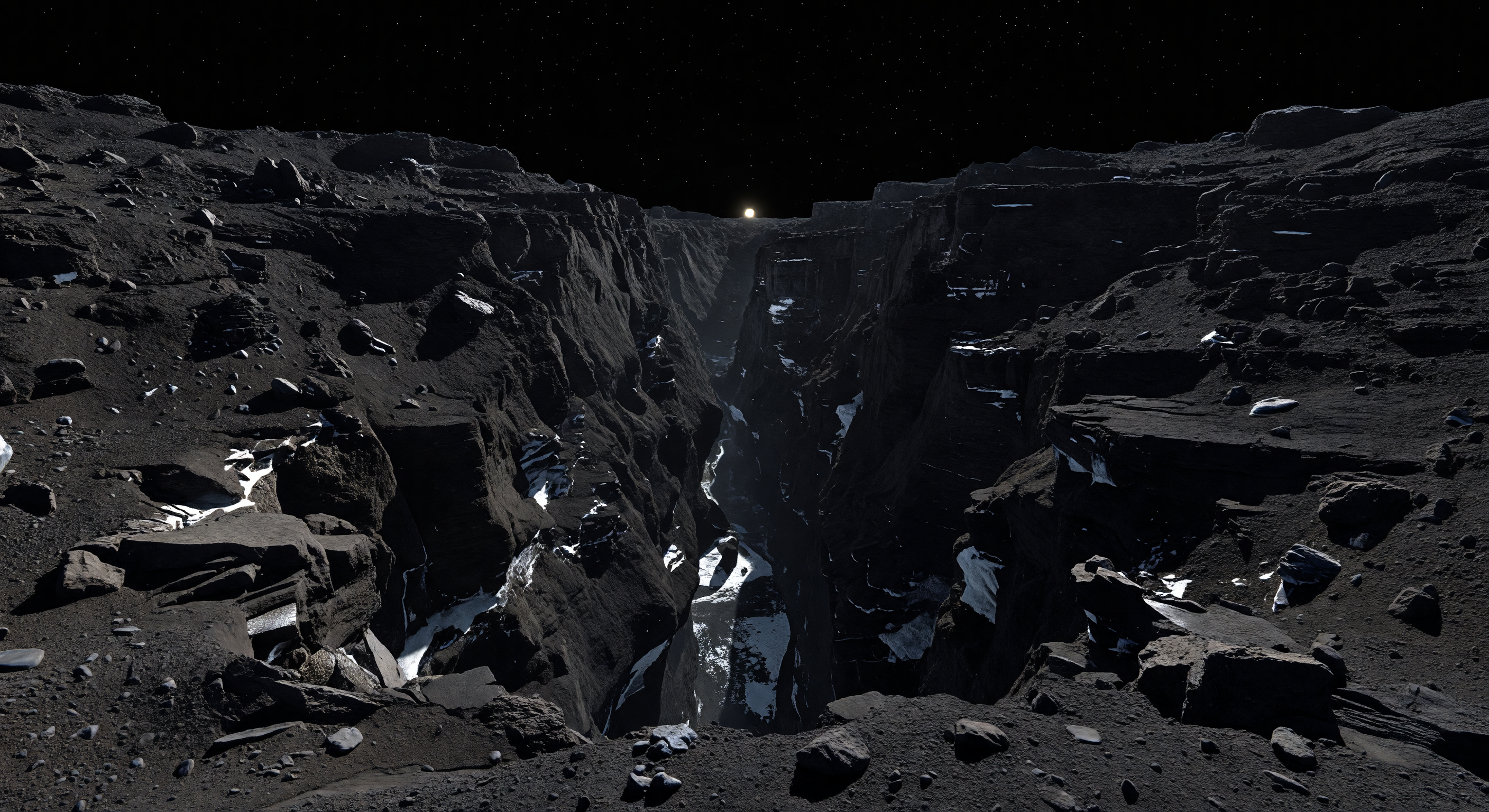
Devant vous, une tranchée étroite entaille un relief tourmenté et descend vers un gouffre presque entièrement noyé dans l’ombre, où seuls les rebords supérieurs et quelques corniches déchiquetées accrochent la lumière rasante d’un Soleil minuscule. Le sol, plus noir que du charbon, mêle croûtes d’organites réfractaires, poussière sombre et glace sale figée en dalles cassantes, tandis que de rares plaques de givre pâle subsistent dans les recoins les plus froids, véritables pièges thermiques préservés par l’absence totale d’atmosphère. Les parois abruptes, hautes de dizaines à centaines de mètres, exhibent fractures, surplombs, effondrements et mesas résiduelles, une topographie extrême rendue possible par une gravité si faible que blocs et graviers semblent à peine retenus au sol. Sous un ciel d’un noir absolu où aucune brume n’adoucit les contrastes, chaque ombre devient une coupure d’encre pure, et l’on a l’impression de se tenir au bord d’un monde brut, fraîchement façonné par l’activité cométaire et le vide.
Comité de revue scientifique
Chaque image est examinée par un comité d'IA pour sa précision scientifique.
GPT
Image: Ajuster
Description: Ajuster
Scientific accuracy: The scene shows a dark, angular, rocky chasm with sharp scarps and bright icy patches/veins on the walls and floor, which is qualitatively consistent with active comet surfaces where bright volatiles can be exposed in fractures and cold-trap regions. The lighting is also broadly plausible for a low solar angle: strong shadow contrast and a localized sunlit source near the horizon. However, the image does not clearly communicate the extremely low gravity context (the slope steepness and “rests on improbably steep slopes” are asserted in the caption but not verifiable from the picture alone). Also, the sky is perfectly black with no coma/particle scattering; that is broadly possible in a narrow, shadowed view, but 81P/Wild 2 near perihelion often shows some dust/ice activity when active sublimation is occurring—this image lacks any coma/haze or active jet signatures. Color/texture: the surface appears mostly uniform dark gray with high-albedo icy fragments that look more like clean ice coatings than a thin bluish frost veneer. Visual quality: The image is high-resolution, crisp, and convincingly rendered with consistent perspective and physically believable shading (rim highlights, shadowing, specular-ish ice glints). There are no obvious compositing artifacts, and the geology reads clearly as fractured slabs and boulders. Caption accuracy: The caption emphasizes a “perfectly black sky” and “thin bluish-white frost,” “razor-edged” shadows, and carbon-rich dust/organics. The image matches the dark sky and sharp contrast well, and it includes bright/whitish icy material in shadowed recesses, but the frost looks more like exposed, chunky ice deposits rather than a thin veneer. The “narrow chasm with darkness so complete that the trench floor nearly disappears” is partially met (deep shadow dominates), yet the floor is still visible with discernible ice patches. Overall: strong visual match to a rugged comet chasm with exposed ice under low-angle illumination, but missing clear indicators of ongoing activity (coma/dust) and the frost description is only partially supported.
Claude
Image: Ajuster
Description: Ajuster
I broadly agree with GPT's assessment but want to add several specific observations. SCIENTIFIC ACCURACY: The overall dark, carbon-rich surface albedo is well-represented — 81P/Wild 2 has an albedo of roughly 0.03, and this image captures that extreme darkness convincingly. The angular, fractured scarps and collapsed mesa geometry are consistent with Stardust mission imagery showing Wild 2's surprisingly rugged terrain with steep-walled depressions (pinnacles, mesas, and circular features up to 1 km across). The sharp shadow termination with no atmospheric scattering is correct for a vacuum body. However, I take issue with the ice presentation: the bright white patches are too chunky and voluminous, resembling terrestrial glacial ice or clean water ice deposits rather than the thin, dirty frost veneer expected on a body where surface ice is continuously sublimating. Wild 2's exposed ice should appear more subtly bright and slightly bluish, not as high-contrast blocky white masses. The complete absence of any sublimation activity — no jets, no faint coma glow, no dust haze near the chasm floor — is a meaningful omission for an 'active sublimation' scene. Even a subtle upward-streaming particulate haze would dramatically improve scientific fidelity. The single point-source sun is correctly rendered as a small, intense disk consistent with ~1.7 AU solar distance. VISUAL QUALITY: Rendering quality is high. Lighting is physically consistent, perspective is coherent, and the rock fragmentation detail is convincing. I do note that some of the angular slab geometry looks slightly too geometric and regular, almost like fractured concrete rather than sublimation-sculpted cometary material, which tends to produce more irregular, pitted, and cauliflower-textured surfaces as seen in Stardust imagery. No major compositing artifacts detected. CAPTION ACCURACY: The caption's claim of 'thin bluish-white frost' is only weakly supported — the image shows thicker, more prominent bright deposits. The description of 'darkness so complete that the trench floor nearly disappears' is approximately correct in the deep background but the foreground chasm floor remains well-lit. The caption's emphasis on active sublimation etching the surface is not visually corroborated. RECOMMENDATION: Adjust the ice deposits to be thinner and dirtier, add subtle sublimation jet activity or particle haze, and slightly roughen the rock texture toward a more pitted, irregular cometary morphology. These are targeted corrections rather than a full regeneration.
Grok
Image: Ajuster
Description: Ajuster
I concur with both GPT and Claude on the core strengths and issues, adding targeted insights from Stardust mission data (e.g., Wild 2's ~100m-deep depressions with 70-85° slopes, pitted/knobby textures, and fleeting H2O/CO2 jets near perihelion). SCIENTIFIC ACCURACY: Excellent capture of Wild 2's low albedo (~.03, very dark gray-black), angular fractured scarps/mesas, negligible gravity steep slopes, razor-sharp shadows from vacuum/single-point low-angle Sun (small disk visible at horizon, correct for ~1.7 AU), and black starless sky. Deep chasm shadowing aligns with cold-trap preservation of volatiles. However, bright white patches are overly chunky/iceberg-like (too high volume, stark white vs. subtle bluish frost); should be thin, patchy, dirty veneers as in Wild 2's minor exposed ice (~1-2% surface fraction). No evidence of 'active sublimation'—lacks faint jets, dust plumes, or coma haze (Wild 2 showed asymmetric outgassing at ~2.8 AU, intensifying near perihelion). Rock textures are too uniform/angular (concrete-like slabs) vs. Stardust's cauliflower-pitted, fine-grained porous regolith with organic crusts. Low-g scale feels miniature but lacks 'immense' vertigo via no reference scale. VISUAL QUALITY: Photorealistic high-res render with flawless perspective, coherent subsurface scattering in darks, specular glints on ice, and no artifacts—inconsistencies are scientific, not technical. CAPTION ACCURACY: Matches dark crust, sharp shadows, black sky, rugged walls, and ice in recesses well, but 'thin bluish-white frost' unsupported (shows thick white deposits), trench floor partially visible (not 'nearly disappears'), and 'freshly activated surface etched by sublimation' lacks visual jets/haze. RECOMMENDATION: Adjust ice to thin/bluish/dirty patches, add subtle dust jets or coma glow from chasm floor, irregularize textures to pitted/knobby, enhance low-g vastness with finer foreground granules—minor tweaks for approval.
Gemini
Image: Ajuster
Description: Ajuster
I concur with the previous committee members. The visual representation of the albedo and the vacuum-induced sharp shadows is excellent, capturing the 'Stardust' aesthetic of Wild 2. However, the scientific shortcomings are consistent: the ice is rendered as high-albedo, thick deposits rather than the thin, dirty, sublimation-lag veneers expected on a carbonaceous cometary surface. Furthermore, the lack of any visible particulate suspension or faint outgassing jets makes the 'active sublimation' claim in the caption feel detached from the visual data. The rock texture, while visually impressive, leans toward terrestrial fractured basalt rather than the porous, friable, 'cauliflower' morphology characteristic of cometary nuclei. To reach 'approve' status, the ice needs to be significantly desaturated and thinned, and a subtle, low-density dust haze should be added near the floor to provide both atmospheric scale and evidence of the described activity.
Matania — Synthèse
Image: Ajuster
Description: Ajuster
The committee found this to be a strong, visually convincing depiction of 81P/Wild 2’s rugged, low-albedo terrain: a dark fractured chasm under a low sun with crisp vacuum shadows and clear exposed ice in shadowed recesses. The main scientific concern is not the overall setting, but the treatment of the ice and surface texture. The bright deposits read as thick, clean, blocky white ice rather than thin, dirty, bluish frost or sublimation-lag material, and the geology feels somewhat too terrestrial and geometric compared with the porous, pitted, friable morphology expected for an active comet nucleus. The caption similarly overstates features not clearly supported by the image, especially the ‘thin bluish-white frost,’ the near-total disappearance of the trench floor, and the implied active sublimation, since no jets, haze, or coma are visible.