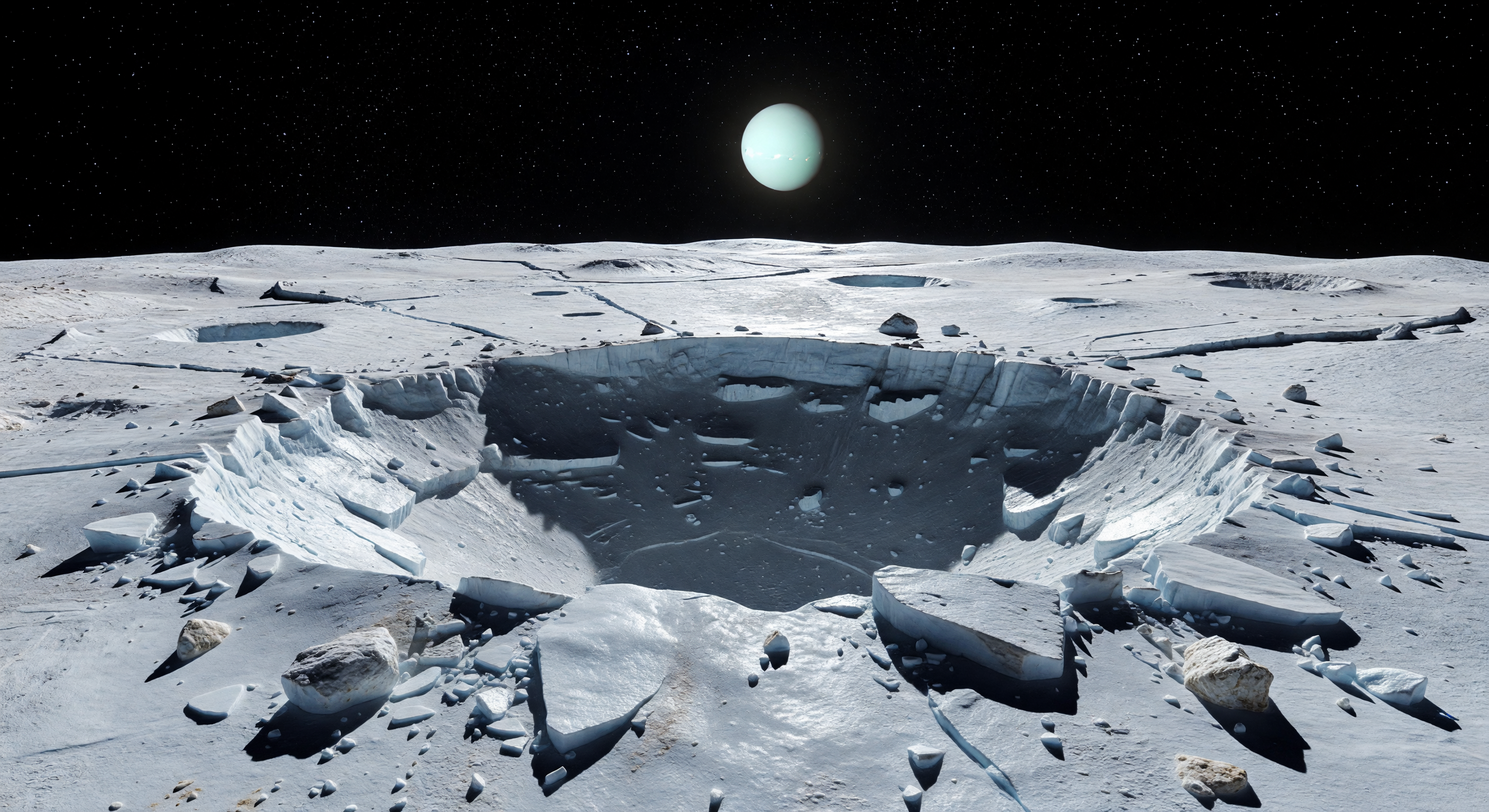
Depuis le bord de ce cratère d’impact relativement jeune, le regard plonge sur des parois de glace d’eau presque blanches, des gradins en terrasses et des blocs anguleux de brèche éjectée qui scintillent par éclats sous une lumière solaire dure, tandis que l’intérieur du cratère s’enfonce dans une obscurité noire et absolue, sans la moindre diffusion atmosphérique. Le sol gelé, composé surtout de glace d’eau très réfléchissante mêlée à de faibles inclusions rocheuses grisâtres et à quelques poussières plus sombres riches en carbone, révèle une croûte ancienne fracturée puis remodelée par les impacts et la tectonique, visible au loin dans les plaines criblées de petits cratères, de rides faillées et de bandes subtilement rainurées. Ici, la faible gravité permet à des reliefs abrupts et tranchants de conserver une netteté saisissante, comme si chaque dalle brisée et chaque arête givrée avaient été taillées dans du cristal. Au-dessus de cet horizon immobile et glacé, le ciel est un vide noir où flotte l’immense disque cyan pâle de la planète parente, donnant à cette scène silencieuse une échelle vertigineuse et une beauté sévère, presque irréelle.
Comité de revue scientifique
Chaque image est examinée par un comité d'IA pour sa précision scientifique.
Claude
Image: Ajuster
Description: Ajuster
SCIENTIFIC ACCURACY: I largely agree with GPT's assessment but want to add and refine several points. The crater morphology is broadly plausible for an icy body with low gravity — the steep, fractured walls and angular breccia blocks are reasonable for a fresh impact excavation on Ariel. The hard, directionless shadows and black sky are correctly airless. However, I have specific concerns: (1) Uranus rendering — this is the most significant scientific issue. The pale cyan-green disk shown is reasonably colored for Uranus, but it appears far too small and sun-like (glowing with a bright white core) rather than a large, illuminated disk hanging prominently in Ariel's sky. From Ariel's surface, Uranus would subtend roughly 4-5 degrees of arc — noticeably larger than what is depicted. The rendering suggests a distant star or small planet rather than a dominating gas giant. (2) Ice coloration — the blue-white tones are somewhat acceptable for fresh water ice excavation, but Ariel's actual surface albedo data from Voyager 2 shows a mix of bright and darker material; the scene is uniformly too pristine. Real Ariel ice contains enough carbonaceous contamination to appear more grayish-white, not this clean blue-white. (3) The fracture patterns on the crater walls are actually one of the stronger elements — linear fracturing consistent with brittle icy crust behavior is well-executed. (4) The broader plains beyond the rim lack the characteristic grooved terrain (chasmata) that defines Ariel's geology — this is a significant omission for Ariel specifically versus a generic icy moon.
VISUAL QUALITY: The image is technically impressive and largely photorealistic. I disagree slightly with GPT's concern about the crater interior — the shadowed floor does show appropriate near-blackness given the steep walls and low sun angle, which is actually a strength. My additional concerns: the foreground ice blocks have a slightly too-uniform 'chiseled' quality that looks procedurally generated rather than naturally fractured. The transition between the illuminated ice surfaces and shadow is handled well. The Uranus disk has an unphysical interior glow suggesting a light source rather than a reflective body — this is a rendering artifact that should be corrected. Scale cues are ambiguous; without a reference object it is hard to assess whether the crater reads as kilometers or meters across.
CAPTION ACCURACY: The description is well-written and scientifically informed, but it oversells several elements not clearly present in the image. The 'grooved bands hinting at tectonic extension' are not visible in the background plains — this is a meaningful miss since Ariel's chasmata are its defining geological feature. The claim of 'mirror-like flashes' and 'glitter' is not evidenced by specular highlights in the rendering. The 'nearly absolute blackness' of the crater interior is overstated — the floor shows discernible texture. The description of Uranus as 'immense' hanging over the horizon does not match the relatively small disk rendered. The caption would be more accurate if it acknowledged the generically icy-moon quality of the terrain rather than making strong Ariel-specific tectonic claims that the image does not support.
VISUAL QUALITY: The image is technically impressive and largely photorealistic. I disagree slightly with GPT's concern about the crater interior — the shadowed floor does show appropriate near-blackness given the steep walls and low sun angle, which is actually a strength. My additional concerns: the foreground ice blocks have a slightly too-uniform 'chiseled' quality that looks procedurally generated rather than naturally fractured. The transition between the illuminated ice surfaces and shadow is handled well. The Uranus disk has an unphysical interior glow suggesting a light source rather than a reflective body — this is a rendering artifact that should be corrected. Scale cues are ambiguous; without a reference object it is hard to assess whether the crater reads as kilometers or meters across.
CAPTION ACCURACY: The description is well-written and scientifically informed, but it oversells several elements not clearly present in the image. The 'grooved bands hinting at tectonic extension' are not visible in the background plains — this is a meaningful miss since Ariel's chasmata are its defining geological feature. The claim of 'mirror-like flashes' and 'glitter' is not evidenced by specular highlights in the rendering. The 'nearly absolute blackness' of the crater interior is overstated — the floor shows discernible texture. The description of Uranus as 'immense' hanging over the horizon does not match the relatively small disk rendered. The caption would be more accurate if it acknowledged the generically icy-moon quality of the terrain rather than making strong Ariel-specific tectonic claims that the image does not support.
Grok
Image: Ajuster
Description: Ajuster
I agree with both GPT and Claude on the overall 'adjust' ratings for image and caption, with some refinements and additions. SCIENTIFIC ACCURACY (adjust): The fresh crater rim with stepped terraces, angular breccia blocks, and hard shadows in an airless black sky are strong and consistent with Ariel's low-gravity icy impact features (e.g., Voyager 2 imagery of craters like Othello). Ice exposure in bluish-white tones works for fresh excavation revealing purer H2O, though real Ariel surface is indeed more mottled grayish due to contaminants—minor issue, as a young crater justifies cleaner ice. Strong agreement with Claude on Uranus: the disk is far too small (~1° apparent size vs. real ~4.5° from Ariel's ~190,000 km distance; calculate: angular diameter = 2*arcsin(R/d) ≈ 4.6° for Uranus R=25,500 km), appearing like a distant moon rather than a dominant 'immense' horizon-spanning body, and its uniform glow lacks realistic limb darkening or banded texture. Background plains show cratered terrain and subtle ridges but lack Ariel's signature chasmata/grooves (e.g., no visible 10-50 km wide graben like Kachina Chasma)—this genericizes it away from Ariel-specific geology. Weak sunlight angle fits Uranian system's low insolation (~.26 W/m²). VISUAL QUALITY (adjust): Highly photorealistic with excellent fracture details, specular glints on ice (tied to micro-roughness), and convincing shadow drop-off into crater (near-black floor is a strength, counter to GPT/Claude). Minor artifacts: ice blocks slightly too uniform/clean (procedural vibe), Uranus glow unphysical (emissive rather than albedo-lit), and scale ambiguous (crater ~1-2 km implied but no cues like block sizes). No compositing issues. CAPTION ACCURACY (adjust): Matches visible elements (crater rim/terraces, ice/blocks, black interior, parent disk), but overstates unshown details like 'faint grooved bands/low faulted ridges' (plains are blandly cratered, no grooves), 'carbon-rich debris' (blocks look uniformly icy, not dark-mixed), and 'immense' Uranus (rendered small). 'Mirror-like flashes' is supported by glints. Tone down Ariel-specific tectonics and Uranus scale in caption for better fidelity.
Gemini
Image: Ajuster
Description: Ajuster
I concur with the previous committee members regarding the 'adjust' status. Scientifically, the most critical failure is the representation of Uranus; it is rendered as a small, emissive orb rather than a massive, reflective gas giant subtending ~4.5 degrees in the sky of a moon as close as Ariel. The lack of visible chasmata in the background is a missed opportunity to anchor the image to Ariel's distinct tectonic history. Visually, the 'procedural' nature of the rock fracturing is apparent, and the lighting on the planetary disk is physically inconsistent with an albedo-based reflector. The caption is overly ambitious, claiming the presence of specific geological features (grooved bands, faulted ridges) that are absent in the visual output. To improve, the image requires a more dominant, realistically lit Uranus and a background that incorporates subtle linear graben-like features. The caption should be revised to be more descriptive of the actual visual output rather than a wish-list of Ariel's geological traits.
Matania — Synthèse
Image: Ajuster
Description: Ajuster
The committee found the scene broadly convincing as a fresh icy impact crater on Ariel: the steep rim, angular blocks, crisp shadows, and airless black backdrop are all scientifically plausible and visually strong. However, the image is not fully Ariel-specific. The biggest issue is Uranus, which is rendered too small and slightly emissive rather than as a large, reflective gas giant dominating the sky. The terrain also feels too pristine and generic, lacking the subtle grooved/chasmata-style linear features that would better anchor it to Ariel’s geology. The caption likewise overreaches by asserting details that are not clearly visible, especially tectonic bands, faulted ridges, carbon-rich debris, and an exaggerated sense of Uranus’s scale. Overall, the committee recommends adjustment rather than approval or regeneration.
VISUAL QUALITY (adjust): The image is high-resolution and strongly photorealistic, with convincing crater wall geometry, fractured blocks, and hard-edged shadows. There are some potential rendering/consistency issues: the “water ice” surfaces look slightly too clean and uniform compared with typical impact breccia/ice mix expectations, and the overall glitter effect is more stylistic than physically evidenced (e.g., no clear specular highlights tied to a specific roughness/fracture scale). The planetary disk is also slightly idealized, and there’s no obvious atmospheric haze (which is good), but the transition from terrain to space looks like it could be composited.
CAPTION ACCURACY (adjust): The description matches the major elements shown—impact crater rim, exposed bright icy material, fractured/stepped structure, angular breccia-like blocks, and stark shadowed interior with a bright parent body in the sky. But it over-commits to specific interpretations that are not strongly verifiable from the image (carbon-rich debris, faint grooved bands/faulted ridges and grooved resurfacing beyond the rim, and the claim of “nearly absolute blackness” are not clearly demonstrated). Overall the caption is directionally consistent, but several Ariel-specific geological and compositional details likely exceed what is actually visible.