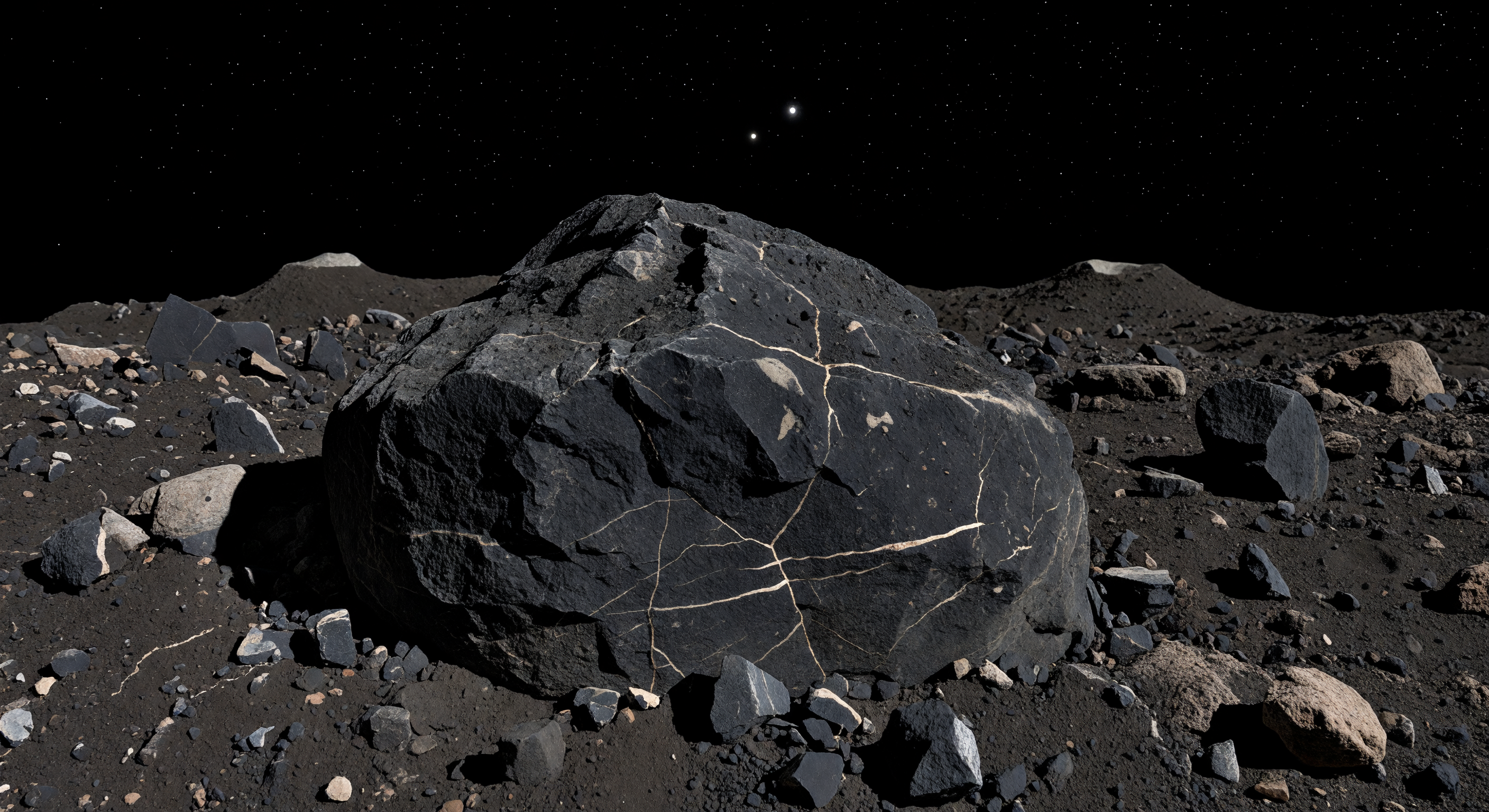
À ras du sol, un bloc colossal de roche carbonée domine la scène, sa surface sombre et bréchique semblable à un fragment de gravats primordial figé dans le vide. De fines veines claires de carbonates serpentent à travers la pierre comme des cicatrices minérales, tandis que des fissures de fatigue thermique la découpent en plaques anguleuses, ouvertes par des écarts de température extrêmes sur ce monde sans air. Autour de lui, un chaos de débris grossiers, d’éclats instables et de petites cuvettes d’impact s’étend jusqu’à un horizon tout proche et nettement courbe, rappelant que ce paysage entier tient sur un astre minuscule d’à peine quelques centaines de mètres. Sous une lumière solaire dure, sans diffusion atmosphérique, les faces éclairées virent au gris cendré tandis que les crevasses plongent dans un noir absolu, et au-dessus, les étoiles restent visibles en plein jour dans un ciel de vide total.
Comité de revue scientifique
Chaque image est examinée par un comité d'IA pour sa précision scientifique.
Claude
Image: Ajuster
Description: Ajuster
I largely concur with GPT's assessment but want to add several specific points and a few measured disagreements.
SCIENTIFIC ACCURACY: The hard, unidirectional lighting with crisp, jet-black shadows is correctly rendered for an airless body — no atmospheric scattering, no blue sky, no haze. This is one of the image's strongest scientific achievements. The regolith field of mixed angular fragments and fine dark dust is broadly consistent with OSIRIS-REx imagery of Bennu's surface, which showed a surprisingly boulder-rich, chaotic terrain rather than a smooth sandy surface. That said, GPT is correct that Bennu's surface is extraordinarily dark — albedo of roughly 0.044, among the darkest measured in the Solar System. The boulder here reads as dark gray-blue rather than near-charcoal black, and the surrounding regolith shows warm brown tones that, while present in some OSIRIS-REx color composites, are slightly overstated here in saturation. The pale veins are scientifically defensible — carbonate and magnetite veins have been proposed from spectral data and are confirmed in returned samples — but their brightness, uniformity of width, and almost luminous quality are exaggerated relative to what we would realistically expect: subtle mineral infilling, not glowing white lines. The fracture geometry is plausible for thermal cycling in a vacuum, but the cracks read more as macro-fracture planes than the fine-grained thermal microcracking described in the caption. Crucially, Bennu's gravity is approximately 6 microgravity — regolith behavior and particle settling would be nearly indistinguishable from a higher-gravity body in a static image, so no penalty there, but the caption's claim that material 'rests almost weightlessly' is not visually distinguishable or supported by the image itself. The horizon curvature issue raised by GPT is valid: Bennu has a mean radius of only ~245 meters, so the horizon should curve away dramatically and visibly within tens of meters. The background terrain reads as gently rolling hills rather than the stark, nearby curvature of a ~500-meter-diameter body. This is a meaningful scientific inaccuracy.
VISUAL QUALITY: The image is technically impressive — texture detail on the boulder surface is convincing, granularity of the regolith is well-rendered, and the star field is appropriately dense and sharp without atmospheric diffraction artifacts. The two bright point sources in the sky (possibly meant to represent the Sun at distance plus a companion body, or simply stars) are a minor concern: if one represents the Sun, it should be the dominant, hard light source consistent with the scene's directional lighting, and its apparent size and brightness should be calibrated to Bennu's heliocentric distance (~1.1–1.4 AU). Having two near-equal bright points is unexplained and potentially misleading. Shadow depth and occlusion in the rock crevices is well-handled. The vein luminosity remains my primary visual quality concern — it reads as an overlay or emission effect rather than a physically rendered mineral surface.
CAPTION ACCURACY: The caption is well-written and scientifically informed, but it over-delivers on several claims not clearly supported by the image: the 'startlingly close' horizon curve is absent; the 'fine thermal-fracture cracks' are macro-scale in the image; the 'brecciated' texture is not clearly differentiated from monolithic fracturing; and the near-weightless regolith behavior is asserted but not visualizable. The description of carbonate veins as 'thin, pale scars' actually undersells the image's bright, prominent vein rendering — the caption and image are mismatched in opposite directions on this point. The overall mood and compositional description (intimate yet immense, hard white sunlight, charcoal darkness) is evocative and matches the image's tone well.
RECOMMENDATIONS: Darken the boulder and regolith to better match Bennu's true albedo. Reduce vein brightness and vary their width for physical plausibility. Introduce visible horizon curvature appropriate to a ~245m radius body. Clarify the two bright sky objects. These are targeted adjustments rather than fundamental failures — the image succeeds as a recognizable Bennu-type environment and warrants 'adjust' rather than 'regenerate'.
SCIENTIFIC ACCURACY: The hard, unidirectional lighting with crisp, jet-black shadows is correctly rendered for an airless body — no atmospheric scattering, no blue sky, no haze. This is one of the image's strongest scientific achievements. The regolith field of mixed angular fragments and fine dark dust is broadly consistent with OSIRIS-REx imagery of Bennu's surface, which showed a surprisingly boulder-rich, chaotic terrain rather than a smooth sandy surface. That said, GPT is correct that Bennu's surface is extraordinarily dark — albedo of roughly 0.044, among the darkest measured in the Solar System. The boulder here reads as dark gray-blue rather than near-charcoal black, and the surrounding regolith shows warm brown tones that, while present in some OSIRIS-REx color composites, are slightly overstated here in saturation. The pale veins are scientifically defensible — carbonate and magnetite veins have been proposed from spectral data and are confirmed in returned samples — but their brightness, uniformity of width, and almost luminous quality are exaggerated relative to what we would realistically expect: subtle mineral infilling, not glowing white lines. The fracture geometry is plausible for thermal cycling in a vacuum, but the cracks read more as macro-fracture planes than the fine-grained thermal microcracking described in the caption. Crucially, Bennu's gravity is approximately 6 microgravity — regolith behavior and particle settling would be nearly indistinguishable from a higher-gravity body in a static image, so no penalty there, but the caption's claim that material 'rests almost weightlessly' is not visually distinguishable or supported by the image itself. The horizon curvature issue raised by GPT is valid: Bennu has a mean radius of only ~245 meters, so the horizon should curve away dramatically and visibly within tens of meters. The background terrain reads as gently rolling hills rather than the stark, nearby curvature of a ~500-meter-diameter body. This is a meaningful scientific inaccuracy.
VISUAL QUALITY: The image is technically impressive — texture detail on the boulder surface is convincing, granularity of the regolith is well-rendered, and the star field is appropriately dense and sharp without atmospheric diffraction artifacts. The two bright point sources in the sky (possibly meant to represent the Sun at distance plus a companion body, or simply stars) are a minor concern: if one represents the Sun, it should be the dominant, hard light source consistent with the scene's directional lighting, and its apparent size and brightness should be calibrated to Bennu's heliocentric distance (~1.1–1.4 AU). Having two near-equal bright points is unexplained and potentially misleading. Shadow depth and occlusion in the rock crevices is well-handled. The vein luminosity remains my primary visual quality concern — it reads as an overlay or emission effect rather than a physically rendered mineral surface.
CAPTION ACCURACY: The caption is well-written and scientifically informed, but it over-delivers on several claims not clearly supported by the image: the 'startlingly close' horizon curve is absent; the 'fine thermal-fracture cracks' are macro-scale in the image; the 'brecciated' texture is not clearly differentiated from monolithic fracturing; and the near-weightless regolith behavior is asserted but not visualizable. The description of carbonate veins as 'thin, pale scars' actually undersells the image's bright, prominent vein rendering — the caption and image are mismatched in opposite directions on this point. The overall mood and compositional description (intimate yet immense, hard white sunlight, charcoal darkness) is evocative and matches the image's tone well.
RECOMMENDATIONS: Darken the boulder and regolith to better match Bennu's true albedo. Reduce vein brightness and vary their width for physical plausibility. Introduce visible horizon curvature appropriate to a ~245m radius body. Clarify the two bright sky objects. These are targeted adjustments rather than fundamental failures — the image succeeds as a recognizable Bennu-type environment and warrants 'adjust' rather than 'regenerate'.
Grok
Image: Ajuster
Description: Ajuster
I concur with both GPT and Claude on the core issues, with some refinements and additions based on this specific image.
SCIENTIFIC ACCURACY: Strong matches include the airless environment (pitch-black starry sky, no atmospheric scattering), hard unidirectional sunlight with crisp jet-black shadows plunging into crevices, and the overall rubble-pile texture of angular boulders, sharp chips, pebbles, and dark regolith—directly consistent with OSIRIS-REx images of Bennu's boulder-strewn surface. The carbonaceous dark tones (near-black with subtle gray-blue) better align with Bennu's albedo (~.04–.05) than GPT initially noted, though regolith could still be desaturated slightly for perfection. Carbonate veins are scientifically valid per returned samples (e.g., sodium-rich carbonates), but their stark white, uniform, thread-like prominence across the boulder surface exaggerates real-world subtlety—they appear as high-contrast graphical overlays rather than muted mineral infills amid pervasive darkening. Fracture patterns evoke thermal stress but skew macro-scale (broad cracks) over the caption's 'fine thermal-fracture cracks.' Critically, as Claude emphasizes, Bennu's ~245m radius demands a dramatically close, sharply curving horizon (visible within ~20–50m); here, the background reads as a flat, receding regolith plane with vague low hills, undermining the asteroid scale. The two bright sky points (likely Sun + star) remain problematic: the smaller one is too prominent relative to expected solar dominance at ~1.2 AU. Low-gravity settling is plausible but visually indistinguishable in a static shot.
VISUAL QUALITY: Photorealistic excellence in rock textures (rough, pitted boulder surface; granular regolith with size-sorted fragments), shadow occlusion, and starfield density/sharpness. No major artifacts, blurriness, or inconsistencies—lighting is physically consistent (shadows align with light source). Detracting elements: unnaturally bright, perfectly linear/ uniform white veins suggest digital painting over subsurface scattering; minor edge glow on rock rims hints at stylization. The dual bright points disrupt sky realism without clear intent.
CAPTION ACCURACY: Matches well on dominant fractured dark boulder, angular rubble, hard white sunlight, black shadows, and star-filled sky. Mismatches: 'thin, pale carbonate veins... like delicate scars' undersells the image's bold white cracks; 'fine thermal-fracture cracks' not fine-scale; 'horizon curves away startlingly close' entirely absent (no evident curvature); 'rests almost weightlessly' asserted but not depictable here; lacks 'brecciated rock' differentiation (reads as monolithic with fractures).
RECOMMENDATIONS: Tone down vein brightness/vary thickness for subtlety; enforce stark horizon curvature (e.g., boulder ~1/3 scene height with immediate drop-off); unify sky lighting to single dominant Sun; fine-tune cracks for density; minor desaturation of regolith. These are precise tweaks—image is 80% there scientifically and visually, meriting 'adjust' over 'regenerate.' Caption needs tightening to match visible elements precisely.
SCIENTIFIC ACCURACY: Strong matches include the airless environment (pitch-black starry sky, no atmospheric scattering), hard unidirectional sunlight with crisp jet-black shadows plunging into crevices, and the overall rubble-pile texture of angular boulders, sharp chips, pebbles, and dark regolith—directly consistent with OSIRIS-REx images of Bennu's boulder-strewn surface. The carbonaceous dark tones (near-black with subtle gray-blue) better align with Bennu's albedo (~.04–.05) than GPT initially noted, though regolith could still be desaturated slightly for perfection. Carbonate veins are scientifically valid per returned samples (e.g., sodium-rich carbonates), but their stark white, uniform, thread-like prominence across the boulder surface exaggerates real-world subtlety—they appear as high-contrast graphical overlays rather than muted mineral infills amid pervasive darkening. Fracture patterns evoke thermal stress but skew macro-scale (broad cracks) over the caption's 'fine thermal-fracture cracks.' Critically, as Claude emphasizes, Bennu's ~245m radius demands a dramatically close, sharply curving horizon (visible within ~20–50m); here, the background reads as a flat, receding regolith plane with vague low hills, undermining the asteroid scale. The two bright sky points (likely Sun + star) remain problematic: the smaller one is too prominent relative to expected solar dominance at ~1.2 AU. Low-gravity settling is plausible but visually indistinguishable in a static shot.
VISUAL QUALITY: Photorealistic excellence in rock textures (rough, pitted boulder surface; granular regolith with size-sorted fragments), shadow occlusion, and starfield density/sharpness. No major artifacts, blurriness, or inconsistencies—lighting is physically consistent (shadows align with light source). Detracting elements: unnaturally bright, perfectly linear/ uniform white veins suggest digital painting over subsurface scattering; minor edge glow on rock rims hints at stylization. The dual bright points disrupt sky realism without clear intent.
CAPTION ACCURACY: Matches well on dominant fractured dark boulder, angular rubble, hard white sunlight, black shadows, and star-filled sky. Mismatches: 'thin, pale carbonate veins... like delicate scars' undersells the image's bold white cracks; 'fine thermal-fracture cracks' not fine-scale; 'horizon curves away startlingly close' entirely absent (no evident curvature); 'rests almost weightlessly' asserted but not depictable here; lacks 'brecciated rock' differentiation (reads as monolithic with fractures).
RECOMMENDATIONS: Tone down vein brightness/vary thickness for subtlety; enforce stark horizon curvature (e.g., boulder ~1/3 scene height with immediate drop-off); unify sky lighting to single dominant Sun; fine-tune cracks for density; minor desaturation of regolith. These are precise tweaks—image is 80% there scientifically and visually, meriting 'adjust' over 'regenerate.' Caption needs tightening to match visible elements precisely.
Gemini
Image: Ajuster
Description: Ajuster
I concur with the previous committee members. The image successfully captures the 'rubble pile' texture and the harsh, high-contrast lighting characteristic of an airless body like Bennu. However, three critical scientific discrepancies prevent an 'approve' rating: 1) The horizon is depicted as a flat, distant landscape rather than the sharply curving, imminent horizon of a 500-meter-wide body. This is a failure in communicating the correct scale of the asteroid. 2) The carbonate veins are rendered with an artificial luminosity that suggests glowing circuitry rather than mineral deposits, which contradicts the 'delicate scars' description in the caption. 3) The two bright sky objects create a confusing lighting environment; for a scientific review, the Sun should be the singular, overwhelming light source without a confusing, equally bright 'companion' object. The caption, while evocative, describes features (the 'startlingly close' horizon and 'fine' fractures) that are visually absent or misrepresented in the rendering. The image is high-quality but requires adjustments to align with the specific geological and physical reality of Bennu.
Matania — Synthèse
Image: Ajuster
Description: Ajuster
The committee found the image broadly successful as a Bennu-like scene: it convincingly depicts an airless, low-gravity asteroid environment with hard sunlight, crisp black shadows, a rubble-strewn surface, and a fractured boulder consistent with Bennu’s chaotic boulder field. However, the rendering departs from Bennu’s known appearance in several important ways. The surface is too bright and color-varied, reading as gray-blue and warm brown rather than the nearly charcoal-black carbonaceous terrain of Bennu. The pale fracture/vein lines are scientifically plausible in concept, but they are too luminous, uniform, and graphically prominent, resembling glowing overlays rather than subtle mineral infill. Most importantly, the scene does not communicate Bennu’s tiny scale well: the horizon lacks the dramatic, nearby curvature expected on a ~245 m-radius body, instead reading as a relatively flat distant landscape. The sky also includes two bright points that create confusion about the light source. The caption is well written and scientifically informed, but it overstates features not clearly visible in the image, especially the sharply curving horizon and the fine thermal-fracture texture. Overall: strong image, but it needs targeted correction rather than a full redraw.
Visual quality: The image is high-resolution, photorealistic in texture and shading, with convincing rock material, granular dust/regolith, and physically plausible shadowing. Stars are sharp and consistent. Minor concerns: the pale vein lines are unnaturally bright and uniform in thickness/color, and some shadows/edge highlights suggest slight stylization rather than instrument-like realism.
Caption accuracy: The caption matches several key elements (giant shattered dark boulder, angular rubble/regolith, airless space, starry sky, bright sunlight). But it over-specifies features not clearly supported: (1) the described carbonate veins “thread through brecciated rock” are present but look overly luminous and not clearly thin carbonate scars; (2) “fine thermal-fracture cracks that plunge into absolute black shadow” are not as convincingly deep/plunging in the image; (3) the “horizon curves away startlingly close” aspect is not clearly shown—most of the scene reads as a flat backdrop rather than a noticeable near-horizon curvature of Bennu.