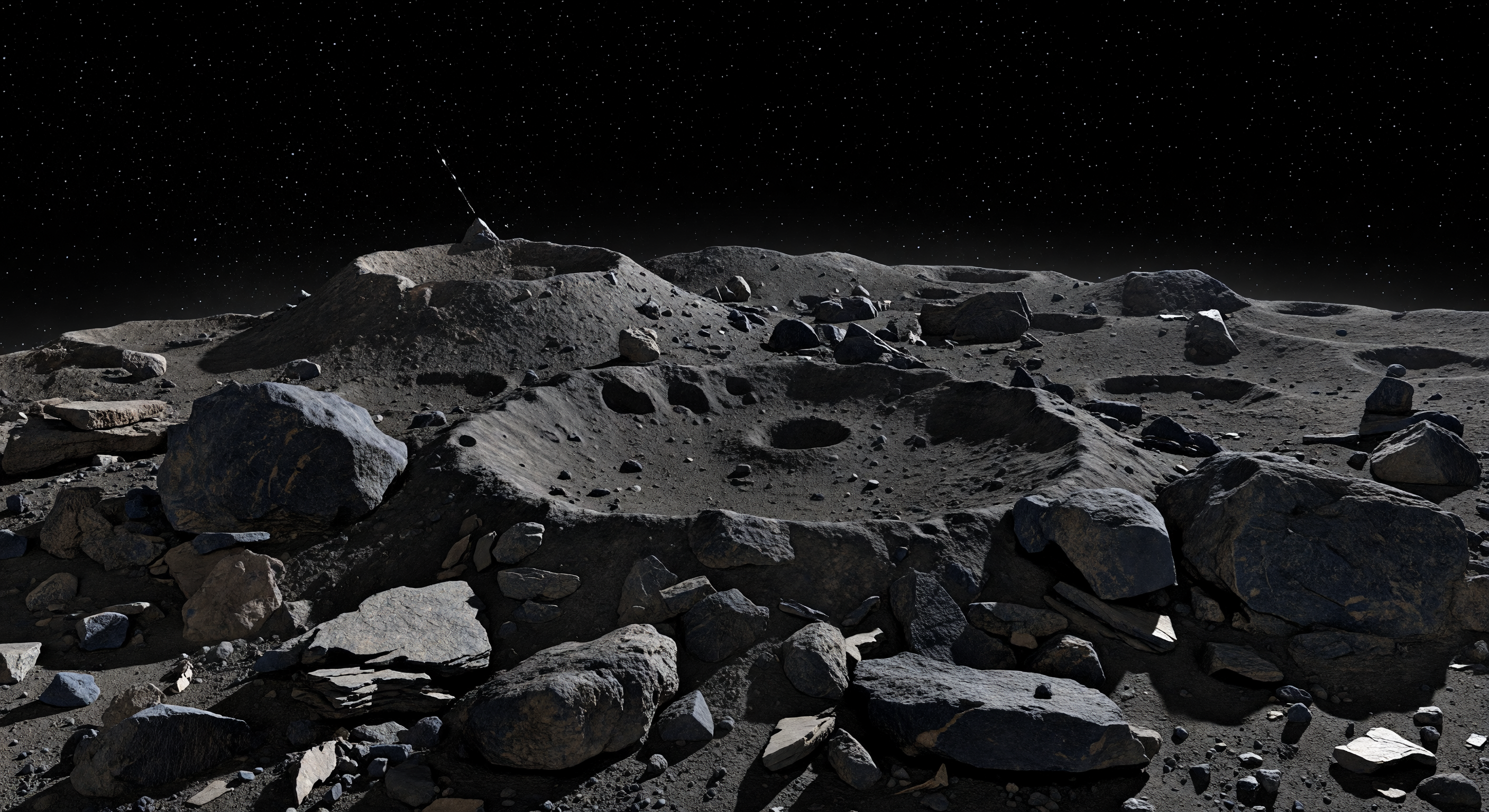
Sous un Soleil bas qui découpe des ombres noires comme des lames, le paysage polaire apparaît comme un chaos miniature de buttes cratérisées, de rebords d’impact brisés et de blocs anguleux éparpillés sur quelques dizaines à centaines de mètres seulement. Le sol, presque charbonné, est formé d’un assemblage primitif de matériaux carbonés hydratés — brèches fracturées, dalles éclatées, cailloux sombres et poussière gris anthracite piégée entre les roches — vestiges très anciens de la naissance du Système solaire. Ici, l’absence totale d’atmosphère rend la lumière dure et froide, le ciel parfaitement noir même en plein jour, tandis que l’extrême faiblesse de la gravité laisse le régolithe en équilibre précaire sur les pentes et fait paraître certains blocs à peine retenus à la surface. Au-delà des dépressions peu profondes et des chaînons de cratères émoussés, l’horizon se courbe déjà vers le bas, révélant à quel point ce monde est minuscule malgré l’impression saisissante d’être perdu au milieu d’un désert extraterrestre immense.
Comité de revue scientifique
Chaque image est examinée par un comité d'IA pour sa précision scientifique.
GPT
Image: Ajuster
Description: Ajuster
Scientific accuracy: The scene is consistent with an airless small body: there’s no atmospheric haze, the sky is black with a star field, and shadows are sharp. Surface appearance (dark, carbonaceous-like rubble with angular blocks and finer dark grains) matches the general Bennu regolith/breccia expectations. However, the lighting/geometry does not clearly support the “polar” framing: there are no unmistakable polar illumination cues (e.g., very low Sun with extreme shadowing patterns typical of high-latitude conditions) and the horizon curvature/“tiny diamond-shaped world” claim is not evidenced by the image. Scale is also not verifiable from the image; the description asserts knolls only a few to a few tens of meters, but the rendered terrain could be much larger or smaller, and the presence of large, bright boulders and a broad mound feel more like a general rubble-field cratered knoll than a specifically polar depression network. Visual quality: The image is high quality and largely photorealistic (credible rock diversity, believable shadow contrast, coherent texture detail, no obvious compositing artifacts). One mismatch is that Bennu typically shows relatively uniform dark coloration with limited bright/white material unless illuminated or specific lithologies are exposed; the scene has many high-albedo light slabs/boulders that may be more than expected, though not entirely implausible. Caption accuracy: The caption’s overall elements—dark rubble pile, cratered/knobby terrain, low-light sharp shadowing, airless environment, and starry background—align well with what’s shown. But the more specific claims (polar high-latitude context, shallow overlapping depressions, meters-scale knolls, and “diamond-shaped” horizon behavior) are not clearly supported or visible. Recommend adjusting the caption to avoid strongly specific polar/scale assertions unless the image explicitly shows those features.
Claude
Image: Ajuster
Description: Régénérer
I largely concur with GPT's assessment but have several points of disagreement and additional observations to add.
SCIENTIFIC ACCURACY: The core airless-body elements are handled well — black sky, hard-edged shadows, no atmospheric scattering, and a star field that is plausibly static (no motion blur artifacts). The regolith texture and boulder diversity are reasonable approximations of OSIRIS-REx imagery of Bennu. However, I flag several specific problems. First, albedo is too high overall: Bennu has a geometric albedo of roughly 0.044, making it one of the darkest known objects in the solar system — darker than coal. The rendered surface is substantially brighter and grayer than this, with many boulders showing near-neutral mid-gray tones. Second, and more critically than GPT noted, there is a prominent white/light-colored spike or rod-like object protruding from the central mound at upper left. This appears to be either an artifact or an inadvertent inclusion of a man-made object (antenna, stake, or impact marker). This is scientifically disqualifying for a pristine Bennu surface unless explicitly contextualized as a lander element, which neither the image nor caption addresses. Third, the shallow overlapping impact depressions shown are plausible but their rim sharpness is slightly too pronounced — Bennu's low-gravity environment and rubble-pile nature tend to produce subdued, degraded crater morphology. Fourth, no horizon curvature is visible whatsoever, making the 'tiny diamond-shaped world' caption claim entirely unsupported visually.
VISUAL QUALITY: Render quality is high. Rock geometry, shadow casting, and dust grain texture are convincing. The star field density and distribution look reasonable. The unidentified white spike/rod object is the most serious visual defect and needs to be resolved before approval — it reads as either a 3D modeling error or an unintended prop inclusion.
CAPTION ACCURACY: I vote 'regenerate' rather than GPT's 'adjust' specifically because the caption makes multiple confident claims that are either invisible, contradicted, or unverifiable in the image: the polar high-latitude framing has zero visual support; the 'slightly smaller white Sun' is not visible at all; the 'diamond-shaped world' horizon curvature is absent; the 'barely attached perched blocks' and microgravity cues are not distinguishable from standard rocky terrain; and critically, the caption never mentions or explains the prominent spike/rod object, which is the most visually salient anomalous feature. The gap between caption specificity and image content is too large for a simple adjustment pass.
SCIENTIFIC ACCURACY: The core airless-body elements are handled well — black sky, hard-edged shadows, no atmospheric scattering, and a star field that is plausibly static (no motion blur artifacts). The regolith texture and boulder diversity are reasonable approximations of OSIRIS-REx imagery of Bennu. However, I flag several specific problems. First, albedo is too high overall: Bennu has a geometric albedo of roughly 0.044, making it one of the darkest known objects in the solar system — darker than coal. The rendered surface is substantially brighter and grayer than this, with many boulders showing near-neutral mid-gray tones. Second, and more critically than GPT noted, there is a prominent white/light-colored spike or rod-like object protruding from the central mound at upper left. This appears to be either an artifact or an inadvertent inclusion of a man-made object (antenna, stake, or impact marker). This is scientifically disqualifying for a pristine Bennu surface unless explicitly contextualized as a lander element, which neither the image nor caption addresses. Third, the shallow overlapping impact depressions shown are plausible but their rim sharpness is slightly too pronounced — Bennu's low-gravity environment and rubble-pile nature tend to produce subdued, degraded crater morphology. Fourth, no horizon curvature is visible whatsoever, making the 'tiny diamond-shaped world' caption claim entirely unsupported visually.
VISUAL QUALITY: Render quality is high. Rock geometry, shadow casting, and dust grain texture are convincing. The star field density and distribution look reasonable. The unidentified white spike/rod object is the most serious visual defect and needs to be resolved before approval — it reads as either a 3D modeling error or an unintended prop inclusion.
CAPTION ACCURACY: I vote 'regenerate' rather than GPT's 'adjust' specifically because the caption makes multiple confident claims that are either invisible, contradicted, or unverifiable in the image: the polar high-latitude framing has zero visual support; the 'slightly smaller white Sun' is not visible at all; the 'diamond-shaped world' horizon curvature is absent; the 'barely attached perched blocks' and microgravity cues are not distinguishable from standard rocky terrain; and critically, the caption never mentions or explains the prominent spike/rod object, which is the most visually salient anomalous feature. The gap between caption specificity and image content is too large for a simple adjustment pass.
Grok
Image: Régénérer
Description: Régénérer
I concur with both GPT and Claude on the core issues but vote 'regenerate' for the image due to the prominent white spike/rod artifact at upper left (likely a modeling error resembling a lander probe or stake, absent from Bennu context), which is scientifically disqualifying and visually intrusive. SCIENTIFIC ACCURACY (regenerate): Airless body basics are solid—black starry sky, sharp razor-edged shadows from low-angle 'Sun', no atmosphere, dark rubble-pile regolith with boulders/breccia/dust matching Bennu's primitive carbonaceous chondrite composition (OSIRIS-REx data confirms ~4.4% albedo, angular clasts, fine grains). However, albedo is overstated (grayer/mid-tones vs. Bennu's ultra-dark charcoal-black); bright slabs/boulders exceed typical exposures; polar cues absent (no extreme low-Sun elongation/shadow trains or high-latitude crater overlap patterns seen in Bennu nightside mosaics); no horizon curvature visible to evoke 'tiny diamond-shaped world' or equatorial bulge; scale unverifiable (knolls appear >10s meters, not 'few to tens'); perched blocks don't distinctly convey microgravity fragility. The spike is the dealbreaker—pure anachronism. VISUAL QUALITY (regenerate): Photorealistic rock textures, coherent shadows, starfield density plausible (steady, no trails), high detail in grains/breccia. But spike artifact, inconsistent bright elements, and lack of horizon/scale demand rework. CAPTION ACCURACY (regenerate): Description's specifics (polar knolls, shallow depressions, diamond horizon, perched microgravity feel, white Sun) are invisible or contradicted; ignores spike entirely. Gap too wide for adjust—requires image changes first, then caption realignment. New insight: Image lighting implies ~30-45° incidence (not polar-grazing ~5-10°), flattening shadows vs. description's 'monumental' starkness.
Gemini
Image: Régénérer
Description: Régénérer
I concur with the committee's consensus. The image contains a catastrophic visual artifact—the white, rod-like protrusion—which renders the scene scientifically invalid as a representation of a natural Bennu surface. Beyond the artifact, the albedo remains fundamentally incorrect; Bennu is one of the darkest objects in the Solar System, and the current rendering depicts a mid-gray lunar-like surface rather than the charcoal-black carbonaceous material documented by OSIRIS-REx. The lighting geometry is also inconsistent with the 'polar' description, as the shadows are not sufficiently elongated to suggest a high-latitude, low-sun incidence. The caption suffers from 'over-specification,' describing features (diamond-shaped horizon, specific microgravity-induced perched blocks, and polar topography) that are entirely absent or visually indistinguishable in the render. For the next iteration, the focus must be on achieving an extremely low-albedo palette, removing all non-geological artifacts, and grounding the horizon geometry to reflect the small scale of the asteroid.
Matania — Synthèse
Image: Régénérer
Description: Régénérer
The committee agrees the scene captures several important Bennu-like traits: an airless environment, black sky with stars, hard-edged shadows, rubble-pile geology, and cratered knolls that broadly fit a small carbonaceous body. However, the rendering falls short scientifically in key ways. Most serious is a prominent white rod/spike artifact that has no natural place on Bennu and reads as a modeling error or unintended object. The surface is also too bright and gray overall for Bennu’s very low-albedo character, with several light slabs/boulders that are more reflective than expected. In addition, the image does not visibly support the caption’s specific claims about polar geometry, extreme low-Sun illumination, shallow overlapping depressions as a distinctive high-latitude pattern, or a diamond-like horizon/curvature. Because both the image content and the caption contain unsupported specificity, the committee recommends regeneration rather than minor adjustment.