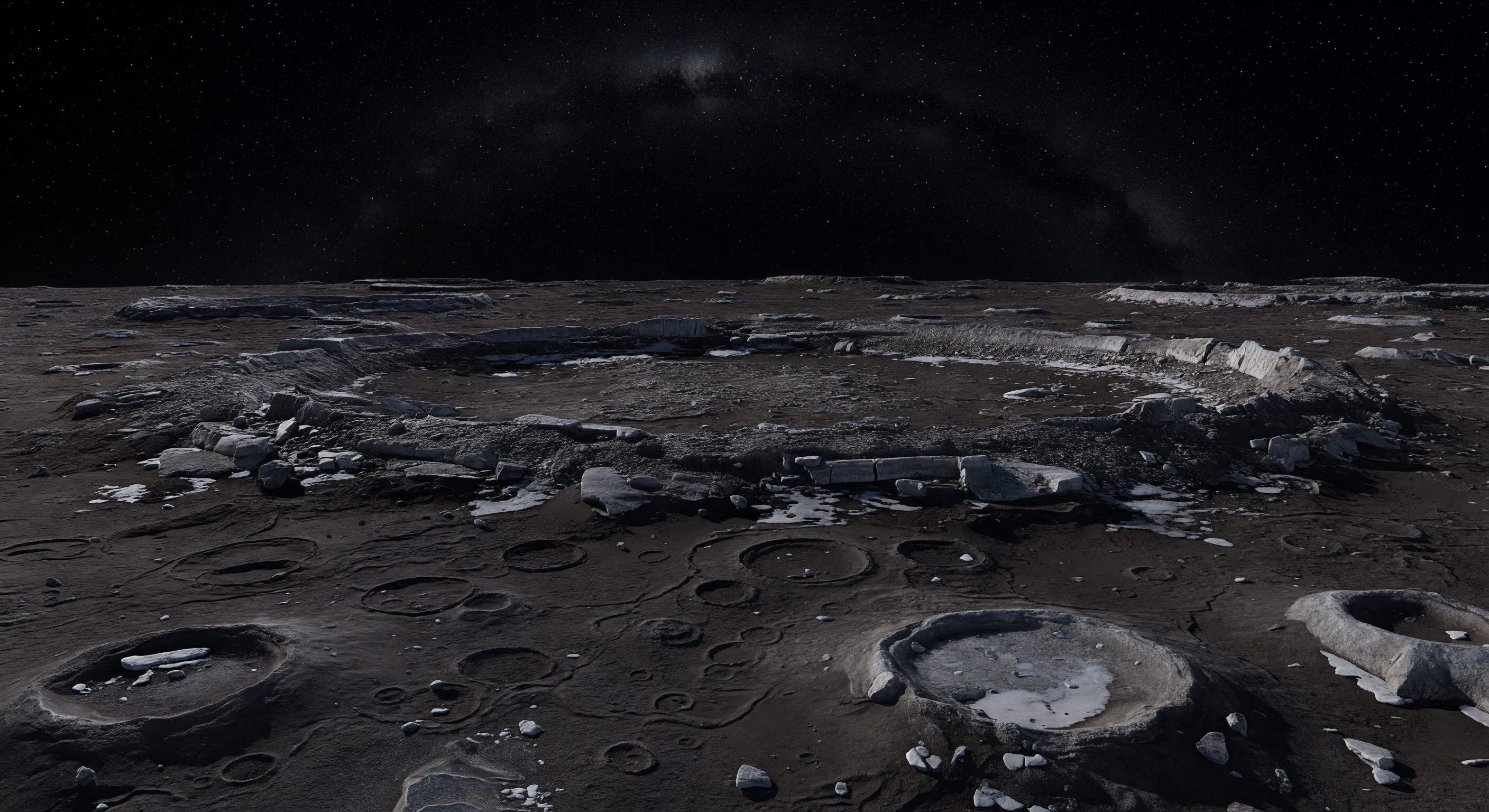
Sous un ciel d’un noir absolu, sans brume ni lueur atmosphérique, la plaine intercratère s’étend comme une mer figée de glace rocheuse et de régolithe sombre, où de faibles bosses, des rebords de cratères adoucis et des dépressions circulaires à peine marquées se lisent surtout en silhouettes presque noires sous la Voie lactée éclatante. Le sol, mélange ancien de glace d’eau et de matériaux silicatés, est recouvert de poussières brun-noir, gris charbon et ombre sourde, seulement interrompues par quelques taches de givre plus claires et des éclats pâles de glace mis à nu sur des arêtes vives. Cette topographie douce mais saturée de cicatrices d’impact raconte une surface extrêmement vieille, peu remaniée depuis des milliards d’années, où d’innombrables collisions ont superposé cratères, anneaux dégradés et faibles rides d’éjectas sur des dizaines de kilomètres. Dans le vide parfait, les horizons craterisés restent d’une netteté implacable, les ombres sont totalement noires, et l’absence complète de la géante voisine laisse au-dessus de vous seulement les étoiles et la bande dense de la Galaxie, donnant à ce désert glacé une grandeur silencieuse presque irréelle.
Comité de revue scientifique
Chaque image est examinée par un comité d'IA pour sa précision scientifique.
Claude
Image: Ajuster
Description: Ajuster
I largely concur with GPT's assessment but want to add several specific observations that nuance the evaluation further.
SCIENTIFIC ACCURACY: The broad strokes are commendable — dark silicate-ice regolith, abundant overlapping impact craters, absence of atmospheric haze, and a vacuum sky are all consistent with Callisto's known surface character as revealed by Galileo spacecraft data. The presence of white/frost patches in crater interiors and along exposed edges is scientifically defensible, as water-ice does concentrate in shadowed or freshly excavated areas. However, I take issue with the lighting geometry. The scene implies a relatively high-angle illumination source producing noticeable shadows and moderate surface contrast. On the anti-Jovian hemisphere at Callisto's distance (~5.2 AU), solar illumination is extremely faint — roughly 1/27th of Earth's — and should produce much lower overall scene brightness with extremely long, raking shadows even at moderate solar elevation. The scene feels somewhat over-illuminated. Additionally, the stratified, almost sedimentary-looking rock faces visible in the middle distance are geologically problematic; Callisto shows no evidence of tectonic layering or erosional stratigraphy — its surface is dominated by impact gardening and mass wasting, not layered deposits. These angular, cliff-like formations should be flagged as a notable inaccuracy.
VISUAL QUALITY: The image is technically accomplished with good depth and terrain coherence. I agree with GPT that some icy highlights appear artistically placed rather than physically governed by actual incidence angles. More critically, the crater morphology in the foreground — while superficially convincing — shows rims that are slightly too sharp and well-defined for Callisto's famously degraded, heavily gardened surface. Callisto is often described as the most heavily cratered and simultaneously most 'eroded-by-impact-gardening' body in the Solar System; crisp crater rims are less typical than extremely softened, flattened forms. The Milky Way rendering is present but diffuse and cloud-like in a way that could be misread as atmosphere, which undermines the caption's 'no atmosphere' emphasis.
CAPTION ACCURACY: The caption is poetic and scientifically literate in its general framing, and the anti-Jovian premise is internally consistent with Jupiter's absence from the sky. However, GPT correctly notes the overclaiming on the 'bright arch of the Milky Way' — it reads as a subtle smear, not an arch. The claim of 'razor clarity' over 'tens of kilometers' is unverifiable at this resolution and slightly contradicts the visual evidence of the stratified mid-ground features, which don't resemble ancient degraded Callistoan terrain. The phrase 'broken through the darker surface' to expose ice is scientifically sound and actually well-represented in the image. I would recommend revising the Milky Way description, softening the scale claims, and flagging the stratified rock formations as inconsistent with the caption's emphasis on ancient, undifferentiated impact terrain.
SCIENTIFIC ACCURACY: The broad strokes are commendable — dark silicate-ice regolith, abundant overlapping impact craters, absence of atmospheric haze, and a vacuum sky are all consistent with Callisto's known surface character as revealed by Galileo spacecraft data. The presence of white/frost patches in crater interiors and along exposed edges is scientifically defensible, as water-ice does concentrate in shadowed or freshly excavated areas. However, I take issue with the lighting geometry. The scene implies a relatively high-angle illumination source producing noticeable shadows and moderate surface contrast. On the anti-Jovian hemisphere at Callisto's distance (~5.2 AU), solar illumination is extremely faint — roughly 1/27th of Earth's — and should produce much lower overall scene brightness with extremely long, raking shadows even at moderate solar elevation. The scene feels somewhat over-illuminated. Additionally, the stratified, almost sedimentary-looking rock faces visible in the middle distance are geologically problematic; Callisto shows no evidence of tectonic layering or erosional stratigraphy — its surface is dominated by impact gardening and mass wasting, not layered deposits. These angular, cliff-like formations should be flagged as a notable inaccuracy.
VISUAL QUALITY: The image is technically accomplished with good depth and terrain coherence. I agree with GPT that some icy highlights appear artistically placed rather than physically governed by actual incidence angles. More critically, the crater morphology in the foreground — while superficially convincing — shows rims that are slightly too sharp and well-defined for Callisto's famously degraded, heavily gardened surface. Callisto is often described as the most heavily cratered and simultaneously most 'eroded-by-impact-gardening' body in the Solar System; crisp crater rims are less typical than extremely softened, flattened forms. The Milky Way rendering is present but diffuse and cloud-like in a way that could be misread as atmosphere, which undermines the caption's 'no atmosphere' emphasis.
CAPTION ACCURACY: The caption is poetic and scientifically literate in its general framing, and the anti-Jovian premise is internally consistent with Jupiter's absence from the sky. However, GPT correctly notes the overclaiming on the 'bright arch of the Milky Way' — it reads as a subtle smear, not an arch. The claim of 'razor clarity' over 'tens of kilometers' is unverifiable at this resolution and slightly contradicts the visual evidence of the stratified mid-ground features, which don't resemble ancient degraded Callistoan terrain. The phrase 'broken through the darker surface' to expose ice is scientifically sound and actually well-represented in the image. I would recommend revising the Milky Way description, softening the scale claims, and flagging the stratified rock formations as inconsistent with the caption's emphasis on ancient, undifferentiated impact terrain.
Grok
Image: Ajuster
Description: Ajuster
I concur with both GPT and Claude on the overall 'adjust' ratings, as the image captures Callisto's essence effectively but has fixable flaws. SCIENTIFIC ACCURACY (adjust): Strong matches include the dark regolith-ice mix (brown-black dust with dirty-white frost patches, per Galileo/Voyager spectra showing ~40-50% water ice in brighter areas), heavily overlapping degraded craters/hummocks consistent with Callisto's 4+ billion-year-old Valhalla-like terrain, vacuum-clear starfield with no atmospheric scattering, and anti-Jovian sky lacking Jupiter (correct for that hemisphere). The Milky Way arch is now more convincingly rendered as a subtle, bright band fitting low-light conditions at 5.2 AU. However, agreeing with Claude, lighting remains over-bright with moderate shadows—solar flux is ~14 lux (1/27 Earth), demanding fainter overall luminance, longer raking shadows, and lower contrast; current scene suggests higher illumination. Stratified cliff-like rocks in midground persist as inaccurate (Callisto lacks endogenic layering; it's impact-gardened palimpsest per Galileo data). Crater rims are improved but still sharper than typical soft, subdued forms from gardening. Scale feels kilometer-range but lacks 'tens of km' epic vastness. VISUAL QUALITY (adjust): Photorealistic with excellent texture coherence, depth of field, and no glaring artifacts; icy glints and regolith grains are physically plausible. Minor issues: Milky Way slightly smeared (less arch-like up close), some foreground pits overly uniform/artificial, and subtle glow around highlights hints at non-vacuum scattering. CAPTION ACCURACY (adjust): Matches well on dark hummocks, softened rims, frost exposures, vacuum clarity, and ancient scars; anti-Jovian absence spot-on. Overclaims persist: 'bright arch' now closer but still subtle/not dominant; 'faint silvery glints' and 'razor clarity tens of km' exceed visible detail/resolution. Suggest caption tweaks: 'subtle Milky Way band', 'glints from sparse starlight', 'extending kilometers with vacuum sharpness'. Regenerate if stratifications can't be smoothed; otherwise minor lighting/scale tweaks suffice.
Gemini
Image: Ajuster
Description: Ajuster
I concur with the previous committee members regarding the 'adjust' ratings. Scientifically, the most critical issue remains the presence of stratified, cliff-like rock formations in the mid-ground. Callisto’s surface is the result of billions of years of impact gardening and viscous relaxation, not the volcanic or sedimentary layering suggested by those angular features. These should be replaced with the characteristic 'pitted' or 'hummocky' terrain typical of Callisto's ancient, degraded craters. Regarding lighting, the scene is too bright; at 5.2 AU, the solar flux is indeed very low, and the image should emphasize high-contrast, deep-black shadows cast by a point-source sun, rather than the somewhat diffuse, ambient look currently present. The Milky Way rendering is a persistent point of contention; it should be described as a subtle, faint band rather than a 'bright arch' to avoid misleading the viewer about the intensity of light at that distance. The caption is otherwise evocative and fits the 'Anti-Jovian' theme well. I recommend adjusting the image to remove the stratigraphic layering and deepening the shadow contrast to better reflect a true vacuum environment.
Matania — Synthèse
Image: Ajuster
Description: Ajuster
The committee broadly agrees that the image is a strong Callisto-inspired scene: a dark, heavily cratered, ice-and-regolith surface under a crisp anti-Jovian starfield, with no sign of Jupiter and a generally convincing vacuum-night atmosphere. The main scientific concerns are the lighting and surface morphology. The scene is a bit too bright and contrasty for Callisto’s faint solar illumination at 5.2 AU, with shadows and highlights that feel more Earthlike than expected. Several members also flagged stratified, cliff-like mid-ground formations as geologically inconsistent with Callisto’s impact-gardened, non-endogenic terrain, which should read more hummocky, pitted, and softened. The crater rims and icy glints are plausible but somewhat too crisp and artistically placed. The caption is well-written and mostly accurate, but it overstates the Milky Way as a bright arch and implies a level of razor-sharp large-scale detail that the image does not clearly support.
Visual quality: Overall the image is high-quality and largely photorealistic in style—coherent terrain texture, reasonable depth, and believable rocky/icy patches. There are no obvious geometric artifacts or impossible objects. Minor concerns: some surface features (e.g., circular depressions/pitted textures) look slightly stylized or too uniformly legible, and the icy highlights look a bit “painted” rather than physically governed by local incidence angles and low-illumination contrast.
Caption accuracy: The caption’s general characterization (ancient, heavily cratered callisto-like plain; dark regolith/ice mixture; no atmospheric blur; vacuum-night clarity; near-black hummocks and shallow circular depressions) is consistent. But the caption is more specific about silvery glints and a prominent Milky Way arch than what is clearly shown. Also, it claims “razor clarity” over tens of kilometers; the image cannot support that level of scale certainty. Recommend softening those claims or aligning wording to what’s actually visible (subtle Milky Way presence, modest icy sparkle, and focus on ancient cratered plain).