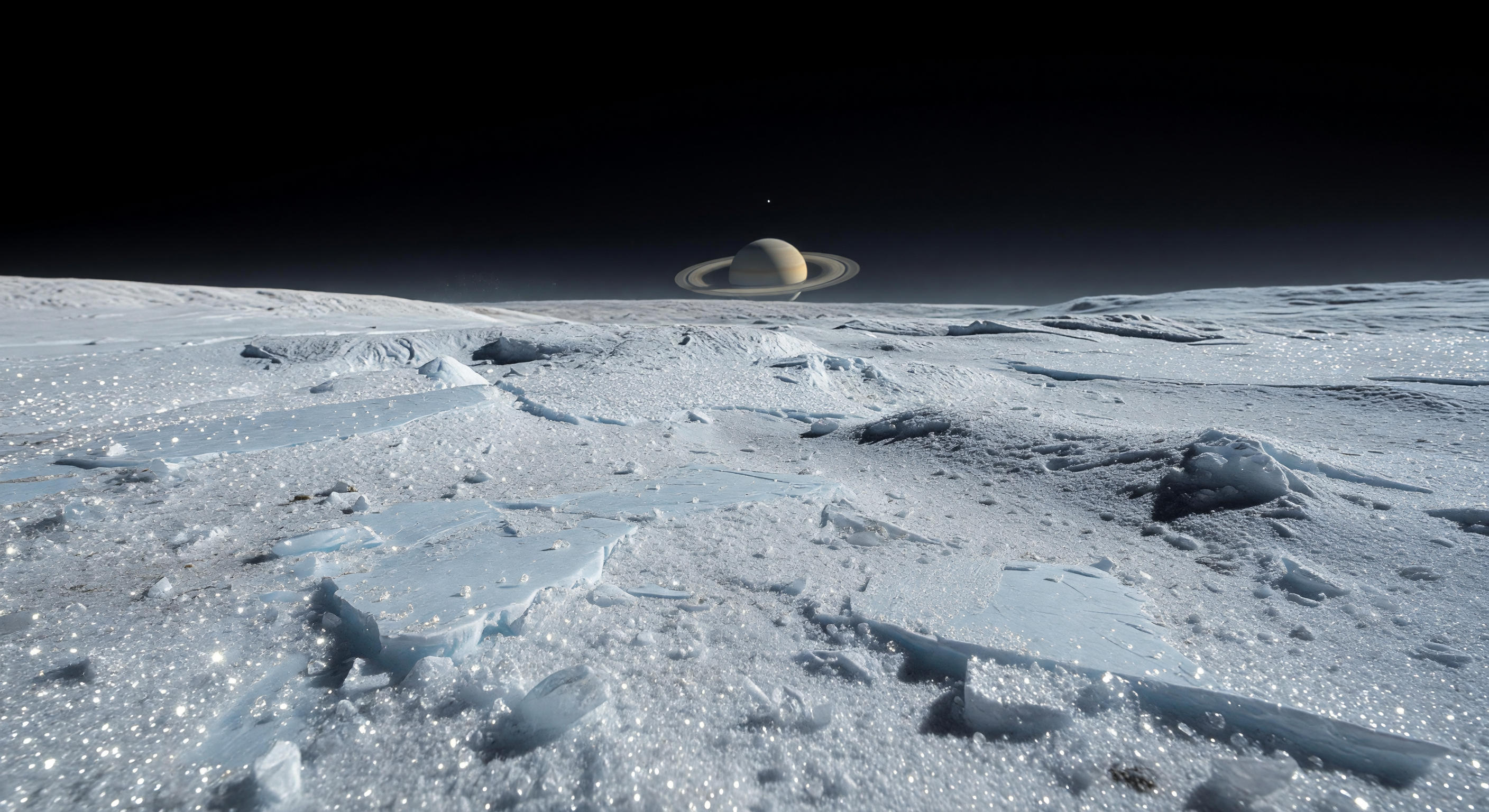
À l’échelle du centimètre, le sol apparaît comme une croûte de givre éblouissante, faite de grains de glace d’eau anguleux, d’éclats translucides aux arêtes vives et de petites plaques frittées qui scintillent sous une lumière solaire lointaine et implacable. Chaque relief minuscule — hummocks à peine surélevés, microfissures, creux peu profonds et voiles de poudre gelée tendus entre les grains — trahit une surface façonnée par le vide, le froid extrême et les contraintes tectoniques d’une coquille glacée encore active. Les teintes restent presque irréelles par leur sobriété, du blanc pur au blanc bleuté avec des ombres gris cyan très dures, parfois ponctuées de rares poussières sombres piégées entre les cristaux. Devant ce ciel noir sans atmosphère, où les ombres sont nettes comme des lames, l’horizon bas et doucement courbe rappelle la petitesse du monde sous vos pieds, tandis que les reflets ponctuels jaillissant de chaque grain de givre donnent à cette plaine gelée l’éclat d’une poussière de diamant figée pour l’éternité.
Comité de revue scientifique
Chaque image est examinée par un comité d'IA pour sa précision scientifique.
Claude
Image: Ajuster
Description: Régénérer
I largely concur with GPT's assessment but want to add several specific observations that sharpen the critique.
SCIENTIFIC ACCURACY: The broad strokes are defensible — a bright, water-ice dominated surface under an airless black sky with hard directional lighting is consistent with what Cassini data and models predict for Enceladus. However, I flag two issues GPT underweighted. First, Saturn's apparent angular size in the image is almost certainly too small. From Enceladus (~238,000 km orbital radius), Saturn would subtend roughly 6–7 degrees of arc — it would appear enormous, spanning perhaps 12× the apparent diameter of our Moon from Earth. The Saturn shown here looks more like a distant Jovian-system view, perhaps from Titan's distance. This is a significant scientific error that should trigger at minimum an 'adjust' vote. Second, the surface morphology — large blocky fractured plates, ridged terrain — is actually more consistent with Enceladus's tiger stripe region or Europa-like chaos terrain than a pristine frost-covered plain, which is not inherently wrong for Enceladus but is inconsistent with the 'diamond dust close-up' framing. The dark specks are almost entirely shadow artifacts, not demonstrably radiation-altered inclusions as the caption implies.
VISUAL QUALITY: The rendering quality is genuinely strong. Specular highlights on ice surfaces are well-handled, the translucency of near-camera ice clasts is convincing, and there are no obvious seams, texture-tiling artifacts, or geometry errors. Shadow edge sharpness is appropriate for an airless body. My one concern is that the lighting angle creates very deep shadows in the mid-ground that slightly obscure what should be the scientifically interesting terrain morphology — a minor compositional issue rather than a technical flaw.
CAPTION ACCURACY: I agree with GPT that the caption requires regeneration rather than adjustment. The disconnect is not merely one of emphasis — the caption explicitly invokes a macro/intimate scale ('spilled diamond dust,' 'angular frost grains,' 'sintered crust plates packed tightly') that is categorically different from what the image depicts, which is a wide-angle landscape view of a fractured icy plain. Additionally, the caption's claim of a 'close, gently curving horizon' does not match the image, where the horizon is relatively high and the curvature is not perceptibly rendered. The caption should be rewritten to describe a mid-range landscape view of fractured ice terrain on Enceladus with Saturn prominently — but more accurately sized — on the horizon.
SCIENTIFIC ACCURACY: The broad strokes are defensible — a bright, water-ice dominated surface under an airless black sky with hard directional lighting is consistent with what Cassini data and models predict for Enceladus. However, I flag two issues GPT underweighted. First, Saturn's apparent angular size in the image is almost certainly too small. From Enceladus (~238,000 km orbital radius), Saturn would subtend roughly 6–7 degrees of arc — it would appear enormous, spanning perhaps 12× the apparent diameter of our Moon from Earth. The Saturn shown here looks more like a distant Jovian-system view, perhaps from Titan's distance. This is a significant scientific error that should trigger at minimum an 'adjust' vote. Second, the surface morphology — large blocky fractured plates, ridged terrain — is actually more consistent with Enceladus's tiger stripe region or Europa-like chaos terrain than a pristine frost-covered plain, which is not inherently wrong for Enceladus but is inconsistent with the 'diamond dust close-up' framing. The dark specks are almost entirely shadow artifacts, not demonstrably radiation-altered inclusions as the caption implies.
VISUAL QUALITY: The rendering quality is genuinely strong. Specular highlights on ice surfaces are well-handled, the translucency of near-camera ice clasts is convincing, and there are no obvious seams, texture-tiling artifacts, or geometry errors. Shadow edge sharpness is appropriate for an airless body. My one concern is that the lighting angle creates very deep shadows in the mid-ground that slightly obscure what should be the scientifically interesting terrain morphology — a minor compositional issue rather than a technical flaw.
CAPTION ACCURACY: I agree with GPT that the caption requires regeneration rather than adjustment. The disconnect is not merely one of emphasis — the caption explicitly invokes a macro/intimate scale ('spilled diamond dust,' 'angular frost grains,' 'sintered crust plates packed tightly') that is categorically different from what the image depicts, which is a wide-angle landscape view of a fractured icy plain. Additionally, the caption's claim of a 'close, gently curving horizon' does not match the image, where the horizon is relatively high and the curvature is not perceptibly rendered. The caption should be rewritten to describe a mid-range landscape view of fractured ice terrain on Enceladus with Saturn prominently — but more accurately sized — on the horizon.
Grok
Image: Ajuster
Description: Régénérer
I concur with both GPT and Claude's assessments, with some refinements and additions. SCIENTIFIC ACCURACY: approve with caveats—the image captures Enceladus's canonical bright water-ice regolith, hard specular lighting from a distant Sun (plausibly low-angle, creating sharp shadows consistent with vacuum conditions and no atmospheric scattering), black airless sky, and fractured icy morphology seen in Cassini images of resurfaced plains and tiger-stripe environs. Dark specks are subtle but interpretable as trapped rocky/radiation-darkened material, aligning with known non-ice contaminants. However, Claude correctly flags the Saturn size as a clear error: at Enceladus's ~238,000 km semi-major axis, Saturn subtends ~6.5° (about 13 Moon diameters from Earth), dominating the sky like a massive ornament; here it's undersized (~1-2°), resembling a view from Mimas or farther, warranting 'adjust'. Surface scale leans toward mid-range fractured plates/hummocks rather than pristine frost plains, but this is plausible for dynamic regions. Colors (bluish-white ice) and brittle fractures match cryo-volcanic resurfacing models. VISUAL QUALITY: High photorealism overall—excellent ice translucency/volume rendering, realistic grain sparkle and sintering textures on near-field clasts, sharp razor-edged shadows without softening, no artifacts (e.g., no aliasing, tiling, or glow anomalies), and coherent perspective. Minor compositional nit: deep mid-ground shadows somewhat mask microtopography details, and horizon curvature is subtle but appropriate for Enceladus's ~252 km radius (gentle arc visible). CAPTION ACCURACY: regenerate—the description demands an intimate macro 'diamond dust close-up' of angular micro-grains, translucent clasts, and sintered plates filling the frame like spilled gems, with a 'low hummocks and close, gently curving horizon' evoking miniature immensity. The image instead delivers a wide-angle ground-level vista of blocky fractured ice slabs, ridges, and regolith patches extending to a distant horizon with prominent (but undersized) Saturn, lacking the specified micro-scale dominance and 'inside a frozen field of gemstones' intimacy. Dark specks are present but not 'occasional' highlights amid uniform glitter. Rewrite caption for fractured icy plain at landscape scale to match.
Gemini
Image: Ajuster
Description: Régénérer
I concur with the committee's consensus. The image is a technical success in terms of material rendering—the icy textures, specular highlights, and vacuum-sharp shadows are excellent—but it fails the scientific requirement for celestial scale. As noted by Claude and Grok, the representation of Saturn is significantly undersized for an observer on Enceladus, which is a major oversight for an 'accurate' scientific visualization. Furthermore, the image provides a wide-angle landscape view rather than the 'diamond dust' macro-perspective requested. The caption must be regenerated to describe the actual subject matter (fractured icy plains) rather than the intended macro-scale scene, as the image does not support the current description's emphasis on micro-clasts and sintering. The image requires adjustment to correct the planetary scale of Saturn and improve the composition to better reflect the 'intimate' scale originally proposed, or alternatively, the caption should be rewritten to accurately reflect the wide-angle vista currently depicted.
Matania — Synthèse
Image: Ajuster
Description: Régénérer
The committee agrees the image is visually strong and broadly plausible for Enceladus: an airless black sky, bright water-ice terrain, crisp vacuum shadows, and convincing icy specular highlights all support the setting. However, the scene misses key scientific and compositional requirements for this prompt. The biggest factual issue is Saturn’s apparent size, which is far too small for Enceladus and should dominate the sky much more prominently. In addition, the surface reads as a wider fractured icy plain with blocky slabs and ridges, not the requested close-up ‘diamond dust’ microtexture. Because of that scale mismatch, the image should be adjusted rather than approved. The caption is a stronger mismatch: it describes a tight macro scene of gem-like frost grains and sintered plates, but the image clearly depicts a broader landscape view. It should be completely rewritten to match the visible fractured-ice vista and the corrected celestial scale.
VISUAL QUALITY: The image is high-quality and visually coherent: good contrast, believable ice translucency, convincing specular highlights, and no obvious rendering artifacts (e.g., warped geometry, inconsistent textures, or posterization). The sky is plausible (airless black/dark background). The main issue is scale/feature mismatch relative to the caption’s stated “close-up diamond dust” granularity, not image realism.
CAPTION ACCURACY: The caption claims a ground-level close-up where the pavement is essentially “spilled diamond dust” of angular frost grains and translucent clasts, with thin sintered crust plates dominating the view. The image instead shows a broader landscape of fractured, blocky ice with scattered bright grains, not a full-frame macro of gem-like microclasts. The horizon is also relatively high and the perspective suggests a wider terrain view rather than an intimate close-up stand-in-inside-a-frozen-field-of-gem-dust scale. Because this mismatch is substantial, the caption should be revised to reflect the visible fractured ice plates/blocks and general icy regolith rather than emphasizing micro-scale clasts and sintered plates as the primary morphology.