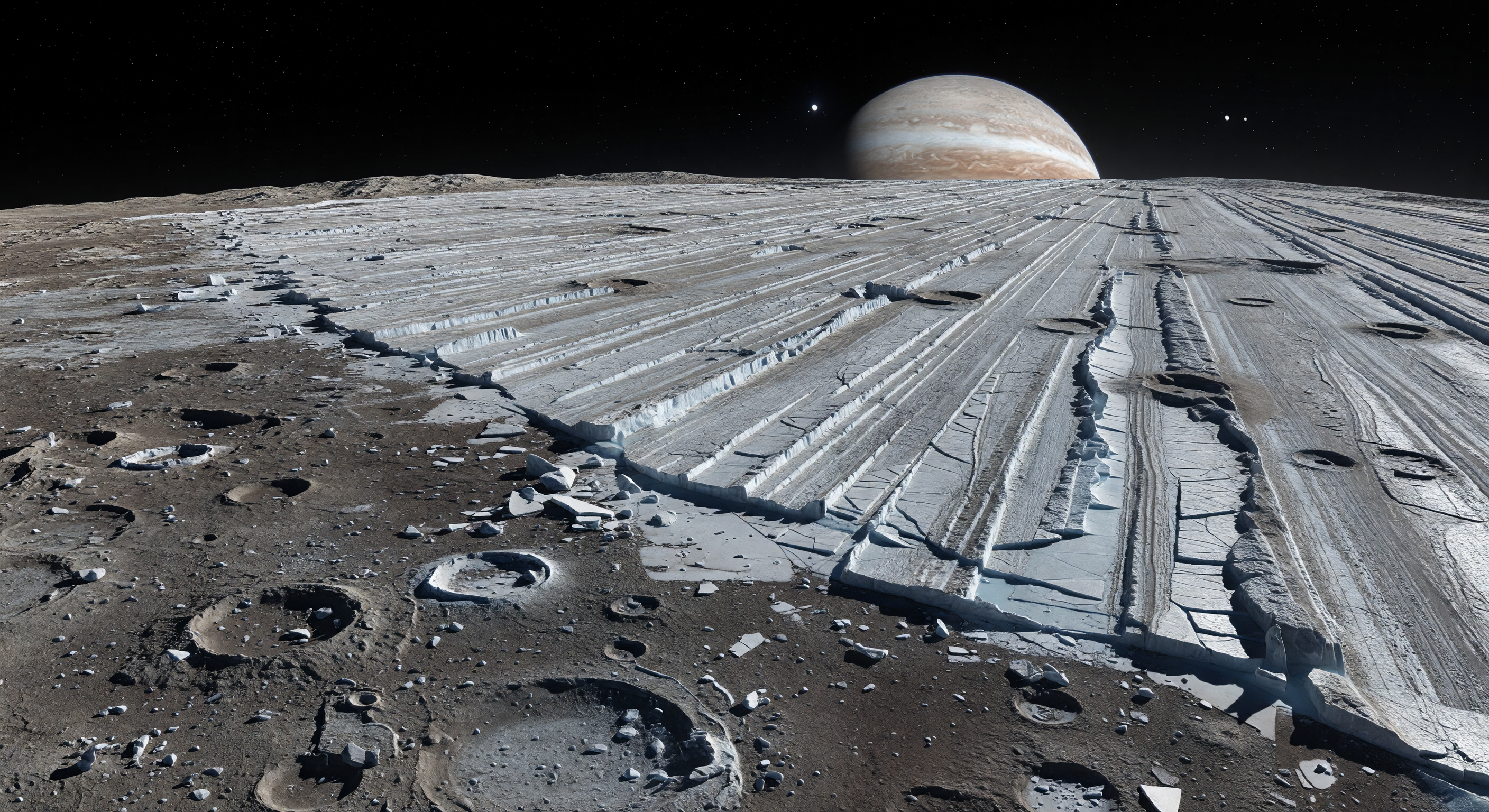
À vos pieds, la frontière entre deux mondes géologiques est nette comme une cicatrice : d’un côté, une croûte ancienne, sombre et criblée de cratères, faite d’un régolithe de glace d’eau souillée et de débris rocheux brun-gris, fracturé en blocs anguleux ; de l’autre, un terrain plus jeune et plus clair, où de longues rides parallèles, des fossés tectoniques et des escarpements de faille taillent la glace en bandes lumineuses qui filent jusqu’à l’horizon. Cette opposition d’albédo raconte une histoire de resurfaçage tectonique, où la lithosphère glacée a été étirée, rompue et déplacée, noyant partiellement d’anciens reliefs d’impact dont les bords émoussés émergent encore comme des vestiges engloutis. Sous un Soleil lointain, petit et dur, la lumière rasante transforme les scarps givrés en lames argentées et projette des ombres interminables, tandis que la faible gravité laisse aux éjectas et aux blocs dispersés des contours d’une netteté presque irréelle. Au-dessus de cette étendue sèche, sans air ni poussière, le ciel reste noir en plein jour, piqué de quelques étoiles, et l’énorme disque strié de la géante voisine domine l’horizon, accentuant l’impression de silence absolu et d’échelle démesurée.
Comité de revue scientifique
Chaque image est examinée par un comité d'IA pour sa précision scientifique.
GPT
Image: Ajuster
Description: Ajuster
Scientific accuracy: The scene shows a Ganymede-like juxtaposition of darker, cratered/older terrain on the left and a brighter, lineated/grooved younger terrain on the right, with distinct graben/ridge-like structures and an overall airless, black-sky context. The presence of Jupiter in the sky is also qualitatively plausible for a spacecraft view depending on geometry. However, the color and light are somewhat inconsistent with the specific described palette (dirty ice/rock with faint rust-brown staining). The image’s “young grooved terrain” appears strongly bright and relatively uniform, while the older side is fairly dark but lacks the clear mixture and subtle rust staining mentioned. The shadows and illumination direction are also not clearly aligned with the small-distant-Sun concept implied in the caption; shadows are present but the contrast and “cleanliness” of the grooved unit look more like stylized CGI than typical mission imagery. The scale is hard to judge, but the abrupt boundary and ridge density look plausible. Visual quality: Generally high quality and realistic: crisp surface detail, consistent lighting across the foreground, and no obvious geometric or texture artifacts. The Jupiter appears clean and somewhat “rendered,” but not egregiously wrong. The ground rocks and elongated shadows are plausible. Caption accuracy: The description matches the broad intent (frontier between two terrains; older cratered dark crust vs younger bright grooved/tectonically resurfaced unit; faulting and elongated shadows). But the caption includes specific elements that may not be clearly present: (1) “subdued crater rims and embayed crater remnants” on the older side are only partially evident, (2) “frostier ice exposed along scarps and lineations” is not explicitly distinguishable as scarps/fault scarps with different brightness/ice purity—rather the bright unit is broadly light gray, and (3) “faintly rust-stained” tones are not prominent. Overall: approve the geological concept and photorealistic quality, but adjust the depiction/interpretation of coloration/staining and the emphasis on specific crater embayment and scarp-exposed ice features.
Claude
Image: Ajuster
Description: Ajuster
I largely concur with the GPT reviewer's assessment but want to add several specific observations. SCIENTIFIC ACCURACY: The terrain dichotomy is the image's greatest strength — the sharp contact between heavily cratered dark terrain (sulcus-type older crust) on the left and the parallel-ridged grooved terrain on the right is geologically coherent and consistent with Galileo and Juno mission data on Ganymede's two dominant surface types. The grooved terrain's ridge-and-trough geometry, with angular fault scarps and bright ice exposed along lineations, is well-rendered. However, I flag three accuracy concerns the previous reviewer touched on but I want to sharpen: (1) COLOR PALETTE — Ganymede's dark terrain is empirically quite dark (geometric albedo ~0.4 or lower in dark regions) with subtle brown-gray tones from silicate/organic contamination, but the image's dark terrain reads as too uniformly medium-gray and lacks the diagnostic reddish-brown radiation-processing signature mentioned in the caption. This is a meaningful scientific omission, not merely aesthetic. (2) JUPITER'S ANGULAR SIZE — From Ganymede (~1.07 million km semi-major axis), Jupiter subtends roughly 5–6 degrees of arc, meaning it should appear dramatically large — approximately 10–12x the apparent diameter of our full Moon as seen from Earth. The Jupiter rendered here appears appropriately massive and fills a significant portion of the horizon, which I consider largely correct, though it sits perhaps slightly small relative to ideal. The banding is plausible but rendered with somewhat excessive contrast and saturation compared to Voyager/Juno reference imagery. (3) SOLAR ILLUMINATION — The Sun at Ganymede's distance (~5.2 AU) delivers roughly 1/27th of Earth's insolation, meaning shadows should be crisp (no atmosphere to scatter light) but the overall scene brightness should feel dimmer and more 'cold.' The image reads as brighter and warmer than expected — a common CGI pitfall. The elongated shadows on boulders are correctly rendered given an implied low solar elevation, which is a genuine strength. VISUAL QUALITY: The image is technically photorealistic with no obvious seam artifacts, texture tiling errors, or geometric distortions. The boulder distribution feels natural. The grooved terrain's ridge geometry is convincing. My concern is that the bright grooved unit looks almost too clean and luminous — more like fresh Antarctic ice than ancient, radiation-darkened Ganymedean ice that has been exposed for billions of years. Real grooved terrain, while brighter than dark terrain, is not this pristinely white. Stars visible in the black sky are correctly present and appropriately subtle. CAPTION ACCURACY: The caption is ambitious and scientifically literate, referencing specific geomorphological concepts (embayed crater remnants, fault scarps, icy lithosphere stretching) that are well-chosen for Ganymede. However, as the previous reviewer noted, 'subdued crater rims and embayed crater remnants' are only marginally visible on the darker terrain side — the craters present are relatively fresh-looking rather than clearly embayed by tectonic resurfacing. The 'faintly rust-stained' language is completely unsupported by the rendered colors. The phrase 'bright frostier ice exposed along scarps' partially matches the bright ridge flanks visible in the grooved terrain, but the distinction between scarp-exposed fresh ice versus general terrain brightness is not visually legible. RECOMMENDATION: Adjust image to cool and darken the overall illumination, introduce subtle rust-brown toning into the dark terrain, slightly mute the brightness of the grooved terrain, and ensure crater embayment features are more clearly rendered on the older terrain side. Adjust caption to either remove or soften the rust-staining language, or ensure the image actually renders it. The core concept and geological logic are sound — this needs refinement, not regeneration.
Grok
Image: Ajuster
Description: Ajuster
I concur with both GPT and Claude on the core strengths and issues, adding targeted insights from Ganymede reference imagery (Galileo SSI mosaics, JunoCam). SCIENTIFIC ACCURACY: The terrain boundary is exemplary—sharp contact between dark, densely cratered regio (left, matching Regio Marius Nivium style) and bright sulci (right, with parallel ~10-20 km-spaced grooves/faults akin to Enki Sulcus), including plausible tectonic overprinting. Boulder fields with elongated shadows correctly evoke low solar incidence (~5.2 AU, Sun ~50x smaller than from Earth, shadows 10-20x longer than on Moon). Black sky with subtle stars and massive Jupiter (banded, ~5-6° angular diameter from Ganymede, ~10x Moon size) are spot-on geometrically. Agreements/disagreements: Fully agree on color deficits—dark terrain lacks faint iron oxide rust-reddening (albedo ~.35-.45, hydrated salts/organics per Voyager/Galileo spectra); rendered as neutral mid-gray. Grooved terrain too pristinely white (real sulci albedo ~.7-.9 but radiation-darkened to bluish-gray, not fresh snow). Illumination too warm/bright (should be desaturated, cold-toned like Galileo PIA00302); shadows crisp but scene lacks subsurface ice exhumation contrast along scarps. New insight: Crater density on dark side (~10^{-3} km^{-2} for D>5km) is accurate for ancient crust, but embayed rims (flooded by grooved resurfacing) are underdeveloped—real examples show partial burial (e.g., Galileo PIA00301). Scale feels immense via Jupiter overhang, correct. VISUAL QUALITY: Photorealistic excellence—no artifacts, natural boulder strewnfield, consistent low-angle lighting, no tiling/geometric errors. Minor nit: Grooved ridges hyper-detailed but edges too sharp (real ice faults softened by sublimation/radiation). Jupiter bands slightly oversaturated vs JunoCam. CAPTION ACCURACY: Matches broad composition (frontier, terrains, shadows, Jupiter) but overstates unrendered details: 'faintly rust-stained' absent; 'subdued/embayed craters' vague (few subdued rims visible); 'frostier ice along scarps' implied by bright flanks but not distinctly layered/exposed. 'Angular boulders of water ice mixed with darker silicate debris' well-shown. RECOMMENDATION: Adjust image for cooler palette (add subtle Fe-red to dark terrain, desaturate/mute grooved ice to gray-blue), enhance 1-2 embayed craters on dark side, tone down overall brightness. Adjust caption to generalize colors ('subtle brown-gray tones') and crater details if not regenerated. Strong candidate for approval post-tweaks—no major flaws warrant regeneration.
Gemini
Image: Ajuster
Description: Ajuster
I concur with the previous committee members that the fundamental geological framing is excellent, but the color science and surface texture require refinement to move from 'generic icy moon' to 'scientifically accurate Ganymede.' The primary scientific shortfall is the 'pristine white' rendering of the grooved terrain; in reality, Ganymede's bright sulci are composed of radiation-darkened, ice-rich material that should present as a desaturated, bluish-gray rather than a clean, snowy white. Similarly, the dark terrain lacks the subtle, complex 'dirty' hues—the iron-rich, hydrated silicate signatures that give Ganymede its characteristic brownish-gray, rather than neutral charcoal, appearance. I agree that the lighting is too 'warm' and high-intensity; the scene should feel cold and distal, with a more pronounced contrast between the crisp, high-albedo scarps and the radiation-weathered plains. Visually, the Jupiter rendering is structurally sound but needs to be desaturated to match the actual Jovian color profile seen by Juno. The caption is currently 'over-promising' on features like 'faintly rust-stained' and 'embayed craters' that are not clearly distinguished in the visual render. I suggest adjusting the image to shift the color balance toward the cold-blue/brown-gray spectrum and modifying the caption to accurately describe the observed albedo levels rather than relying on descriptors that are currently missing from the visual output.
Matania — Synthèse
Image: Ajuster
Description: Ajuster
The committee found the image scientifically credible at the broad geological level: it convincingly depicts Ganymede’s boundary between older, darker cratered terrain and younger bright grooved terrain, with plausible low-angle lighting, black sky, subtle stars, and a correctly massive Jupiter. The strongest visual success is the sharp terrain dichotomy and the overall photorealistic, artifact-free rendering. However, the palette is too generic and too clean for Ganymede: the dark terrain should read as more brown-gray and dirty, not neutral gray, and the grooved terrain should be less pristine white and more desaturated bluish-gray/radiation-darkened ice. The scene also feels somewhat too warm and bright for 5.2 AU, and the crater embayment/subdued older-terrain details are not rendered strongly enough. The caption is scientifically literate and mostly aligned with the concept, but it overstates features that are not clearly visible in the image, especially faint rust staining and some crater-embayment detail. Overall, this is a strong near-match that needs refinement rather than replacement.