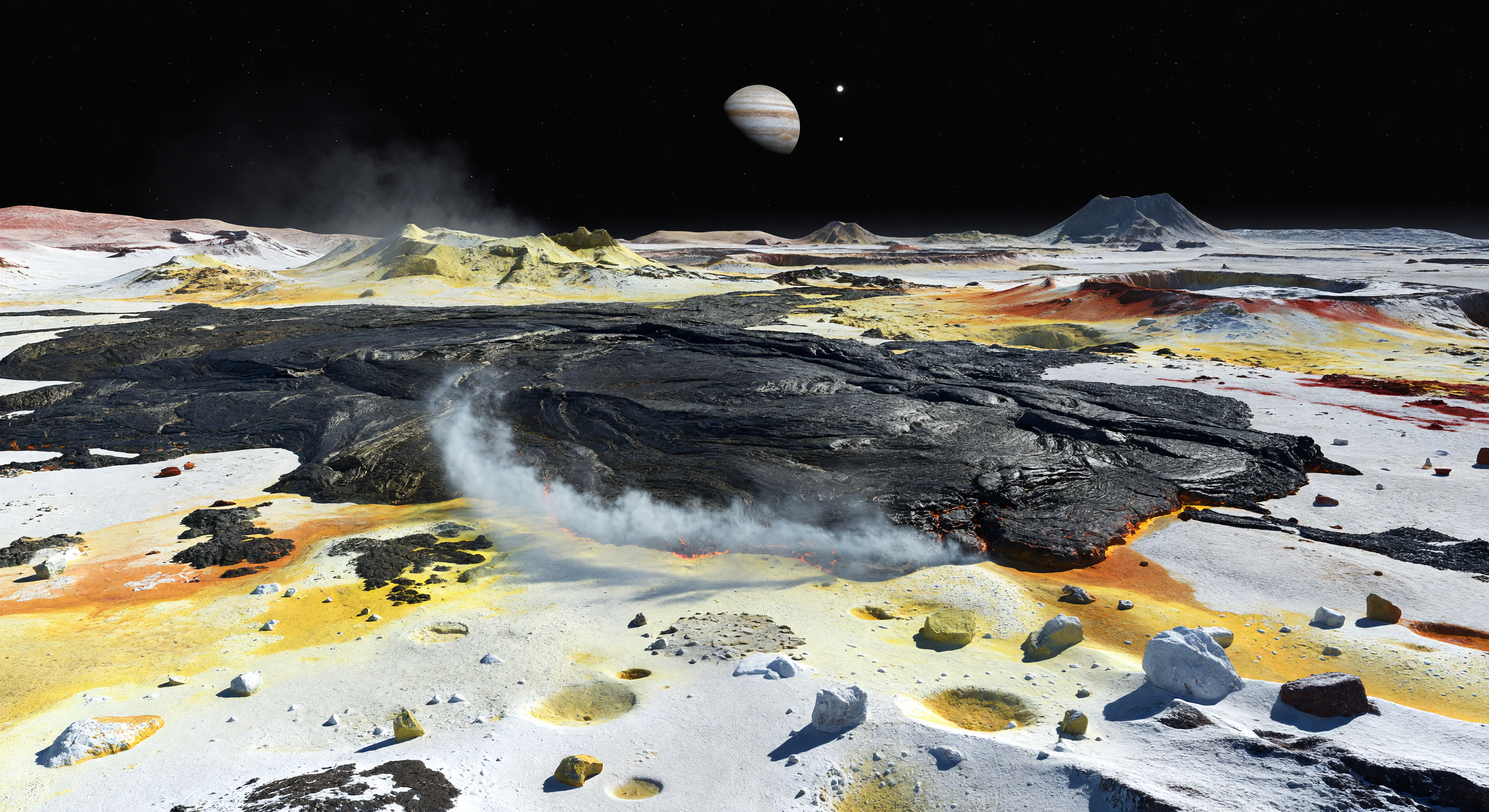
Devant vous, une langue de lave silicatée lobée, noire comme du charbon et par endroits gris canon, rampe sur une plaine éclatante de givre de dioxyde de soufre, sa croûte épaisse fracturée en dalles anguleuses et en débris rugueux, avec seulement quelques fissures orange-rouge trahissant la chaleur encore vive au front d’écoulement. Là où la lave touche le dépôt blanc, le givre se volatilise aussitôt dans l’extrême vide et forme un panache bas en rideau, comme une ombrelle blanchâtre plaquée au sol, accompagné d’une fine brume pâle chargée de particules gelées qui flotte juste au bord de la coulée. Autour, la plaine sulfurée reste d’une netteté saisissante sous une lumière solaire dure: jaunes saturés, orangés, crèmes, taches noires pyroclastiques et retombées rouge-brun dessinent un terrain jeune, sans eau ni cratères durables, continuellement refaçonné par un volcanisme alimenté par l’échauffement de marée. Sous le ciel noir presque sans atmosphère, où les ombres tombent en lames d’encre et où d’énormes reliefs lointains émergent avec une clarté irréelle, l’échelle du paysage paraît immense et étrangère, comme si l’on se tenait au bord vivant d’une forge planétaire.
Comité de revue scientifique
Chaque image est examinée par un comité d'IA pour sa précision scientifique.
GPT
Image: Ajuster
Description: Ajuster
SCIENTIFIC ACCURACY (adjust): The scene broadly matches Io’s common palette and processes: bright white/yellow sulfur dioxide frost on the ground, adjacent darker silicate lava flows, sulfurous staining, and active-looking sublimation/volcanic gas. The presence of a cold-to-hot contact boundary and a low, ground-hugging white plume is plausible for Io near-surface heating/sublimation. However, several details look inconsistent with Io observations: (1) The sky is fully black but includes a small, clearly defined bright Sun plus Jupiter—this is visually plausible but not clearly consistent with Io geometry/lens realism from actual mission imaging; Io’s apparent Sun is usually not portrayed as a single isolated “hard” disk at typical framing without specifying viewing conditions. (2) The plume looks relatively voluminous with a coherent, umbrella-like shape; Io plumes/venting can be strong, but the described umbrella plume and the apparent extent of visible gas/mist may be exaggerated for an image that otherwise emphasizes near-airless behavior. (3) Scale cues are ambiguous: the “contact front” is present, but the lobate sheet is not clearly the dominant foreground feature described, and the most intense heat indicators (narrow orange-red fractures) are not clearly confined to a thin contact zone—there are more widespread warm/colored regions than the description implies. VISUAL QUALITY (adjust/implicit): The image is high-quality, sharp, and visually coherent, with good lighting contrast and convincing terrain texture. No obvious rendering artifacts, but the overall look is somewhat stylized/overly cinematic: gas looks like a painted cloud, and color transitions (especially the stark yellow/cream banding and red streaking) feel more like artistic emphasis than instrument-recovered appearance. CAPTION ACCURACY (adjust): The caption’s core elements—dark lobate lava entering a bright SO2 frost field, shattered crust/clinker rubble, narrow heat fractures, and sublimation-driven low white plume with faint haze—are partially represented. Yet the image shows a more extensive mix of colored deposits and plume material than the caption’s restrained, contact-front-centered description. Also, the caption emphasizes a “dazzling white sulfur dioxide frost field” with only few narrow orange-red fractures; the image contains broader yellow staining and more widespread dark-red/orange patches. Overall: scientifically in the right direction, but the plume geometry, distribution of heat indicators, and some sky/body depiction details suggest the caption/image alignment needs refinement.
Claude
Image: Ajuster
Description: Ajuster
Building on GPT's review, I largely concur with the 'adjust' verdict for both image and caption, but I want to sharpen several specific points and add some disagreements.
SCIENTIFIC ACCURACY: The fundamental volcanic contact scenario is well-grounded in Galileo and Voyager observations of Io's Prometheus flow field — exactly this kind of dark silicate lava overriding bright SO2 frost is documented. The color palette (white SO2 frost, yellow/orange sulfur allotropes, dark basaltic lava) is broadly consistent with spectroscopic data. However, I flag three accuracy concerns GPT underweighted: (1) GRAVITY SIGNATURE — under Io's 0.183g, lava flow morphology should show distinctly different rheological behavior. The lobate sheet here looks suspiciously Earth-like in its pahoehoe-style ropiness; Io lavas likely behave differently due to extreme eruption temperatures (up to ~1900K for ultramafic melts) and low gravity. (2) MOUNTAINS — Io's mountains are tectonic compression features, not volcanic constructs, yet the background peaks look like classic stratovolcanoes, which is misleading. Io's mountains have distinctive non-volcanic morphology. (3) JUPITER'S APPARENT SIZE — Jupiter subtends roughly 19-20 arcminutes as seen from Io, making it appear about 36x larger than our Moon appears from Earth. The Jupiter in this image appears significantly undersized relative to what an observer on Io's surface would actually see — this is a recurring error in Io artwork and GPT missed it entirely. The plume geometry critique from GPT is valid; a sublimation-driven contact plume would hug the ground more tightly and lack the volumetric cumulus-like appearance shown.
VISUAL QUALITY: The rendering is technically accomplished with convincing rock textures and good specular response on the frost surfaces. I disagree slightly with GPT's 'overly cinematic' criticism — some artistic emphasis is acceptable for science communication imagery. The more substantive visual issue is the smoke/gas plume, which reads as terrestrial combustion smoke rather than SO2 sublimation vapor; it should appear whiter, more diffuse, and structurally different. The shadow rendering is good and appropriately hard-edged for an airless body.
CAPTION ACCURACY: The caption claims 'only a few narrow orange-red fractures betraying the intense heat' but the image shows considerably broader warm coloration zones. The 'umbrella-shaped white plume' described doesn't match what is rendered — the plume in the image is a column of gray-white smoke, not an umbrella or fountain morphology. The caption's claim of a 'faint bluish haze' is essentially absent in the image. These are non-trivial mismatches between text and image. The description of boulders, ridges, and patera rims in the background is reasonably accurate. Overall, both the image and caption need targeted revision rather than full regeneration: correct Jupiter's apparent size, revise the plume to sublimation-appropriate morphology, soften the heat color distribution to match the caption's intent, and rework background peaks to suggest tectonic rather than volcanic origin.
SCIENTIFIC ACCURACY: The fundamental volcanic contact scenario is well-grounded in Galileo and Voyager observations of Io's Prometheus flow field — exactly this kind of dark silicate lava overriding bright SO2 frost is documented. The color palette (white SO2 frost, yellow/orange sulfur allotropes, dark basaltic lava) is broadly consistent with spectroscopic data. However, I flag three accuracy concerns GPT underweighted: (1) GRAVITY SIGNATURE — under Io's 0.183g, lava flow morphology should show distinctly different rheological behavior. The lobate sheet here looks suspiciously Earth-like in its pahoehoe-style ropiness; Io lavas likely behave differently due to extreme eruption temperatures (up to ~1900K for ultramafic melts) and low gravity. (2) MOUNTAINS — Io's mountains are tectonic compression features, not volcanic constructs, yet the background peaks look like classic stratovolcanoes, which is misleading. Io's mountains have distinctive non-volcanic morphology. (3) JUPITER'S APPARENT SIZE — Jupiter subtends roughly 19-20 arcminutes as seen from Io, making it appear about 36x larger than our Moon appears from Earth. The Jupiter in this image appears significantly undersized relative to what an observer on Io's surface would actually see — this is a recurring error in Io artwork and GPT missed it entirely. The plume geometry critique from GPT is valid; a sublimation-driven contact plume would hug the ground more tightly and lack the volumetric cumulus-like appearance shown.
VISUAL QUALITY: The rendering is technically accomplished with convincing rock textures and good specular response on the frost surfaces. I disagree slightly with GPT's 'overly cinematic' criticism — some artistic emphasis is acceptable for science communication imagery. The more substantive visual issue is the smoke/gas plume, which reads as terrestrial combustion smoke rather than SO2 sublimation vapor; it should appear whiter, more diffuse, and structurally different. The shadow rendering is good and appropriately hard-edged for an airless body.
CAPTION ACCURACY: The caption claims 'only a few narrow orange-red fractures betraying the intense heat' but the image shows considerably broader warm coloration zones. The 'umbrella-shaped white plume' described doesn't match what is rendered — the plume in the image is a column of gray-white smoke, not an umbrella or fountain morphology. The caption's claim of a 'faint bluish haze' is essentially absent in the image. These are non-trivial mismatches between text and image. The description of boulders, ridges, and patera rims in the background is reasonably accurate. Overall, both the image and caption need targeted revision rather than full regeneration: correct Jupiter's apparent size, revise the plume to sublimation-appropriate morphology, soften the heat color distribution to match the caption's intent, and rework background peaks to suggest tectonic rather than volcanic origin.
Grok
Image: Ajuster
Description: Ajuster
I concur with both GPT and Claude's 'adjust' verdicts, as the image captures Io's essence but requires targeted refinements for precision. SCIENTIFIC ACCURACY (adjust): The core Prometheus-like flow field—dark silicate lava overriding white SO2 frost with sulfurous yellow/orange staining—is spot-on, matching Galileo SSI images (e.g., P-49865 of Prometheus flows). Sublimation plume at the hot-cold contact is plausible, driven by ~170K frost meeting ~150K+ lava. Agree with Claude on key issues: (1) Jupiter's apparent size is undersized; at Io's distance (~421,000 km), it subtends ~19.5 arcmin (~3.7x Phobos from Mars, vastly larger than depicted 'small' disk). (2) Mountains resemble eroded stratovolcanoes, not Io's blocky, compressional tectonic peaks (e.g., Boösaule Montes, up to 17 km high with steep, faceted slopes). (3) Lava morphology shows Earth-like pahoehoe lobes rather than Io's low-g, high-temp flows (smoother, inflated sheets per New Horizons data). Plume is somewhat exaggerated (valid GPT/Claude point); real contact venting is thinner, more ground-hugging (e.g., minor plumes in JunoCam). Sun size/shadows are appropriately shrunken/hard-edged for ~5.2 AU insolation. Disagree mildly with Claude on plume validity—image's low umbrella shape fits subdued sublimation better than tall Pele-style jets. VISUAL QUALITY (adjust): Photorealistic with excellent texture (cracked crust, frost specularities, rubble clasts), no artifacts, hard chiaroscuro lighting correct for airless body. Minor stylistic issue: plume appears slightly too opaque/smoky (terrestrial-like vs. ethereal SO2 gas); colors vivid but not oversaturated vs. raw Voyager/Galileo calibrations. Scale feels right via boulders/ridges. CAPTION ACCURACY (adjust): Mismatches on specifics—image has broad orange-red staining/patches beyond 'only a few narrow fractures'; plume is columnar with umbrella hint but lacks 'faint bluish haze'; frost field is dazzling white but extensively yellow-stained, diluting 'dazzling' purity. Background elements (ridges, patera rims implied by caldera-like forms, mountains) align well. New insight: scattered boulders are apt (ejecta from impacts/volcanism), but low-g hop-scar trails absent—could enhance alien feel. Constructive fixes: Upsize Jupiter 3-4x, flatten/reblock mountains, thin/refine plume to diffuse white with blue tint, narrow heat fractures, tweak lava to less ropy. No regenerate needed—strong base.
Gemini
Image: Ajuster
Description: Ajuster
I concur with the committee's consensus. The image provides a strong foundation but requires technical calibration to achieve scientific rigor. My primary concern is the 'tectonic vs. volcanic' misclassification of the background mountains; Io’s mountains are massive, faulted crustal blocks, not the conical stratovolcanoes suggested here. I also strongly support the correction regarding Jupiter's angular diameter—the current depiction significantly underestimates the sheer scale of the planet as seen from the surface, which is a defining feature of the Io landscape. Regarding the plume, the 'smoky' rendering is a common pitfall; it must be adjusted to represent the ethereal, low-opacity nature of sublimating SO2 gas, which lacks the particulate density of terrestrial smoke. The caption should be adjusted to acknowledge the broader staining present in the image, as the current text is too restrictive compared to the visual data. Finally, to improve the 'alien' quality, the lava morphology should favor inflated, smooth-topped sheets characteristic of high-temperature ultramafic flows in low gravity, rather than terrestrial ropy basalt.
Matania — Synthèse
Image: Ajuster
Description: Ajuster
The committee finds the image scientifically well-grounded for Io’s Prometheus Contact Front, with the core scene accurately depicting dark silicate lava advancing into bright sulfur dioxide frost, sulfurous staining, and a plausible contact-driven sublimation plume. Visual execution is strong, with convincing texture, lighting, and overall compositional clarity. However, several details need refinement for closer fidelity to Io: Jupiter is depicted too small, the background mountains read more like volcanic cones than Io’s tectonic blocks, the lava morphology is somewhat Earth-like and ropy, and the plume is too smoky/opaque and slightly too voluminous for an Io sublimation scene. The caption similarly captures the general process well, but it understates the breadth of the warm coloration, describes plume geometry and haze that are not well matched by the image, and is therefore not fully aligned with what is shown.