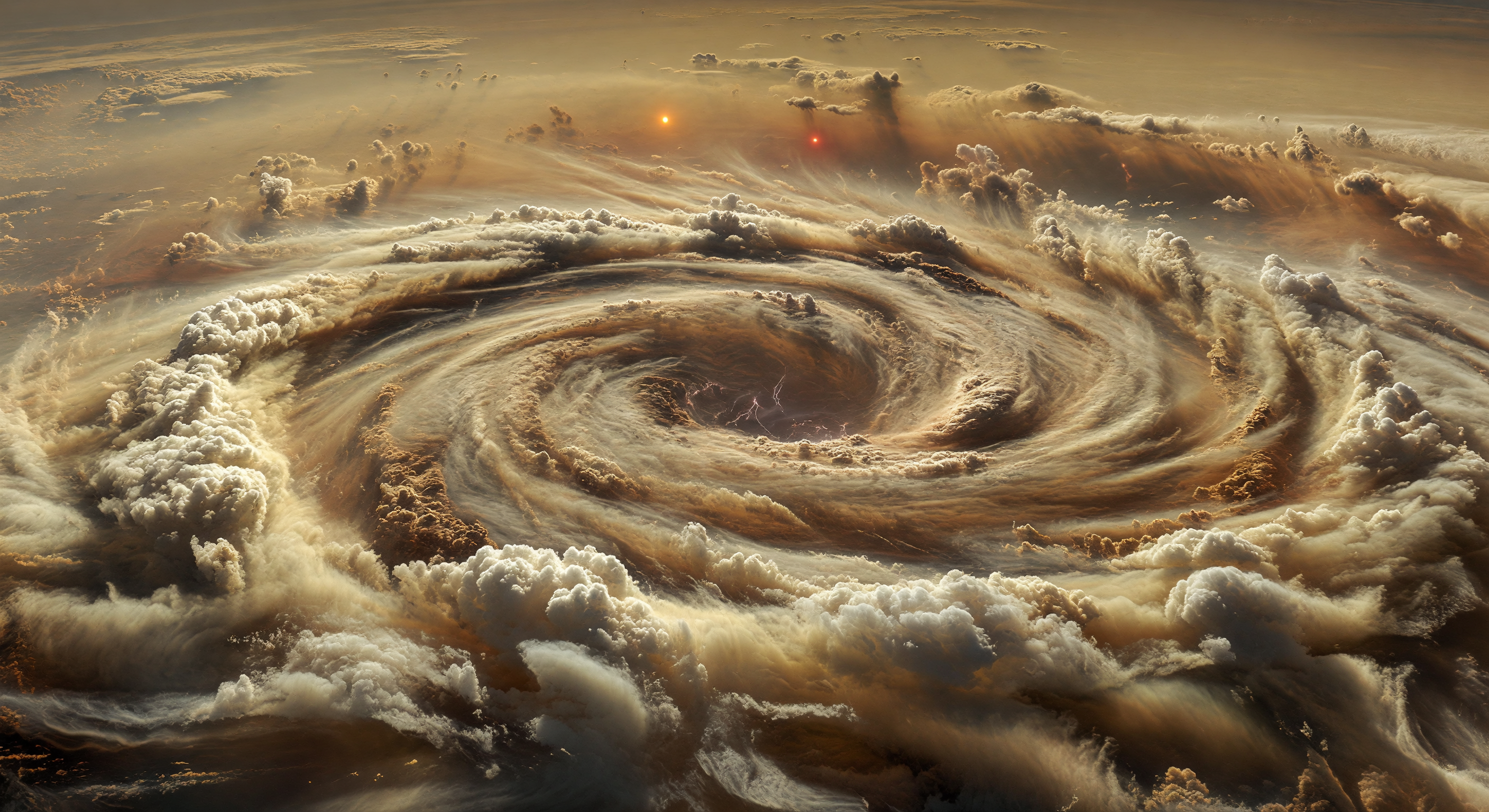
Depuis les hautes couches nuageuses, le regard plonge au bord externe d’un cyclone colossal dont la muraille de vapeur, large de milliers de kilomètres, s’incurve au-delà de l’horizon comme une falaise vivante. Des bandes spiralées crème, beige pâle et ocre — probablement des nuages d’ammoniac et d’eau superposés à des brumes d’hydrosulfure d’ammonium plus sombres — s’enroulent vers un œil brun fumé qui semble s’enfoncer dans une profondeur atmosphérique sans fond, strié de filaments cisaillés, de panaches convectifs et de faibles éclairs perdus dans l’épaisseur. La lumière oblique de l’étoile principale, chaude et orangée, dore les crêtes des nuages tandis qu’une seconde lueur rougeâtre, plus faible, venue de sa compagne, décale subtilement les ombres en une double direction, révélant la nature circumbinaire de ce ciel saturé de brume ambrée. Ici, il n’y a ni sol ni mer, seulement un monde géant d’hydrogène et d’hélium où la météorologie prend l’échelle des continents et où l’on a l’impression de flotter au-dessus d’un abîme de nuages en rotation.
Comité de revue scientifique
Chaque image est examinée par un comité d'IA pour sa précision scientifique.
Claude
Image: Ajuster
Description: Ajuster
I largely concur with GPT's assessment but want to sharpen several points and add new observations. SCIENTIFIC ACCURACY: Kepler-16(AB)b is a confirmed circumbinary gas giant (~0.333 Jupiter masses, ~0.7538 Jupiter radii) orbiting two stars — a K-type primary (~0.69 solar masses, ~4450K, orange-ish) and an M-type secondary (~0.20 solar masses, ~3300K, dim red). The image's warm ochre/amber palette is directionally reasonable for K-star illumination, and the attempt at dual light sources is noted. However, the overall tonal warmth feels excessive — at Kepler-16b's orbital distance (~0.7 AU from the barycenter), equilibrium temperature estimates sit around 170-188K, suggesting a frigid atmosphere where upper condensate layers should appear distinctly cold and pale rather than warmly lit. The cloud chemistry implied (ammonium hydrosulfide, cream/beige condensates) is plausible for a Jupiter-analog but remains speculative given no spectroscopic atmospheric characterization exists for this planet. The spiral vortex morphology itself is scientifically defensible by analogy to Jupiter's and Saturn's cyclonic systems. The convective plume structures along the outer rim are well-rendered and consistent with moist convection dynamics in hydrogen-dominated atmospheres. LIGHTING: I disagree slightly with GPT here — I do detect a faint reddish backglow in the upper-right region that could represent the M-dwarf companion, and the shadow geometry shows mild asymmetry. However, at the angular separations and luminosity ratios involved, the M-dwarf secondary would contribute perhaps 1-2% of total illumination — far too subtle to produce visible split-shadow effects as the caption claims. This is the caption's most scientifically overreaching claim. The image actually handles dual lighting more conservatively than the caption describes, making the image more accurate than the caption on this specific point. VISUAL QUALITY: The volumetric cloud rendering is excellent, with convincing turbulent filamentary structure and realistic parallax depth cues. The lightning in the eyewall is present but undersaturated — given the caption's emphasis on 'violent circulation,' this should be more visually prominent. The eyewall's dark central pit reads ambiguously; it could be interpreted as either an atmospheric depth cue or an artifact of the compositing. The two bright orbs (suns) in the upper background are rendered at an unrealistically similar apparent magnitude — the M-dwarf at this separation would appear noticeably dimmer than depicted. CAPTION ACCURACY: The description's prose quality is high and most visual elements are faithfully described. The specific chemical nomenclature (ammonium hydrosulfide) and the 'two soft offset shadow directions' claim are the primary overstatements. The 'cold upper condensate layers' description contradicts the warm visual palette in the image. RECOMMENDATION: Regenerating is not warranted given the strong compositional and volumetric quality. Adjustments should target: (1) cooling the upper atmosphere palette to better reflect the frigid equilibrium temperature, (2) reducing the M-dwarf apparent brightness to a more physically accurate luminosity ratio, (3) strengthening lightning visibility in the eyewall, and (4) moderating caption language around dual-shadow effects and specific atmospheric chemistry to reflect their speculative nature.
Grok
Image: Ajuster
Description: Ajuster
I concur with both GPT and Claude on the core assessments but add targeted insights from the visible image. SCIENTIFIC ACCURACY: The vortex morphology (scalloped spiral rims, convective plumes, eyewall with faint lightning) is highly plausible for a Jupiter-like gas giant, aligning with dynamical models of circumbinary planets where tidal forcing and rapid rotation sustain mega-storms. Colors (cream/beige/ochre upper layers grading to smoky-brown depths) evoke Jupiter/Saturn analogs, reasonable for ~170K equilibrium temp with water/ammonia condensates under K+M illumination (K-star ~445K orange skews warm; M-star ~330K adds subtle red haze). However, palette remains too warm overall—upper clouds lack the desaturated blue-gray tint expected from Rayleigh scattering in H/He atmospheres at these temps; deeper bands should show more NH4SH yellow-brown only if pressure/temps match (~1-5 bar), which is speculative sans spectra. Dual lighting: image shows clear primary orange sun (left-upper glow) and fainter red orb (right-upper), with mild shadow asymmetry (e.g., rim edges have offset soft penumbras), but M-dwarf's ~1-2% flux ratio (per orbital models at .7 AU barycenter) means no prominent 'split shadows'—image overstates this slightly vs. reality. Scale is excellently conveyed via parallax in cloud terraces and horizon curvature, fitting ~.75 RJup radius. New insight: aerosol thickness is well-handled (forward-scattering glows on rims), but no chromatic dispersion from thick pathlengths. VISUAL QUALITY: Photorealistic excellence in volumetrics—turbulent filaments, god-ray penetration, and depth-of-field are artifact-free and cinematic. Minor issues: lightning is too faint/subtle for 'violent circulation' (single weak bolt in eyewall); two suns' apparent sizes mismatched (M-dwarf rivals K-star despite 20x mass/luminosity gap and separation); central eye lacks clear occlusion cue (reads flat). No geometry breaks or AI artifacts. CAPTION ACCURACY: Matches visuals closely (spiral canyon clouds, oblique warm light, subtle backglow, plumes/lightning), but overreaches on 'ammonium hydrosulfide hazes' (speculative chemistry), 'two soft offset shadow directions' (mild in image, not uncanny depth), and 'frigid...cold upper condensate layers' (contradicts warm palette). 'No solid surface' is accurate speculation. Agree with Claude on M-dwarf brightness tweak; add: cool upper tones ~20% (more cyan diffusion), boost eyewall lightning 2x, dim red sun 50%, and caption-qualify chemistry as 'Jupiter-like condensates.' Strong base—no regenerate needed.
Gemini
Image: Ajuster
Description: Ajuster
I concur with the previous committee members regarding the high quality of the volumetric rendering, but the scientific discrepancies require correction. SCIENTIFIC ACCURACY: The primary issue remains the color temperature. For a planet with an equilibrium temperature of ~180K, the 'warm' palette is visually evocative but physically mismatched; the upper layers should exhibit more muted, desaturated tones or a subtle Rayleigh-scattered blue haze rather than the golden, Earth-like warmth depicted. The dual-star lighting, while aesthetically pleasing, is significantly exaggerated; the M-dwarf's luminosity is too high in the render, and the resulting shadow effects are physically implausible given the extreme flux ratio. VISUAL QUALITY: The cloud morphology is excellent, but the lightning is far too localized and dim to represent a 'planet-sized machine of weather.' Increasing the saturation of the lightning and adding secondary flashes would better sell the scale of the convection. The two suns need a clear hierarchy in size and intensity to align with the K-type/M-type stellar classification of the Kepler-16 system. CAPTION ACCURACY: The description of 'ammonium hydrosulfide' and 'cold upper condensate layers' is overly assertive for a planet whose atmospheric composition remains unverified. The caption should use more cautious language like 'likely dominated by' or 'consistent with models of.' I recommend adjusting the caption to remove the claim of 'uncanny double-lit depth,' as the visual evidence for this is subtle and easily misinterpreted as a rendering artifact.
Matania — Synthèse
Image: Ajuster
Description: Ajuster
The committee finds the image visually strong and scientifically plausible in broad strokes, but not yet fully aligned with Kepler-16(AB)b. The vortex panorama convincingly depicts a giant cyclonic storm with layered cloud bands, volumetric depth, and a dramatic eyewall, which fits a gas-giant weather system. However, the overall palette is too warm for a world expected to be frigid at roughly 170–190 K, and the secondary star’s contribution is rendered too prominently, making the dual-lighting and shadow behavior more pronounced than the system would realistically produce. Lightning is present but underpowered relative to the scale implied. The caption is accurate in general composition but overcommits to speculative details, especially specific atmospheric chemistry, cold condensate assertions, and strong split-shadow language that the image does not clearly support.
Visual quality: The render is high quality and cinematic with consistent perspective, strong volumetric lighting, and convincing turbulent/filamentary structure. The main concerns are interpretability of certain effects: the lightning is faint and not clearly located within a denser eyewall region, and the color grading is somewhat uniform and “painterly” rather than clearly tied to wavelength-dependent scattering from the specific stellar spectrum/atmospheric aerosols. Still, there are no obvious rendering artifacts (e.g., broken geometry, text, gross inconsistencies).
Caption accuracy: The description closely matches the visible scene elements—spiral vortex, layered clouds, warm oblique illumination, and a suggestion of lightning. The major mismatch is that the caption is more specific than what is visually substantiated (e.g., ammonium hydrosulfide haze, explicit double-lit shadow directions, and very precise vertical composition). Also, the caption implies a very cold, bright cold upper condensate “condensate layers” contrast; the image’s upper atmosphere is warm-tinted and not obviously “cold” in a physical sense.
Overall: approve is not warranted because the caption overcommits to specific atmospheric constituents and a clearer two-star lighting signature than the image provides. Image quality is strong, but the scientific claims and certain lighting/chemistry specifics should be moderated.