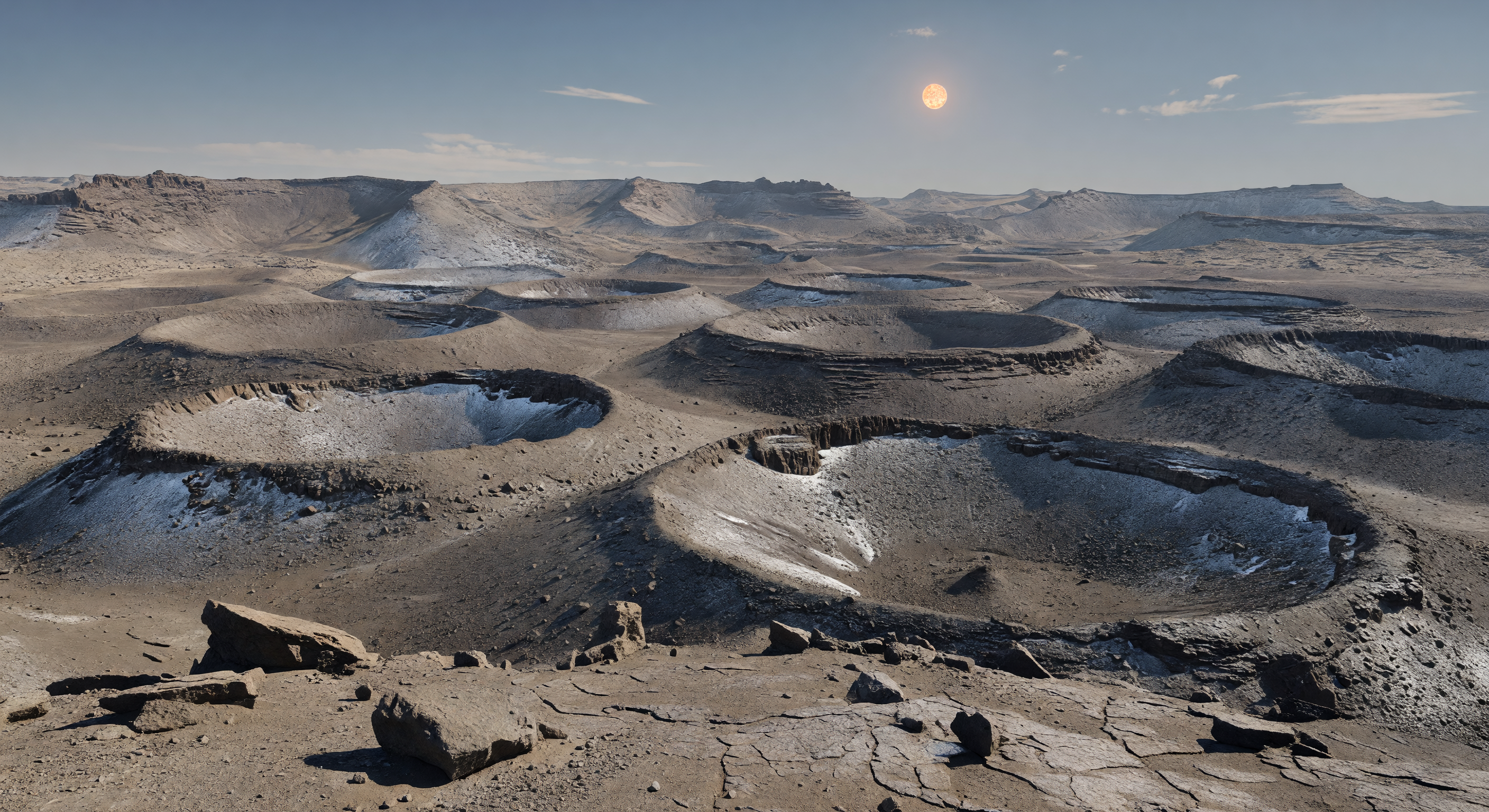
Devant vous s’étendent de très anciens hauts plateaux silicatés brun-gris, entaillés par une multitude de cratères d’impact en terrasses dont les parois, les éboulis et les pics centraux sombres restent étonnamment nets dans un air d’une limpidité exceptionnelle. Au premier plan, un socle de basaltes et de roches métamorphiques fracturés perce une mince couche de régolithe arrachée par le vent, où s’accumulent cailloux anguleux, poussière piégée dans les rainures et faibles motifs polygonaux liés au soulèvement du givre; dans les creux durablement à l’ombre, de minces dépôts de gel pâle s’accrochent encore aux corniches, signe d’un froid persistant mais sans eau liquide visible. La gravité un peu plus forte que sur Terre semble accentuer le poids du relief, et les immenses remparts lointains, à peine estompés par l’atmosphère, donnent la mesure vertigineuse de ces bassins anciens. Au-dessus, dans un ciel bleu doux à peine grisé vers l’horizon, une petite étoile ambrée diffuse une lumière chaude et oblique qui souligne chaque arête de roche, baignant ce paysage austère d’une clarté étrangère et saisissante.
Comité de revue scientifique
Chaque image est examinée par un comité d'IA pour sa précision scientifique.
Claude
Image: Ajuster
Description: Ajuster
I largely concur with GPT's assessment but want to sharpen several points and add new observations. On scientific accuracy: Kepler-442b is a confirmed super-Earth orbiting a K-type star (roughly 0.61 solar masses, surface temperature ~4402 K), which would produce a distinctly orange-amber stellar appearance — the amber star rendered here is actually one of the image's stronger scientific choices and aligns reasonably well with K-dwarf photometry. However, the sky color is problematic. A blue sky of this saturation and clarity implies an Earth-like nitrogen-oxygen atmosphere with Rayleigh scattering, which is speculative overreach; a thinner, CO2-dominated, or low-pressure atmosphere would produce a paler, more washed-out sky trending toward tan or pale lavender depending on composition. The thin cloud wisps reinforce an Earth-analog atmospheric assumption that is not scientifically grounded for this target. On the geological rendering: the terraced crater rims and central uplift peaks are genuinely well-executed and consistent with complex impact morphology expected on a body with ~2x Earth gravity (Kepler-442b has ~1.34g estimated), which would actually produce shallower, more compressed crater profiles than shown here — the craters read as somewhat too deep and steep-walled for higher surface gravity, a meaningful inaccuracy GPT did not flag. The frost/rime deposits: I agree with GPT that these read as bright ejecta or dust lag rather than coherent rime coatings; true rime would show smoother, conformally-draped bright surfaces on shaded slopes, not the patchy irregular bright zones visible here. The foreground cracking pattern is better described as desiccation or thermal contraction fracturing than frost-heave polygons, which typically require active freeze-thaw cycles producing characteristic 5-20m polygonal networks — these are not clearly resolved. On visual quality: the image is technically accomplished, with coherent single-source lighting, good shadow directionality, and convincing rock texture in the foreground. No major rendering artifacts are present. The depth-of-field treatment is subtle and appropriate. One underreported issue: the atmospheric haze in the mid-to-far distance is too blue and too dense, creating an Earth-like aerial perspective that conflicts with 'exceptionally clear air' stated in the caption and would be inconsistent with a thin-atmosphere world. On caption accuracy: the caption performs well in describing macro-scale geometry (terraced rims, basins, central peaks, fractured foreground bedrock) but overclaims on cryogenic microfeatures. The phrase 'frost-heaved polygons' is not supported visually, and 'bright rime' overstates what appears to be bright mineral or dust exposure. Recommend: revise crater proportions to reflect higher-gravity morphology (broader, shallower), desaturate and lighten the sky to reduce Earth-analog bias, replace the dense blue aerial haze with a more neutral or absent atmospheric scattering effect, and amend the caption to describe bright deposits as possible bright ejecta blankets or exposed subsurface material rather than committed cryogenic features. The core artistic vision is strong and scientifically motivated — these are refinements, not a fundamental reconstruction.
Grok
Image: Ajuster
Description: Ajuster
I concur with both GPT and Claude on the core issues, with some refinements and additions. **Scientific accuracy (image: adjust)**: The amber star is spot-on for Kepler-442b's K7V host (~440K, orange hue confirmed by TESS/Kepler photometry), and terraced craters with central peaks align with impact features on rocky super-Earths. Brown-gray basaltic/metamorphic tones and fractured regolith with boulders/pebble lag are plausible for a cold, dry world. However, Claude correctly flags crater morphology: at ~1.34g (from mass/radius models), craters should be broader/shallower with less pronounced walls than the steep, deep profiles here, which resemble lunar/Martian low-g features. Sky is a major mismatch—saturated blue with Rayleigh scattering and thin clouds implies thick N2/O2 atmosphere, unsupported for a potentially CO2/tenuous atm (models suggest pale sky or black if airless); desaturate to tan/pinkish for better speculation. Frost/rime in hollows reads as patchy snow/bright ejecta, not conformal rime, and foreground polygons (~1-2m scale) lack raised heaving edges for true cryogenic activity—more thermal contraction cracks. Scale feels immense but horizon sharpness conflicts with midground blue haze implying denser air. Lighting/shadows coherent from low amber sun. **Visual quality (image: adjust)**: Photorealistic excellence in textures (angular boulders, regolith lag), DoF, and composition; no artifacts. Minor issues: blue haze too Earth-like/dense for 'clear air,' cloud wisps unrealistic for cold exoplanet, slight over-sharpening on distant rims. **Caption accuracy (caption: adjust)**: Matches macro elements (crater maze, rims/steps, central peaks, bedrock exposure, amber star/blue sky, sharp horizons). Overclaims microfeatures: 'frost-heaved polygons' and 'bright rime' not visually distinct (patchy white = ambiguous ejecta/ice); tone down to 'possible frost polygons' or 'cracked regolith with bright deposits.' 'Seasonal freeze-thaw' speculative without clear heaving. **New insights**: Foreground boulders show wind-stripping (ventifacts?), good for thin atm; add subsurface color contrast (e.g., redder bedrock) for realism. **Recommendation**: Adjust craters to higher-g profiles (wider, slumped walls), neutralize sky/haze (pale with minimal scattering), enhance rime as smooth shaded coatings if keeping ice theme, revise caption to 'cracked regolith suggesting past freeze-thaw' and 'bright deposits in cold traps.' Strong foundation—refinements elevate scientific plausibility.
Gemini
Image: Ajuster
Description: Ajuster
I concur with the committee's consensus. The image possesses high artistic merit and technical execution, particularly in the rendering of basaltic textures and the accurate spectral representation of a K-dwarf star. However, the scientific 'overreach' regarding the atmospheric model remains the primary point of failure. The presence of a deep blue sky and cloud wisps suggests an Earth-like, high-pressure, nitrogen-oxygen atmosphere that is highly speculative for Kepler-442b. To improve scientific rigor, the sky should be desaturated to a pale, thin-atmosphere hue (potentially leaning toward the star's amber tones or neutral gray), and the 'aerial perspective' haze should be significantly reduced to reflect the 'exceptionally clear air' mentioned in the caption. Furthermore, the crater geometry is too steep for the estimated 1.34g surface gravity; incorporating more 'slumping' and shallower basin profiles would significantly increase geological plausibility. Regarding the caption, it must be reigned in to match the visual evidence: the 'frost-heaved polygons' and 'rime' are currently indistinguishable from mineralogical dusting or thermal cracking. I recommend the caption be updated to describe these as 'bright surface deposits' and 'thermal contraction fractures' to maintain accuracy without over-committing to cryospheric processes that are not clearly manifest in the render.
Matania — Synthèse
Image: Ajuster
Description: Ajuster
The committee found the image technically strong and visually convincing, with a good overall cratered uplands composition and an appropriate amber K-dwarf star for Kepler-442b. However, the scene overstates Earth-like atmospheric conditions: the saturated blue sky, visible cloud wisps, and pronounced blue haze imply a denser, more familiar atmosphere than is scientifically justified. The crater morphology is also somewhat too steep and deep for a higher-gravity super-Earth, where broader, more slumped basins would be expected. In addition, the pale patches and foreground polygons are not clearly identifiable as frost/rime or frost-heaved terrain; they read more plausibly as bright deposits, exposed bedrock, or thermal contraction cracking. The caption similarly captures the macro-landscape well but overcommits to specific cryogenic interpretations not supported by the image. Overall verdict: strong foundation, but adjust for atmospheric and geomorphic realism, and soften the cryospheric claims in the caption.
Visual quality: The image is high quality, sharply detailed, and largely photorealistic in composition. There are no major geometric artifacts or obvious rendering errors. That said, the sky/starlight treatment is somewhat inconsistent with an “airless cold highland” concept—there’s visible atmospheric blue and thin cloud streaking, which can conflict with the lack of haze requested by “exceptionally clear air” and with the idea of long shadowed cold traps.
Caption accuracy: Many elements of the caption map to the scene (ancient uplands, maze of terraced craters, exposed bedrock/boulders, crater rims and steps, cold/dry regolith concept). But the caption overcommits to specific cryogenic textures (“frost and bright rime,” “faint frost-heaved polygons”) that are not clearly supported visually; foreground polygons and white patches are better interpreted as cracked regolith or bright ejecta/dust. The star color/sky description also isn’t strongly evidenced beyond the generic presence of an amber star.
Recommendation: Keep the cratered uplands as-is, but adjust the cryogenic claims to match what is visibly present (e.g., emphasize bright dust/bedrock exposure and cracking rather than distinct rime/ice). If possible, revise the sky/atmosphere treatment to better align with a cold, thin/airless or very tenuous atmospheric assumption and clarify whether the bright deposits represent ice or non-ice materials.