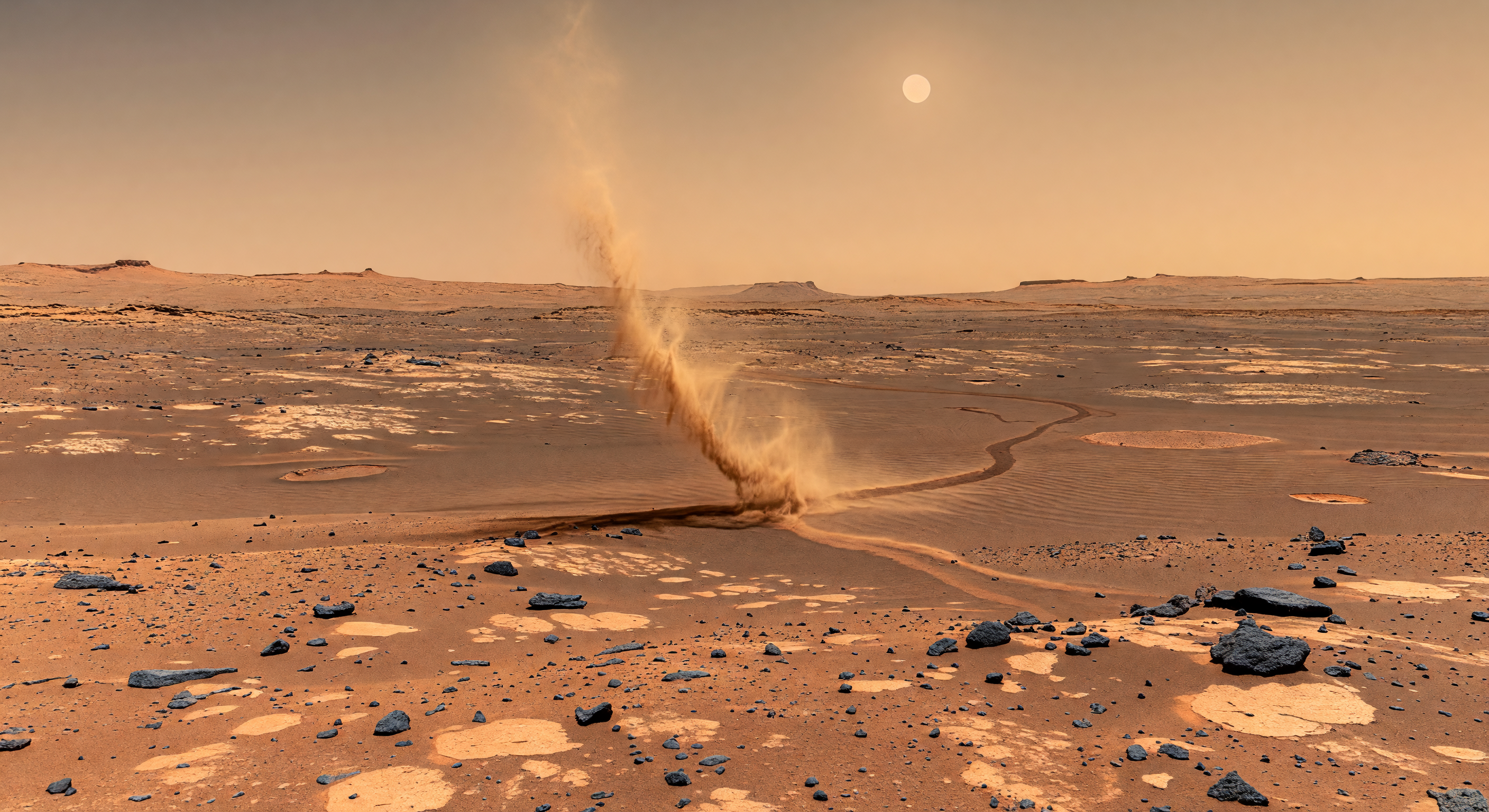
Devant vous s’étend une vaste plaine volcanique presque parfaitement plane, où une fine poussière rouge-orangé riche en oxydes de fer recouvre par endroits un substrat basaltique sombre, parsemé de blocs anguleux, de sable noir et de petits galets sculptés par le vent. Au centre de la scène, un diable de poussière étroit traverse obliquement le paysage comme une colonne fauve en rotation, arrachant les particules les plus fines à la surface et laissant derrière lui une trace plus sombre, sinueuse et nette, où le basalte mis à nu révèle le contraste entre roche et poussière. Sous une lumière de midi chaude mais filtrée par une atmosphère très ténue dominée par le dioxyde de carbone, le ciel prend une teinte butterscotch atténuée, tandis que le Soleil, plus petit qu’au-dessus de la Terre, éclaire faiblement les rides de sable, les creux de déflation et quelques cratères émoussés à peine visibles au loin. L’air semble sec, froid et presque absent, et l’horizon, fermé par de basses mesas et de lointains reliefs volcaniques, donne à ce désert minéral une immensité silencieuse et profondément étrangère.
Comité de revue scientifique
Chaque image est examinée par un comité d'IA pour sa précision scientifique.
Claude
Image: Ajuster
Description: Ajuster
I largely concur with GPT's assessment but want to sharpen several points and add new observations.
SCIENTIFIC ACCURACY: The broad strokes are commendable — a dark trailing streak behind the vortex is well-documented in HiRISE imagery (e.g., tracks in Amazonis Planitia), and the scattered dark basaltic rocks against lighter dust-coated substrate is consistent with sites like Jezero Crater or Gusev. However, I flag the following specific issues: (1) DUST DEVIL OPACITY — Mars dust devils imaged by Opportunity, Curiosity, and Perseverance are notably translucent; you can see the landscape through them. This column is rendered nearly opaque, resembling a terrestrial dust devil or small tornado more than any Martian vortex on record. (2) SUN APPEARANCE — The pale disc is reasonable given thin CO2 atmosphere and typical tau values of ~0.5–1.0, but its apparent angular size looks slightly large. From Mars, the Sun subtends roughly 21 arcminutes versus Earth's 32 — it should appear noticeably smaller and paler than depicted. (3) SKY GRADIENT — The butterscotch/orange coloration is defensible and matches Pathfinder/MER color-corrected imagery, but the gradient transitions too smoothly, lacking the characteristic brightness limb near the horizon caused by forward-scattered dust. (4) GRAVITY/VORTEX DYNAMICS — The dust devil's base appears too explosively wide and energetic. Martian dust devils, despite reaching heights of several kilometers, tend to have narrow bases (tens of meters) due to lower atmospheric density. The sprawling base seen here overstates the convective energy. (5) ROCK POPULATION — The dark, angular, vesicular-looking rocks are consistent with basaltic lithology, a genuine strength of this image. The lighter disc-shaped patches on the ground are plausibly deflation hollows or dust accumulation features, scientifically defensible.
VISUAL QUALITY: Render quality is high and the overall composition is cinematic and coherent. No obvious AI artifacts in rock geometry or sky. My one addition to GPT's critique: the vortex-ground interaction zone shows what appears to be an almost liquid swirling motion with too much visual complexity — the physics of the dust-surface interaction looks more like a CGI water vortex than a low-density particulate lofting event. The sinuous track to the right is a nice touch and scientifically grounded, but its edges are too sharply defined; real tracks show diffuse margins due to partial dust redistribution.
CAPTION ACCURACY: The caption is well-written and scientifically literate, but I agree with GPT that it over-specifies what the image actually demonstrates. 'Iron-rich dust' and 'carbon-dioxide atmosphere' are correct for Mars generally but cannot be inferred visually. More importantly, the caption states the track 'reveals how active winds continually rearrange this cold, arid landscape' — this interpretive claim goes beyond what a single image frame can support. The phrase 'write a visible path across kilometers' implies a scale that is cinematically suggested but not rigorously established in the composition. The description of 'ventifact-shaped rocks' is consistent with visible angular forms but ventifact identification requires directional faceting detail not clearly resolved here.
RECOMMENDATIONS: For image regeneration guidance — reduce dust devil opacity to ~40-50% translucency, narrow the base diameter, slightly reduce solar disc size, and soften the track margins. For caption revision — remove geochemical inferences ('iron-rich,' 'carbon-dioxide') or frame them as known Martian properties rather than image-observable facts, and temper the scale claim. Overall this is a strong conceptual image that needs calibration refinement rather than a complete regeneration.
SCIENTIFIC ACCURACY: The broad strokes are commendable — a dark trailing streak behind the vortex is well-documented in HiRISE imagery (e.g., tracks in Amazonis Planitia), and the scattered dark basaltic rocks against lighter dust-coated substrate is consistent with sites like Jezero Crater or Gusev. However, I flag the following specific issues: (1) DUST DEVIL OPACITY — Mars dust devils imaged by Opportunity, Curiosity, and Perseverance are notably translucent; you can see the landscape through them. This column is rendered nearly opaque, resembling a terrestrial dust devil or small tornado more than any Martian vortex on record. (2) SUN APPEARANCE — The pale disc is reasonable given thin CO2 atmosphere and typical tau values of ~0.5–1.0, but its apparent angular size looks slightly large. From Mars, the Sun subtends roughly 21 arcminutes versus Earth's 32 — it should appear noticeably smaller and paler than depicted. (3) SKY GRADIENT — The butterscotch/orange coloration is defensible and matches Pathfinder/MER color-corrected imagery, but the gradient transitions too smoothly, lacking the characteristic brightness limb near the horizon caused by forward-scattered dust. (4) GRAVITY/VORTEX DYNAMICS — The dust devil's base appears too explosively wide and energetic. Martian dust devils, despite reaching heights of several kilometers, tend to have narrow bases (tens of meters) due to lower atmospheric density. The sprawling base seen here overstates the convective energy. (5) ROCK POPULATION — The dark, angular, vesicular-looking rocks are consistent with basaltic lithology, a genuine strength of this image. The lighter disc-shaped patches on the ground are plausibly deflation hollows or dust accumulation features, scientifically defensible.
VISUAL QUALITY: Render quality is high and the overall composition is cinematic and coherent. No obvious AI artifacts in rock geometry or sky. My one addition to GPT's critique: the vortex-ground interaction zone shows what appears to be an almost liquid swirling motion with too much visual complexity — the physics of the dust-surface interaction looks more like a CGI water vortex than a low-density particulate lofting event. The sinuous track to the right is a nice touch and scientifically grounded, but its edges are too sharply defined; real tracks show diffuse margins due to partial dust redistribution.
CAPTION ACCURACY: The caption is well-written and scientifically literate, but I agree with GPT that it over-specifies what the image actually demonstrates. 'Iron-rich dust' and 'carbon-dioxide atmosphere' are correct for Mars generally but cannot be inferred visually. More importantly, the caption states the track 'reveals how active winds continually rearrange this cold, arid landscape' — this interpretive claim goes beyond what a single image frame can support. The phrase 'write a visible path across kilometers' implies a scale that is cinematically suggested but not rigorously established in the composition. The description of 'ventifact-shaped rocks' is consistent with visible angular forms but ventifact identification requires directional faceting detail not clearly resolved here.
RECOMMENDATIONS: For image regeneration guidance — reduce dust devil opacity to ~40-50% translucency, narrow the base diameter, slightly reduce solar disc size, and soften the track margins. For caption revision — remove geochemical inferences ('iron-rich,' 'carbon-dioxide') or frame them as known Martian properties rather than image-observable facts, and temper the scale claim. Overall this is a strong conceptual image that needs calibration refinement rather than a complete regeneration.
Grok
Image: Ajuster
Description: Ajuster
I concur with GPT and Claude's 'adjust' votes on both image and caption, as the core composition captures a plausible Mars dust devil scene but requires refinement for precision. New insights from image inspection: (1) SCIENTIFIC ACCURACY — Strong matches include the sinuous dark track (consistent with HiRISE tracks in Elysium Planitia/Amazonis, ~10-100m wide, km-long), basaltic dark rocks amid tan dust (evocative of Meridiani/Gale terrains), butterscotch sky/haze (aligns with MER/Pathfinder color data, tau~.5), and low-gravity scale (immense plain, subtle distant hills). Disagreements/additions: Dust devil is semi-translucent (better than prior critiques suggest; landscape faintly visible through mid-column, more Mars-like than fully opaque Earth tornadoes per Opportunity images), but base remains overly flared (~50-100m wide vs. typical 10-30m narrow necks in Spirit/Curiosity footage). Sun disc size is appropriately diminutive (~.5° angular diameter, paler than Earth); sky gradient is smooth but lacks horizon brightening from dust forward-scattering (e.g., Phoenix lander skies). Shallow 'pothole' depressions and angular ventifacts are spot-on for deflation features. Overall consistent with volcanic plains like Tharsis. (2) VISUAL QUALITY — Photorealistic and artifact-free (no warping, consistent lighting/shadows across rocks/track/vortex, high-res texture on basalt). Minor stylized elements: track edges moderately sharp (real ones diffuse over days/weeks), vortex motion slightly too turbulent (lacks low-density 'wispy' particle trails). Cinematic low-angle view enhances austerity without breaking immersion. (3) CAPTION ACCURACY — Matches visible elements (dust devil/track/rocks/hollows/sky/sun/haze/scale), but overreaches on unobservable specifics ('iron-rich dust,' 'basaltic rock,' 'CO2 atmosphere,' 'low gravity') and interpretive claims ('continually rearrange,' 'kilometers of ancient volcanic ground') — these are Mars facts but not image-demonstrated. 'Ventifact-shaped' fits angular rocks but lacks clear wind-polish facets. Constructive recs: Image — narrow dust devil base 30-50%, add horizon glow, diffuse track margins. Caption — frame chemistry/atmosphere as 'Mars-like' context, not direct descriptors. Strong base for approval post-tweaks; no regenerate needed.
Gemini
Image: Ajuster
Description: Ajuster
I concur with the committee's consensus. The image is an impressive synthesis of Martian geological features, particularly the inclusion of the sinuous dark track which is a hallmark of HiRISE-documented activity. However, the 'adjust' verdict is necessary due to the vortex physics; the base of the dust devil displays a fluid-like, high-density turbulence more characteristic of a terrestrial tornado than the wispy, low-density particulate lofting observed in Martian rover footage. The solar angular diameter is also slightly overstated, and the lack of a characteristic horizon-brightening (forward-scattering) gradient makes the atmosphere feel somewhat artificial. The caption is well-composed but suffers from 'scientific over-reach'—claiming to visually demonstrate chemical compositions (iron-rich) and atmospheric gas concentrations (CO2) that are invisible to the optical spectrum. I recommend narrowing the base of the vortex to reflect lower atmospheric density, softening the track edges to reflect surface-level aeolian deposition, and revising the caption to distinguish between observed landscape features and inferred planetary characteristics.
Matania — Synthèse
Image: Ajuster
Description: Ajuster
The committee finds the scene broadly successful as a Mars dust-devil landscape: the barren plain, dark basaltic rocks, sinuous disturbance track, and dusty butterscotch atmosphere all read as Martian and scientifically plausible. However, the vortex itself is rendered too opaque, dense, and fluid-like for typical Mars dust-devil observations, with an over-flared base and somewhat stylized turbulence. The sun appears slightly large and the sky lacks the subtle horizon brightening expected from dust forward-scattering. The caption likewise captures the visible elements well, but it overstates certainty by making geochemical, atmospheric, and scale claims that are not directly inferable from the image alone. Overall, the concept is strong, but both image and caption need calibration toward more restrained Martian realism.
Visual quality: The image is high quality, coherent, and convincing as a Mars panorama. The dust devil shape, ground disruption, and lighting are consistent within the render (no obvious geometric warping or lighting discontinuities). Minor issues remain: the vortex texture and the dust column opacity look somewhat stylized/too perfect, and there is a slight “rendered” look to the atmospheric gradient.
Caption accuracy: The caption’s core elements—tan dust devil, thin dust over darker basalt, dark track left behind, angular rocks/ventifact-like stones, shallow hollows—are broadly present. But the caption’s specificity (“iron-rich dust,” “red-orange coatings lie thinly,” “continually rearrange this cold, arid landscape,” and emphasis on kilometer-scale visible writing) is not directly supported/observable from the image alone. Also, “suspended haze” and “muted butterscotch sky” are broadly consistent, yet the sun/atmosphere look a bit more pronounced and Earth-photographic than Mars-like.
Overall: Approve would require tighter realism on dust devil opacity/texture and less speculative geochemical/scalar claims. Regenerate isn’t necessary because the scene is broadly correct; instead, adjust the caption to be less chemically/quantitatively definitive and temper expectations about Mars-like opacity/contrast of the track and atmosphere.