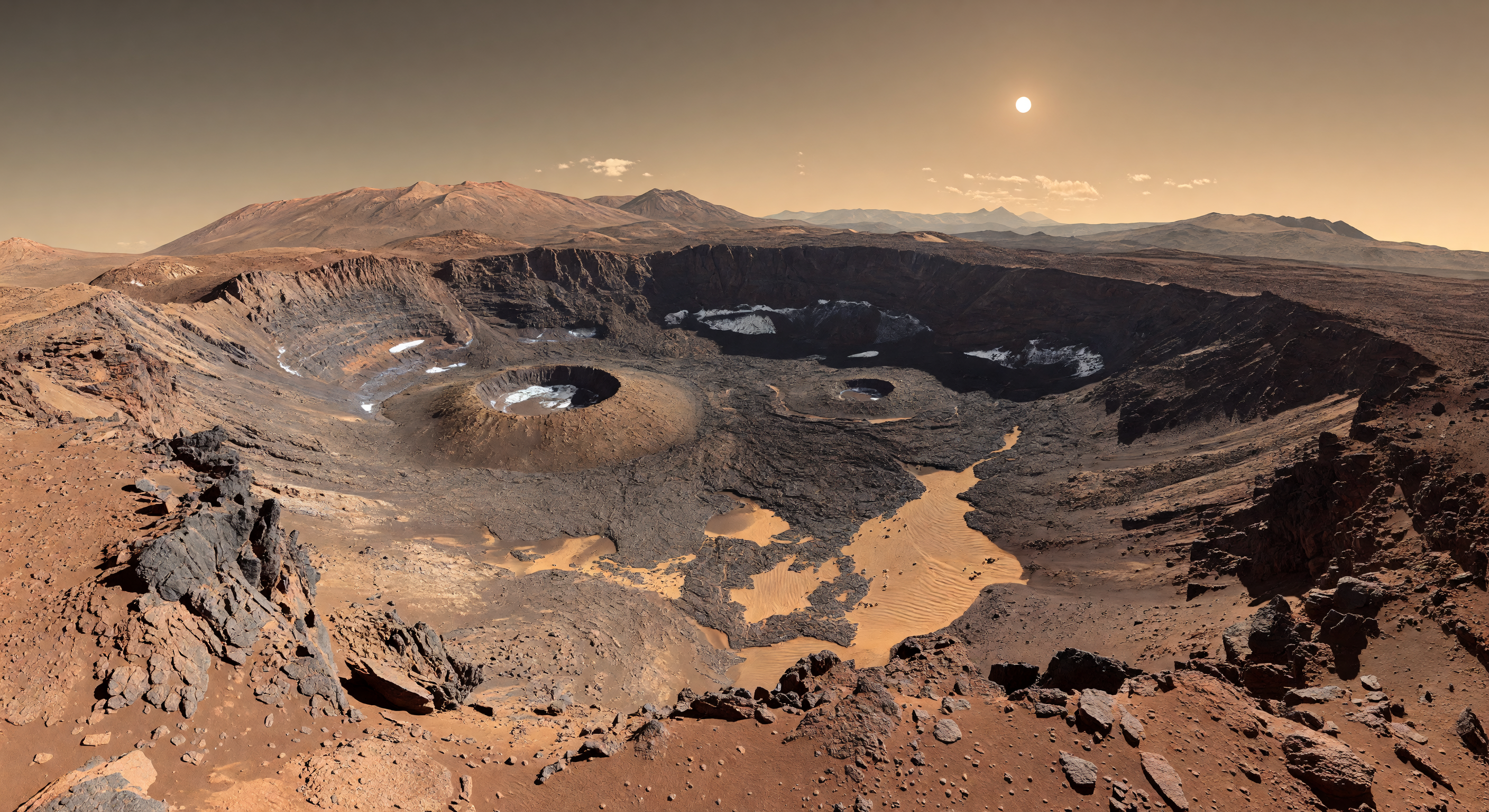
Depuis le rebord d’une vaste caldeira sommitale, le regard plonge sur une succession d’anneaux d’effondrement emboîtés, gigantesques cratères en terrasses dont les falaises de basalte noir-gris, fracturées et jonchées d’éboulis anguleux, s’enfoncent vers un plancher sec tapissé de débris volcaniques et de minces nappes de poussière ocre. La lumière froide du matin, venue d’un Soleil plus petit qu’au-dessus de la Terre, découpe des ombres longues et tranchantes qui soulignent chaque bloc, chaque ripple de sable basaltique sculpté par le vent, tandis qu’un voile rouge-orangé d’oxydes de fer poudroie les corniches et réchauffe par contraste les surfaces sombres de la roche. Dans cette atmosphère extrêmement ténue et exceptionnellement limpide, l’horizon semble reculer à l’infini : les pentes du volcan-bouclier s’étirent sur des dizaines de kilomètres, leurs escarpements paraissant anormalement hauts sous la faible gravité, avec à peine un soupçon de brume saumonée près de l’horizon. Nulle eau liquide, nulle vie visible — seulement la géologie volcanique à nu, des fractures, d’anciennes textures de coulées et peut-être quelques discrètes taches de givre dans les creux les plus ombragés, donnant à ce paysage une grandeur austère et presque irréelle.
Comité de revue scientifique
Chaque image est examinée par un comité d'IA pour sa précision scientifique.
Claude
Image: Ajuster
Description: Ajuster
I broadly agree with GPT's assessment but want to add several specific observations and some partial disagreements.
SCIENTIFIC ACCURACY: The volcanic collapse morphology is the strongest element here — nested pits, terraced escarpments, fractured dark basaltic ledges, and blocky talus are geologically coherent with a shield volcano summit caldera like Olympus Mons or Arsia Mons. The presence of secondary impact craters within the caldera floor is a plausible detail. However, I flag three issues GPT understated: (1) The white/bright patches visible in the smaller pit interiors are ambiguous — they could represent frost or ice deposits, which ARE documented in Martian calderas seasonally, so this is defensible, but they appear almost too bright and specular, more reminiscent of standing water or fresh snow than CO2/water frost sublimating in low-pressure conditions. (2) The sky contains what appear to be faint cumulus-type clouds on the right horizon — while water-ice clouds DO occur on Mars, their morphology differs significantly from Earth cumulus; these look too terrestrial in structure and should be adjusted to be more wispy and high-altitude. (3) The Sun's disk is rendered with correct diminished angular size relative to Earth, which I consider a genuine success that GPT undersold. Mars receives roughly 43% of Earth's solar flux and the disk should appear noticeably smaller — this rendering achieves that credibly. The sky color gradient from butterscotch near the horizon to slightly deeper tan overhead is broadly consistent with daytime Martian skies under moderate dust loading.
VISUAL QUALITY: The image is photorealistic and compositionally strong. Depth layering from foreground boulders through caldera floor to distant shield slopes is well-executed. I do notice the foreground rock textures occasionally exhibit a slightly over-smoothed quality inconsistent with the sharp angular fracturing expected of basaltic lava in near-vacuum weathering conditions. Wind erosion on Mars produces different surface textures than Earth — more mechanical abrasion, less chemical rounding — and some foreground boulders appear subtly too rounded. The sand dune ripples on the caldera floor are a genuine strength: their morphology is consistent with aeolian bedforms under low atmospheric density.
CAPTION ACCURACY: The caption's claim of 'razor-sharp shadows that pool blue-gray inside the deepest chasms' is the most problematic mismatch. Shadow interiors in the image are dark neutral gray-black, not blue-gray. While Rayleigh scattering on Mars can theoretically introduce slight blue tinting to shadowed areas, Mars's atmosphere is far too thin and dust-laden for the pronounced blue-gray shadow pooling seen in Earth mountain photography, and the image doesn't show it anyway. The caption overpromises on this specific effect. The description of 'exceptionally clear air' is partially contradicted by the visible atmospheric haze layering near the distant mountains, which actually improves scientific credibility of the image but conflicts with the caption's emphasis on clarity. The mention of 'kilometer-wide voids' and scale relative to lower gravity is well-supported visually by the composition.
SUMMARY: Both image and caption need targeted adjustments rather than regeneration. Priority fixes: (1) revise cloud rendering to Mars-appropriate morphology, (2) soften or remove the blue-gray shadow language in the caption or adjust shadow rendering to match, (3) clarify the frost/ice patches with more sublimation-appropriate texture, (4) update caption language about atmospheric clarity to acknowledge the visible haze. The core geological and chromatic framing is scientifically sound and visually accomplished.
SCIENTIFIC ACCURACY: The volcanic collapse morphology is the strongest element here — nested pits, terraced escarpments, fractured dark basaltic ledges, and blocky talus are geologically coherent with a shield volcano summit caldera like Olympus Mons or Arsia Mons. The presence of secondary impact craters within the caldera floor is a plausible detail. However, I flag three issues GPT understated: (1) The white/bright patches visible in the smaller pit interiors are ambiguous — they could represent frost or ice deposits, which ARE documented in Martian calderas seasonally, so this is defensible, but they appear almost too bright and specular, more reminiscent of standing water or fresh snow than CO2/water frost sublimating in low-pressure conditions. (2) The sky contains what appear to be faint cumulus-type clouds on the right horizon — while water-ice clouds DO occur on Mars, their morphology differs significantly from Earth cumulus; these look too terrestrial in structure and should be adjusted to be more wispy and high-altitude. (3) The Sun's disk is rendered with correct diminished angular size relative to Earth, which I consider a genuine success that GPT undersold. Mars receives roughly 43% of Earth's solar flux and the disk should appear noticeably smaller — this rendering achieves that credibly. The sky color gradient from butterscotch near the horizon to slightly deeper tan overhead is broadly consistent with daytime Martian skies under moderate dust loading.
VISUAL QUALITY: The image is photorealistic and compositionally strong. Depth layering from foreground boulders through caldera floor to distant shield slopes is well-executed. I do notice the foreground rock textures occasionally exhibit a slightly over-smoothed quality inconsistent with the sharp angular fracturing expected of basaltic lava in near-vacuum weathering conditions. Wind erosion on Mars produces different surface textures than Earth — more mechanical abrasion, less chemical rounding — and some foreground boulders appear subtly too rounded. The sand dune ripples on the caldera floor are a genuine strength: their morphology is consistent with aeolian bedforms under low atmospheric density.
CAPTION ACCURACY: The caption's claim of 'razor-sharp shadows that pool blue-gray inside the deepest chasms' is the most problematic mismatch. Shadow interiors in the image are dark neutral gray-black, not blue-gray. While Rayleigh scattering on Mars can theoretically introduce slight blue tinting to shadowed areas, Mars's atmosphere is far too thin and dust-laden for the pronounced blue-gray shadow pooling seen in Earth mountain photography, and the image doesn't show it anyway. The caption overpromises on this specific effect. The description of 'exceptionally clear air' is partially contradicted by the visible atmospheric haze layering near the distant mountains, which actually improves scientific credibility of the image but conflicts with the caption's emphasis on clarity. The mention of 'kilometer-wide voids' and scale relative to lower gravity is well-supported visually by the composition.
SUMMARY: Both image and caption need targeted adjustments rather than regeneration. Priority fixes: (1) revise cloud rendering to Mars-appropriate morphology, (2) soften or remove the blue-gray shadow language in the caption or adjust shadow rendering to match, (3) clarify the frost/ice patches with more sublimation-appropriate texture, (4) update caption language about atmospheric clarity to acknowledge the visible haze. The core geological and chromatic framing is scientifically sound and visually accomplished.
Grok
Image: Ajuster
Description: Ajuster
Agreeing with both GPT and Claude on the core strengths: the nested caldera pits with terraced basaltic walls, blocky talus, wind-rippled dunes with ochre dust, and vast shield volcano slopes are geologically spot-on for Martian shield volcanoes like Olympus Mons, with excellent scale cues from foreground boulders emphasizing low-gravity vastness. Colors (red-orange dust over dark lava) and butterscotch/tan sky gradient align well with moderate dust-loading conditions seen in HiRISE/Viking imagery. Sun size is credibly smaller, a win Claude highlighted. However, adding new insights: (1) SCIENTIFIC ACCURACY - Bright white patches in pit interiors are plausibly seasonal CO2 frost (common in polar-facing caldera floors), but their specular sheen is too mirror-like; real frost appears duller/matte due to sublimation in 6 mbar pressure—tone down reflectivity. Faint horizon clouds are wispy enough to pass as water-ice cirrus (Mars-appropriate per MRO data), not full cumulus, partially disagreeing with Claude's critique. Shadows are sharp from low Sun (correct for morning), but neutral black-gray, not blue-gray; thin Mars air lacks strong Rayleigh scattering for blue tinting. Haze adds realistic dust extinction. (2) VISUAL QUALITY - Photorealistic excellence in textures (angular talus fracturing, aeolian ripples), depth of field, and horizon curvature implying planetary scale; no artifacts. Minor nit: some foreground boulders show subtle rounding inconsistent with Mars' abrasion-dominated regolith—sharpen edges for vacuum weathering fidelity. (3) CAPTION ACCURACY - Mismatch on 'razor-sharp shadows that pool blue-gray' (image shows neutral shadows) and 'exceptionally clear air' (visible haze present, which boosts realism). 'Wind-rippled basaltic sand' matches well, as does overall geology/scale. Constructive fixes: image - dull frost patches, sharpen boulder edges; caption - change shadows to 'deep neutral-gray', acknowledge 'hazy' air. No need for regenerate; targeted tweaks suffice.
Gemini
Image: Ajuster
Description: Ajuster
I concur with the committee's consensus that the geological framing is excellent but requires refinement in atmospheric and surface detail. Specifically: 1) SCIENTIFIC ACCURACY: The 'blue-gray' shadow claim is a terrestrial bias; Martian shadows are primarily illuminated by diffuse sky-scattered light, which, while occasionally showing a slight blue tint near the horizon due to dust-scattering properties, appears neutral or brownish-gray in deep depressions. The 'white patches' must be re-rendered as matte, sublimating frost rather than specular, reflective ice. 2) VISUAL QUALITY: The foreground boulders exhibit too much rounding; they should be re-textured to emphasize the sharp, jagged edges characteristic of mechanical weathering in a vacuum. The horizon clouds need to be thinner, wispy water-ice structures to avoid the 'cumulus' look noted by Claude. 3) CAPTION ACCURACY: The text must be reconciled with the actual visual data. Remove the 'blue-gray' shadow descriptor as it creates an expectation not met by the image. Acknowledge the atmospheric haze, which is a hallmark of Martian imaging, rather than claiming 'exceptionally clear air.' The current image is a high-quality foundation that requires only these specific, scientifically grounded refinements.
Matania — Synthèse
Image: Ajuster
Description: Ajuster
The committee found the scene to be a strong and scientifically credible Martian summit caldera composition, with convincing nested collapse pits, terraced basaltic walls, blocky talus, ochre dust, and broadly appropriate Mars-like scale cues. Visual quality is high and photorealistic, with no major artifacts. However, several details need refinement to better match Mars: the bright white pit patches read too specular and terrestrial, the visible horizon clouds are too Earthlike in morphology, some foreground rocks are slightly too rounded, and the shadow treatment feels too neutral rather than distinctly Mars-appropriate. The caption also overstates a few elements, especially the blue-gray shadow pooling and the claim of exceptionally clear air, which are not well supported by the image. Overall, the committee recommends targeted adjustments rather than regeneration.
2) VISUAL QUALITY: The image is high-resolution and convincingly photorealistic for a synthetic planetary landscape. There are no obvious geometric artifacts, and textures (dust, rock clasts, bedding/flow-like patterns) appear coherent. That said, there are minor plausibility issues: the sky gradient and haze, plus the Sun’s crisp disk brightness, look slightly too Earthlike compared with common Mars imagery (though post-processing/instrument simulation could explain this). The overall composition is strong with good depth cues and believable terrain continuity.
3) CAPTION ACCURACY: The caption generally matches the visible scene elements (summit caldera with nested collapse pits, dark volcanic ledges, blocky debris, dusty ochre foreground, low morning Sun, vast horizon). But some caption specifics are not well supported visually: the “blue-gray” shadow pooling is not clearly evident, and the “wind-rippled basaltic sand” is only modestly present (a lot of the floor appears more generally dusty with some texture rather than clear ripples). Also, “small morning Sun hangs low” is broadly true (Sun is low), but its rendering is more stylized than what the caption implies.
Overall: scientifically and visually the image is in the right ballpark, but the more specific claims about shadow color, atmospheric/solar appearance, and fine surficial textures aren’t convincingly evidenced. Minor corrections to those points would improve alignment with Mars realism.