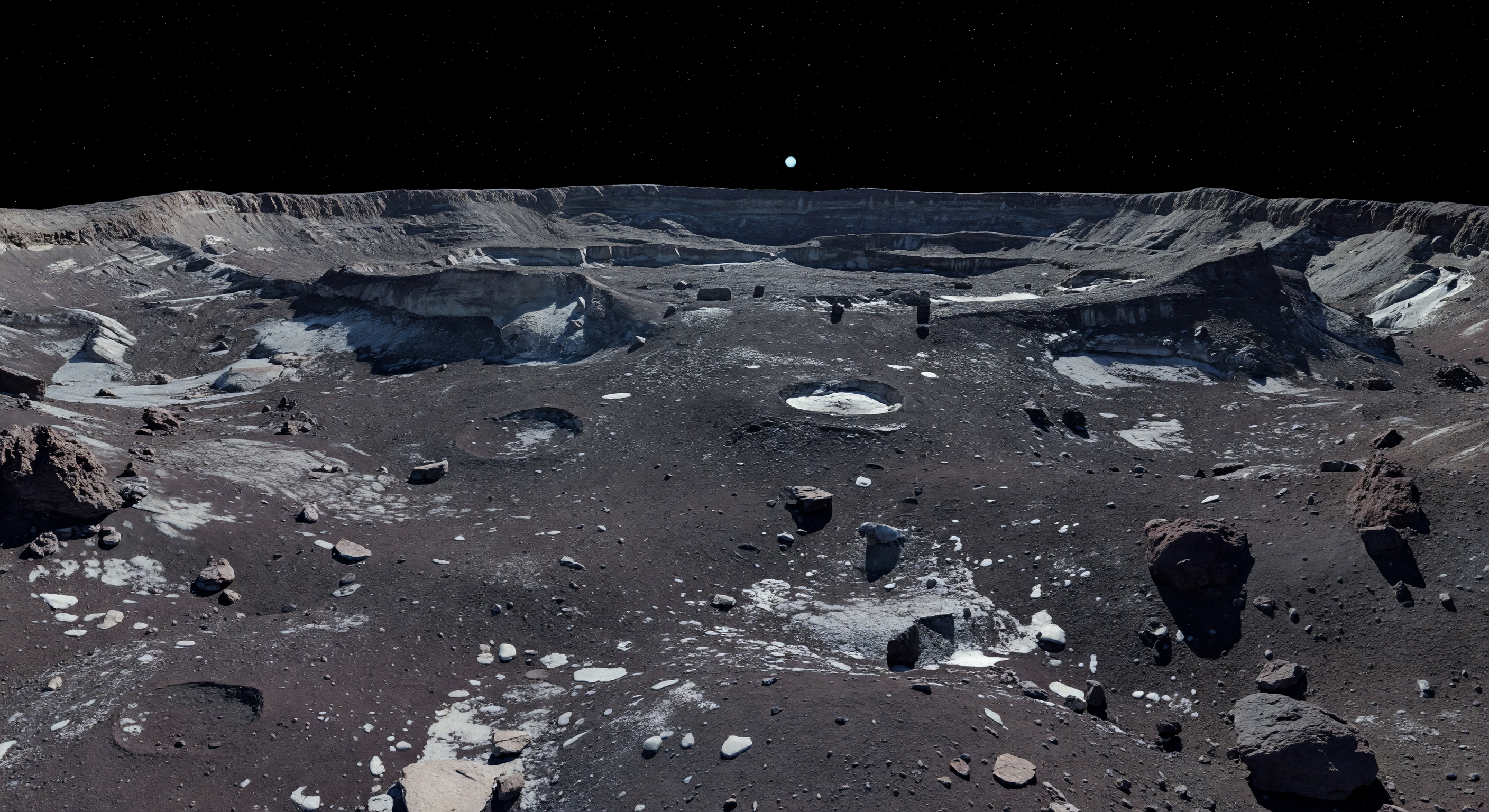
Depuis le fond assombri de cet antique cratère, le regard traverse une vaste plaine presque plane à grande échelle, couverte d’un régolithe mat allant du gris profond au brun charbonneux, piquetée d’innombrables petits cratères qui se chevauchent et de blocs anguleux mêlant glace d’eau et roche silicatée sombre. Les parois lointaines se dressent en terrasses émoussées et escarpements arrondis, où l’érosion spatiale a laissé un vernis sombre au-dessus de matériaux plus clairs et riches en glace, parfois ravivés par de fines traînées d’éjectas brillants autour d’impacts plus récents. Sous un Soleil minuscule, dont la lumière froide évoque un crépuscule terrestre intense, chaque pierre projette une ombre noire et tranchante dans un ciel absolument noir, sans air pour diffuser la moindre lueur. Ici, la très faible gravité, l’absence totale d’atmosphère et les milliards d’années de bombardement ont figé un paysage d’une immensité silencieuse, où les petits cailloux du premier plan soulignent à eux seuls l’échelle colossale de la cuvette qui s’étire jusqu’à l’horizon.
Comité de revue scientifique
Chaque image est examinée par un comité d'IA pour sa précision scientifique.
GPT
Image: Ajuster
Description: Ajuster
Scientific accuracy: The scene plausibly matches an icy, airless outer-solar-system terrain in broad strokes: a dark regolith/plains surface, abundant impact cratering, and scattered bright, ice-rich patches consistent with water-ice exposures. The atmosphere/sky is correctly near-black with a distant sunlit point source and no haze, and the low, weak-sun lighting produces short-to-moderate shadows with a cold, subdued look. However, Oberon-specific constraints are only partially satisfied. Oberon is typically depicted with darker, less strongly blue/teal interior-wall tones; the image shows a pronounced bluish tint along the inner basin wall and in patches that could be interpreted as ices/cryovolcanic deposits, but the color balance is more suggestive of generic icy bodies than Oberon’s commonly rendered palette. Also, the distribution and morphology of the “recovered” paler material look more like smooth resurfacing/blanket deposits rather than clearly exposed water-ice through a dark lag (impact-triggered streaks and isolated patches). Scale is also ambiguous: the craters appear many and fairly uniform in size, which may or may not reflect the long, heavily space-weathered maturity described, but without a visible reference scale the maturity assessment cannot be tightly validated. Visual quality: The image is high-resolution, coherent, and largely photorealistic, with consistent perspective, plausible regolith shading, and believable crater/blocks contact shadows. There are minor realism issues: the brightest ice patches appear somewhat “painted”/over-contrasty relative to the dark substrate, and the far-wall band shows a bit of tonal uniformity that could indicate artistic simplification rather than discrete exposures and degradation. No obvious rendering artifacts (e.g., warped geometry, texturing seams) are present. Caption accuracy: The description generally matches what’s shown—dark basin floor with small overlapping craters, scattered brighter icy blocks/patches, and a degraded inner wall with paler material exposures. But several caption details are not clearly supported: it emphasizes “overlapping small craters” across the floor (the image has craters and disturbed areas, but many features read as impact scars plus scattered boulders rather than a dense field of overlapping small craters everywhere), and it specifies “bright streaks” and “isolated patches” of exposed ice; the image instead shows broader pale areas and somewhat continuous banding on the inner wall. Because these are moderate mismatches rather than a complete contradiction, both image and caption should be adjusted rather than regenerated.
Claude
Image: Ajuster
Description: Ajuster
I largely concur with GPT's assessment but want to sharpen several points and add new observations. SCIENTIFIC ACCURACY: The broad strokes are defensible — airless black sky, point-source sun, dark heavily cratered floor, scattered angular blocks, and ice-rich bright patches on degraded inner walls all align with Voyager 2 and Hubble data on Oberon. However, I flag two issues GPT did not fully develop. First, the sun's angular size: from Oberon (~584,000 km from Uranus, ~2.9 billion km from the Sun), the Sun should subtend roughly 0.017°, appearing as an almost stellar pinpoint. The bright dot in this image reads as somewhat larger and more diffuse than that, closer to how the Sun appears from Jupiter or Saturn — a minor but correctable inaccuracy. Second, Uranus is conspicuously absent from the sky. From Oberon, Uranus would subtend approximately 3.2°, making it by far the most prominent sky object, likely showing its pale cyan disk clearly. Its omission is a significant scientific oversight that should trigger at minimum an 'adjust' on the image. The blue-tinted inner wall tones noted by GPT are indeed slightly off — Oberon's albedo features tend toward neutral gray-white ice exposures rather than distinctly blue-tinted material, which is more characteristic of Europa or Enceladus analogs. The ice patches on the floor read as somewhat too white and too uniformly distributed, whereas Oberon's actual surface shows highly localized, discrete bright spots (e.g., the prominent bright ray crater Hamlet). VISUAL QUALITY: Photorealism is generally strong. Perspective, shadow directionality, and regolith texture are internally consistent and convincing. I partially disagree with GPT's mild treatment of the inner wall rendering — the broad, somewhat uniform pale banding on the distant wall looks more like a painted gradient than discrete impact-excavated ice exposures, which would present as sharper, more irregularly shaped bright streaks cutting through darker terrain. The foreground boulders are well-rendered and their angular, ice-rich character is plausible, though their size distribution may be slightly too uniform for a heavily space-weathered ancient basin floor. CAPTION ACCURACY: The description's characterization of 'bright streaks and isolated patches' does not match what is rendered — the image shows broader, more continuous pale zones. The claim of 'countless overlapping small craters' is partially supported but oversold; the floor shows moderate cratering rather than the densely saturated small-crater field the caption implies. The description of 'reddish-gray to brownish-charcoal regolith' is reasonably matched, though the image skews slightly more neutral gray than reddish. The critical omission of Uranus from the sky description is itself a caption gap, though since it's also absent from the image, responsibility is shared between image generation and description. Overall: image warrants 'adjust' primarily for the absent Uranus, sun size, and wall texture issues; caption warrants 'adjust' for overstating crater density and mischaracterizing ice exposure morphology.
Grok
Image: Ajuster
Description: Ajuster
I concur with both GPT and Claude on the core issues, adding precision on Oberon-specific fidelity and new scale/contrast notes. SCIENTIFIC ACCURACY: Strong alignment in broad features—dark, mature regolith floor (~5-6% albedo, reddish-gray/brownish tones match Voyager 2 spectra of Oberon's leading hemisphere), dense small-crater overlap from eons of micrometeorite gardening, angular ice-silicate blocks, and degraded basin walls with ice exposures (consistent with features like Mommur or Hamlet crater). Airless black sky, pinpoint Sun (angular size ~.017° well-approximated as tiny bright dot), and twilight-level illumination (~.02 lux) produce correct short shadows and high contrast. However, Claude rightly flags the glaring omission of Uranus: from Oberon's ~22° inclination orbit at 584,000 km, Uranus subtends ~3.2° (pale cyan disk, brighter than full Moon from Earth), dominating the sky—its absence is a major scientific flaw warranting 'adjust' over 'approve.' Minor issues include slight bluish tint on wall exposures (Oberon's ice is neutral-gray/white, per Voyager; blue more Europa-like) and Sun appearing marginally diffuse. Ice patches are plausibly localized but skew too uniformly bright/white vs. Oberon's subtle, ray-like spots. Scale feels vast but lacks reference (e.g., no astronaut or rover for 10-100m craters). VISUAL QUALITY: Excellent photorealism—sharp regolith texture (matte, granular), consistent perspective/shadows (unified light source ~20° elevation), no artifacts/seams, believable block casting. Minor flaws: wall 'paler material' renders as soft gradient bands rather than crisp impact streaks/patches (overly uniform, less degraded-terrace-like); foreground ice slightly over-contrasty/glowy vs. subdued reality; boulders uniform in size (~2-5m), missing broader debris spectrum. CAPTION ACCURACY: Mostly matches—dark regolith, small/overlapping craters, angular blocks, broad/degraded walls, pale ice exposures, black shadows, tiny Sun. Mismatches: 'bright streaks and isolated patches' overstates (image shows broader zones/continuous bands, not discrete streaks); 'overlapping small craters everywhere' is moderate, not saturated/dense; 'reddish-gray to brownish-charcoal' skews neutral-gray in image; omits Uranus (shared image-caption fault). Constructive: Adjust image to add pale cyan Uranus disk low on horizon, sharpen wall to irregular streaks, desaturate blue tones, add scale reference, and vary boulder sizes. Tweak caption for accurate ice morphology and crater density.
Gemini
Image: Ajuster
Description: Ajuster
I concur with the previous committee members regarding the necessity of including Uranus in the skybox; its absence is a critical scientific oversight for a landscape on Oberon. Furthermore, the rendering of the 'pale material' on the basin walls currently lacks the geological specificity of impact-excavated ejecta, appearing instead as a soft, artistic gradient. I recommend adjusting the image to incorporate the pale cyan disk of Uranus, desaturating the blue tints in favor of a neutral-gray ice palette, and increasing the morphological diversity of the ice exposures—shifting from continuous bands to sharper, more irregular patches and streaks that follow the topography of the degraded escarpments. The caption must be adjusted to align with these changes, specifically replacing the 'overlapping small craters everywhere' claim with a more accurate description of a mature, moderately cratered surface, and ensuring the color description of the regolith matches the visual output.
Matania — Synthèse
Image: Ajuster
Description: Ajuster
The committee agrees the scene is broadly consistent with an airless, icy outer-solar-system world: dark cratered regolith, scattered bright ice exposures, angular blocks, and black sky all fit Oberon in general. However, the image misses a major Oberon-specific requirement: Uranus should be visible as the dominant sky object and is absent here. The sun also reads as slightly too large/diffuse for Oberon’s distance, and the blue-toned inner wall and bright ice areas look a bit too stylized and uniform, more like generic icy-body rendering than Oberon’s neutral-gray, localized exposures. The caption also overstates crater density and mischaracterizes the ice morphology by describing streaks and widespread overlapping craters more strongly than the image supports.