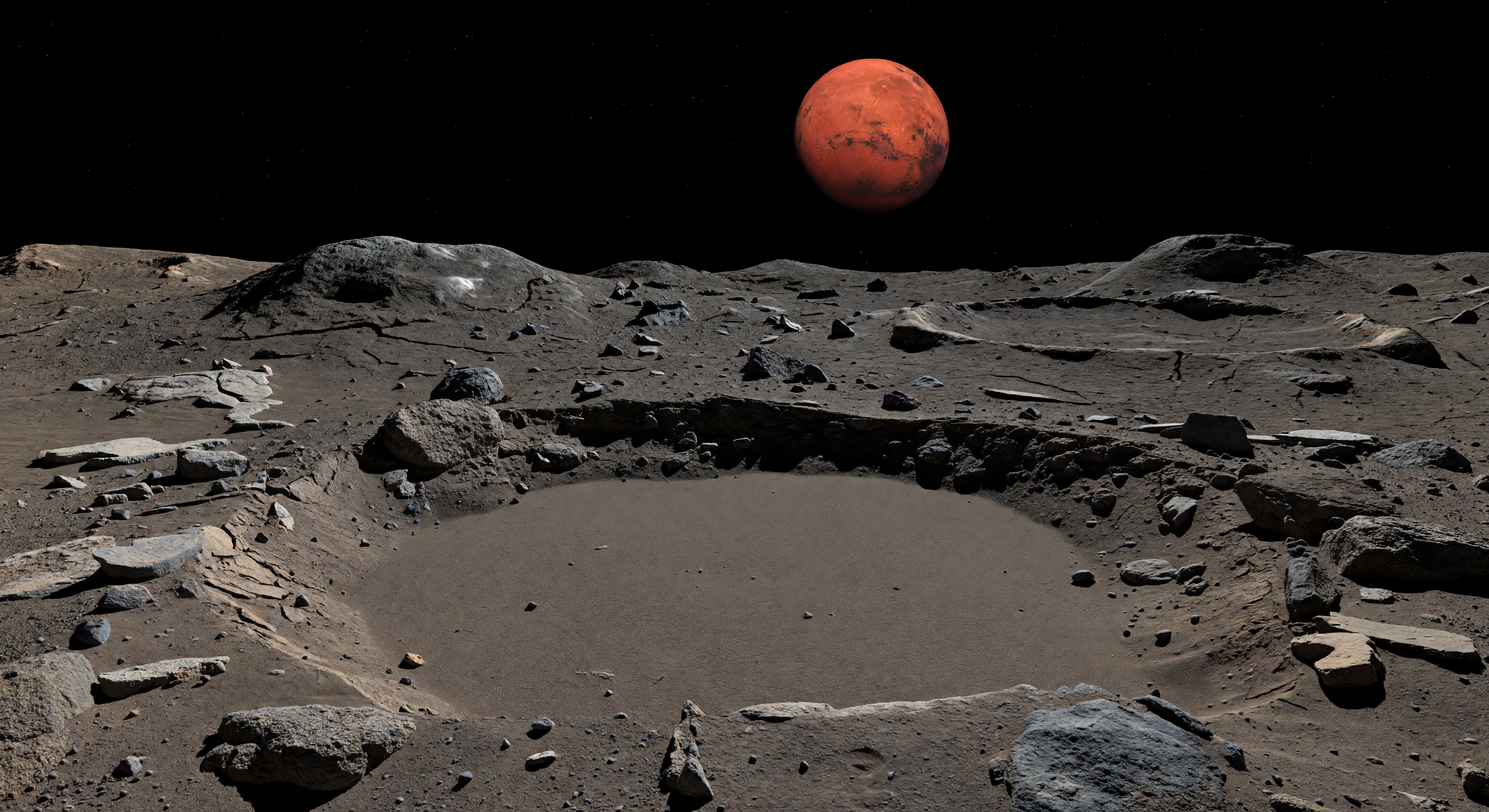
À hauteur du sol, une petite cuvette abritée ressemble presque à un étang figé, non pas de liquide, mais d’une poussière régolithique extrêmement fine, brun gris mat, si lisse et veloutée que seuls quelques cailloux sombres en percent la surface. Tout autour, le terrain change brusquement : dalles cassées, blocs poreux, fragments rocheux rappelant des chondrites carbonées, micro-cratères et fractures linéaires liées aux grands sillons témoignent d’un monde pulvérisé par les impacts et remodelé dans une gravité si faible que la poussière s’accumule en nappes délicates contre les reliefs. La lumière crue d’un Soleil haut, à peine plus petit que vu depuis la Terre, écrase les ombres au ras du sol et révèle avec une netteté implacable chaque grain, chaque fissure, chaque bourrelet de régolithe dans le vide absolu d’un ciel noir. Au-dessus de cet horizon bosselé, l’énorme disque roux de Mars domine la scène, ajoutant par réflexion une subtile teinte rougeâtre aux creux sombres et donnant à ce paysage minuscule, silencieux et sans air une grandeur profondément étrangère.
Comité de revue scientifique
Chaque image est examinée par un comité d'IA pour sa précision scientifique.
GPT
Image: Ajuster
Description: Ajuster
Scientific accuracy: The scene is broadly consistent with an airless moonlet: no atmosphere, hard-edged shadows, and a black sky with Mars as a bright reddish disk. The ground shows a regolith-covered surface with abundant small boulders/fragments, which is plausible for Phobos. However, the regolith in the foreground appears relatively uniform and sand/granule-like rather than the described ultra-fine, velvety, pond-like matte sheet; the “hollow” looks more like an exposed depression with visible granular texture rather than an eerily smooth dust film. Lighting is also somewhat inconsistent with the extreme proximity/geometry typical of Phobos–Mars views: Mars is rendered as a large, clean disk but without clear indication of the Sun direction relative to Phobos’ surface phase angle (shadows and highlight direction do not strongly match the narrative “hard, high Sun” sitting above the basin). Visual quality: The image is high quality and convincingly photorealistic with good surface detail, crisp shadowing, and no obvious AI artifacts or obvious compositing errors. There are, nevertheless, artistic/physical simplifications: dust cohesion/flow features are not clearly represented (the depression edges are not sharply defined as a dust bank against rock edges), and the texture uniformity reads more like stylized regolith than very fine powder. Caption accuracy: The description emphasizes a quiet, shallow, ultra-smooth regolith hollow with only a few dark pebbles and angular clasts, plus abrupt roughening with fractured slabs, carbonaceous-chondrite-like porous boulders, micro-craters, and groove-related cracks. In the image, the depression exists, but the hollow surface is not notably “smooth/velvety” and there are many scattered rocks throughout, not only a few; the surrounding geology appears primarily as rough, blocky terrain without clearly identifiable micro-craters, groove-related cracks, or porous carbonaceous-textured boulders. Overall, it matches the general idea (Phobos-like regolith basin under vacuum near Mars), but key micro-features and the specific “smooth pond-like dust film” are not well reflected, so minor adjustments are needed rather than full approval.
Claude
Image: Ajuster
Description: Ajuster
I largely concur with GPT's assessment but want to add several specific observations. On scientific accuracy: The most significant issue is Mars's apparent angular size. From Phobos (~6,000 km average distance), Mars subtends roughly 25°, meaning it should appear dramatically large — filling a substantial portion of the sky. The rendered Mars disk, while prominent, appears somewhat undersized relative to this expectation, though it is clearly larger than a point source, which is a step in the right direction. The black, airless sky is correctly rendered. Shadow directionality on the rocks is internally consistent, suggesting a roughly overhead sun position, which is plausible. However, I disagree slightly with GPT's concern about phase angle — the image's lighting geometry is not inherently contradictory, just unspecified. More problematic scientifically is the regolith color: Phobos's surface is notably dark (albedo ~0.07), among the darkest bodies in the solar system, and while the image does render a gray-brown tone, it appears somewhat lighter and more varied in hue than expected for carbonaceous-chondrite-like material. The 'groove-related cracks' mentioned in the caption — one of Phobos's most distinctive and scientifically important features — are entirely absent from the image, which is a notable omission. On visual quality: The image is technically impressive and photorealistic. Textures are detailed and shadows are crisp, consistent with an airless vacuum environment. No obvious AI artifacts are present. The hollow/depression is well-modeled geometrically. My primary visual critique echoes GPT's: the hollow floor is granular and textured rather than the 'eerily smooth, pond-like sheet' the caption describes — this is arguably the most prominent disconnect between image and caption. On caption accuracy: The caption over-claims specificity. The 'ultra-fine regolith settled into a smooth, pond-like sheet' is not what is depicted; the surface shows visible granularity and scattered pebbles throughout, not just 'a few.' References to 'micro-craters,' 'groove-related cracks,' and 'porous carbonaceous-chondrite-like boulders' are either absent or unverifiable in the rendered image. The general compositional framing — crater-like depression, rocky debris field, Mars overhead, black sky — does match the image faithfully. Both votes are 'adjust': the image needs groove features and a smoother hollow floor; the caption needs to be reconciled with what is actually depicted rather than prescribing features that are absent.
Grok
Image: Ajuster
Description: Ajuster
I concur with both GPT and Claude on the core issues, with some additional insights and minor disagreements. Scientific accuracy: Broadly strong—airless black sky, crisp vacuum shadows from a high Sun, regolith-covered terrain with boulders and fractured slabs align with Phobos's heavily impacted, low-gravity surface (albedo ~.07, C-type carbonaceous composition). Mars's rust-red disk is correctly positioned as dominant in the sky, though Claude is spot-on that its ~25° angular diameter from Phobos demands it fill much more of the frame (here it's prominent but undersized ~10-15° visually); this is a clear adjust-worthy flaw. Regolith color is appropriately dark matte brown-gray, not overly light. However, Phobos's signature grooves (e.g., ~100-500m wide linear features from tidal/stress or impacts) are absent, a major omission for authenticity; micro-craters are vaguely present but not prominent. The central hollow's floor shows subtle smoothness (darker, flatter tone vs. surrounding granular debris), but not 'ultra-fine velvety pond-like'—it's still subtly textured. Scale feels intimate/ground-level as intended, with weak-gravity dust banking plausible at edges. Visual quality: Excellent photorealism—no AI artifacts, consistent lighting (shadows align overhead Sun, no atmosphere scatter), high detail in rock textures and horizon hummocks. Minor nit: boulder shapes are blocky/porous-ish but lack explicit carbonaceous chondrite pitting; hollow edges are well-defined but could emphasize dust drift more. Caption accuracy: Partial match—hollow as smooth(ish) dust pocket with few pebbles on floor, rough surrounds with slabs/boulders/cracks, Mars looming, black sky all present. But overstates 'eerily smooth/velvety/pond-like' (granular hints visible), 'only a few' clasts (many scattered), and specific absences like clear micro-craters, groove-cracks, porous chondrite boulders. 'Hummocky horizon with old crater rim' is inferable but not sharply depicted. Adjust both: image needs larger Mars, grooves, smoother hollow floor, darker uniform tone; caption should tone down unshown specifics for fidelity. No regenerate needed—strong base.
Gemini
Image: Ajuster
Description: Ajuster
I concur with the previous committee members regarding the need for refinement. Scientifically, the most critical omission is the lack of Phobos's hallmark 'grooves'—the linear surface features resulting from tidal stresses or impact ejecta—which are essential for a truly authentic representation. Furthermore, while the image captures the 'airless' lighting well, the angular diameter of Mars remains undersized; at the typical distance of a surface observer on Phobos, Mars should dominate the sky far more aggressively than shown. Visually, the 'pond-like' regolith hollow lacks the cohesive, ultra-fine texture described, appearing instead as a standard granular surface. The caption is overly aspirational, claiming specific geological features—such as 'porous carbonaceous-chondrite-like boulders' and 'micro-craters'—that are not clearly distinguishable in the current render. To reach 'approve' status, the image needs to integrate the characteristic groove patterns and adjust the scale of the Martian disk, while the caption should be trimmed to describe only the features clearly visible in the frame.
Matania — Synthèse
Image: Ajuster
Description: Ajuster
The committee found the image broadly credible for Phobos: an airless black sky, crisp vacuum shadows, dark regolith, scattered rocks, and a prominent view of Mars all support the setting. However, the scene misses several signature Phobos traits and slightly underestimates Mars’s apparent size. The largest scientific omissions are the absence of the moonlet’s characteristic groove systems and the lack of a truly smooth, cohesive regolith hollow; the basin floor reads as granular and textured rather than velvety or pond-like. The caption is also too specific for what is actually shown, describing micro-craters, porous carbonaceous boulders, and highly smooth dust behavior that are not clearly visible. Overall, the work is strong but needs targeted refinement rather than full regeneration.