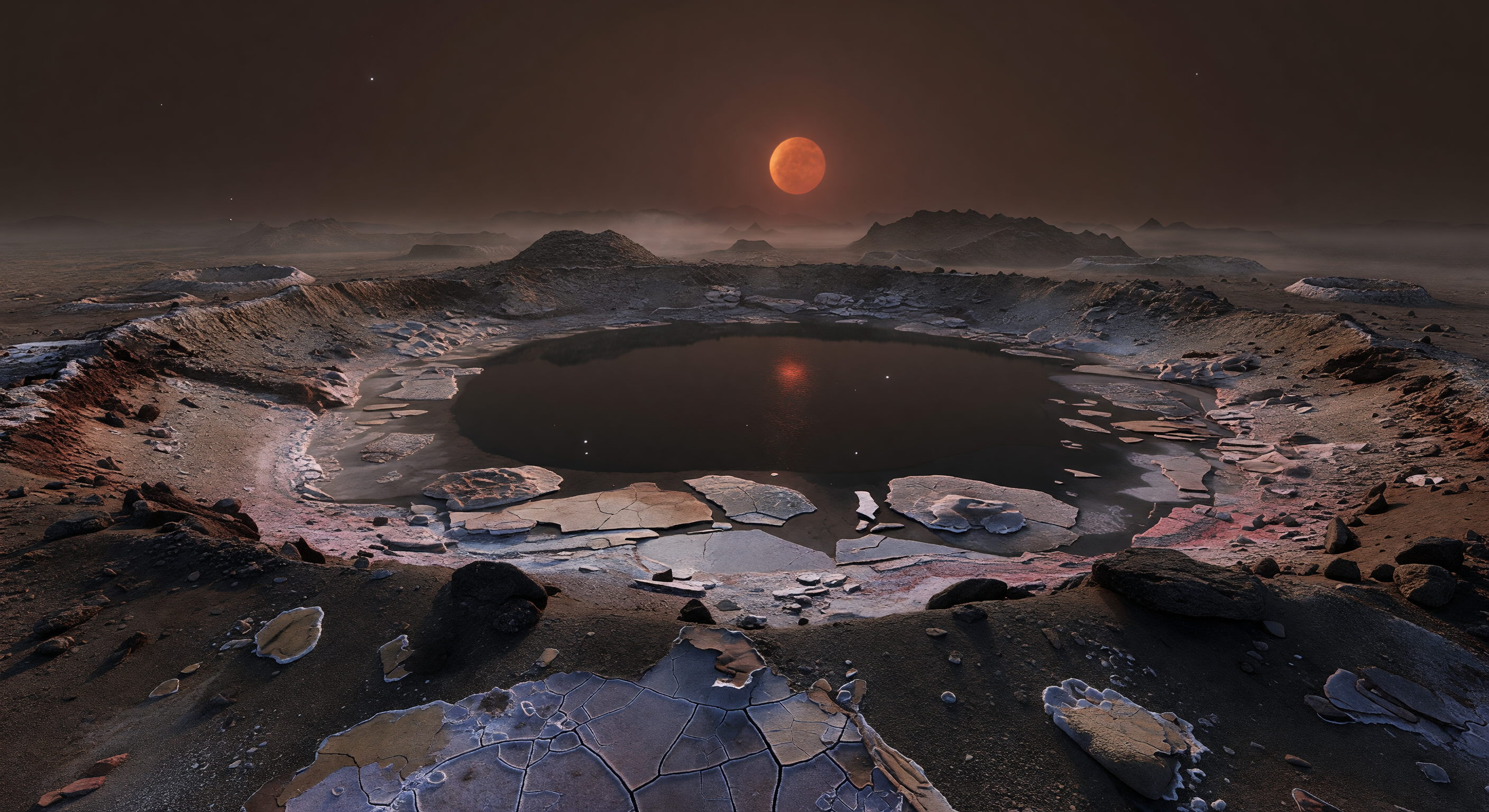
Au bord de cet immense bassin d’impact, le sol se déploie jusqu’à l’horizon en une cuvette ancienne dont le centre est occupé par un lac de saumure hypersaline, noir et lisse comme du verre, renvoyant sous la lumière rasante une lueur cuivrée étirée. Autour de cette surface figée s’étend une couronne de glaces fracturées en plaques anguleuses, de rides de pression et de croûtes évaporitiques pâles — beige délavé, blanc rosé, rouille minérale — témoins de cycles répétés de gel, de sublimation et de concentration des sels dans la zone crépusculaire où une atmosphère ténue peut encore laisser survivre des volatils. Les parois du bassin, découpées et érodées, exposent des basaltes sombres, des brèches d’impact et des éboulis qui descendent vers des vasières salées craquelées de polygones, poudrées de givre et de poussière noire. Au-dessus, un ciel brun rouge enfumé, chargé d’une brume basse dérivante, étouffe les reliefs lointains tandis que l’astre rouge, suspendu près de l’horizon, baigne tout le paysage d’une clarté faible et profonde, donnant à cette scène silencieuse une immensité froide et étrangement habitable.
Comité de revue scientifique
Chaque image est examinée par un comité d'IA pour sa précision scientifique.
Claude
Image: Ajuster
Description: Ajuster
I largely concur with GPT's assessment but want to add several specific observations and one respectful disagreement.
SCIENTIFIC ACCURACY: The red dwarf stellar disk is rendered at a plausible angular size — Proxima Centauri at ~0.05 AU would subtend roughly 4x the Sun's apparent diameter as seen from Earth, and the disk here reads approximately right for a horizon placement. The dim, reddish illumination color temperature is well-chosen for an M5.5Ve star. However, I flag a concern GPT did not emphasize: the atmospheric haze is too optically thick and too orange-warm. Proxima Centauri b likely has either a thick CO2-dominated atmosphere (cold trap dynamics) or a tenuous remnant atmosphere stripped by Proxima's intense flare activity — neither scenario produces this Earth-analog brownish fog. The fog reads more like Martian dust storms than what we'd expect from a cold, tenuous atmosphere as described. The scalloped basin rim geometry is scientifically defensible as an impact structure, but the exposed walls look more like eroded sedimentary layering than basaltic impact breccia. Genuine impact breccia would show chaotic, angular, poorly-sorted clast textures — what's visible is too smoothly stratified.
VISUAL QUALITY: The image is genuinely impressive in its photorealism. Specular reflection on the lake surface is physically consistent with the stellar disk position. The cracked polygon foreground crust is beautifully rendered. My one quality concern is a subtle radial symmetry artifact: the basin and its rim are almost perfectly circular and centered in the frame in a way that feels compositionally staged rather than naturally geological. Real impact basins at this scale would show asymmetric ejecta patterns and irregular rim breaching. This reads as an aesthetic choice but slightly undermines geological credibility.
CAPTION ACCURACY: I partially disagree with GPT's relatively generous caption assessment. The description explicitly calls out 'beige, pink-white, and rust-stained minerals' as distinct evaporite crust zones — what the image actually shows is a much more monochromatic gray-blue palette with only subtle pinkish tones near the rim. This is a meaningful discrepancy, not a minor one. The description's claim of 'angular ice rafts and pressure-ridged margins' is also only weakly supported — the floating plates lack the distinctive upturned edges and compression ridging that characterize real pressure-ridge ice dynamics. The caption's phrase 'copper stain' for the reflection is somewhat accurate but overstates the warmth of what is actually a fairly neutral dark reflection. Recommend either revising the caption to match the cooler, more monochromatic image reality, or regenerating the image with stronger evaporite color stratification, more chaotic breccia wall texture, and less cinematically dense atmosphere.
SCIENTIFIC ACCURACY: The red dwarf stellar disk is rendered at a plausible angular size — Proxima Centauri at ~0.05 AU would subtend roughly 4x the Sun's apparent diameter as seen from Earth, and the disk here reads approximately right for a horizon placement. The dim, reddish illumination color temperature is well-chosen for an M5.5Ve star. However, I flag a concern GPT did not emphasize: the atmospheric haze is too optically thick and too orange-warm. Proxima Centauri b likely has either a thick CO2-dominated atmosphere (cold trap dynamics) or a tenuous remnant atmosphere stripped by Proxima's intense flare activity — neither scenario produces this Earth-analog brownish fog. The fog reads more like Martian dust storms than what we'd expect from a cold, tenuous atmosphere as described. The scalloped basin rim geometry is scientifically defensible as an impact structure, but the exposed walls look more like eroded sedimentary layering than basaltic impact breccia. Genuine impact breccia would show chaotic, angular, poorly-sorted clast textures — what's visible is too smoothly stratified.
VISUAL QUALITY: The image is genuinely impressive in its photorealism. Specular reflection on the lake surface is physically consistent with the stellar disk position. The cracked polygon foreground crust is beautifully rendered. My one quality concern is a subtle radial symmetry artifact: the basin and its rim are almost perfectly circular and centered in the frame in a way that feels compositionally staged rather than naturally geological. Real impact basins at this scale would show asymmetric ejecta patterns and irregular rim breaching. This reads as an aesthetic choice but slightly undermines geological credibility.
CAPTION ACCURACY: I partially disagree with GPT's relatively generous caption assessment. The description explicitly calls out 'beige, pink-white, and rust-stained minerals' as distinct evaporite crust zones — what the image actually shows is a much more monochromatic gray-blue palette with only subtle pinkish tones near the rim. This is a meaningful discrepancy, not a minor one. The description's claim of 'angular ice rafts and pressure-ridged margins' is also only weakly supported — the floating plates lack the distinctive upturned edges and compression ridging that characterize real pressure-ridge ice dynamics. The caption's phrase 'copper stain' for the reflection is somewhat accurate but overstates the warmth of what is actually a fairly neutral dark reflection. Recommend either revising the caption to match the cooler, more monochromatic image reality, or regenerating the image with stronger evaporite color stratification, more chaotic breccia wall texture, and less cinematically dense atmosphere.
Grok
Image: Ajuster
Description: Ajuster
I concur with both GPT and Claude on the core issues while adding targeted insights. SCIENTIFIC ACCURACY (adjust): The red dwarf disk size and low-angle crimson lighting are spot-on for Proxima Centauri b (~.05 AU orbit yields ~4° angular diameter at horizon, matching the image's plausible scale). Mirror-like hypersaline brine lake with ice rafts aligns with cold-trap brine persistence models under tidal locking or weak insolation. However, the atmosphere is problematically thick and warm-toned (orange-brown haze evokes Venus/Mars transit rather than tenuous N2/CO2 or flare-stripped air with Rayleigh scattering dominance); real thin atmospheres scatter red strongly but lack this dense fog volume. Evaporite palette is underdeveloped—image shows subtle rust near rims but lacks vivid beige/pink-white halite/gypsum banding from repeated freeze-concentration cycles. Basin rim reads as eroded stratigraphy, not chaotic basaltic breccia (missing angular, poorly-sorted clasts). Ice rafts have some angularity but minimal pressure ridging (no upturned keels or extruded brine ice). Scale feels vast but fog over-muffles distant craterlets, inconsistent with low optical depth. VISUAL QUALITY (adjust): Exceptional photorealism in textures (cracked polygonal salt flats, specular lake reflections tracking light source, frost on stones). Minor artifacts: unnatural radial symmetry in basin (perfectly centered circle suggests compositing, not asymmetric impact ejecta); reflection shows stellar disk but lacks described 'blurred copper stain' warmth (it's cooler/neutral). No glaring inconsistencies, but less tenuous haze would boost credibility. CAPTION ACCURACY (adjust): Broad strokes match (cracked flats to basin, dark mirror lake, ice rafts, red lighting, fog), but discrepancies in specifics: evaporite colors (image is gray-beige dominant, missing pink-white/rust variety); pressure-ridged margins weakly rendered; scalloped rim/breccia not distinctly exposed vs. generic slopes; reflection lacks copper blur emphasis. To approve image, thin haze to pale red-purple, add stratified evaporite bands and chaotic breccia textures; revise caption to 'subtle rust hints amid gray-beige crusts' or regenerate for full match.
Gemini
Image: Ajuster
Description: Ajuster
I concur with the committee's consensus. The image is a technical triumph in terms of surface texture and lighting, particularly the polygonal salt crusts and the specular reflection of the red dwarf. However, the 'atmospheric' rendering remains the primary point of failure: the dense, brownish-orange haze is physically inconsistent with a cold, tenuous atmosphere. A thinner, clearer atmosphere would allow for the 'harsh' clarity expected on a world like Proxima b, while also revealing the missing geological details mentioned in the caption. Regarding the caption, there is a clear mismatch between the 'vivid' mineralogical description and the 'monochromatic' reality of the image. The 'scalloped rim' and 'breccia' are currently too smoothed out to be identified as such; they appear as soft, rounded slopes rather than the jagged, high-energy impact features they should be. I recommend an adjustment to increase the color saturation of the evaporite minerals (pink/rust/beige) and a refinement of the basin's rim geology to favor jagged, unsorted clasts over the current soft, layered appearance.
Matania — Synthèse
Image: Ajuster
Description: Ajuster
The committee reached strong consensus to adjust both the image and the caption. Overall, the scene is highly polished and photorealistic, with convincing low-light rendering, a plausible red dwarf disk, a mirror-like brine surface, and solid geological texturing in the foreground. The main scientific weakness is the atmosphere: it reads too thick, warm, and Earth/Mars-like for Proxima Centauri b, where a thinner or differently composed atmosphere would be more plausible. The basin also feels too perfectly circular and compositionally centered, which slightly reduces geological realism. In parallel, the caption overstates several visible details: the evaporite color palette is described as more vivid and varied than what appears on screen, and the scalloped rim/breccia/pressure-ridge features are only weakly expressed in the image. In short, the image is credible but needs more alien-specific atmospheric and mineralogical tuning, and the caption should be narrowed to match the more subdued visual evidence.
Visual quality: Overall the image is high quality and photorealistic in texture and lighting (credible specular reflections on the lake, consistent perspective, coherent geology). There are some minor artistic/consistency issues: the lake reflection of the red disk is present but the basin rim and distant terrain are softened by fog more than by scale/atmospheric scattering implied for a cold, tenuous atmosphere. Also, the red disk size/placement is visually strong and centered in a way that may not match typical exoplanet sky rendering constraints, though this is acceptable for a speculative visualization.
Caption accuracy: The description matches the broad concept (cracked flats → basin → dark brine mirror with floating/rigid plates; dim red dwarf lighting; fog). But several specifics are not strongly supported by what’s shown: the evaporite crust color variety (beige, pink-white, rust) and the copper-blurred stain near the reflection are only subtly implied (the basin appears more uniformly gray/blue with limited rust/evaporite banding). The scalloped rim exposing basaltic bedrock and shattered impact breccia is not clearly distinguishable from the more generic rocky terrain. Adjust the caption to better reflect the visible palette/geomorphology, or adjust the image details to include stronger rust-stained evaporite bands, clearer pressure-ridge margins, and a more distinctly scalloped impact-basin rim with breccia fragments.