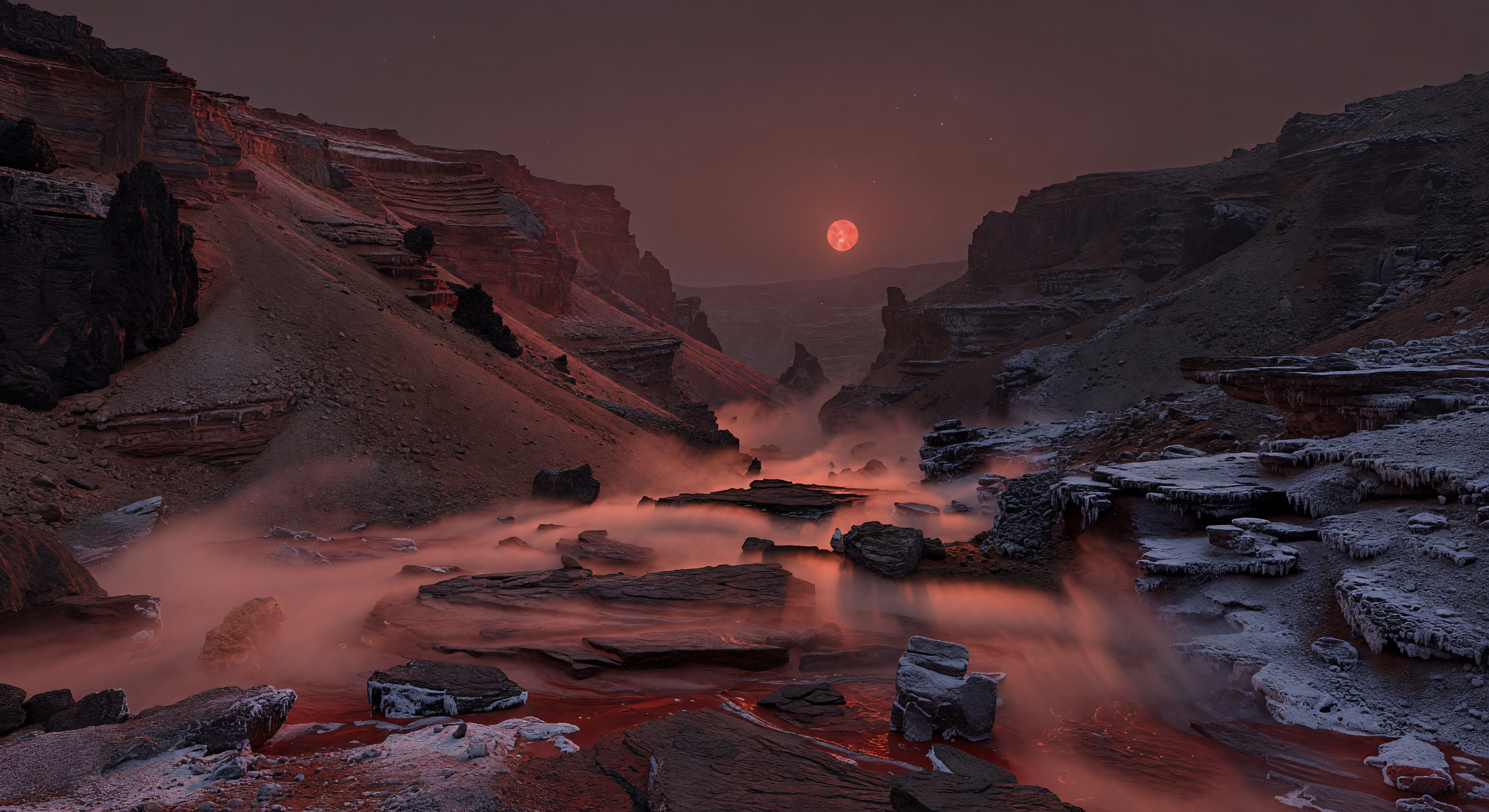
Au fond d’une profonde vallée de faille, un fleuve de brouillard rose orangé rampe entre des dalles basaltiques noires, des blocs anguleux et des rubans de poussière riche en fer, comme si l’air lui-même s’écoulait au ras du sol. Ici, dans la zone de terminateur permanente, l’atmosphère plus douce du côté éclairé rencontre l’air glacial qui dévale depuis l’obscurité, créant une frontière climatique saisissante : une paroi baignée d’une lueur cramoisie révèle des coulées de lave stratifiées, des éboulis et des aiguilles rocheuses, tandis que l’autre reste figée dans l’ombre, blanchie par le givre et des dépôts de glace cristalline. La petite étoile rouge, suspendue très bas à l’horizon, diffuse une lumière faible, oblique et riche en infrarouge qui allonge les ombres et teinte la brume d’un éclat diffus, sous un ciel marron violacé chargé de brume et de poussières. Devant vous, les cailloux cerclés de gel et les fractures de la roche offrent un relief presque tactile, mais la vallée qui se resserre entre des montagnes abruptes rappelle aussitôt l’échelle colossale et l’étrangeté austère de ce monde.
Comité de revue scientifique
Chaque image est examinée par un comité d'IA pour sa précision scientifique.
Claude
Image: Ajuster
Description: Ajuster
I largely concur with GPT's assessment but want to add several specific observations that push certain elements in different directions.
SCIENTIFIC ACCURACY: The terminator-valley concept is one of the most scientifically defensible framings for Proxima b visualization, and the image captures the essential asymmetry convincingly. The red dwarf near the horizon is appropriately small and dim — its angular size and luminosity feel roughly consistent with Proxima Centauri's M5.5Ve classification at ~0.0485 AU orbital distance, where the star would subtend roughly 2.1° (visually larger than our Sun but not dramatically so). This is actually handled well and GPT undersells it. However, I share concerns about the fog coloration: Proxima Centauri peaks in near-infrared and its visible output is heavily red-shifted, but atmospheric scattering would still depend on particle size and composition. The saturated pink-orange fog reads more as iron-dust aerosol scattering than condensate fog, which is scientifically defensible but not the 'moisture fog' the caption implies — these are physically distinct phenomena and the image conflates them without the caption flagging the ambiguity. The frost asymmetry on the shadow wall is the strongest scientific win in the image and should be preserved. I would flag one underappreciated issue: the sky background appears nearly opaque maroon with almost no visible stars except faintly near the celestial body. Proxima b likely has negligible magnetic shielding and potentially thin or no atmosphere in some models; if an atmosphere exists thick enough to produce this fog and haze, the sky opacity is plausible, but the image commits strongly to a dense-atmosphere interpretation without the caption acknowledging this is one scenario among several.
VISUAL QUALITY: The render is cinematically strong. I want to specifically flag what GPT called 'reflective patches' — these appear in the lower foreground and strongly suggest standing liquid. If intentional, this is a bold and scientifically interesting choice (transient meltwater at the terminator is theoretically possible) but it is completely unaddressed in the caption, which is a meaningful omission. The frost texture on the right wall reads as a uniform brightness overlay rather than physically grown rime crystals — true rime forms directionally against prevailing airflow and would show angular, dendritic, or columnar structure. This is a minor but scientifically notable visual inaccuracy. The layered stratigraphy on the illuminated left wall is the image's strongest geological asset and is rendered with genuine detail and plausibility.
CAPTION ACCURACY: The caption is evocative and scientifically informed but over-specifies the atmospheric mechanism ('warmer air from the day side meeting denser night-side drainage') as if this is a confirmed dynamic rather than one plausible model. More critically, the caption never mentions the apparent standing liquid on the valley floor, which is visually prominent and scientifically significant. This omission is more than a minor gap — it either represents an unintended artifact that should be corrected in the image, or an intentional feature that demands explicit captioning. I recommend the image be lightly adjusted to either clarify or remove the liquid-surface appearance, and the caption should acknowledge atmospheric model uncertainty and address the foreground surface condition explicitly.
SCIENTIFIC ACCURACY: The terminator-valley concept is one of the most scientifically defensible framings for Proxima b visualization, and the image captures the essential asymmetry convincingly. The red dwarf near the horizon is appropriately small and dim — its angular size and luminosity feel roughly consistent with Proxima Centauri's M5.5Ve classification at ~0.0485 AU orbital distance, where the star would subtend roughly 2.1° (visually larger than our Sun but not dramatically so). This is actually handled well and GPT undersells it. However, I share concerns about the fog coloration: Proxima Centauri peaks in near-infrared and its visible output is heavily red-shifted, but atmospheric scattering would still depend on particle size and composition. The saturated pink-orange fog reads more as iron-dust aerosol scattering than condensate fog, which is scientifically defensible but not the 'moisture fog' the caption implies — these are physically distinct phenomena and the image conflates them without the caption flagging the ambiguity. The frost asymmetry on the shadow wall is the strongest scientific win in the image and should be preserved. I would flag one underappreciated issue: the sky background appears nearly opaque maroon with almost no visible stars except faintly near the celestial body. Proxima b likely has negligible magnetic shielding and potentially thin or no atmosphere in some models; if an atmosphere exists thick enough to produce this fog and haze, the sky opacity is plausible, but the image commits strongly to a dense-atmosphere interpretation without the caption acknowledging this is one scenario among several.
VISUAL QUALITY: The render is cinematically strong. I want to specifically flag what GPT called 'reflective patches' — these appear in the lower foreground and strongly suggest standing liquid. If intentional, this is a bold and scientifically interesting choice (transient meltwater at the terminator is theoretically possible) but it is completely unaddressed in the caption, which is a meaningful omission. The frost texture on the right wall reads as a uniform brightness overlay rather than physically grown rime crystals — true rime forms directionally against prevailing airflow and would show angular, dendritic, or columnar structure. This is a minor but scientifically notable visual inaccuracy. The layered stratigraphy on the illuminated left wall is the image's strongest geological asset and is rendered with genuine detail and plausibility.
CAPTION ACCURACY: The caption is evocative and scientifically informed but over-specifies the atmospheric mechanism ('warmer air from the day side meeting denser night-side drainage') as if this is a confirmed dynamic rather than one plausible model. More critically, the caption never mentions the apparent standing liquid on the valley floor, which is visually prominent and scientifically significant. This omission is more than a minor gap — it either represents an unintended artifact that should be corrected in the image, or an intentional feature that demands explicit captioning. I recommend the image be lightly adjusted to either clarify or remove the liquid-surface appearance, and the caption should acknowledge atmospheric model uncertainty and address the foreground surface condition explicitly.
Grok
Image: Ajuster
Description: Ajuster
I concur with both GPT and Claude on the overall 'adjust' ratings for image and caption, as the core terminator concept is scientifically compelling and visually executed at a high level, but minor tweaks are needed for precision and consistency. SCIENTIFIC ACCURACY (image: adjust): The image strongly captures the tidally locked terminator asymmetry expected for Proxima Centauri b, with the small, low-horizon red dwarf (angular size ~2.1° as Claude notes, well-scaled here), oblique crimson lighting on the left wall revealing plausible stacked basaltic lava flows and spires, and frost-whitened shadow wall on the right with cold-trapped rime—excellent match to microclimate models. Pink-orange fog evokes iron-rich dust or condensate aerosols under red dwarf illumination (Proxima's spectrum peaks ~800-100nm, scattering to orange-red hues plausible). However, the prominent reflective, flowing pink patches on the valley floor suggest liquid water or melt, which is theoretically possible (transient terminator hydrology) but overstated for Proxima b's uncertain thin/CO2-heavy atmosphere and stellar flare risks; reduce saturation or stylize as fog-diffused glow to avoid implying improbable open liquids. Sky's opaque maroon haze fits dense-atmosphere scenarios but lacks subtle stellar glints for realism in thinner-air models. Geoscale feels immense (kilometer-scale valley), consistent with volcanic tectonics. VISUAL QUALITY (image: adjust): Photorealistic and cinematic with superb depth-of-field, volumetric fog, detailed rubble textures, and atmospheric perspective; no glaring artifacts. Issues are subtle stylistic choices: fog/liquid overly saturated (dial to desaturated rust for physics-based scatter), frost lacks directional rime crystal structure (add feathery/dendritic details), and shadow wall's uniform whitening feels like a flat overlay vs. pooled ice variance. Foreground 'river' reflectivity risks looking like wet pavement rather than dry dust/fog. CAPTION ACCURACY (adjust): Description aligns well with visible elements (fog 'river', basalt/rubble, contrasting walls, low red star, dim sky), but omits the reflective foreground liquid/flow—Claude is spot-on that this prominent feature demands mention (e.g., as 'transient melt-pools' or clarify as fog illusion). Over-specifies unconfirmed mechanisms ('warmer day-side air meeting night-side drainage') as fact vs. speculation; soften to 'plausibly.' Stacked lava flows are evident but not sharply stratified; rime/crystals are suggestive but not distinctly crystalline. NEW INSIGHT: The narrowing distant mountains add excellent scale sense, but ensure they fade correctly into haze (current image does this well). RECOMMEND: Image—tone down liquid reflectance, refine frost texture; Caption—add foreground note, qualify science as 'speculative model.' Strong candidate post-adjustments.
Gemini
Image: Ajuster
Description: Ajuster
I concur with the committee's consensus. The image effectively captures the 'terminator zone' aesthetic, but the presence of high-reflectivity patches on the valley floor creates a significant ambiguity: they read as standing liquid water, which is a major scientific claim that remains unaddressed in the text. I recommend adjusting the image to reduce the specular highlights on these patches, rendering them as denser fog pockets or crystalline salt-flats to align with current exoplanetary models that favor volatile sublimation over open liquid bodies. The frost texture on the shadow wall requires more directional, dendritic detail rather than the current uniform 'whitewash' to better simulate rime accumulation. The caption must be adjusted to explicitly acknowledge the speculative nature of the atmospheric dynamics (e.g., changing 'exactly what scientists expect' to 'consistent with models suggesting'), and it must account for the foreground terrain features, whether they be identified as transient melt or atmospheric illusions.
Matania — Synthèse
Image: Ajuster
Description: Ajuster
The committee agrees the scene is a strong and scientifically plausible Proxima Centauri b terminator-valley visualization, with convincing day/night contrast, a low red dwarf on the horizon, basaltic canyon walls, and fog pooling through the basin. The main strengths are the cinematic scale, atmospheric depth, and the asymmetric lighting that suggests a tidally influenced boundary zone. However, several elements are visually and scientifically overcommitted: the valley-floor reflective patches read too much like standing liquid water or melt, the fog color is highly saturated and could be mistaken for stylized glow rather than a physically motivated aerosol/condensate, and the shadow-side frost appears more like a uniform white overlay than directional rime or crystal growth. The caption also goes beyond what the image can firmly support by stating specific atmospheric mechanisms as if confirmed, while omitting the ambiguous foreground surface behavior that is visually prominent. Overall, the image and caption are close, but both need refinement for tighter scientific alignment.
Visual quality: The render is high-quality, cinematic, and coherent (good depth, perspective, and atmospheric perspective). The fog has believable volume and motion blur-like smoothing, and the basalt/rubble textures are detailed. Main concerns are realism/consistency rather than obvious artifacts: (1) the fog color is very saturated pink-orange throughout, which can look more like a stylized aesthetic than a physically derived aerosol/condensate scattering color; (2) the “frost/ice” on the shadow side appears as a uniform pale coating rather than varied rime/crystal growth, and the ice boundary reads slightly like a painted layer; (3) there is a suggestion of small reflective “water” or wetness on the valley floor that is not discussed in the caption (the caption calls it fog river through rubble; the image shows some smoother, reflective patches). No major compositing errors are apparent.
Caption accuracy: The caption matches the key motifs (fog drifting like a slow river, broken volcanic/basaltic terrain, stark contrasting illuminated vs shadowed walls, reddish star low in the sky, immense still valley). But it over-specifies details that are not clearly verifiable from the image as rendered: the “stacked lava flows” are somewhat present on the left wall, yet not clearly distinct lava-flow stratigraphy; the “crystalline ice” and “rime” on the cold side is not clearly differentiated from generic frost-like texture; and the description’s terminator/microclimate explanation is interpretive and goes beyond what the image itself demonstrates. Overall alignment is good, but there are minor-to-moderate mismatches in how precisely the visible features support the stated scientific specifics.